

TL;DR: Most hair transplant before/after photos are real, but selectively curated or subtly styled with lighting, angles, and product. Nine checks reveal authenticity: matched lighting direction, matched camera height, a visible donor area, no concealers, comparable hair length, a real 12-plus month timeline, independent forum threads, verifiable credentials, and unfiltered pore-level texture.
Why should you scrutinize before and after hair transplant photos so carefully?
A hair transplant is permanent, and you cannot return it. Costs in the United States run from roughly $4,000 to $15,000 depending on graft count and technique, and some overseas clinics charge $1,500 to $3,000 with very different quality and safety standards [1]. The hairline gets carved into your face for good.
That is why before and after photos deserve the same suspicion you would give any expensive, irreversible purchase. Photos are a clinic's main sales tool, and some style those photos, consciously or not, to flatter the outcome. A 2021 review of online aesthetic marketing found photo manipulation and selective presentation among the most common misleading tactics in cosmetic advertising [2].
None of this means every photo is a fraud. Most are genuine. The trap is selective presentation. A clinic may have 500 patients and put its 30 best results on the website. That is technically honest and practically misleading.
Your job is to push past the curated gallery and find the full picture.
If you have not confirmed your own loss pattern yet, reading what causes hair loss first tells you whether the cases on display are even comparable to your situation.
What lighting tricks make hair transplant results look better than they are?
Lighting is the strongest photo tool there is, and it takes zero Photoshop. Hair density reads completely differently depending on the angle, harshness, and color temperature of the light. Move the light, change the density on camera.
Harsh overhead light drops shadows between individual hairs, so sparse coverage looks thicker. Diffused front-facing light fills those shadows and can make thin hair look almost normal. A before photo shot under hard overhead fluorescent light and an after photo shot under warm studio diffusion can suggest a 30 to 40 percent density gain with zero actual regrowth. Nobody lied in a legal sense. The difference is just light.
What to check:
- Does the light hit from the same direction in both photos? Watch which side the shadows fall on the nose and cheeks.
- Is one photo clearly more washed out or more contrasty than the other?
- Is the before shot from slightly above and the after shot at eye level? The above angle makes the crown look thinner.
- Does the after photo have a shine or wet look? Wet or product-coated hair clumps together and reads denser.
If a clinic will not provide photos with matched lighting, treat that as a signal worth a question. Not a dealbreaker on its own, but a reason to press.
How can camera angles fake a better hairline result?
Camera position changes the apparent hairline location, temple shape, and crown coverage in ways you cannot catch without a careful side-by-side. A five degree tilt is invisible until you know to look for it.
A camera angled even five degrees down makes the hairline look further back, because you see more of the top of the scalp. Angled up, the same head reads lower and fuller. Shoot the before with the chin tucked and the after with the chin lifted, and the hairline shift can fake a full Norwood stage of improvement without a single graft.
The crown is the softest target. Shooting straight down at an oblique angle exaggerates crown thinning in the before. A shallower angle from behind hides remaining crown thinness in the after.
What to look for: are both ears visible in both photos? Is the ear-to-scalp proportion the same? Does the face fill the frame similarly? Small inconsistencies stack. One degree of tilt, plus one degree of height, plus a slightly wider crop, can make the result look two Norwood stages better than the surgeon actually delivered.
For what Norwood stages mean as loss patterns, the receding hairline guide breaks it down.
What styling and concealer tricks hide thin spots in after photos?
This is where photos move from technically misleading to actively deceptive. US cosmetic advertising law is murky here. The FTC requires that testimonials and endorsements reflect typical results, but photos posted voluntarily by patients on social media or forums sit in a gray zone [3].
Concealers like Toppik, DermMatch, and Caboki are fiber powders that coat individual hairs and cling to the scalp by static charge. A transplanted area at 40 percent density can look nearly full with a light application. From normal shooting distances these products are invisible unless you know the tell: scalp-attached fibers read slightly matte and uniform instead of the natural variation of real hair. The scalp looks a little flat.
Styling matters too. Fine transplanted hair swept forward and set with a light paste can cover a receding temple convincingly. Styled back, the way many men actually wear it, the same hair would expose the coverage underneath. Ask to see photos styled both forward and back.
Hair length is a quieter version of the same trick. A number-four clipper guard (about 12 mm) shows scalp coverage most honestly. Very short hair (number one or two) exposes sparse zones. Long hair (four inches or more) drapes over them. If the after photo shows noticeably longer hair than the before, the comparison is not honest, whatever the intent.
How do you check if the post-op photo timeline is long enough to be meaningful?
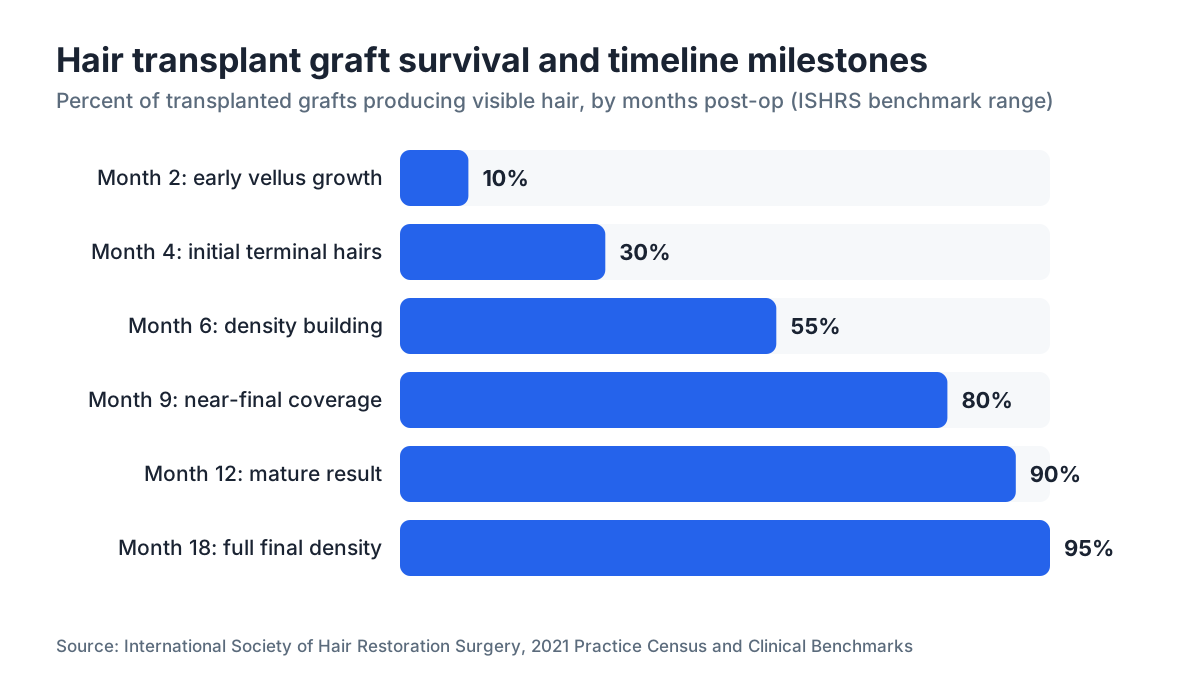
Twelve months minimum, eighteen for final density. Transplanted grafts run a predictable cycle. They shed between weeks two and six in a phase called shock loss. Regrowth starts around month three, but those hairs are fine and soft. Mature, full-caliber hair does not show up until months nine to twelve, and final density usually lands between months twelve and eighteen [4].
A clinic photographing patients at month four or five is shooting real hair, but premature hair. The result will look meaningfully different at month twelve. This is not fraud, but it flatters in a misleading direction, because fine early regrowth scatters light and often photographs thicker than it feels.
Always ask one question: how many months post-op was this after photo taken? If a clinic cannot or will not answer that for every photo in the gallery, you have your answer about the clinic.
The table below lays out the transplant growth timeline, one of the most misunderstood parts of the whole process.
| Weeks/Months Post-Op | What Is Happening | Photo Value |
|---|---|---|
| Weeks 1-2 | Grafts healing, scalp red and swollen | No value |
| Weeks 2-6 | Shock loss, most grafts shed | No value |
| Months 2-4 | Fine vellus regrowth starts | Very low |
| Months 4-6 | Early terminal hairs emerging | Low to moderate |
| Months 6-9 | Density building, still thin | Moderate |
| Months 9-12 | Near-final density | High |
| Months 12-18 | Full mature result | Best for evaluation |
What does a legitimate donor area photo tell you that clinics often hide?
The donor area, usually the back and sides of the scalp where grafts get harvested, is almost never shown in clinic marketing. That absence alone is worth noting.
In FUT (strip) procedures, the donor area carries a linear scar. How visible that scar is at a number-two or number-three guard length is genuinely useful information, and clinics vary a lot in how cleanly they close these wounds. If you are considering FUT and cannot find a single donor scar photo from a clinic, ask straight out and watch how they respond.
In FUE (follicular unit extraction), the donor should show tiny circular punch sites that heal to near invisibility [11]. But aggressive extraction past roughly 6,000 to 8,000 grafts over a lifetime can leave visible thinning or a moth-eaten look in the donor zone [5]. A clinic that never shows the donor may be harvesting hard to inflate recipient-area density.
Watch also for heavy donor use in a young patient. Male pattern loss is progressive. A 28-year-old who gets 3,000 grafts packed at the hairline may look great at 30 and have drained his donor supply by the time he needs coverage for Norwood 5 or 6 progression at 40. A real clinic talks about that tradeoff. Galleries full of young patients with dramatic hairlines, and no older patients with later-stage coverage, are a soft warning.
How do you use reverse image search and metadata to verify photos are real?
This is the most underused check and it takes about three minutes per photo. Right-click any image on a clinic site and run it through Google Images reverse search (or drag it to images.google.com). If that exact photo turns up on a stock site, on a different clinic's page in another country, or in an article about something unrelated, it is not a real patient of that clinic. This happens more than you would think, especially with international clinics marketing to English speakers.
For photos you download, check the EXIF metadata with a free viewer like Jeffrey's Image Metadata Viewer. Genuine patient photos shot over years should carry varied data: different cameras, different dates spanning months, different exposure settings baked in. A gallery where every photo has identical or stripped metadata, or all appear processed by the same software on the same date, is suspicious.
Social media is your friend here. Clinics that post regularly on Instagram or YouTube document work in real time with patient-permission reels and progress updates. Time-stamped, unedited content is harder to fake than a static website gallery.
Cross-reference the gallery against the social history. Do the results actually match?
What third-party review sources actually show unmanipulated results?
A clinic's own gallery is the worst source for evaluation, because it is built to sell. The honest results live on forums and platforms where patients post their own progress, often starting before surgery and running monthly for a year or more.
The forums worth checking: the Hair Restoration Network (hairrestorationnetwork.com), Reddit's r/HairTransplants, and RealSelf. None are perfect. RealSelf reviews can be gamed, and the platform has had documented issues with incentivized reviews [6]. Reddit is messier but harder to manipulate at scale, because users call out inconsistencies in public. The Hair Restoration Network has run since the late 1990s and holds the deepest archive of long-term results anywhere.
What you want on these platforms is a time-stamped photo thread from a real patient documenting the full timeline, ugly middle months included. A clinic whose patients post openly, and whose results match its marketing gallery, is a clinic you can trust. A clinic whose patients are nowhere to be found on independent forums is one to approach with much more caution.
The International Society of Hair Restoration Surgery (ISHRS) publishes a physician-finder directory of members at ishrs.org [7]. Membership is not proof of quality, but it is a baseline credential check. A surgeon findable in no credentialing database at all is a problem.
How do you evaluate results that match your specific hair loss pattern?
A gallery of 50 excellent results means almost nothing if none of those patients had your degree of loss. That sounds obvious, yet most people judge galleries on general impressiveness instead of case-matched relevance.
At Norwood 3 vertex, you want Norwood 3 vertex cases with long-term follow-up, not Norwood 2 hairline refinements where the surgery is simpler and the cosmetic win is easier. With diffuse thinning rather than a defined frontal recession, ask specifically for diffuse thinning cases, because the surgical approach and the photographic baseline are completely different.
Texture matters too. Curly or tightly coiled hair gives more visual coverage per graft than fine straight hair, thanks to natural volume. A result that looks like 2,500 grafts on a coarse wavy patient might take 3,500 grafts on a fine straight patient for the same apparent coverage. Ask to see cases with hair texture like yours.
If you are also using or weighing medical treatment alongside surgery, read up on finasteride and minoxidil for men before you consult. Most surgeons want to see that you are managing ongoing loss medically before they commit to a surgical plan. Transplanted hair is permanent. The native hair around it keeps miniaturizing without treatment.
For a fast baseline on your current pattern, the free AI scan at MyHairline maps your Norwood stage from a photo before you book any consultations.
What questions should you ask a clinic directly about their before and after photos?
A good clinic is not rattled by detailed questions. A bad one deflects, gets defensive, or answers in fog. Here is exactly what to ask:
- How many months post-op was each after photo taken? Can you show the same patient at 12 months or later?
- Can you show me the donor area for any of these cases?
- Were concealers or scalp powders applied before the after photos?
- Can I speak with any of these patients directly, or see their independent forum threads?
- How many grafts were transplanted in this case, and what was the pre-op estimate versus the actual harvest?
- What is your clinic's graft survival rate, and how do you measure it? (The ISHRS benchmark is roughly 85 to 95 percent survival for well-executed FUE or FUT [7].)
- Were these procedures performed by the supervising physician or by technicians under physician oversight?
That last one matters in the US, because the legal definition of who must perform each step of a transplant varies by state. In some states the incisions and graft placement must be done by, or directly supervised by, a licensed physician. In others, trained technicians work with far less oversight [8]. The photos tell you none of this, which is why you have to ask.
The American Board of Hair Restoration Surgery (ABHRS) keeps a searchable list of board-certified surgeons at abhrs.org [9]. Cross-check the surgeon's name before you schedule.
Are there any objective quality signals you can look for in the photos themselves?
Yes. Several visual features in after photos flag good technical work, and you can read them without any medical training.
Hairline irregularity. A natural hairline is never a straight line. It has micro-irregularities, single-hair grafts set at odd angles along the very front, and a soft fade from bare skin to full density. An after photo with a perfectly straight or geometric hairline means either poor planning or a shot taken before the hairline matured. Both are concerning.
Hair direction. Frontal scalp hair grows forward at roughly 30 to 45 degrees. Crown hair grows in whorls. Hair placed without respect for native direction looks wrong in motion even when a static photo looks fine. In windswept or moving shots, you can see whether direction was honored.
Temple points. The temporal peaks are one of the hardest areas in hairline surgery and one of the first things skipped in budget work. After photos with well-built temple points and natural single-hair gradients show real craft. Their absence in every case shown suggests the clinic avoids or underprices this element.
Pore visibility. In tight close-ups, natural scalp shows follicular openings that give texture. Photos that lack that pore structure have been smoothed or heavily compressed, which strips out the fine detail that would otherwise reveal sparse coverage or scarring.
If you worry about ongoing miniaturization in the native hair around a graft, DHT blockers and how they protect non-transplanted follicles are the relevant background.
What is the difference between a misleading photo and a fraudulent one?
This line matters, because it changes what you can do about it. A misleading photo uses legal but unflattering-to-you techniques: favorable lighting, an optimal camera angle, a patient shot at his genetic peak, the 30 best cases out of 500. No law is clearly broken. The FTC's guidance on endorsements requires that results be typical, or that atypical results be clearly disclosed, but enforcement in this specific corner is inconsistent [3].
A fraudulent photo is a different animal: someone else's photos, digitally altered images passed off without disclosure, stock images sold as real patients, or false factual claims about graft counts or survival rates. Those can support a complaint to the FTC, to a state medical board, or in some cases a civil lawsuit. The relevant rule is 16 CFR Part 255, which covers endorsements and testimonials in advertising [3].
For most people shopping for a surgeon, the response is the same either way. Do not use the clinic.
But if you have already had surgery with a clinic you believe committed outright fraud, the escalation path is a state medical board complaint (boards vary by state) and a consult with a medical malpractice or consumer protection attorney.
Understanding the surgery itself, including what a well-run hair transplant actually involves, gives you sharper tools to read any photo.
How do overseas hair transplant photos compare to domestic ones in authenticity?
Turkey has become the dominant destination for transplant tourism. The country performs an estimated 500,000 to 700,000 procedures a year, more than any other, though precise official figures are hard to verify [10]. Packages average $1,500 to $3,000 all-inclusive with accommodation, transport, and post-op kits. Comparable US graft counts run $7,000 to $15,000.
The photo problem with overseas clinics is not that the results are necessarily worse. Some Turkish surgeons produce outcomes that match or beat typical US work. The problem is accountability. US medical board oversight, FTC advertising rules, and the ability to follow up legally if something goes wrong all apply to domestic providers. With an overseas clinic, your practical recourse when the result does not match the photos is close to zero.
Overseas galleries also tend to show heavier graft counts and more dramatic before-to-after swings, which look more impressive at a glance. Part of that is real (some Turkish clinics harvest very aggressively) and part is selection of only the dramatic cases for marketing. The reverse image search step above matters most for these clinics, because some aggregate patient photos from multiple sources.
If the recovery and post-op shock loss phase worries you, telogen effluvium explains why some temporary shedding after a transplant is normal and how to tell it apart from a graft survival problem.
What should a legitimate before photo look like, and what makes it credible?
The before photo carries as much weight as the after. A cherry-picked before that makes the starting point look worse than it was can make a mediocre result look excellent.
A credible before photo shows the patient in neutral lighting, no harsh overhead flash that exaggerates scalp, hair clean and dry with no product, a standard camera height at face level, and no odd parting or wet-down that fakes extra scalp exposure. It should include multiple angles: frontal, top-down, and both temples.
Red flags in before photos: hair wet or slicked back to expose more scalp than normal styling would; a small, low-resolution image that hides density; an unusually wide angle that distorts scalp-to-hair proportion; no crown or top-of-head view at all.
One practical test. Compare the clinic before photo to the patient's own forum posts, if they exist. Independent posters almost never optimize their before shots for maximum baldness. If the clinic's before looks dramatically worse than the patient's self-posted starting photo from around the same date, you are looking at selective presentation.
If you are also weighing non-surgical maintenance, finasteride and minoxidil combined has the strongest evidence for slowing ongoing loss while a transplant handles the cosmetic correction.
Sources
- American Society of Plastic Surgeons, Hair Transplant Cost Information
- JAMA Facial Plastic Surgery, Misleading Advertising in Aesthetic Medicine (2021)
- Federal Trade Commission, 16 CFR Part 255 Guides Concerning Use of Endorsements and Testimonials in Advertising
- American Academy of Dermatology, Hair Loss: Diagnosis and Treatment
- International Society of Hair Restoration Surgery, ISHRS Practice Census
- RealSelf, Review Integrity and Incentivized Review Policy
- International Society of Hair Restoration Surgery, Physician Finder Directory
- American Board of Hair Restoration Surgery, ABHRS Certification Standards
- American Board of Hair Restoration Surgery, Diplomate Directory
- International Society of Hair Restoration Surgery, Practice Census on Global Procedure Volume
- National Library of Medicine, PubMed: Follicular Unit Extraction Techniques and Outcomes
- FDA, Drugs@FDA: Minoxidil Drug Label and Labeling Information