

TL;DR: Yes, hair loss in your 20s is meaningfully different from hair loss at 40. The underlying cause, androgenetic alopecia, is often the same, but younger men lose hair faster, have more aggressive genetic trajectories, and respond better to medication started early. Age also changes which treatments are appropriate, how urgently to act, and what realistic outcomes look like.
What actually causes hair loss at any age?
Most hair loss in men, and a big share in women, comes from androgenetic alopecia (AGA), the thing everyone calls male or female pattern baldness. It runs on dihydrotestosterone (DHT), a hormone made when testosterone gets converted by an enzyme called 5-alpha reductase. DHT binds to receptors in genetically sensitive follicles and gradually shrinks them, a process called miniaturization. Those follicles produce thinner, shorter hairs until they stop producing anything at all [1].
The biology is identical for a 23-year-old and a 43-year-old. What differs is how long it has been running, how much follicle damage has already stacked up, and where the person's genetic ceiling sits. A 23-year-old might have had DHT attacking his follicles for two or three years. A 43-year-old may have had two decades of slow miniaturization before he ever noticed.
Other causes matter too. Telogen effluvium is a diffuse shedding triggered by physical or emotional stress, nutritional deficiency, illness, or major surgery. It tends to be temporary and reversible, and it shows up at any age. Alopecia areata is an autoimmune condition that causes patchy loss. Traction alopecia comes from years of tight hairstyles. If you are in your 20s and losing hair fast and all over, rule these out before you assume you have genetic hair loss for life [2].
See a full breakdown at what causes hair loss.
How common is hair loss in your 20s and does it really start that early?
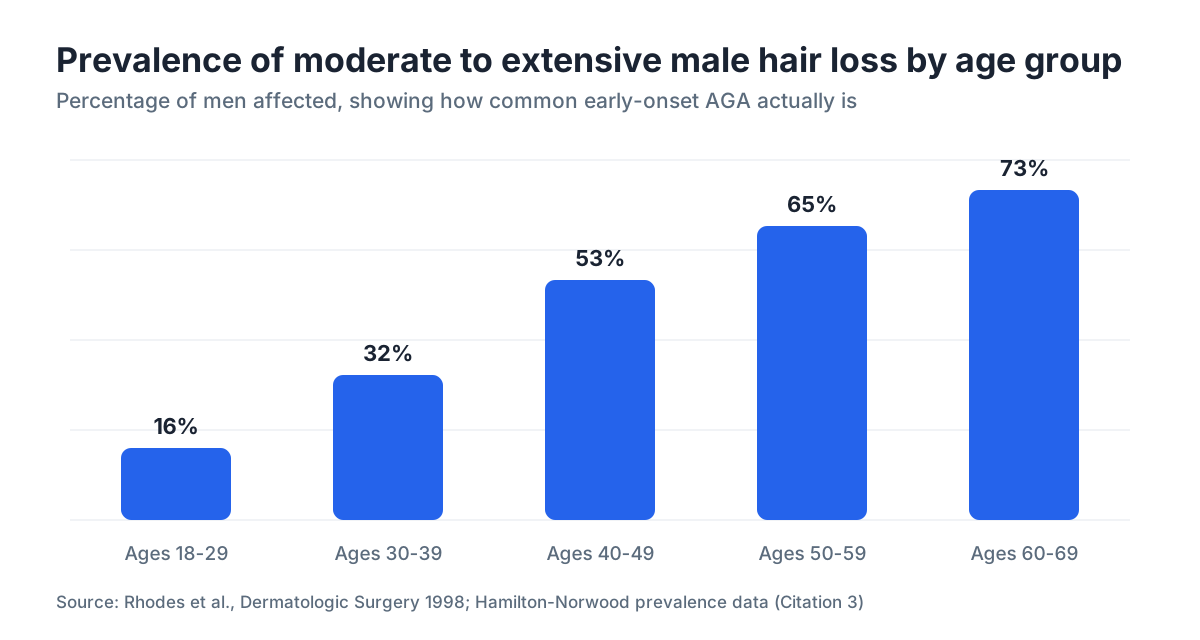
It really does start that early, and more often than most people expect. About 16 percent of men aged 18 to 29 have moderate to extensive hair loss, rising to roughly 53 percent by their forties [3]. The Hamilton-Norwood scale, the standard classification for male pattern baldness, exists partly because researchers kept seeing young men show up with real recession in their twenties.
For women, pattern hair loss is less common in the twenties but still happens, especially in women with polycystic ovary syndrome (PCOS), which pushes androgens up. The American Academy of Dermatology notes that women are more likely to notice diffuse thinning across the crown than a receding hairline [2].
Early onset changes the prognosis a lot. A man who is already a Norwood 3 at 21 is statistically more likely to reach Norwood 6 or 7 in his lifetime than a man who first noticed thinning at 42. Early onset is a signal of aggressive genetic expression, not bad luck this one year.
Why does hair loss progress faster when it starts young?
Two things drive faster progression in young people. First, there is more time for DHT to work. Start losing hair at 22, live to 75, and that is 53 years of follicle miniaturization unless you step in. Someone who starts at 45 has maybe 30 years in the same scenario. Cumulative damage is unforgiving math.
Second, earlier onset often signals a more aggressive genetic variant. The androgen receptor gene on the X chromosome (inherited from your mother) is strongly tied to AGA susceptibility, and its expression level shapes how sensitive follicles are to DHT [4]. If your receptors are highly sensitive, the damage per year is greater. That is why some men go from a full head of hair to Norwood 5 in under a decade, all before 30.
Then there is the Norwood trajectory. Studies following men over time have found that the pattern you show in your twenties roughly predicts where you end up. A man with temple recession at 22 is far more likely to eventually lose the crown than someone whose recession starts at 50 and crawls along. Not guaranteed. But it should shape how hard you treat.
Stress and lifestyle hit differently in your twenties too. Poor sleep, crash dieting, heavy training on bad nutrition, and high cortisol from career pressure can all trigger or worsen telogen effluvium on top of genetic loss. The picture ends up looking worse and more confusing than it actually is.
What does the pattern of loss look like at different ages?
In your twenties, male pattern loss almost always starts at the temples and hairline. The classic Norwood 2 to 3 transition, a slight recession at the corners with the hairline itself mostly intact, is the most common early presentation. Some men thin at the crown (vertex) at the same time. A smaller number start with isolated crown thinning, which is hard to catch without a mirror or a camera.
By the forties, men usually present at a more advanced Norwood stage because the loss has had time to develop. You see more Norwood 4 to 6, meaning real hairline recession plus crown loss, sometimes with the two zones merging. Progression can actually slow in some men after 40, since testosterone starts declining gradually from the late thirties on, easing the total DHT load on follicles.
For women, the Ludwig scale (I, II, III) describes central part widening and diffuse crown thinning with a preserved frontal hairline. This can happen in the twenties, especially with hormonal triggers, but is more common after menopause when estrogen drops and the relative androgen effect on follicles rises.
The receding hairline article covers early recognition in detail if you want to know exactly what to watch for.
Does starting treatment younger actually produce better results?
Almost certainly yes, with one caveat. Minoxidil and finasteride both work by slowing or stopping miniaturization. Neither can bring back follicles that are fully dead, because the follicle socket is gone for good. So the earlier you treat, the more living follicles you are protecting, and the better the picture years later.
Finasteride (1 mg daily, oral) cuts scalp DHT by roughly 60 percent according to its FDA-approved label, which showed statistically significant hair count increases in men 18 to 41 in the registration trials [5]. A 23-year-old starting finasteride at Norwood 2 is protecting follicles a 43-year-old Norwood 5 has already lost. The 43-year-old still benefits a lot from stopping further loss, but his ceiling is lower.
Minoxidil (topical 5% or oral) works differently. It prolongs the anagen (growth) phase of the hair cycle and may widen scalp blood vessels. It does not block DHT. Used alone, it buys time. Used with finasteride, the combined evidence is stronger than either drug alone: a 2015 study in the Journal of the American Academy of Dermatology found combination therapy produced significantly greater improvements in hair density than either drug on its own [6]. See finasteride and minoxidil for how to run them together.
The caveat for younger men: finasteride carries real risks of sexual side effects in a subset of users, estimated at 1 to 4 percent in trials (post-marketing reports suggest the rate may run higher in some populations) [5]. At 23, that is a real trade-off, and it deserves an honest talk with a physician, not a checkout page. See finasteride for the full picture.
Are the same treatments used for 20-somethings and 40-somethings?
Mostly yes, but the risk-benefit math shifts. Both finasteride and minoxidil for men are approved and appropriate across the adult age range. The FDA-approved indication for finasteride covers men 18 and older [5]. Minoxidil topical 2% and 5% solutions and the 5% foam are FDA-approved for men over 18 with androgenetic alopecia [7].
For women, finasteride is not FDA-approved for hair loss and carries a pregnancy risk (Category X), so it is generally avoided in women of childbearing age without strict contraception protocols. Minoxidil 2% topical is FDA-approved for women's AGA [7]. Off-label oral minoxidil at low doses (0.25 to 1.25 mg daily) has growing evidence behind it and may be the dermatologist's pick for women who find topical messy. See oral minoxidil.
Hair transplants are where age matters most directly. Most experienced transplant surgeons hesitate to operate on men under 25 to 28, for good reason. Transplant hairline grafts at 22, then watch the patient keep losing native hair behind them over the next decade, and you get an unnatural island of hair surrounded by baldness. The donor supply is finite. A surgeon cannot know at 22 how much scalp will eventually need coverage. At 40 the pattern is largely set, donor supply is calculable, and the result is predictable. See hair transplant for the full age considerations.
DHT blockers beyond finasteride, including dutasteride and saw palmetto-based hair loss supplements, get used across ages. Dutasteride blocks both types of 5-alpha reductase (finasteride only blocks type II) and cuts DHT by about 90 percent, but it is not FDA-approved for hair loss in the US. See DHT blocker for the comparison.
Comparing hair loss at 20s vs 40s: a side-by-side look
The table below sums up the differences across the dimensions most people actually want to know about.
| Factor | Hair loss in your 20s | Hair loss in your 40s |
|---|---|---|
| Most likely cause | AGA, often aggressive onset; rule out telogen effluvium | AGA at a more advanced stage; miniaturization well underway |
| Norwood stage at presentation | Typically 2 to 3 | Typically 3 to 6 |
| Rate of future progression | Often faster; more years of DHT exposure ahead | May slow; testosterone/DHT levels begin declining |
| Finasteride benefit | High: more viable follicles to protect | Moderate to high: slows further loss, some regrowth possible |
| Minoxidil benefit | Good for stabilization and some regrowth | Good; regrowth potential lower if follicles more miniaturized |
| Hair transplant candidacy | Usually too early; surgeon may refuse under 25-28 | Usually appropriate if pattern is stable and donor supply adequate |
| Reversible causes more likely? | Yes: stress, diet, crash dieting, PCOS in women | Less common, but hypothyroidism and medication causes still relevant |
| Emotional impact | Often higher: social identity, dating, career confidence | Real, but often better psychological preparation |
None of this is absolute. A 24-year-old with a stable Norwood 2 who has not moved in four years is a different case from a 24-year-old who went from Norwood 1 to Norwood 4 in 18 months. Trajectory and rate of change matter as much as current stage.
Could my hair loss in my 20s be caused by something other than genetics?
Absolutely, and this deserves a serious look before you assume lifelong genetic baldness. Telogen effluvium is the most common impostor. It causes diffuse shedding, typically 200 to 400 hairs a day versus the normal 50 to 100, starting two to four months after a triggering event [8]. That trigger is often crash dieting or extreme caloric restriction (very common in twentysomethings), a serious illness, surgery, emotional shock, or childbirth in women.
Iron deficiency and ferritin levels below 30 to 40 ng/mL are strongly linked to hair shedding in premenopausal women, though the causal evidence in men is weaker [9]. Thyroid trouble, both hypothyroidism and hyperthyroidism, causes diffuse loss at any age. So does serious protein deficiency.
Creatine has come up as a possible factor. One 2009 study found creatine loading raised DHT by about 56 percent in college-aged rugby players, though the study was small and never measured hair loss directly [10]. See does creatine cause hair loss for a measured look at the evidence.
The practical takeaway: if you are in your twenties with significant, rapid, diffuse shedding, get blood work first. A complete blood count, ferritin, thyroid panel (TSH, free T4), and a basic metabolic panel are a reasonable start. A dermatologist can also do a pull test and examine hair caliber under dermoscopy to tell AGA miniaturization apart from telogen effluvium. Those two do not get the same treatment.
How should someone in their 20s actually respond to hair loss?
Confirm what you actually have. That comes first. See a dermatologist, ideally one who specializes in hair. A trichoscopy or dermoscopy exam takes 10 minutes and tells you whether you have miniaturized hairs (AGA), uniform shedding (effluvium), or both.
If it is AGA, early treatment wins. The evidence here is about as clean as dermatology gets: finasteride and minoxidil both slow loss, and starting earlier preserves more hair over a lifetime. The question is not whether to treat. It is which treatment, and how much risk you will accept from finasteride's side effect profile.
Do not rush into a hair transplant. The temptation is strong when you are 23 and watching your hairline retreat. But the surgeons with the best long-term outcomes are the ones who refuse to operate too early. A good surgeon will ask you to get on medication first, stabilize for 12 to 24 months, then reassess transplant candidacy.
If you want a low-stakes starting point, MyHairline's free AI hair analysis can map your current hairline pattern from photos and give you a Norwood estimate before you pay for a clinic visit. Reasonable first step to understand what you are dealing with. Not a replacement for a clinical diagnosis.
And address the reversible causes regardless. Eating enough protein (roughly 1.6 g per kg of body weight daily is well supported for general health), getting iron and thyroid checked, and managing extreme stress are worth doing anyway.
How should someone in their 40s approach hair loss differently?
By 40 you usually have a clearer picture of where the loss is headed. The genetic trajectory has had time to declare itself, and you can make better decisions about treatment goals.
For men in their forties who have never tried finasteride or minoxidil, starting now still makes a real difference. You are not getting a Norwood 2 hairline back from a Norwood 5 baseline with medication, but you can meaningfully slow or stop further loss and regrow some density in partially miniaturized zones. The 5-year finasteride trial data showed that 83 percent of men on the drug maintained or increased hair count, versus 28 percent on placebo [5].
Transplant candidacy is often better at 40 than at 25, precisely because the pattern is stable and the surgeon can plan the restoration properly. Follicular unit excision (FUE) or strip surgery (FUT) at 40 or 45 can produce results that look natural for the rest of your life, because you are not racing against future loss in unpredictable directions.
Women in their forties heading into or through perimenopause should know that the estrogen decline of menopause accelerates AGA in genetically susceptible women. This is a common but underdiagnosed cause of thinning that starts in the mid to late forties. A dermatologist or gynecologist can discuss whether hormonal options fit. Low-level laser therapy (LLLT) devices have modest but real evidence in women and can be a reasonable add-on.
Read the minoxidil side effects article before starting, at any age. Scalp irritation, unwanted facial hair in women, and the shedding phase that hits in weeks 2 to 8 of topical use are all worth knowing in advance.
What does good hair loss treatment actually look like long-term?
Here is the realistic picture for most men on finasteride plus minoxidil. Shedding slows within three to six months. Baseline hair count stabilizes or improves by month six to twelve. The best results show up at 12 to 24 months. After that, the job is maintenance. These drugs are not a cure. Stop them and the DHT-driven miniaturization restarts, and most of the ground you gained is gone within 12 months of stopping [5].
For women on minoxidil the timeline is similar. The AAD notes it typically takes at least four months of consistent use to see any benefit [2], and the treatment has to continue indefinitely to hold results.
Hair transplants offer a permanent change, because the transplanted grafts come from DHT-resistant donor areas (usually the back and sides of the scalp). But those grafts do not protect the native hair around them, which is why most transplant surgeons want you to keep taking medication after surgery.
The honest summary: hair loss treatment is a long game. Starting in your twenties means more years of treatment but more hair preserved across them. Starting in your forties means fewer years of DHT damage to undo but a lower ceiling for regrowth. Neither situation is hopeless. Neither promises miracles. The tools we have (finasteride, minoxidil, transplants) have decades of real trial data behind them. The supplements mostly do not. Spend your money accordingly.
MyHairline's free AI scan (/scan) is a reasonable way to get a baseline picture of your pattern and track changes over time, especially if you are managing treatment yourself and want objective data without a clinic visit every six months.
Sources
- American Academy of Dermatology, Hair Loss Overview
- American Academy of Dermatology, Hair Loss: Who Gets It and Causes
- Norwood OT, JAMA Dermatology 1975 (Hamilton-Norwood classification); prevalence data cited in Rhodes T et al., Dermatologic Surgery 1998
- Hillmer AM et al., American Journal of Human Genetics 2005, androgen receptor gene and AGA susceptibility
- US Food and Drug Administration, Propecia (finasteride) prescribing information
- Hu R et al., Journal of the American Academy of Dermatology 2015, combination minoxidil and finasteride
- US Food and Drug Administration, minoxidil topical drug information
- Grover C and Khurana A, Indian Journal of Dermatology, Venereology and Leprology 2013, telogen effluvium review
- Trost LB et al., Journal of the American Academy of Dermatology 2006, iron and hair loss
- van der Merwe J et al., Clinical Journal of Sport Medicine 2009, creatine and DHT
- National Institutes of Health MedlinePlus, Alopecia (Hair Loss)