
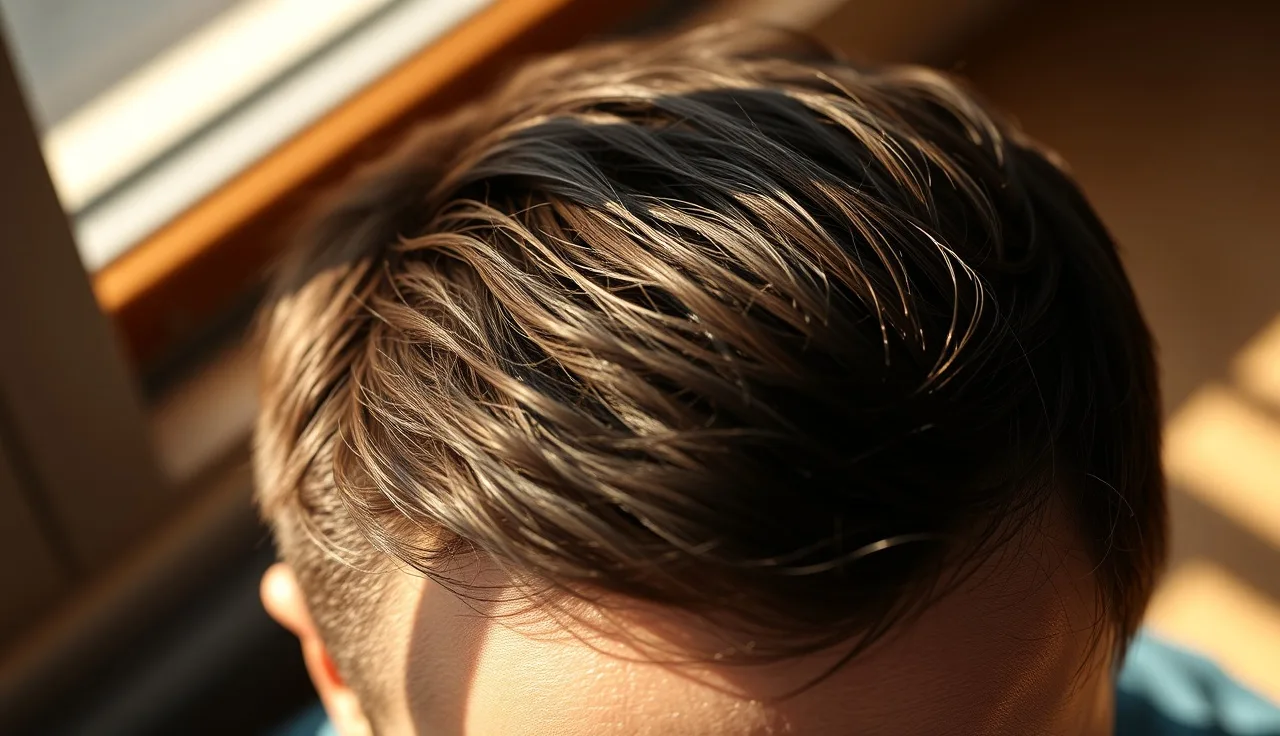
TL;DR: Curly or wavy growth after a hair transplant is common and usually temporary. The follicle gets disrupted during harvesting and healing, so the first hairs grow out kinked. Most people with straight donor hair see texture normalize between 6 and 12 months. If your donor hair is naturally curly, the transplant stays curly. Persistent curl past 18 months is worth investigating.
Why does transplanted hair grow in curly or wavy?
The short answer is follicle trauma. When a follicle gets harvested, either by FUT strip or FUE punch, it's cut away from the tissue around it, chilled in a holding solution, then placed into a tiny incision in your scalp. That whole sequence bends, stretches, and reorients the lower half of the follicle, which is the part that sets hair shaft shape [1].
A hair shaft is not a simple tube. Its curvature as it emerges depends on the shape and angle of the follicular bulb and the inner root sheath. Disrupt that geometry with surgery, then add swelling and scar tissue during wound healing, and the first hairs to regrow often exit at an odd angle or with more curl than the donor hair ever had [2].
Some surgeons call it the follicle "recalibrating." That's a useful mental model. The follicle is genetically intact, so once it settles into its new spot and the surrounding tissue matures, it tends to produce hair closer to your natural texture. It can take a while. For some people it takes long enough to feel alarming.
One distinction matters. If your donor hair was already naturally curly, your transplanted hair may always be curlier than whatever originally grew in the recipient area. Surgeons can do a lot with graft angle and density. They cannot change the follicle's inherent programming.
Is curly or wavy transplant hair a sign something went wrong?
Usually no. Temporary texture change is a documented part of the post-transplant timeline, not a surgical mistake [2]. Don't panic at 3 months when the new growth looks nothing like your original hair.
There are situations where abnormal texture does flag a problem. If grafts sat too long before placement (more than a few hours at room temperature sharply increases graft mortality [3]), if the recipient sites were cut at the wrong angle, or if the follicles got crushed during handling, the surviving hairs can emerge distorted and stay that way. Tight coils in someone who had straight donor hair are worth a conversation with your surgeon.
Poor angulation is the more common surgical cause of permanent texture issues. The incision angle at the recipient site should mimic the natural exit angle of the surrounding native hair. When it doesn't, the hair comes out pointing wrong, which reads as wavy or kinked even when the follicle itself is fine. A good surgeon checks this closely at the hairline, where flat, forward-pointing angles matter most for a natural look [1].
Here's the line. Wavy or curly growth in the first year is expected. Wavy or curly growth that hasn't budged by 14 to 18 months, in someone with straight donor hair, is worth investigating.
How long does the curly phase last after a hair transplant?
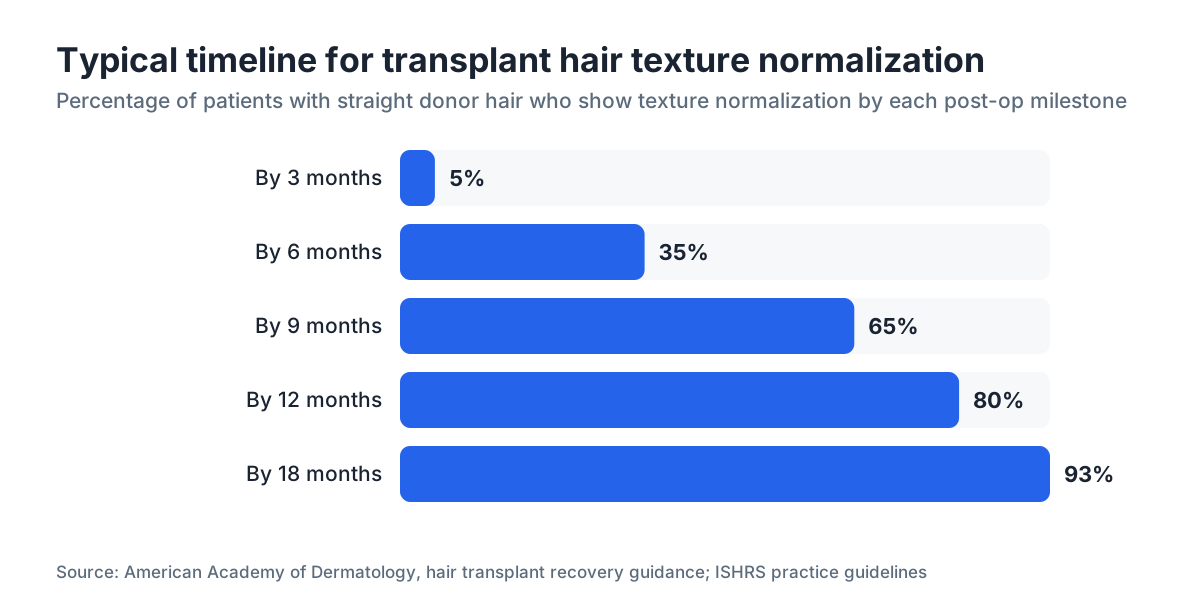
Most patients see texture begin normalizing between 6 and 12 months after surgery [2]. Here is roughly how the timeline plays out:
| Phase | Timeframe | What's happening with texture |
|---|---|---|
| Shock loss | Weeks 2 to 8 | Transplanted hairs shed; texture not yet relevant |
| Early regrowth | Months 3 to 5 | Fine, often kinked or wavy hairs emerge |
| Texture shift | Months 6 to 9 | Hair thickens and frequently straightens |
| Near-final result | Months 10 to 14 | Texture usually close to donor hair baseline |
| Full result | Month 18 | Final assessment; persistent curl unlikely to resolve further |
The variance is real. People with naturally wavy or curly donor hair stay curly throughout, which is expected. People with straight donor hair typically see the curl phase resolve closer to the 6-to-9 month mark. Scalp health, blood supply to the recipient area, and how well the grafts were handled all change how fast the follicle settles in.
What actually helps curly transplant hair in the short term?
Before you do anything, wait. Managing texture too early, especially with heat, risks damaging hairs that are still loosely anchored in the scalp. Most surgeons ask you to skip high-heat blow dryers for at least 3 months, and some say 6 months for the transplanted zone [1].
Once you're past the fragile early window, a few things genuinely help.
Moisture and conditioning. Kinked post-transplant hair runs dry because the sebaceous glands haven't fully re-established around the new follicles. A good leave-in conditioner or a light hair oil (argan, jojoba) softens the shaft and cuts frizz with zero heat risk.
Low-heat blow drying with a round brush. After about 4 to 6 months, when grafts are firmly integrated, light heat styling can temporarily straighten wayward hairs. Use the lowest effective setting and always use a heat protectant. It fixes nothing permanently. It gets you through the awkward phase.
Water-based styling products. A small amount of light pomade or styling cream trains hair in the direction you want and softens the visual impact of the curl. Skip heavy waxes that can clog follicles, especially in the first year.
Length. Longer hair has weight. Weight pulls curl out. This is the simplest fix and the most underrated. If you can tolerate the growth phase, letting the transplanted hair get a bit longer than you ultimately want will help it lie flatter and look less textured.
None of these change what your follicle produces. They manage appearance while the follicle finishes settling in.
Can you permanently straighten transplanted hair with chemical treatments?
Yes, but timing matters and the risks are real. Chemical relaxers and keratin treatments work by breaking and reforming the disulfide bonds in the hair shaft. They don't touch the follicle, so they don't affect future growth. They do stress the shaft hard, and applied too early, they can break off hairs that are still thin and new.
Most dermatologists say wait at least 12 months post-transplant before any chemical straightening in the recipient area. By then grafts should be fully anchored and producing hair at normal thickness. Even then, patch test first. Transplanted hair can have slightly different porosity than your native hair and react differently to the same chemicals.
Keratin treatments (often sold under brand names like Brazilian Blowout) are gentler than traditional lye relaxers and can work well for people with moderately wavy transplant hair who want something longer-lasting than daily styling. Results usually last 3 to 5 months.
If you're using finasteride or minoxidil for men to protect the surrounding native hair (a smart move after a transplant), neither drug interacts with chemical straightening treatments in any documented way [8][9].
Does the type of transplant technique affect how curly the hair grows back?
There's some evidence it does, though not dramatically. FUE (follicular unit extraction) removes individual follicular units with a circular punch. That punch can introduce a slight rotational or angular error, and if the follicle comes out even a few degrees off its natural axis, the hair may grow out pointing somewhere unexpected [4]. FUT (strip harvesting) keeps follicular units in their natural groupings within the strip, which some surgeons argue preserves orientation better. FUT brings its own variables during the dissection step.
In practice, the skill of the surgical team matters far more than the technique. A well-executed FUE by an experienced surgeon beats a sloppy FUT on texture every time. Look for a surgeon who manually controls graft orientation during placement and cuts recipient sites at the correct angle and depth for your scalp.
Robotic FUE systems like ARTAS make precision claims, but independent data on texture outcomes specifically is thin. Manufacturers report consistent graft quality with robotic harvesting, but published work has not tracked post-operative curl rates in any direct way, so treat that as an open question rather than a selling point.
When should you go back to your surgeon about this?
Book a follow-up, not an emergency call, if your curl hasn't changed at all by 12 months. Most reputable clinics include scheduled follow-ups at 3, 6, and 12 months. That should be part of your post-op plan before you leave the clinic.
Go back sooner if any of these show up.
The new hairs come in at obviously wrong angles relative to the surrounding hair, creating a visible mismatch at the hairline. That can point to recipient site angulation errors a skilled surgeon can sometimes fix with a small corrective procedure.
You have tight, coiled growth in an area where your donor hair is naturally straight, especially if the coiling is patchy rather than uniform. Patchy distortion can mean focal graft damage.
The curly hairs are also thin and sparse at 12 months. Texture problems plus poor density suggest graft survival issues, which is a separate conversation from normal curl.
For the broader question of whether your hair loss is progressing in areas the transplant didn't cover, the free AI hair analysis at MyHairline lets you track changes over time with photos, which gives you and your surgeon a cleaner baseline for follow-up conversations.
Your surgeon cannot fully assess texture before 12 to 18 months. Any clinic promising an earlier final verdict is overpromising.
Does post-transplant curl affect hair density and coverage?
Yes, in an indirect way, and it's more favorable than you might think. Curly or wavy hair bends back on itself, so it covers more scalp per strand than straight hair lying flat. Plenty of patients with naturally wavy hair find their transplant gives better-looking coverage than the graft count would predict on paper.
The flip side. When the curl phase resolves and hair straightens, the visual coverage can look like it dropped a little. The hair is the same. It just lost the volumizing bend. This catches people off guard: they thought the result was improving, then it looked thinner. It isn't thinner. It lies differently.
If density worried you before the transplant and you're also prone to more hair loss, this is a good moment to revisit retention. Finasteride and minoxidil used together have the strongest evidence for slowing androgenetic alopecia in surrounding native hair [11], and keeping native hairs around the transplant site matters a lot for long-term coverage. A DHT blocker protects the follicles the transplant didn't replace.
Can the curly phase come back after it resolves?
Rarely discussed, but a fair question. In most cases, once transplanted hair straightens and you're past month 12 to 14, that texture holds. The follicle has finished adapting.
Some people report a second wave of texture change after significant scalp trauma, severe illness, or major physiological stress. Telogen effluvium, the diffuse shedding triggered by surgery, illness, major weight loss, or extreme stress, can push transplanted hairs to cycle out and regrow with temporary texture changes [10]. Same mechanism as the initial post-op curl, just later.
Pregnancy and big hormonal shifts can also temporarily change hair texture in transplanted and native hair alike. Not permanent.
If you get a second round of unexpected curl in previously straightened transplant hair more than 18 months out, check whether you had a significant physiological stressor in the prior 3 to 4 months. That's the lag time for telogen effluvium [10].
Are some people at higher risk of persistent curl after a transplant?
Several factors genuinely raise your odds of persistent or more pronounced texture change.
Naturally curly or coily donor hair. This is the big one. If your donor zone has tight curls, your transplant will too, full stop. Surgeons working with Type 3 or Type 4 hair (the Andre Walker classification is the most widely used framework) have to account for this in graft placement, because extracting curly follicles is technically harder and the punch has to follow the subsurface curl of the follicle rather than the surface exit angle [6].
Low-quality graft handling. Grafts left out of solution, allowed to dry, or kept at room temperature too long take cellular damage that can distort the follicle permanently [3].
Keloid or hypertrophic scarring tendency. People prone to heavy scarring can build more scar tissue around follicles in the recipient area, which physically redirects hair exit angle.
Recipient site too small for the graft. If the site is undersized for the follicular unit, the graft gets compressed during placement, which can permanently deform follicle direction.
Recipient area with poor blood supply. Scalp scarred from prior surgery, radiation, or injury may not vascularize new grafts as well, which changes how cleanly the follicle settles in.
If you're researching a hair transplant and worried about this, ask your prospective surgeon directly: what's your protocol for graft storage, what holding solution do you use, and how do you handle Type 3 or Type 4 donor hair? The answers tell you how seriously they take the details.
Daily grooming tips for managing curly transplant hair
The awkward middle, roughly months 5 through 10, is when most people feel worst about texture. A few habits make a real difference.
Wash with lukewarm water, not hot. Hot water lifts the cuticle and makes frizz worse. True for all hair, but newly growing transplant hair is especially porous and reactive.
Pat dry, don't rub. Towel friction creates frizz in wavy hair. A microfiber towel or an old cotton T-shirt cuts the friction a lot.
Apply products to slightly damp hair. Leave-in conditioners and light creams penetrate better when the shaft is slightly wet. On bone-dry hair they mostly coat the outside and can look greasy.
Comb, don't brush, in the early months. A wide-tooth comb is far less likely to catch and snap thin new hairs than a brush. Once the hair hits 2 to 3 cm, a soft boar-bristle brush can help train direction.
Sleep on a satin or silk pillowcase. Cotton creates overnight friction that roughens the cuticle and plays up curl. Minor, and it costs almost nothing to change.
Think about the haircut. A barber who knows how to work mixed textures can cut around the transplanted zone so the curl blends with native hair instead of fighting it. That's not giving up. It's practical.
If your transplant touched a receding hairline, those hairline hairs get the most scrutiny and are the most sensitive to texture issues, so an early styling routine pays off there more than anywhere else.
Sources
- International Society of Hair Restoration Surgery (ISHRS)
- American Academy of Dermatology: hair transplant guidance
- Journal of Cutaneous and Aesthetic Surgery, graft storage and survival in FUE (2013), PMC
- Dermatologic Surgery, follicle extraction angle and transection in FUE
- ISHRS: hair restoration in patients with Afro-textured hair
- FDA: Drugs@FDA, minoxidil topical solution label
- FDA: Drugs@FDA, finasteride (Propecia) prescribing information
- American Academy of Dermatology: telogen effluvium guidance
- Journal of the American Academy of Dermatology, finasteride and minoxidil for androgenetic alopecia