TL;DR: Losing 50 to 100 hairs in the shower is normal shedding, not damage. The techniques that reduce breakage and scalp stress: lukewarm water, gentle fingertip massage (not nails), lathering the scalp rather than the lengths, and a long rinse. No shampoo reverses genetic hair loss, but bad technique speeds up shedding from a fragile or inflamed scalp.
Is hair loss in the shower actually a problem, or is it normal?
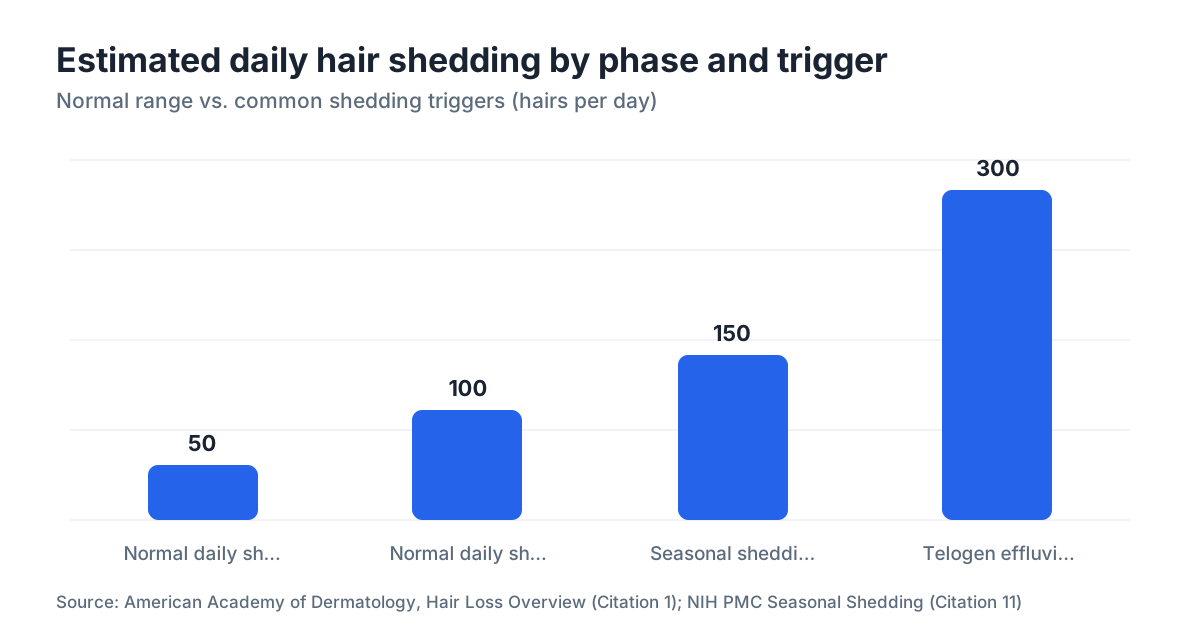
Most of what you see circling the drain is not hair loss in the clinical sense. The American Academy of Dermatology puts normal daily shedding at 50 to 100 hairs for adults [1]. On days you skip washing, those hairs stay tangled in the rest until the next wash sets them free all at once. One shower looks alarming. It usually is not.
The hair growth cycle runs in three phases: anagen (active growth, 2 to 7 years), catagen (transition, about 2 weeks), and telogen (resting, about 3 months before the hair sheds) [2]. At any moment, roughly 10 to 15 percent of your hairs sit in telogen and are ready to drop. Washing, combing, or running your fingers through your hair just hurries along the ones that were leaving anyway.
So when does shower shedding turn into a real signal? Watch for a few things. If you are consistently losing well over 100 hairs per wash, your ponytail feels thinner, your part has widened, or you can suddenly see scalp, those are worth investigating. Conditions like telogen effluvium, where a physical or emotional shock pushes a big chunk of follicles into resting at once, can triple normal shedding for months. Your shower technique will not cause that or cure it. But it can stop you from adding mechanical breakage on top of already-stressed hair.
What water temperature does the least damage to your scalp and hair?
Hot water feels great and does real harm. High heat strips the scalp's sebum barrier faster than the skin can rebuild it, which leaves it dry, itchy, and inflamed [3]. An inflamed scalp does not kill follicles outright, but chronic irritation lines up with heavier shedding in people already primed for hair loss.
Aim for lukewarm, roughly 98 to 100 degrees Fahrenheit. That opens the cuticle enough for shampoo to clean without the aggressive stripping very hot water causes. A cool rinse at the end closes the cuticle and adds a little shine, though the strengthening effect is modest. The real payoff is comfort and less frizz.
Skip the scalding showers if your hair matters to you. This one is free, and you can start today.
How much shampoo should you actually use?
More shampoo does not mean cleaner hair. A dime- to quarter-sized amount (roughly 5 to 10 mL) covers most people with short to medium hair. Long or thick hair may need closer to a tablespoon. Go beyond that and you get lather you can never fully rinse, plus residue that sits on the scalp, clogs follicles, and irritates over time.
Dispense into your palm first, never straight onto the scalp. Dropping concentrated shampoo on one spot and scrubbing drags the hair sideways and snaps it at the root. Rubbing it between your palms spreads it out before it touches your head.
Oily hair tempts you to pour more. The fix is washing more often, not doubling the dose.
What is the right way to massage the scalp while shampooing?
This is where most people do the most preventable damage. The wrong move: piling hair on top of the head, scrubbing in circles, grinding strands against each other, digging in with fingernails. Each one builds friction, tangles the cuticle, and breaks fragile hairs.
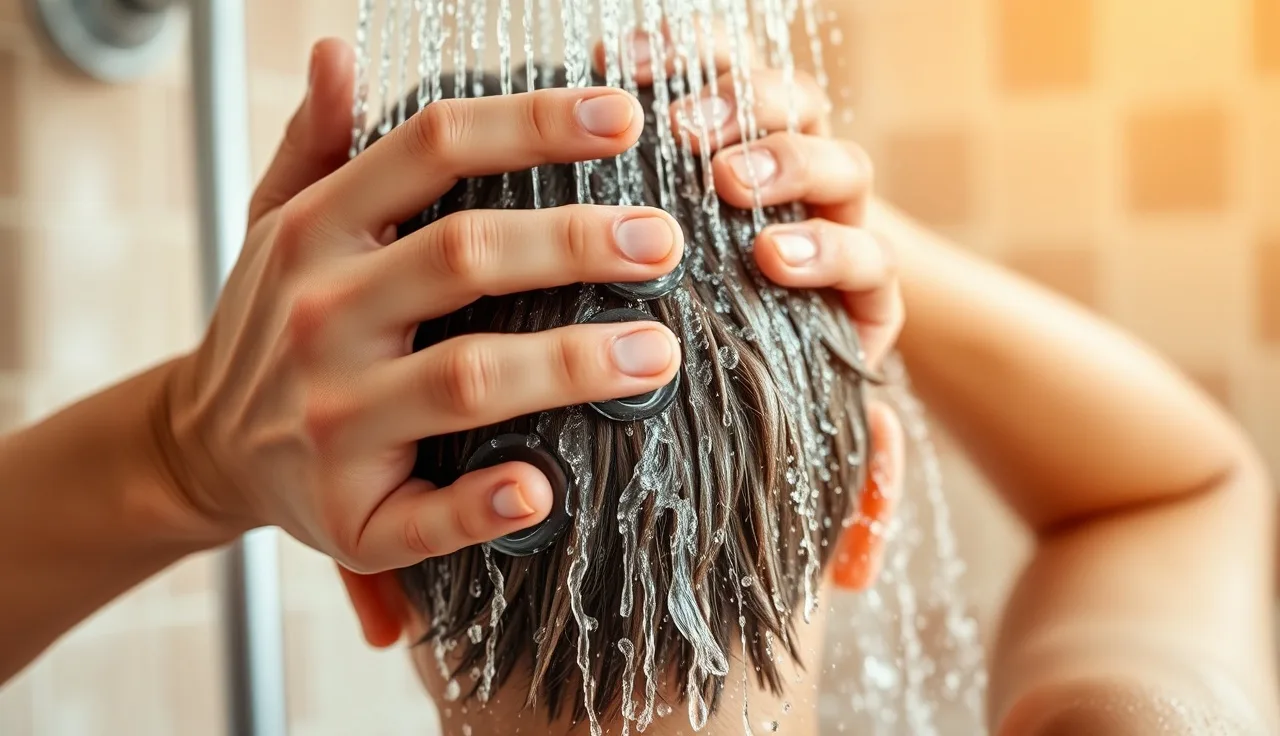
The right technique is simpler than it sounds. Put all ten fingertips (pads, not nails) flat on your scalp. Press gently and move the scalp itself instead of sliding your fingers through the hair. Small, deliberate circles, about the size of a quarter, cover the whole scalp from hairline to nape. Thirty to sixty seconds cleans well and gets blood moving to the follicles [4].
A 2016 scalp massage study in ePlasty found that 4 minutes of daily massage over 24 weeks lined up with thicker hair in the men who took part [4]. The proposed mechanism was mechanical stretching of the dermal papilla. The catch: 9 participants, no control group. Take it as interesting, not proof. What is not in doubt: gentle massage will not hurt, costs nothing, and keeps you from ripping hairs out.
Do not work shampoo through the lengths and ends. Sebum and product buildup collect on the scalp, so that is where the cleaning needs to happen. The lengths rinse clean on their own as the water runs down. Scrubbing the mid-shaft and ends is the biggest cause of the split ends and breakage people mistake for hair loss.
How often should you wash your hair to minimize shedding?
There is no single right number, and anyone who hands you one without seeing your hair is guessing. The AAD says wash frequency should track your scalp's oil production, not a calendar [1].
Fine, oily hair: daily or every other day is fine. Oil weighs fine hair down and can irritate the scalp, which sometimes worsens shedding.
Coarse, dry, or chemically treated hair: every 2 to 4 days spares the natural oils. Overwashing dry hair leaves the shaft brittle and easy to break.
Textured or coily hair: once a week or less is common and healthy. The curl pattern keeps sebum from traveling down the shaft, so the scalp rarely gets oily, and frequent washing causes real dryness.
The idea that infrequent washing causes hair loss by clogging follicles has no evidence behind it. Seborrheic dermatitis (dandruff at its worse end) is real, involves scalp inflammation, and can add to shedding. In that case, washing more often with a medicated shampoo is the move [5]. But on a healthy scalp, three days without a wash does no damage to the follicle.
Does the type of shampoo you use affect hair loss?
Shampoo marketing wildly oversells what a bottle can do for hair loss. No shampoo reverses androgenetic alopecia. Full stop.
The formula still matters for scalp health. Harsh sulfates (sodium lauryl sulfate especially) clean well but strip sebum hard. If your scalp is dry or sensitive, a sulfate-free formula or a gentler surfactant like sodium laureth sulfate or cocamidopropyl betaine cuts irritation without leaving you dirty.
Ketoconazole shampoo is the one real exception. Ketoconazole 2% (prescription; 1% over the counter as Nizoral) is an antifungal with a mild anti-androgenic effect at the scalp. A double-blind trial in the Journal of Dermatology found ketoconazole 2% shampoo produced hair density gains comparable to 2% minoxidil solution in men with androgenetic alopecia over 6 months [6]. That is a striking result from one study, never replicated at scale, so it does not change standard care. But if you have dandruff and hair loss, ketoconazole treats both at once.
For most people without a specific scalp condition, a gentle, well-rinsed shampoo matched to their hair type is enough. Technique beats brand.
| Shampoo type | Best for | Hair loss evidence |
|---|---|---|
| Sulfate-free, gentle surfactant | Dry, color-treated, coily hair | None direct; reduces scalp irritation |
| Ketoconazole 1-2% | Seborrheic dermatitis, dandruff | Some: modest density improvement in one RCT [6] |
| Zinc pyrithione | Dandruff | Reduces scalp inflammation; indirect benefit |
| Biotin-enriched | Fine, limp hair (cosmetic coating) | No clinical evidence for hair growth |
| Standard SLS-based | Oily hair, otherwise healthy scalp | No harm if scalp tolerates it |
How should you rinse and towel-dry to reduce breakage?
Rinsing is the most underrated step in the whole routine. Leftover shampoo on the scalp is a genuine irritant, and most people rinse for about 10 seconds when they need closer to 60. Run water through until the hair feels slippery-clean, more than until the suds vanish.
Towel drying wrecks more hair than people realize. The usual move, rubbing a terry towel all over your head, grinds friction into the cuticle at the exact moment hair is weakest. Wet hair stretches up to 30 percent more than dry hair before it breaks [3]. A cotton T-shirt or a microfiber towel, used in a squeeze-and-press motion, does far less. Blot, do not rub.
Let hair air-dry at least partway before you touch it with a brush. Detangle wet hair with a wide-tooth comb, starting at the ends and working up toward the roots, never the other way. Starting at the roots just packs tangles tighter and tears through them.
Can the right shampoo technique help if you have genetic hair loss?
Honestly? Only at the margins. With androgenetic alopecia, the follicles are programmed to miniaturize in response to dihydrotestosterone (DHT), and no amount of gentle washing changes that path. The treatments with real evidence are finasteride (an oral DHT-blocker FDA-approved for male pattern hair loss) and minoxidil for men (a topical or oral vasodilator that stretches out the anagen phase) [7][8].
What good technique does is stop you from losing extra hair on top of the genetic loss. If you are already thinning, you want to keep every healthy hair you still have. Breakage from rough handling, inflammation from overwashing with harsh products, and residue buildup that triggers folliculitis are all things you control. None of them is the root cause of your hair loss, but fixing them is free and carries no side effects.
If you want to know whether what you are losing is normal shedding, mechanical breakage, or the start of a pattern, the MyHairline AI scan maps your current density and tracks changes over time before you book a dermatologist.
For people further along and weighing surgery, one detail matters: a hair transplant moves follicles that resist DHT, so all of this technique still applies to both your native and transplanted hairs.
What ingredients in shampoos might actually irritate the scalp and worsen shedding?
A handful of ingredients show up again and again in scalp sensitivity reports.
Sodium lauryl sulfate (SLS) is the most studied. It is a surfactant that cleans hard and penetrates the skin barrier more aggressively than gentler options, and it is a known irritant at higher concentrations [9]. For anyone with a compromised scalp barrier (eczema, psoriasis, sensitive skin), SLS shampoos can set off flares with itching, inflammation, and secondary shedding.
Fragrance is the second most common contact allergen in hair care. Fragrance-driven scalp dermatitis brings itching and inflammation that can push shedding in susceptible people. If your scalp stays itchy and red, a fragrance-free formula is a cheap experiment to try before anything fancier.
Formaldehyde-releasing preservatives (DMDM hydantoin, quaternium-15) turn up in some shampoos and conditioners. The FDA has moved to regulate formaldehyde in hair-smoothing products, though its presence in rinse-off shampoos at low levels is less clearly harmful [10]. If your scalp is touchy, avoiding them is reasonable.
Silicones (dimethicone, cyclomethicone) get blamed online for buildup and hair loss. The evidence for scalp harm from silicones in rinse-off products is thin. They coat the shaft rather than sink in, and a gentle sulfate or amphoteric surfactant rinses them out. For dry, coarse, or textured hair, silicones actually cut breakage by cutting friction.
What about hair loss in the shower after starting minoxidil or finasteride?
This one trips people up constantly. When you start topical or oral minoxidil, a burst of shedding (the "dread shed" or minoxidil shed) usually hits around weeks 2 to 8 and can run a few months [8]. Here is what is happening: minoxidil pushes resting telogen hairs out to clear space for new anagen hairs entering growth. It looks like the treatment is backfiring. It is actually the follicles waking up.
The same idea applies to finasteride, though the shed shows up less often. If you want the full minoxidil side effects picture before you start, read that first.
During an active shed, your shower technique matters more than usual, not less. Be gentler. Cooler water. Blot instead of rub. You will not stop the shed by being careful, but you will avoid stacking mechanical breakage on top of an already-high shed count.
If you are not on treatment yet and want to see how the two stack up as a combined plan, finasteride and minoxidil together have the strongest evidence for androgenetic alopecia.
Does brushing or combing before shampooing reduce shower hair loss?
Yes, and this is one of the most practical steps most people skip. Detangling dry hair before the shower releases hairs already sitting in telogen and keeps them from knotting up when wet, which is what makes you tear them out mid-wash.
Use a wide-tooth comb or a boar-bristle brush on dry hair before you wash. Work gently from ends to roots. You will lose some hairs here, but they are the ones that were shedding anyway, often with more force in the shower.
This matters most for longer or thicker hair, where wet tangles get bad fast. A pre-wash detangle visibly cuts what comes out during shampooing.
Are there any shampoo habits specifically for women with hair thinning?
Women lose hair for a wider set of reasons than men: androgenetic alopecia (female pattern hair loss), postpartum shedding, thyroid problems, iron deficiency, and telogen effluvium from crash diets or illness [2]. The shampooing principles hold, but a few things deserve their own callout.
Postpartum shedding usually peaks around 3 to 4 months after delivery and settles on its own within 6 to 12 months for most women [2]. No shampoo changes that timeline. Gentle handling during those months just keeps you from adding breakage to an already-stressful shed.
Women with long hair make the same mistake almost every time: heaping it all on top and scrubbing it like a loofah. The scalp-focused fingertip technique matters even more here, because long hair turns aggressive scrubbing into a nest of tangles.
For women dealing with a receding hairline or frontal thinning, tight styles (high ponytails, braids, buns) drive traction alopecia, and the pull peaks right before and during washing when the hair is wet and stretchy. Take styles down before you wash.
What does good shower hair care look like as a complete routine?
Here is the whole evidence-informed sequence, start to finish.
Before the shower: detangle dry hair gently from ends to roots with a wide-tooth comb. Take down any tight styles.
Water temperature: lukewarm, roughly body temperature. Not cold, not hot.
Wetting: saturate hair and scalp fully before any product goes on. This dilutes the shampoo as it lands and spreads it evenly.
Shampoo application: dispense into your palm. Emulsify between your palms. Apply to the scalp, not the mid-lengths.
Massage: fingertip pads, not nails. Move the scalp, not your fingers through the hair. Cover the full scalp in 30 to 60 seconds.
Lengths and ends: let the rinse water carry diluted shampoo down without extra scrubbing. Condition from mid-shaft to ends only (skip the scalp if yours runs oily).
Rinsing: at least 60 seconds, until the hair feels clean and slippery, more than until the bubbles are gone.
Optional cool rinse: 10 to 15 seconds of cooler water to close the cuticle.
Post-shower: blot with a microfiber towel or T-shirt, press instead of rub. Wide-tooth comb wet hair only if you have to, starting at the ends. Air-dry, or use a blow-dryer on low heat with the nozzle pointing down the shaft to protect the cuticle.
If your hairline or part has been shifting and you want a baseline before you build a routine, the MyHairline AI scan maps your density for free and lets you watch whether it changes.
Sources
- American Academy of Dermatology, Hair Loss Overview
- American Academy of Dermatology, Hair Loss Types and Causes
- National Institutes of Health / PMC, Hair Cosmetics: An Overview (Int J Trichology)
- NIH / PMC, Standardized Scalp Massage Results in Increased Hair Thickness (ePlasty 2016)
- American Academy of Dermatology, Seborrheic Dermatitis Overview
- NIH / PubMed, Ketoconazole vs Minoxidil in Androgenetic Alopecia (Journal of Dermatology, Piérard-Franchimont et al.)
- U.S. National Library of Medicine, MedlinePlus: Finasteride
- U.S. National Library of Medicine, MedlinePlus: Minoxidil Topical
- NIH / PMC, Sodium Lauryl Sulfate Skin Irritation (Contact Dermatitis literature review)
- U.S. Food and Drug Administration, Cosmetics: Hair Products
- NIH / PMC, Seasonal Changes in Human Hair Growth (British Journal of Dermatology / PMC archive)