TL;DR: Store minoxidil at room temperature, roughly 68°F to 77°F (20°C to 25°C), away from heat, light, and moisture. Never freeze it. Keep the original container tightly closed. Stored right, it holds potency until the printed expiry date. Bathroom steam, direct sun, or temperatures above 86°F (30°C) can break down the active ingredient and cut how well it works.
Why does minoxidil storage actually matter?
Minoxidil is a real drug, not a supplement. The FDA classifies both topical and oral forms as approved medications, which means they carry the same stability requirements as anything you'd pick up at a pharmacy counter. That matters because minoxidil's efficacy depends on the active ingredient staying chemically intact from the day you open the bottle to the day you use the last drop.
The solution or foam can break down two ways. The minoxidil molecule itself can degrade under heat and light, cutting the concentration of active drug. And the carrier ingredients, like propylene glycol in the liquid and surfactants in the foam, can separate or shift consistency when the temperature swings. Either way, you end up applying something weaker than what the label promises.
For a medication you'll likely use for years, this is worth taking seriously. The cost adds up fast. A year of OTC topical minoxidil runs roughly $120 to $300 depending on brand and formulation, and that's before any prescription oral versions. Storing it badly just burns money. [1]
If you're combining minoxidil with other treatments, storage matters even more. Our guide on finasteride and minoxidil covers how they work together.
What is the correct temperature range for storing minoxidil?
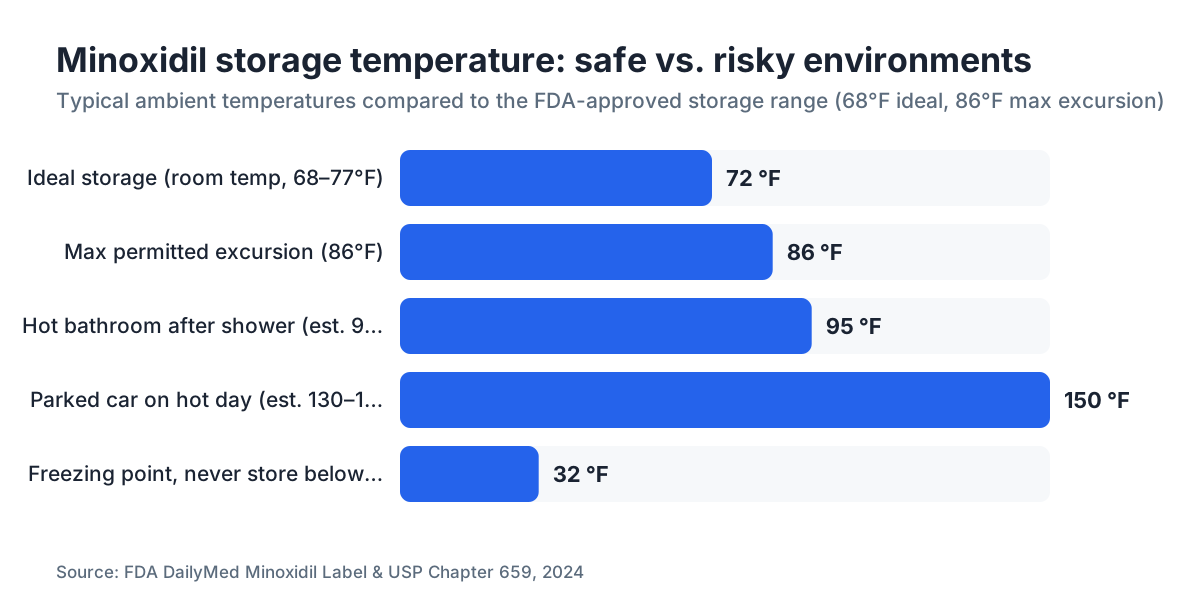
The FDA-approved labeling for topical minoxidil specifies storage at controlled room temperature, defined by the USP as 68°F to 77°F (20°C to 25°C), with excursions allowed between 59°F and 86°F (15°C to 30°C). [2] Plain English: a typical air-conditioned room is fine. A car dashboard in July, or a bathroom that turns into a sauna, is not.
The upper limit is the one most people blow past. A parked car on a hot day can hit 130°F to 170°F (54°C to 77°C) inside, well beyond the point where many pharmaceutical compounds start to fall apart. Even a bathroom cabinet above a radiator or near a heating vent can regularly reach 85°F to 90°F. That's right at or above the excursion ceiling.
The lower limit matters too. Do not freeze minoxidil. Freezing can permanently separate the solution's components and wreck the foam's structure. The product label for Rogaine, one of the most widely used branded versions, warns against freezing outright. [3] Once separated or frozen and thawed, the product won't reliably return to its original consistency or concentration.
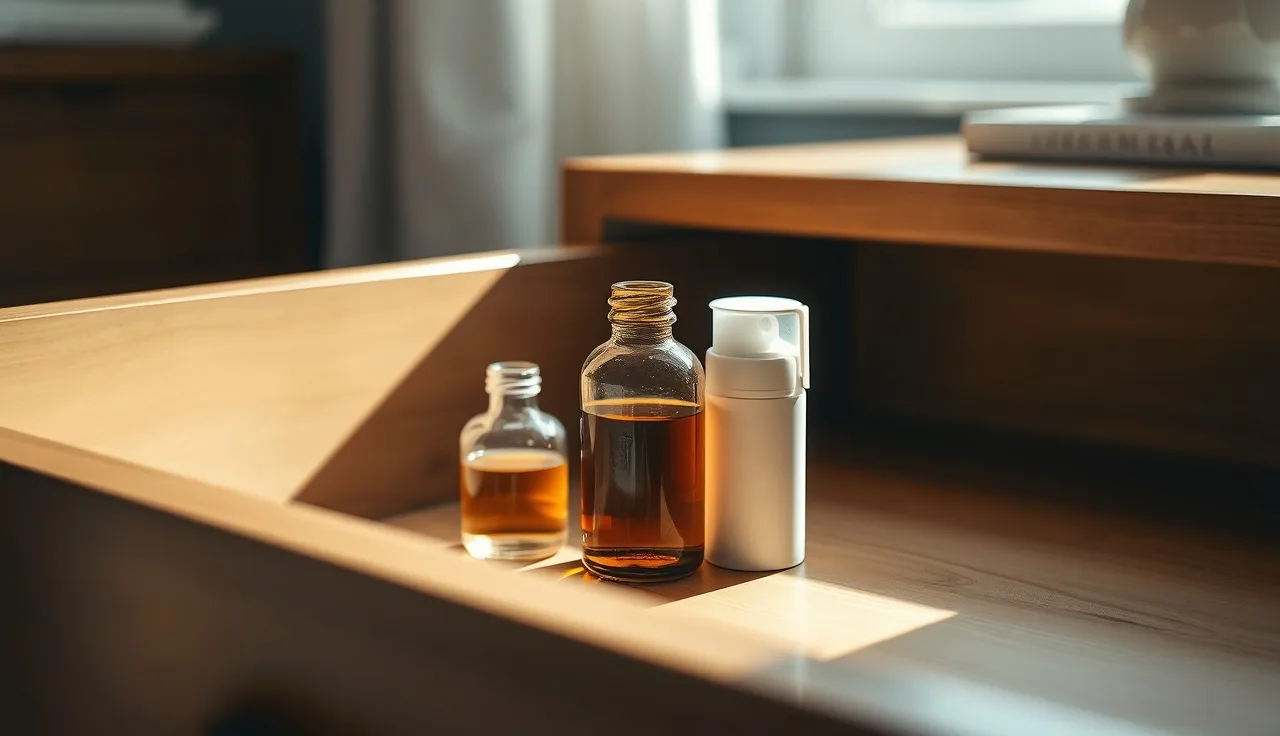
A bedroom dresser drawer, a kitchen cabinet away from the stove, or a closet shelf are all genuinely good picks. Simple, boring, effective.
Should you store minoxidil liquid and foam differently?
Somewhat, yes. The active ingredient is identical, but the two formulations use different carrier systems, and they react to stress differently.
Topical minoxidil liquid (2% or 5%) uses propylene glycol as its main carrier. Propylene glycol is fairly stable, but prolonged heat can speed up oxidation of the minoxidil molecule and thicken the solution. Keep the dropper cap tight after every use. Leave it loosely capped and the alcohol component evaporates, which shifts the concentration and turns the liquid stickier and harder to spread evenly. [4]
Foam is fussier. It comes in a pressurized can, so you have one more concern: never store foam canisters near open flame, heat sources above 120°F, or direct sunlight. The aerosol can is a safety risk, not only an efficacy problem. The foam also needs to stay cool enough to dispense right, which is why the directions tell you to squirt it onto a cool cap or your fingers rather than straight onto your scalp. Body heat melts the foam to liquid too fast. Chilling the can briefly before use is a common trick in warm climates, and it's fine as long as you don't freeze it.
For both forms, the original container is the right container. Don't decant minoxidil into a different bottle or a decorative dispenser. Pharmaceutical packaging is built to block light and limit air exchange.
Is the bathroom cabinet a bad place to store minoxidil?
For most people, yes. The bathroom is one of the worst spots in a house to keep any medication.
The American Academy of Dermatology and most pharmacy guidance say to keep medications out of the bathroom, specifically because of the humidity and temperature swings. [5] A shower in a small bathroom can push humidity to 80% to 100% and spike the temperature 10°F to 20°F in minutes. Do that twice a day and you're running your minoxidil through repeated heat-and-moisture cycling that degrades both the active molecule and the packaging.
Moisture is a real problem for foam canisters. The valve on an aerosol can corrode or clog after repeated steam exposure. You'd notice it as inconsistent dispensing or a can that sputters before it's empty.
The bathroom is convenient, which is exactly why everyone leaves products there. A practical fix: keep the main supply in a bedroom drawer or a cool closet, and stash only a few days' worth in the bathroom in a small secondary container, tightly closed. That way you're not cycling the whole bottle through the worst room in the house every morning.
If you're not sure what's behind your hair loss yet, which shapes which treatment makes sense, our guide on what causes hair loss is a good place to start.
How long does minoxidil stay effective after opening?
The printed expiration date is your real reference point. That date comes from stability testing on an unopened product stored under ideal conditions. Once you open the container, two clocks start: the official expiry date, and the practical shelf life under everyday use.
For topical liquid, most pharmacists say to use it within 12 months of opening, even if the printed expiry sits further out. Alcohol-based solutions start evaporating once opened, slowly concentrating the remaining ingredients and shifting the formula. The FDA notes that drug degradation is usually gradual rather than a cliff, but the rate depends heavily on how you store it. [6]
For foam, the pressurized format actually helps shield it from air, but once you crack the valve the can won't reseal perfectly. Manufacturers generally recommend using an opened can within the window in the package insert, typically 6 to 12 months.
One quick check: if the liquid has darkened noticeably (from clear or faint yellow to dark amber or brown), or if the foam comes out as a thin liquid instead of a light foam at room temperature, treat those as signs of degradation. Don't use a product that smells sharply off or has visible particles.
Nobody has great published data on exactly how much potency is lost at specific points past expiry. The closest thing is the FDA's review of shelf-life extension studies from the military's drug stockpile program, which found many drugs kept potency well past their printed dates under ideal storage. That finding does not carry over to products stored badly. [11]
What happens if minoxidil gets too hot or too cold?
Heat speeds up the chemical breakdown of minoxidil. The molecule oxidizes, and the by-products that form are less active or dead weight. In most cases you won't see a dramatic change in color or smell, which is what makes heat exposure sneaky. You might apply what looks and feels like normal minoxidil for weeks before you notice weaker results.
A 2018 review of topical medication stability in the International Journal of Pharmaceutics found that most topical drug formulations degrade much faster at 104°F (40°C) than at room temperature, with some losing 10% to 30% of active content within weeks at elevated temperatures. [7] Minoxidil has been flagged in compounding pharmacy literature as sensitive to heat and oxidation. If you use a compounded minoxidil product, ask your compounding pharmacy about its specific stability directly.
Cold exposure short of freezing is usually less damaging, but it can cause precipitation. If you've stored liquid minoxidil in a cold garage or car trunk over winter and you see crystals or cloudiness, don't use it until it returns to room temperature and the liquid is clear again. If it stays cloudy, the product may be compromised.
Freezing is the worst case. Ice crystals can physically disrupt the emulsion and permanently separate propylene glycol from everything else. There's no reliable way to confirm a thawed product kept full potency, so the safe answer is to replace it.
Does light exposure degrade minoxidil?
Yes. Minoxidil is light-sensitive, which is why manufacturers use opaque or amber containers. Direct sunlight carries UV radiation that can break chemical bonds in the minoxidil molecule. Even bright indoor light, given enough time, adds to slow degradation.
This is one reason moving minoxidil into a clear glass bottle or a see-through travel container is a bad idea, however convenient it looks. The original packaging, whether an opaque plastic bottle or an aluminum foam canister, is built to block light.
If you travel often and want a smaller container, look for small amber glass or opaque travel bottles made for pharmaceutical use. Keep that travel container in a bag or toiletry case, not sitting on a sunlit hotel bathroom counter.
The rule is simple: out of light means one fewer degradation pathway working against you. A closed drawer handles light and temperature stability in one move.
Can you store minoxidil in the fridge?
A standard refrigerator runs about 35°F to 40°F (2°C to 4°C). That sits inside the safe range for minoxidil, above freezing and below the degradation threshold. So refrigerating it is technically fine, and in some climates (think an apartment with no air conditioning in a hot summer) genuinely better than a warm shelf.
The downside for foam is texture. Cold foam dispenses oddly, coming out denser and slower to spread. Let it warm up a bit before applying, or dispense into your hand and wait a few seconds. Some users chill the can on purpose, especially in humid climates, because it dispenses more cleanly and the cold feels good on the scalp.
For liquid, cold storage is mostly a non-issue. The solution stays liquid and applies the same way when it's cool.
What you want to avoid is a fridge that accidentally freezes things. A refrigerator with a faulty thermostat or set to a high-cool setting can drop near 32°F (0°C). Check the temperature before you use a fridge as a storage spot. A cheap appliance thermometer costs about $5 and pays for itself the first time it catches a freezing shelf.
If you're dealing with a broader pattern of hair loss and wondering how much of your effort, storage habits included, is actually moving the needle, an AI-based hair scan through tools like MyHairline can track changes over time and show whether your regimen is producing results.
How should you store minoxidil when traveling?
Travel creates the exact conditions that degrade minoxidil: hot car trunks, baggage holds that swing between extremes, and hotel bathrooms with no steady temperature.
For carry-on, the TSA's 3-1-1 liquid rule caps containers at 3.4 oz (100 ml) each. Most standard minoxidil bottles are 60 ml (2 oz) for the 5% dropper formulation, so they clear it. Foam canisters are typically 2.11 oz (60 g), which also passes. The TSA treats medications differently from toiletries and allows medically necessary liquids in reasonable quantities even above 3.4 oz if you declare them. [8]
Don't check minoxidil in baggage if you can help it. Cargo holds can reach temperatures well outside the safe range, both very cold at altitude and very hot on the tarmac. Carry-on stays in the cabin, which is temperature-controlled.
On road trips, keep the product in the air-conditioned cabin, not the trunk. A small insulated pouch, the kind used for insulin, keeps the temperature stable on long drives.
Hotel tip: find the coolest, darkest spot in the room, usually a closed closet or a drawer away from windows, and skip the bathroom shelf.
How do you know if your minoxidil has gone bad?
There's no single at-home test that measures potency. But a few signs are worth watching.
For liquid minoxidil, a clear darkening from its original clear or pale-yellow color points to oxidation. Some color shift over months is normal. A dark amber or brown liquid that has changed noticeably since you opened it is a red flag. Cloudiness or particles that won't dissolve at room temperature are another warning.
For foam, the texture tells you plenty. Good foam is light and airy and holds its shape briefly on your fingertip before melting into the skin. If the can dispenses a thin, watery liquid, either the canister is nearly empty and going propellant-heavy, or the formula has broken down. An unusually strong or off chemical smell, different from the product's normal faint alcohol odor, is also worth noting.
The most honest signal is results, or the lack of them. If you've been consistent with application and suddenly see less response over a few weeks, and you've ruled out technique and frequency, degraded product is worth considering.
If you're not sure whether your hair loss is responding at all, our piece on minoxidil for men covers what realistic results look like on a normal timeline.
When in doubt, replace the product. A new bottle of generic 5% minoxidil costs $15 to $25. That's cheap next to months of reduced efficacy.
What does the FDA label actually say about minoxidil storage?
The FDA-approved prescribing information for topical minoxidil (both 2% and 5% solutions) says to store at controlled room temperature, 20°C to 25°C (68°F to 77°F). Some labeling adds a note to keep the product away from flame and heat, which matters for the alcohol-containing liquid. [1]
For the foam, labeling adds an instruction to store upright and away from extreme heat or open flame, because the canister is pressurized with a flammable propellant.
Oral minoxidil tablets, FDA-approved at the 2.5 mg and 10 mg doses for hypertension and increasingly prescribed off-label for hair loss, carry the same general instruction of controlled room temperature. [9] Tablets are more stable than liquids and less sensitive to humidity than topical solutions, but the same temperature window applies.
The FDA's labeling requirements come from real stability testing data submitted during the approval process. When the label says controlled room temperature, that's actual chemistry, not boilerplate. You can read the current labeling for any approved drug through the FDA's DailyMed database. [1]
If you're weighing oral minoxidil as an alternative to topical forms, our article on oral minoxidil covers dosing, evidence, and tradeoffs.
Is there anything you should never store minoxidil near?
A few specific hazards beyond heat and light are worth naming.
Open flame. Topical minoxidil liquid contains alcohol and is flammable. Don't store it near a gas stove, candles, or any open flame. The foam canister is pressurized and flammable too. Both are fire hazards if you keep them carelessly near heat.
Children and pets. The AAD recommends storing all medications where children can't reach them. [5] Minoxidil is worth extra care: it's toxic to cats even in small amounts, and accidental ingestion by a small child can cause serious cardiovascular effects. A locked cabinet or high shelf is not overkill.
Other medications. Keep minoxidil in its own container and don't mix bottles. Cross-contamination from dropper tips isn't really a storage risk, but grabbing the wrong bottle is a genuine practical problem if you use several topical treatments.
Sunlit windowsills. Common in bathrooms. Between UV exposure and the temperature swings from sun hitting a south-facing window, a windowsill is about as bad as it gets. A drawer below that same windowsill is meaningfully better.
If you're thinking about adding finasteride and wondering whether the storage rules match, our overview of finasteride covers the basics, though tablets forgive a lot more than liquids do.
Sources
- FDA DailyMed, Minoxidil 5% Topical Solution Label
- USP General Chapter <659> Packaging and Storage Requirements
- FDA DailyMed, Rogaine (Minoxidil) Foam 5% Label
- FDA, Guidance for Industry: Q1A(R2) Stability Testing of New Drug Substances and Products
- American Academy of Dermatology, Medication Storage Tips
- FDA, Don't Be Tempted to Use Expired Medicines (Consumer Update)
- International Journal of Pharmaceutics, Topical Drug Stability Review, 2018
- TSA, What Can I Bring? Medications and Liquids Guidance
- FDA DailyMed, Minoxidil Tablets 2.5 mg and 10 mg Label
- NIH MedlinePlus, Minoxidil Topical Drug Information
- FDA, Drug Expiration Dates: Do They Mean Anything? (Consumer Update)