
TL;DR: When you stop minoxidil, the hair it was maintaining slides into a resting phase and sheds within 3 to 4 months, returning you roughly to where your hair loss would have been without it. Nothing fully prevents this. But tapering slowly, overlapping with finasteride, and timing your quit can make the shed feel less brutal.
What actually happens to your hair when you stop minoxidil?
Minoxidil holds hair in the anagen (active growth) phase longer than it would stay there on its own. It does this mostly by opening potassium channels in follicle cells, which improves blood flow to the follicle and shortens the telogen (resting) phase [1]. Stop applying or swallowing it, and that signal is gone.
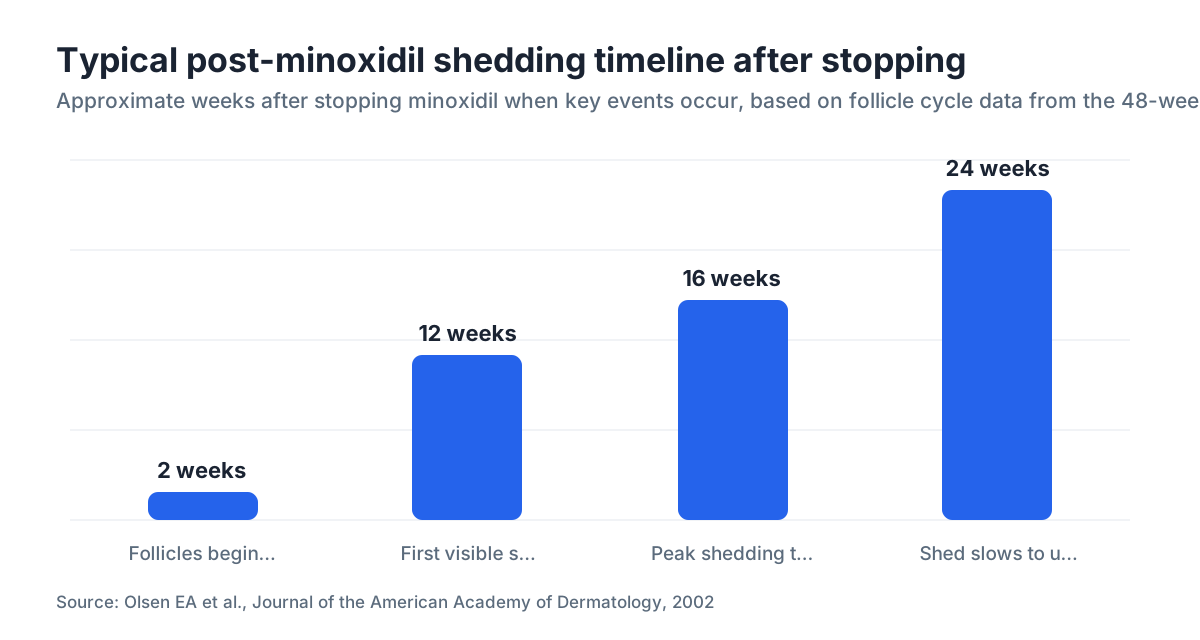
Within two to eight weeks, the hairs minoxidil was holding in anagen start shifting into telogen. About 12 to 16 weeks after that shift, they fall out. That is why most people notice a real shed around three to four months after quitting, not the week they stop [2].
Here is the part people underestimate. You lose more than the hair minoxidil grew. You lose the hair it was maintaining. In someone with androgenetic alopecia, many follicles were already on a slow decline before minoxidil slowed the process down. When the drug is gone, that underlying loss resumes at roughly the rate it would have reached anyway. The result often looks worse than day one of treatment, because several years of suppressed loss show up at once.
The label is blunt about it. The FDA-approved prescribing information for topical minoxidil states that "cessation of treatment with minoxidil topical solution usually results in the return of hair loss" [1]. Nothing in the drug permanently reprograms follicles. Every gain from minoxidil depends on staying on it. That is not a flaw you can engineer around. It is the pharmacology.
How much hair will you lose if you stop?
It varies, and the thing that decides it is how far along your underlying hair loss is, not how long you used the drug.
In the 48-week trial that supported FDA approval of 5% topical minoxidil for men, subjects who had regrown or held hair during treatment lost most of those gains within 16 weeks of stopping [2]. That is not a rare outcome. That is the expected one.
Use minoxidil for two years with real regrowth, and you should expect to lose most of that regrowth. Use it for six months with modest maintenance and no obvious regrowth, and the shed will probably feel smaller simply because there is less to lose.
Age matters too. A 22-year-old stopping during aggressive androgenetic progression will likely see a sharper shed than a 55-year-old whose underlying loss has mostly leveled off. The what causes hair loss picture keeps running in the background the whole time.
A realistic range: most people land back near the density they would have had if they had never touched the drug, adjusted for time elapsed. Some report ending up worse than their pre-treatment baseline, though that is hard to confirm because you cannot run a control scalp on the same head.
Is there a way to stop minoxidil without shedding at all?
No. No method stops the shed entirely. Anyone selling a "quit minoxidil without shedding" protocol is selling wishful thinking.
What you can do is soften the severity and slow the speed. That difference matters. A shed that unfolds over eight months feels and functions differently than one that dumps over six weeks, even when the endpoint is the same.
The strategies below carry different levels of evidence. None are proven in randomized trials built specifically to test post-minoxidil discontinuation. That gap in the literature is real, and I am not going to paper over it.
Does tapering your minoxidil dose actually help?
Tapering means reducing your dose gradually over weeks or months instead of stopping cold. It is the most commonly recommended approach, and the theory holds up: a slower withdrawal gives follicles time to adjust rather than hitting them with an abrupt vascular and hormonal change.
In practice, no published clinical trial shows that a specific taper schedule cuts post-discontinuation shedding versus stopping abruptly. The recommendation exists by analogy to other drug tapers and by clinical experience reported by dermatologists, not by controlled data. Say that out loud before you commit to a plan.
A commonly suggested approach looks like this:
| Phase | Dosing schedule | Duration |
|---|---|---|
| Standard use | Once daily (or twice daily if prescribed) | Ongoing |
| Step 1 taper | Every other day | 4 weeks |
| Step 2 taper | Every third day | 4 weeks |
| Step 3 taper | Twice weekly | 4 weeks |
| Step 4 taper | Once weekly | 4 weeks |
| Stop | None | done |
The full taper runs about four months. Whether that meaningfully changes the shed compared to stopping in four weeks is genuinely unknown. It does give you time to start an alternative treatment and let it reach partial effect before minoxidil clears your system. That overlap is probably the most useful thing a taper buys you.
What is the best time of year to stop minoxidil?
This sounds odd, but timing matters more than most people expect. Spring is the better window to absorb a shed, and here is why.
Hair shedding in general, including telogen effluvium, tends to peak in autumn. Research published in the British Journal of Dermatology found that human hair follicles follow a seasonal pattern, with the highest percentage in telogen in July and August, then peak shedding roughly three months later in autumn [3].
Stop minoxidil in July and you stack a withdrawal shed on top of a seasonal one. That combined hit lands in October and November, which feels awful. Start your taper in November or December and any withdrawal shed peaks in spring, when seasonal telogen pressure is lowest.
This is a minor variable next to the overall pharmacology. But if you have any flexibility in when you quit, use it.
Can finasteride protect your hair when you stop minoxidil?
This is the strategy with the most practical evidence behind it, and it is what I would actually do here.
Finasteride works through a completely different mechanism than minoxidil. It lowers dihydrotestosterone (DHT), the androgen mostly responsible for follicle miniaturization in androgenetic alopecia [4]. Minoxidil does not touch DHT at all. If you are already on finasteride, or you start it before quitting minoxidil, the underlying androgenetic process is being handled at the hormonal level.
A 2003 study in the Journal of the American Academy of Dermatology compared men on finasteride alone, minoxidil alone, and the combination over 12 months. The combination produced the best outcomes, and finasteride alone beat minoxidil alone on vertex hair count [5]. For men with androgenetic alopecia, that means finasteride is the foundation minoxidil was layering on top of, not the reverse.
Start finasteride at least three to six months before stopping minoxidil. Finasteride needs time to bring scalp DHT down. You want it working before you pull the minoxidil safety net out from under yourself.
The finasteride and minoxidil article covers the evidence for running both together in more detail. Finasteride has its own side effect profile and is not right for everyone, so talk to a physician before starting.
What about switching from topical to oral minoxidil first?
Some people switch to oral minoxidil before tapering off entirely, figuring a low systemic dose is easier to step down from than a topical. The evidence here is thin.
Low-dose oral minoxidil (0.625 mg to 2.5 mg daily) has solid efficacy data for hair retention and is now widely used off-label by dermatologists [6]. Whether tapering from oral minoxidil produces a gentler discontinuation shed than stopping topical cold has not been studied directly. Nobody has that data.
What is clear: oral minoxidil at low doses has real systemic effects, including fluid retention and cardiovascular effects, that topical mostly avoids. Switching modalities just to make quitting easier is a bad trade. Do it if you have independent reasons to prefer the oral form. Do not do it as a quitting trick.
The minoxidil for men guide covers the dosing and application differences if you want the full comparison.
Are there any supplements or treatments that cushion the loss?
Some people try to soften the shed with supplements. The evidence is limited but not zero.
Ketoconazole shampoo (1% or 2%) has some evidence for modest benefit in androgenetic alopecia. A 1998 trial in Dermatology found ketoconazole 2% shampoo improved hair density versus placebo, with results comparable on some metrics to minoxidil 2% [7]. It is not a substitute for minoxidil. But it is cheap, low risk, and may help scalp health during a transition.
DHT-blocking supplements like saw palmetto have limited clinical data. A 2002 study in the Journal of Alternative and Complementary Medicine found 60% of men with androgenetic alopecia who took saw palmetto (320 mg daily) improved versus 11% on placebo, though it was a small study with self-reported endpoints [8]. I would not count on it to offset stopping minoxidil, but it is unlikely to hurt. The dht blocker article digs into the evidence.
Microneedling shows a genuine signal. A 2013 randomized trial in the International Journal of Trichology found microneedling plus minoxidil beat minoxidil alone by a wide margin, which suggests it activates follicle growth pathways somewhat on its own [9]. Whether it helps after you stop is unknown, but some dermatologists build it into transition plans.
Worth a look: hair loss supplements breaks down what the evidence shows versus what supplement brands claim.
What should you do in the months after you stop?
The three to six months after stopping are the hardest stretch. The shed will happen. Your job is to measure it honestly and not make panic decisions based on how bad your hair looks on a bad day.
Get a baseline photo before you start tapering. Same lighting, same angle, wet or dry but consistent. Take another set every month. Human memory for hair density is garbage. Photos are the only way to tell whether you are stabilizing, still shedding, or recovering.
If you have access to a dermatologist, a trichoscopy reading before stopping and three months after gives you actual follicle density numbers. That matters if you are eyeing a hair transplant later, because surgeons need stable donor and recipient areas.
Do not stack multiple new treatments at once during this window. Start finasteride, add microneedling, and begin a new supplement all in month one, and you will never know which one did what. Add changes one at a time, three months apart minimum.
Seeing diffuse shedding beyond what you expected? Get a blood panel. Iron deficiency, thyroid dysfunction, and low ferritin can all amplify a medication-withdrawal shed. These are treatable causes that pile onto the androgenetic picture. The what causes hair loss section covers these overlapping causes.
For an objective read on how your hairline stacks against typical progression, a free AI scan at MyHairline maps your current Norwood stage and gives you a baseline to track against, which is useful during exactly this kind of transition.
When does the shedding stop after quitting minoxidil?
For most people the main post-discontinuation shed runs two to four months, then slows. By six months post-stop, shedding usually settles back to whatever your underlying androgenetic rate is without treatment.
Still shedding heavily at six months? That is your cue to see a dermatologist. At that point you are either dealing with another cause layered on top, or your underlying loss is moving faster than average and needs a fresh plan.
The shed itself does not cause extra permanent damage beyond what the underlying androgenetic alopecia was going to do anyway. Stopping minoxidil does not speed up hair loss past its natural path. The fear that quitting permanently wrecks your hair below baseline has not held up in the clinical literature.
Who should actually consider stopping minoxidil?
Most people quit for one of three reasons: side effects, cost, or the mental weight of a daily treatment with no end date.
Minoxidil side effects are real and downplayed in marketing. Scalp irritation, contact dermatitis from propylene glycol in topical formulas, unwanted facial hair in women, and cardiac effects (mostly with oral minoxidil) are all documented reasons to stop [11]. Those are legitimate.
Cost is a messier calculation. Generic topical minoxidil runs about $20 to $40 a month. Oral minoxidil runs $10 to $50 a month in the US depending on the compounding pharmacy or brand. Over ten years, that is $2,400 to $6,000. Set against a hair transplant in the $4,000 to $15,000 range, staying on minoxidil is often the cheaper way to keep hair, not the expensive one.
Quitting because you feel like you have seen no results? Take the baseline photo test seriously first. Plenty of minoxidil users are maintaining hair they would otherwise have lost, and maintenance is invisible as a success because the loss never happened. The counterfactual is hard to see. A receding hairline that stopped advancing is a win, even if it does not feel like one.
If your real issue is that minoxidil never addressed the root cause, you are right. It does not. That is the case for adding a DHT blocker like finasteride, or eventually a transplant for the worst areas, rather than stopping and hoping.
Is the "minoxidil rebound shed" a real thing or just anxiety?
It comes up constantly in hair loss forums, and the answer is: partly real, partly anxiety, hard to pull apart.
The biology is real. Follicles shed hair that was being held past its natural cycle. Documented, expected, not in dispute.
The anxiety layer is that people in a shed tend to catastrophize and overestimate the loss, because they are inspecting their scalp every single day. The same density drop that feels devastating at 28 while you are quitting minoxidil would barely register on a casual observer across a room.
Where it gets genuinely tangled is the nocebo effect. Expecting a severe shed, reading forum posts about dramatic regrowth loss, and checking your hair compulsively can pile stress-related telogen effluvium on top of the pharmacological shed. Stress is a documented trigger for hair shedding [12]. The two feed each other.
The practical move: set your baseline with photos, commit to a monthly check, and close the forums. Studying your hairline under six lighting conditions is not data collection. It is anxiety.
Sources
- FDA, Minoxidil Topical Solution Prescribing Information (Rogaine label)
- Olsen EA et al., Journal of the American Academy of Dermatology, 2002: A randomized clinical trial of 5% topical minoxidil vs 2% topical minoxidil and placebo in the treatment of androgenetic alopecia in men
- Courtois M et al., British Journal of Dermatology, 1994: Periodicity in the growth and shedding of hair
- Kaufman KD, Journal of Investigative Dermatology Symposium Proceedings, 1996: Androgen metabolism as it affects hair growth in androgenetic alopecia
- Kaufman KD et al., Journal of the American Academy of Dermatology, 2003: Finasteride in the treatment of men with androgenetic alopecia
- Randolph M and Tosti A, Journal of the American Academy of Dermatology, 2021: Oral minoxidil treatment for hair loss
- Pierard-Franchimont C et al., Dermatology, 1998: Ketoconazole shampoo: effect of long-term use in androgenic alopecia
- Prager N et al., Journal of Alternative and Complementary Medicine, 2002: A randomized, double-blind, placebo-controlled trial to determine the effectiveness of botanically derived inhibitors of 5-alpha-reductase in the treatment of androgenetic alopecia
- Dhurat R et al., International Journal of Trichology, 2013: A randomized evaluator-blinded study of the effect of microneedling in androgenetic alopecia
- U.S. National Library of Medicine, MedlinePlus: Minoxidil Topical
- American Academy of Dermatology, Hair loss: causes and types