

TL;DR: The Ludwig scale sorts female-pattern hair loss into three stages by how much thinning shows at the crown and top of the scalp. Stage I is a widening part. Stage II is obvious diffuse thinning. Stage III is near-total loss at the crown. The frontal hairline usually stays. Treatment works best started early, and the two best-studied options are topical minoxidil and low-level laser therapy.
What is the Ludwig scale and who created it?
The Ludwig scale is the most widely used classification system for female-pattern hair loss (also called androgenetic alopecia in women). Dr. Erich Ludwig, a German dermatologist, published it in 1977 in the British Journal of Dermatology. It divides hair loss severity into three stages based on how much thinning has occurred across the top and crown of the scalp. [1]
Before Ludwig's system, doctors had no shared language for describing how far a woman's hair loss had gone. That made it hard to compare treatment outcomes across studies or explain prognosis to patients. The scale fixed that with something simple: three photographs, three descriptions, one axis of progression.
The thing that sets the Ludwig scale apart from the Norwood-Hamilton scale used for men is where thinning shows up. Men typically lose hair at the temples and vertex in distinct patterns. Women almost always keep their frontal hairline and instead thin diffusely across the crown and top of the scalp. [2] Ludwig's scale reflects that. It is not perfect, and newer systems like the Sinclair scale have been proposed, but Ludwig is still the standard in most clinical trials and dermatology practices.
What does each Ludwig stage look like?
Stage I (mild): The central part line looks wider than it used to, with some thinning on either side, but overall density still reads close to normal to most people who look at you. Women at Stage I often first notice the change when pulling their hair back or catching the top of their head in a second mirror. Hair-count studies show density at the crown is down at this stage, but only by a modest amount.
Stage II (moderate): Thinning is clearly visible across the top of the scalp. The part is obviously wide, and looking down at the crown, you see scalp through the hair. Other people start to notice. This is when many women first book a dermatologist, often describing hair "coming out in clumps" or "getting so thin overnight," though the process has usually crept along for years.
Stage III (severe): Heavy loss across the entire top of the scalp, with scalp clearly showing or nearly bare in that zone. The frontal hairline is still mostly there, which separates Stage III Ludwig from advanced male-pattern baldness. This stage hits a smaller share of women and often shows up after menopause, when estrogen drops. [3]
A fourth pattern, sometimes called a "frontal accentuation" variant, brings more recession at the front center than classic Ludwig predicts. Some researchers now classify it separately. It matters clinically because it can look like the receding hairline patterns more common in men.
| Ludwig Stage | Central part appearance | Crown visibility | Observer detection |
|---|---|---|---|
| I (mild) | Widened but subtle | Scalp barely visible | Usually self-detected only |
| II (moderate) | Clearly wide | Scalp visible through hair | Often noticed by others |
| III (severe) | Very wide | Scalp prominently exposed | Obvious to all observers |
How is the Ludwig scale diagnosed by a dermatologist?
Diagnosis starts with a visual assessment, but a good dermatologist does more than look. They part your hair down the center, then take standardized photographs from directly above (the "bird's eye" view) and from the front. Those photos let them track progression by comparing visits.
Trichoscopy, a dermoscopic exam of the scalp at magnification, is increasingly used alongside Ludwig staging. It shows early signs like miniaturized follicles, perifollicular pigmentation, and hair shaft diameter variability, all of which help confirm androgenetic alopecia and separate it from other causes of diffuse thinning. [4]
Blood work usually comes with a Ludwig assessment. Thyroid function (TSH), ferritin, total iron-binding capacity, complete blood count, and sometimes androgens (free and total testosterone, DHEAS) get checked. Not because low ferritin or thyroid disease causes pattern hair loss, but because those conditions can cause telogen effluvium, a separate shedding disorder that often overlaps with androgenetic alopecia and can muddy staging. [5]
A scalp biopsy is done occasionally when the picture is ambiguous, mainly to rule out scarring alopecia, which is irreversible. Biopsies in androgenetic alopecia show a characteristic rise in the ratio of telogen to anagen follicles and shrinking follicle diameter.
How common is female-pattern hair loss at each Ludwig stage?
Female-pattern hair loss is more common than most people think. The American Academy of Dermatology estimates that more than 50 percent of women will have noticeable hair loss in their lifetime. [6]
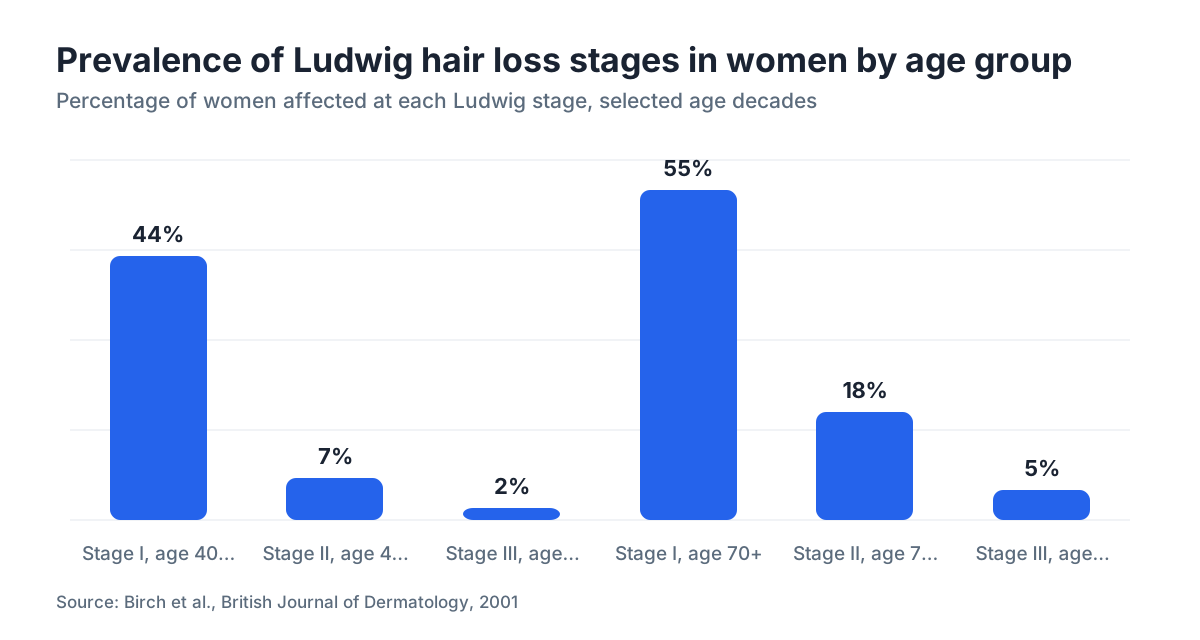
Breaking that down by Ludwig stage is harder, because large population studies rarely apply the Ludwig scale the same way, and prevalence swings hard with age. The best female prevalence data comes from a 2001 study by Birch, Messenger, and Messenger in the British Journal of Dermatology. It examined 377 Caucasian women and found Stage I in about 44 percent, Stage II in about 7 percent, and Stage III in about 2 percent of women aged 40 to 49. Every stage climbed sharply after menopause. [1]
Among women over 70, that same study found Stage I in roughly 55 percent, Stage II in around 18 percent, and Stage III in about 5 percent. These are not small numbers. The stigma around female hair loss leaves many affected women assuming they are rare exceptions. They are not.
What causes hair loss to progress through the Ludwig stages?
Androgenetic alopecia in women runs mostly on genetic sensitivity of hair follicles to dihydrotestosterone (DHT), a metabolite of testosterone, even in women whose total androgen levels sit in the normal range. Follicles on the top and crown carry more androgen receptors and make more 5-alpha reductase (the enzyme that turns testosterone into DHT) than follicles at the back and sides. That is why thinning follows that specific map. [7]
Say this part plainly: a woman can have "normal" testosterone on a blood test and still have real androgen-driven hair loss. The problem sits at the follicle, not always in the hormone level. That is why dermatologists sometimes prescribe anti-androgens like spironolactone even when bloodwork looks fine.
Hormonal shifts speed things up. Postpartum shedding, stopping oral contraceptives, perimenopause, and menopause all tilt the estrogen-to-androgen ratio in ways that can push a woman from Stage I to Stage II faster than her genetics alone would have. Stress, crash dieting, and iron deficiency pile on by triggering telogen effluvium on top of the background pattern. Reading up on what causes hair loss is worth doing before you choose a treatment.
Genetics count too. A mother, maternal grandmother, or father with heavy hair loss raises your risk meaningfully, though the inheritance pattern for female androgenetic alopecia is polygenic and less predictable than people often claim.
What treatments work for Ludwig Stage I and Stage II hair loss?
Minoxidil is the only FDA-approved topical treatment for female-pattern hair loss. The FDA cleared 2% topical minoxidil for women in 1991. A 5% foam, originally approved for men, is also widely used off-label in women and tends to beat the 2% in head-to-head comparisons. [8]
The main randomized controlled trial behind 2% minoxidil in women (Olsen et al., Journal of the American Academy of Dermatology, 2002) showed statistically significant gains in non-vellus hair count versus placebo at 48 weeks. The effect was modest but real: the treated group gained roughly 13 more hairs per cm² than placebo at the vertex. You will not get your 25-year-old hair back. Stopping progression and adding visible density is the realistic goal. [8]
Minoxidil has to be used indefinitely. Stop it, and whatever density you gained sheds out over about three to six months. That is not the drug failing. That is how the biology works. For the full tradeoffs, read about minoxidil side effects before starting.
Oral minoxidil, at low doses (0.25 mg to 1 mg daily in women), is increasingly used off-label and has posted strong results in small trials. A 2020 study in the Journal of the American Academy of Dermatology found significant density improvement with low-dose oral minoxidil in women, with tolerability that was generally acceptable, though hypertrichosis (unwanted body hair) is a real side effect. Oral minoxidil is worth raising with a dermatologist if topical application has been a barrier.
Spironolactone (100 to 200 mg daily) is the most commonly prescribed anti-androgen for women with androgenetic alopecia in the U.S. It blocks androgen receptors at the follicle. It is off-label for hair loss but very widely used. It needs monitoring of potassium and blood pressure, and it is contraindicated in pregnancy. A systematic review in JAMA Dermatology (2018) found consistent evidence of benefit across observational studies, though randomized trial data are still thin. DHT blockers including spironolactone work differently from minoxidil and can be paired with it.
Finasteride at 1 mg daily is FDA-approved for male-pattern hair loss and used off-label in postmenopausal women. Evidence in premenopausal women is weaker, and it is absolutely contraindicated in women who are or could become pregnant, because of the risk of feminizing a male fetus. A small randomized trial (Iorizzo et al., 2006) found no significant benefit in postmenopausal women at 1 mg, but higher doses (2.5 to 5 mg) have looked more promising in some studies. Read more about finasteride if you want the full evidence.
Platelet-rich plasma (PRP) injections into the scalp have growing evidence. A 2019 meta-analysis found statistically significant increases in hair density and thickness in androgenetic alopecia patients treated with PRP, though study quality varied. This is a real option, not quackery, but it is expensive (typically $1,500 to $3,500 per course), not covered by insurance, and needs maintenance sessions.
At Stage I, the honest advice is to start something sooner rather than later. Follicle miniaturization is partly reversible early. Once a follicle sits as a vellus (tiny, colorless) hair long enough, it can go permanently dormant.
Does anything work for Ludwig Stage III?
Stage III is harder. When follicles have been miniaturized for years, topical minoxidil and anti-androgens can slow further loss and may recover some density, but they rarely bring back what was lost at Stage III.
Hair transplant surgery is an option for women with stable pattern hair loss, but it is trickier in women than in men. The catch is that women with androgenetic alopecia often thin diffusely across the donor area at the back of the scalp too, which limits donor supply and means some transplanted hairs may eventually thin. A skilled hair restoration surgeon checks donor density carefully before recommending surgery. The hair transplant process for women deserves its own research.
Hair prosthetics (wigs, toppers, integration systems) have gotten far better in the past decade and should not be brushed off. For Stage III with limited treatment response, a high-quality human hair topper can restore a fully natural look. That is not giving up. It is a real solution.
Low-level laser therapy (LLLT) devices, including FDA-cleared combs and helmets, have modest but real evidence for slowing progression and improving density. The mechanism likely involves stimulating mitochondrial activity in follicle cells. They are not transformative at Stage III, but they are low-risk and stack fine with other treatments.
At Stage III, honest expectations matter. No current treatment regrows a full head of hair from near-total crown baldness. Combination approaches (oral minoxidil plus spironolactone, for example) give the best real-world results, and a dermatologist who specializes in hair loss is worth seeing.
How is the Ludwig scale different from the Sinclair scale?
The Sinclair scale, introduced in 2004, is a five-stage alternative for classifying female diffuse hair loss. It also measures central parting width and crown thinning, but uses five grades instead of three, which gives more detail in the middle range where Ludwig's Stage I and Stage II can feel like one wide bucket.
Sinclair Stage 1 lines up roughly with Ludwig Stage I (minimal widening). Sinclair stages 2 through 4 cover what Ludwig calls Stage II, with more granularity. Sinclair Stage 5 roughly matches Ludwig Stage III. Some researchers prefer Sinclair because the five-point range is more sensitive to change over time, which helps when tracking treatment response in trials.
In practice, most U.S. dermatologists still use Ludwig in clinic. Most peer-reviewed treatment trials use Ludwig staging to describe their populations. So if you are reading research on minoxidil or spironolactone, the staging language is almost certainly Ludwig.
The Savin scale is another variant, adding a frontal recession grade. The specific scale matters less than one thing: your dermatologist is using a reproducible system and tracking you photographically over time.
Can the Ludwig scale be applied to hair loss from causes other than androgenetic alopecia?
Technically the Ludwig scale was built for androgenetic alopecia, and purists would say it belongs there only. In practice, dermatologists sometimes borrow Ludwig terminology to describe the pattern of hair loss in other conditions as rough shorthand for location and severity.
Telogen effluvium causes diffuse shedding that can look like Ludwig Stage II on the surface, but it is a different process. It is triggered by a stressor (illness, delivery, rapid weight loss, surgery) and usually resolves within six to nine months once the trigger clears. Androgenetic alopecia is gradual and permanent without treatment. The distinction changes prognosis and treatment decisions completely.
Central centrifugal cicatricial alopecia (CCCA), more common in women of African descent, starts at the crown and radiates outward, mimicking a Ludwig Stage II or III pattern on the surface. But CCCA involves scarring and permanent follicle destruction, which neither minoxidil nor anti-androgens can reverse. A dermatologist who misreads this as Ludwig staging and starts minoxidil without a biopsy could delay the correct treatment. [4]
Frontal fibrosing alopecia (FFA) causes loss at the frontal hairline and eyebrows, which is nearly the opposite of the Ludwig pattern. These conditions show why pattern and staging are starting points, not the whole story.
How do I track my own progression at home between appointments?
The best thing you can do at home is standardized photography. Once a month, in the same lighting (natural light facing a window works well), take three photos: one straight down at the crown from above, one of your central part with hair pulled flat, and one frontal view. Keep the zoom level consistent. Date them and store them in one folder. This beats any subjective "does it look worse today" gut check.
A simple hair-count method dermatologists sometimes teach patients is the 60-second hair collection: comb a defined section of hair for one minute, collect the hairs that fall, count them, record the number. More than roughly 100 hairs shed per day across the whole scalp counts as above normal, though shedding naturally varies with seasons and wash frequency. The method is imprecise but useful for catching a sudden jump.
If you want a more structured read before or between dermatologist visits, the free AI scan at MyHairline can give you a preliminary sense of your pattern and severity from photos, using the same crown-and-part reference points a dermatologist would look at. It is not a diagnosis, but it can help you describe your concerns more precisely at a medical appointment.
Weigh your own perception carefully. Hair loss has well-documented psychological effects including anxiety and depression, and it is easy to see loss as worse than it objectively is (or, the other way, to wave off something real as "just stress"). The photo record cuts through that.
When should I see a dermatologist instead of self-treating?
See a board-certified dermatologist if you are losing hair in patches rather than diffusely, if shedding started suddenly and dramatically, if your scalp itches or burns, if you see redness or scale, or if your eyebrows and eyelashes are thinning too. Any of those points to something other than standard androgenetic alopecia.
For classic Ludwig-pattern gradual thinning, starting 2% or 5% topical minoxidil from a pharmacy without a prescription is a reasonable first step in the U.S. and is supported by dermatology guidelines. But if you see no response after six months of consistent use, or if you slide to Stage II or beyond, a dermatologist appointment earns its cost. Prescription options (spironolactone, oral minoxidil, finasteride) need a clinician.
The American Academy of Dermatology recommends that women investigating pattern hair loss ask specifically for a dermatologist with a hair specialty, or one who sees a high volume of hair loss patients, because not every general dermatologist has deep expertise here. [6]
Cost is a real barrier. A dermatologist visit plus labs can run $200 to $500 out of pocket. If cost is the issue, consider telehealth hair loss platforms, which have cut consultation prices a lot and can prescribe oral or topical minoxidil and spironolactone by video visit in most states.
Sources
- British Journal of Dermatology, Birch et al. 2001, 'Female pattern hair loss: clinical and pathophysiological aspects' / prevalence study of androgenetic alopecia in healthy females
- American Academy of Dermatology, Hair Loss Types: Androgenetic Alopecia
- JAMA Dermatology, Olsen EA. 'Female pattern hair loss' 2001
- Journal of the American Academy of Dermatology, Miteva M, Tosti A. 'Dermoscopy guided scalp biopsy in cicatricial alopecia' 2012
- American Academy of Dermatology, Hair Loss: Overview
- American Academy of Dermatology, Hair Loss resource center
- Journal of Investigative Dermatology, Sawaya ME, Price VH. 'Different levels of 5alpha-reductase type I and II, aromatase, and androgen receptor in hair follicles of women and men with androgenetic alopecia' 1997
- Journal of the American Academy of Dermatology, Olsen EA et al. 'A randomized clinical trial of 5% topical minoxidil versus 2% topical minoxidil and placebo in the treatment of androgenetic alopecia in men' / women's minoxidil efficacy data 2002
- JAMA Dermatology, Mella JM et al. 'Efficacy and safety of finasteride therapy for androgenetic alopecia: a systematic review' 2010
- Journal of the American Academy of Dermatology, Randolph M, Tosti A. 'Oral minoxidil treatment for hair loss: a review of efficacy and safety' 2021
- JAMA Dermatology, systematic review on spironolactone for female androgenetic alopecia, 2018
- Dermatologic Surgery, Hausauer AK, Jones DH. 'Evaluating the efficacy of different platelet-rich plasma regimens for management of androgenetic alopecia: a single-center, blinded, randomized clinical trial' 2018
- International Journal of Dermatology, Sinclair R et al. 'A new scale for the assessment of female androgenetic alopecia: the Sinclair Scale' 2004