

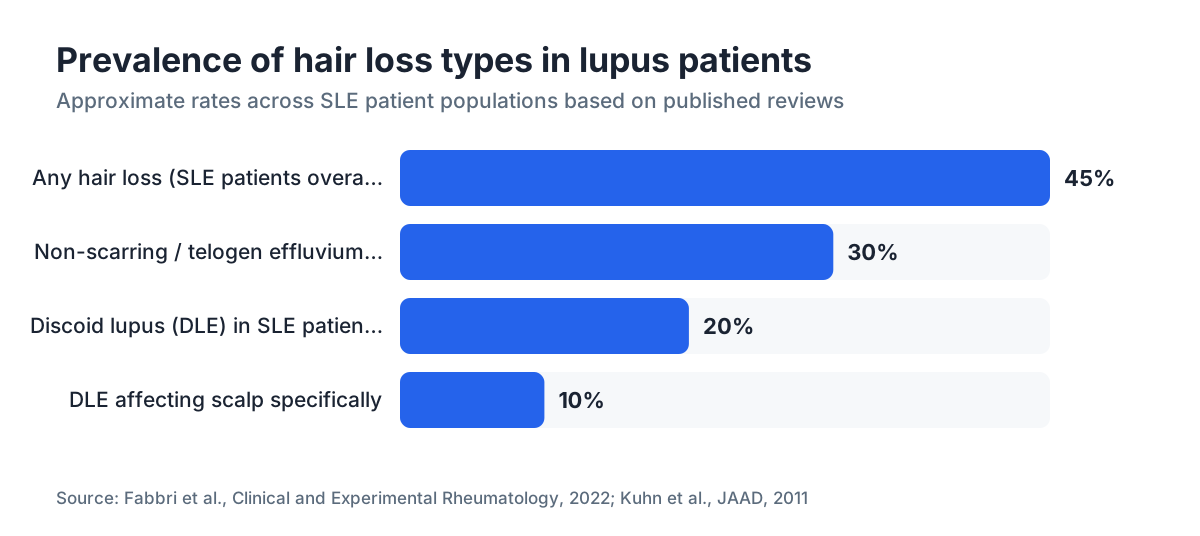
TL;DR: Lupus causes hair loss two ways. One is diffuse shedding triggered by disease activity or medications, and it grows back. The other is scarring loss from discoid lupus lesions, and it destroys follicles for good. Up to 45% of lupus patients lose hair at some point. Treatment depends entirely on which type you have, so the diagnosis comes first.
Why does lupus cause hair loss?
Lupus is an autoimmune disease, which means the immune system attacks the body's own tissue. On the scalp, that attack takes two very different forms, and mixing them up leads to the wrong treatment.
The first form is inflammatory. During a flare, the body floods with cytokines and inflammatory signals. Those signals disrupt the hair growth cycle and push follicles early into the resting phase (telogen). Hair sheds faster than it grows back. This is lupus-related telogen effluvium, and because the follicles themselves are intact, regrowth is possible once inflammation is controlled [1].
The second form scars. Doctors call it cicatricial alopecia. It happens when discoid lupus erythematosus (DLE) lesions form on the scalp. These raised, scaly, coin-shaped plaques cause deep inflammation that reaches below the follicle's stem cell reservoir. Destroy those stem cells and the follicle cannot regenerate. Hair loss in those spots is permanent [2].
A third cause gets overlooked: the medication itself. Hydroxychloroquine rarely causes shedding, but other drugs used in lupus, particularly high-dose corticosteroids and some immunosuppressants, can trigger or worsen diffuse shedding on their own. If your hair loss started shortly after a medication change, tell your rheumatologist before you blame the disease.
Lupus patients also have higher rates of thyroid disease, iron deficiency, and vitamin D deficiency, all of which cause hair loss on their own. The honest clinical reality is that many lupus patients are dealing with more than one cause at once.
How common is hair loss in lupus?
Hair loss is one of the more common features of systemic lupus erythematosus (SLE). Studies put the prevalence between 30% and 45% of SLE patients over the course of their disease [1][3]. It appears in the American College of Rheumatology's classification criteria for SLE, which tells you how seriously dermatologists and rheumatologists take it.
Discoid lupus, the scarring form, is less common in people who only have DLE without systemic involvement, but DLE shows up in roughly 15 to 25% of SLE patients at some point [2]. When DLE hits the scalp specifically, the risk of permanent loss is real, and it climbs the longer the lesions go untreated.
A pattern called "lupus hair" or frontal alopecia also shows up in the literature. It looks like fragile, broken hairs along the hairline, mostly at the temples and forehead. It is not always easy to tell apart from the hairline thinning of androgenetic alopecia, which is why a dermatologist with lupus experience (more than a general practitioner) should be involved early.
What are the different types of lupus hair loss?
Getting clear on the type matters because the treatment is completely different for each.
Non-scarring (reversible) hair loss
This is the more common form. It covers telogen effluvium triggered by a flare, frontal "lupus hair" with fragile breakage, and medication-induced shedding. Under a dermoscope, the follicle openings are visible and intact. A scalp biopsy, if done, shows no fibrosis. Regrowth can happen, though it often takes 3 to 6 months after the trigger is controlled [1].
Scarring (irreversible) hair loss from DLE
Discoid lupus on the scalp produces inflamed plaques with follicular plugging, scaling, and redness. Over time those areas turn pale or dark and sink into atrophy. Under a dermoscope you see absent follicular openings, which is the giveaway that the follicles are gone. A biopsy confirms interface dermatitis and fibrosis around the hair structures [2]. Once that fibrosis sets in, no medication regrows hair in the scarred zone.
How they look side by side
| Feature | Non-scarring (telogen effluvium / lupus hair) | Scarring (discoid lupus) |
|---|---|---|
| Follicle openings visible | Yes | No |
| Scalp texture | Normal or mildly inflamed | Atrophic, scarred, may be hypopigmented |
| Reversibility | Yes, if treated early | No |
| Typical pattern | Diffuse or frontal fringe | Patchy plaques, often vertex or vertex-temporal |
| Biopsy findings | Telogen shift, no fibrosis | Interface dermatitis, perifollicular fibrosis |
| Urgency | Moderate | High (permanent loss if delayed) |
A smooth, shiny patch on your scalp with no visible pores is the one to treat as urgent. Get to a dermatologist.
How is lupus-related hair loss diagnosed?
Diagnosis has several layers, and you may need both a dermatologist and a rheumatologist to see the full picture.
A dermatologist usually starts with a scalp exam and dermoscopy, a handheld magnifier that shows whether follicle openings are present or absent without cutting anything. If the picture is unclear, a 4mm punch biopsy (two samples, one from the edge of an active lesion and one from unaffected skin) is the standard approach for diagnosing scarring alopecias [11]. Pathology looks for the hallmarks of discoid lupus: interface change at the follicle, lymphocytic infiltrate, and fibrosis [2].
Blood work matters too. A metabolic panel, CBC, ANA (anti-nuclear antibody), anti-dsDNA, complement levels, TSH, ferritin, and 25-OH vitamin D should all be on the table. Many lupus patients have ferritin low enough to worsen shedding on its own. Nobody has clean data on the exact ferritin threshold that causes hair loss, but most dermatologists aim for levels above 40 ng/mL when evaluating hair concerns.
The pull test, where a dermatologist grasps about 60 hairs and pulls gently, quantifies active shedding. More than 6 hairs coming out is generally abnormal, though the test depends on who's doing it and isn't definitive alone.
If you haven't been evaluated for lupus and your hair loss comes with joint pain, photosensitivity, a butterfly-shaped rash across your cheeks and nose, or mouth sores, that combination should push your doctor toward a full lupus workup rather than assuming plain pattern hair loss. See the American Academy of Dermatology's guidance on hair loss evaluation for how dermatologists approach this [4].
What treatments actually work for lupus hair loss?
Short answer: treat the disease first. Hair loss driven by inflammation will not improve much if you dab on topicals while a flare runs unchecked.
Controlling disease activity
Hydroxychloroquine (Plaquenil) is the backbone of SLE management, and it also helps discoid lupus lesions on the scalp. Multiple studies support it for DLE, and because it hits the root inflammatory mechanism, it can slow or stop scarring from advancing. The ACR and EULAR both recommend it as first-line for most SLE patients [5].
For more active scalp DLE, intralesional corticosteroid injections (triamcinolone acetonide, typically 5 to 10 mg/mL) into the active lesion margins are a standard dermatology move. They calm local inflammation fast. They don't reverse existing scarring, but they can stop the advancing edge.
Oral corticosteroids, tacrolimus, and other immunosuppressants may come in during severe flares under rheumatology supervision.
Topical treatments for non-scarring loss
Once disease activity is controlled, the scalp can recover. Topical minoxidil (2% or 5%) can support regrowth in non-scarring lupus hair loss and is safe alongside lupus medications. There are no lupus-specific randomized trials on minoxidil, but its mechanism, prolonging anagen and increasing follicle blood flow, works regardless of what caused the telogen shift [6]. If you want the side effect profile before starting, the minoxidil side effects breakdown covers what to watch for.
Topical corticosteroids (clobetasol 0.05% solution or foam) applied to active but non-scarred areas can bring down scalp inflammation between injections.
Hair transplant: not the right tool here
For active lupus, hair transplant is generally a bad idea. Transplanting into an area with active disease leads to poor graft survival, and immune-mediated inflammation can destroy the transplanted follicles. Some specialists consider transplantation into genuinely stable, burned-out DLE scars after two or more years of disease quiet, but this is uncommon and the success rate runs lower than in androgenetic alopecia.
What does not help
Finasteride and DHT blockers target androgen-driven follicle miniaturization. Lupus hair loss is not androgen-driven, so these drugs don't address the mechanism. They aren't harmful, but spending money on them for lupus-specific hair loss is unlikely to pay off. Hair loss supplements marketed broadly aren't tested in lupus populations either. Biotin in particular can interfere with thyroid lab assays and some lupus-related blood tests at high doses, which is a real practical concern.
If you're unsure whether your hair loss comes from lupus activity, medication, or another cause like androgenetic alopecia running alongside it, a structured look at your scalp pattern helps clarify where to focus. MyHairline's free AI scan at /scan can show whether your pattern matches inflammatory diffuse loss or something else, giving you a clearer starting point before your next dermatology visit.
Can lupus hair loss grow back?
For non-scarring lupus hair loss, yes, regrowth is realistic. Most people who get their disease activity under control see meaningful regrowth within 3 to 6 months, though it can take longer after a severe flare [1]. The hair that returns may come in a different texture or color at first, especially after heavy inflammation, but that usually normalizes.
For scarring DLE hair loss, the honest answer is no. Once follicles are replaced by fibrous tissue, they cannot regenerate. The goal shifts from regrowth to halting further loss. This is why spotting DLE on the scalp early, before extensive fibrosis develops, is the single most useful thing a patient can do.
One nuance is worth knowing. The area right around a DLE scar often holds follicles that are inflamed but not yet destroyed. Treating that margin aggressively can save follicles that would otherwise be lost in the next 6 to 12 months. Early biopsy and early intralesional steroid injections matter.
Does lupus medication cause hair loss?
Yes, and this gets missed a lot. The disease and its treatments can both cause shedding, sometimes at the same time.
Hydroxychloroquine, the most common lupus drug, rarely causes hair loss on its own. It tends to help scalp health over time.
Methotrexate, used as an immunosuppressant in some lupus patients, is a well-known cause of diffuse thinning. It works partly by blocking folate metabolism, which affects rapidly dividing cells including hair follicle cells. The effect is dose-dependent. Folate supplementation is routinely co-prescribed for this reason, though it doesn't erase the hair side effect entirely [7].
High-dose systemic corticosteroids (prednisone and similar) can trigger telogen effluvium, which sounds backwards but happens. The mechanism is thought to involve an abrupt shift in cortisol signaling that throws off the follicle cycle.
Mycophenolate mofetil and azathioprine have been reported to cause diffuse shedding in some patients, though the evidence is thinner.
If you started a new medication and noticed shedding 2 to 4 months later (the usual lag for telogen effluvium), bring that timeline to your rheumatologist. Switching or adjusting the dose may be possible, and it's a different conversation than treating lupus-driven inflammation.
How does lupus hair loss differ from other types of hair loss?
This is a practical question, because many lupus patients are also at the age where androgenetic alopecia starts, and sorting out which is which (and how much each contributes) changes the treatment.
Androgenetic alopecia follows a predictable pattern: temples and crown in men, diffuse thinning at the part line in women. It runs on DHT sensitivity in genetically prone follicles and creeps along over years. What causes hair loss at a biological level is completely different from lupus, even though the result (fewer hairs) looks similar.
Telogen effluvium, including the lupus version, shows up as diffuse all-over shedding rather than patterned loss. A positive pull test across several scalp regions, not only the crown, points more toward telogen effluvium.
Alopecia areata is another autoimmune condition and shares some immunological ground with lupus. It shows smooth, circular patches with no scaling. Some lupus patients get both. A biopsy or dermoscopy can tell them apart.
The features that mark DLE on the scalp are scaling, follicular plugging, and the atrophic scar it leaves behind. No other common form of hair loss looks quite like that. See any of those signs and DLE belongs near the top of the differential, whether or not you have a confirmed lupus diagnosis yet.
What can you do day-to-day to protect your hair with lupus?
Daily habits matter here, especially because lupus patients often start with hair that's already fragile from disease activity or medication.
Sun protection does real work. UV light triggers lupus flares, and scalp UV exposure can wake up DLE lesions or worsen the ones you have. Wide-brimmed hats and SPF scalp sprays are worth using every day, not only at the beach.
Gentle hair care cuts mechanical stress on already-fragile strands. Wide-tooth combs, low-heat styling, and skipping tight hairstyles that pull on the hairline all reduce breakage. This won't stop immune-mediated loss, but it keeps you from stacking mechanical loss on top of it.
Check your scalp regularly for new plaques, patches of scaling, or spots where hair isn't returning. Monthly photos of the same spots in the same lighting are a simple way to track change and give your dermatologist better information.
Close nutritional gaps. If your ferritin is low, supplement iron under your doctor's guidance. If vitamin D is low (common in lupus patients who avoid sun), correct it. These alone won't fix lupus hair loss, but a depleted body has less capacity for regrowth even after inflammation is under control.
Pace your expectations on treatment. Even when everything goes right, hair takes months to visibly respond. Three months is usually the minimum before you can judge whether an approach is working.
When should you see a dermatologist, more than your rheumatologist?
Your rheumatologist manages the systemic disease. A dermatologist, ideally one who focuses on hair disorders or autoimmune skin conditions, handles the scalp. You need both.
See a dermatologist promptly (within a few weeks, not months) if you notice smooth, shiny, follicle-free patches on your scalp. That signals possible scarring, and the window for saving the surrounding follicles is short.
If your hair loss is diffuse and your rheumatologist says the disease is controlled, a dermatologist can chase other contributors: nutritional deficiency, thyroid dysfunction, or androgenetic alopecia running at the same time.
If you're weighing any hair loss treatment, from topical minoxidil to oral minoxidil, having a dermatologist review your scalp pattern first confirms you're treating the right thing. Oral minoxidil has systemic effects and drug interactions worth discussing, since lupus patients are often on several medications.
The American Academy of Dermatology runs a "Find a Dermatologist" directory at aad.org that lets you filter by specialty, including hair disorders [4].
What does the research actually say about lupus hair loss treatment?
Honest answer: this field has less high-quality trial data than most patients would hope for.
Hydroxychloroquine has the most consistent evidence for DLE, including scalp DLE, across multiple observational studies and a few small randomized trials. A 2017 review in the Journal of the American Academy of Dermatology pooled data pointing to response rates around 50 to 60% for DLE with hydroxychloroquine, though the definition of "response" varied across studies [8].
Intralesional triamcinolone acetonide for scalp DLE rests mainly on clinical experience and case series rather than randomized controlled trials. Most dermatologists still treat it as standard of care, because the reasoning is sound and the alternative (watching scarring spread) is worse.
Topical minoxidil for lupus-related non-scarring loss specifically hasn't been studied in a dedicated randomized trial as of this writing. Extrapolating from telogen effluvium and other non-scarring alopecias is reasonable, and the FDA approved minoxidil for hair loss broadly without requiring a separate trial for each subtype [6].
A 2023 paper in Lupus Science and Medicine noted that hair loss outcomes in SLE are under-studied compared with other disease features and called for dedicated trials with standardized endpoints [3]. That peer-reviewed observation is a fair snapshot of where the field stands: clinicians work with limited direct evidence, leaning on mechanistic reasoning and extrapolation from nearby conditions.
For patients, that means staying skeptical of anyone who claims certainty about what will regrow your hair, and putting your energy into the interventions with the clearest rationale: controlling disease activity and shielding still-viable follicles from ongoing inflammation. If you want to understand your specific pattern before your next appointment, MyHairline's free AI scan at /scan maps your shedding distribution and hands you a structured report to bring to your dermatologist.
Sources
- Fabbri M et al., Clinical and Experimental Rheumatology, 2022 - Hair loss in SLE prevalence and type review
- Kuhn A et al., Journal of the American Academy of Dermatology, 2011 - Discoid lupus erythematosus clinical review
- Munguia-Realpozo P et al., Lupus Science and Medicine, 2023 - Hair loss outcomes under-studied in SLE
- American Academy of Dermatology - Hair Loss overview and Find a Dermatologist directory
- American College of Rheumatology - Lupus treatment guidelines, hydroxychloroquine recommendation
- FDA - Minoxidil Drug Label, NDA 019501
- Kremer JM et al., New England Journal of Medicine, 1994 - Folate supplementation and methotrexate toxicity
- Okon L et al., Journal of the American Academy of Dermatology, 2017 - Hydroxychloroquine for DLE response rates
- National Institute of Arthritis and Musculoskeletal and Skin Diseases (NIAMS) - Lupus overview
- NIH MedlinePlus - Systemic Lupus Erythematosus
- Sinclair R, Australasian Journal of Dermatology, 2004 - Scalp biopsy technique in scarring alopecia
- Vega-Memije ME et al., International Journal of Dermatology, 2009 - Dermoscopy in discoid lupus scalp