TL;DR: Spironolactone is an off-label oral pill that blocks androgens at the hair follicle. Roughly 30 to 50% of women with hormonal hair loss get measurable regrowth, and more see their loss stop. You judge it at 6 to 12 months, not before. It needs a prescription. It's unsafe in pregnancy. And it won't touch hair loss that isn't androgen-driven.
What is spironolactone and why do doctors prescribe it for hair loss?
Spironolactone started as a heart drug. It's a potassium-sparing diuretic, meaning it pushes your body to excrete sodium and water while holding onto potassium. That's still its day job. But dermatologists worked out decades ago that it also blocks androgen receptors, and that second effect is why it treats acne, unwanted facial hair, and female pattern hair loss.
Here's why the androgen part matters. Androgenetic alopecia, the most common cause of female hair loss, happens partly because androgens (mainly dihydrotestosterone, or DHT) bind to receptors inside the hair follicle. That binding shrinks the follicle over time. Dermatologists call it miniaturization. Spironolactone parks itself on those receptors and partly blocks the DHT signal. At higher doses it also cuts how much androgen your adrenal glands make [1].
It is not FDA-approved for hair loss. The FDA approvals are for hypertension, heart failure, and primary hyperaldosteronism [2]. So every dermatologist who prescribes it for thinning hair is doing so off-label. That's legal and ordinary in medicine. The American Academy of Dermatology's 2017 guidelines name it as an option for women with androgenetic alopecia who haven't done well enough on topical minoxidil alone [3].
Want a clearer read on what's driving your loss before you start any pill? MyHairline's free AI hair scan maps your pattern and lets you track it month to month.
Who is a good candidate for spironolactone treatment?
The best fit is a woman with female pattern hair loss who either shows signs of androgen excess or hasn't responded to minoxidil by itself. Androgen excess turns up as elevated DHEA-S, elevated free testosterone, or clinical clues like acne and coarse facial hair sitting alongside the thinning.
Plenty of women with androgenetic alopecia have completely normal androgen labs. Spironolactone can still help them, because the follicle can be sensitive to androgens even when your blood levels look fine. Dermatologists prescribe it in exactly that situation all the time.
Postmenopausal women tend to respond well. Estrogen has dropped, so androgens carry relatively more weight at the follicle. Premenopausal women can use it too, but they need reliable contraception, no exceptions. Spironolactone is teratogenic and can feminize a male fetus. That's a hard contraindication [2].
It's a bad choice when the hair loss isn't androgen-driven. Telogen effluvium, thyroid disease, iron deficiency, and scarring alopecias don't respond to androgen blockade. Getting the diagnosis right first is not optional. A dermatologist should rule these out before writing anything.
Skip it, or use it only with close monitoring, if you have kidney disease, meaningfully reduced kidney function, or high potassium. The potassium-sparing effect can push potassium into dangerous territory, a state called hyperkalemia [7]. The same caution applies if you're on an ACE inhibitor or ARB, since those raise potassium too.
What does the evidence say about how well it works?
Honest answer: the evidence is decent, but it isn't what you'd get from a drug that ran the full FDA approval gauntlet for this exact use. Most of it comes from retrospective studies and smaller randomized trials, not large, double-blind, placebo-controlled ones.
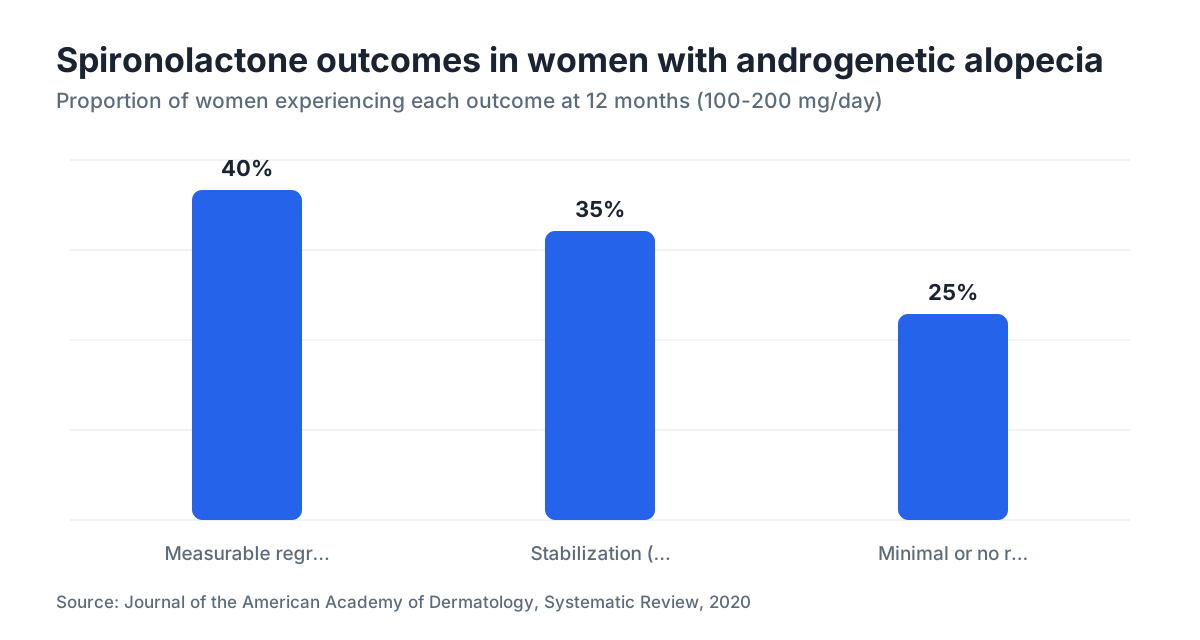
A 2020 systematic review in the Journal of the American Academy of Dermatology pooled the available studies and found roughly 30 to 50% of women with androgenetic alopecia had measurable regrowth on spironolactone, with a larger share seeing their loss stop [4]. Stopping the slide is underrated. If you were on track to lose another 30% of your density over three years, keeping what you have counts as a win.
The strongest single trial is newer. A 2023 randomized controlled trial in Trials tested spironolactone against minoxidil and the combination in women with female pattern hair loss, and both drugs improved hair growth over the study period [10]. The 2020 JAAD review put it plainly: spironolactone produced measurable regrowth in a meaningful minority and stabilization in more.
Dose seems to matter. Most of the positive data clusters around 100 to 200 mg per day. Lower doses give more scattered results.
Combining spironolactone with topical minoxidil looks better than either drug alone, based on clinical experience and smaller studies. A large head-to-head combo trial in women still hasn't been run. Many dermatologists prescribe both anyway.
What is the right spironolactone dosage for female hair loss?
The usual starting dose is 50 to 100 mg per day, taken once daily or split into two [3]. Dermatologists often begin low, watch how you tolerate it for 2 to 3 months, then move up toward 100 to 200 mg per day if side effects stay manageable and your blood pressure holds steady.
Most of the stronger efficacy data sits at the higher end, around 200 mg daily [4]. But that dose also brings more side effects, especially irregular periods and breast tenderness. A lot of women land at 100 to 150 mg as the practical middle ground.
Can't tolerate the pill? Compounding pharmacies can make topical spironolactone, usually 1 to 5% in a solution or cream. The topical form isn't FDA-approved and has far thinner data. A few small studies hint that it works, but nobody has run a large controlled trial. If oral side effects are the sticking point, it's fair to ask your dermatologist about it.
Adjust the dose with your doctor, never on your own. A blood pressure check and a basic metabolic panel to watch potassium make sense at baseline and after any dose increase.
How long does it take to see results?
Slowly. The hair growth cycle takes months to turn over, so patience isn't optional. Most dermatologists tell patients not to expect visible change before 4 to 6 months, and the fair point to judge the drug is 12 months.
That 12-month mark isn't padding. Miniaturized follicles have to cycle through the resting phase (telogen), then push out a new, thicker growing hair. No drug speeds up that clock.
What you may notice earlier, around 2 to 3 months, is less shedding. Fewer strands in the shower drain, fewer in the brush. That's often the first hint the drug is doing something. Real density gains show up later.
Zero change at 12 months? It's reasonable to call it. The drug isn't working well enough for you. Some women respond later than that, but most dermatologists would revisit the diagnosis or add a second drug at that point rather than keep waiting.
What are the side effects of spironolactone?
The most common side effect, by a wide margin, is menstrual irregularity. Spironolactone shifts progesterone and estrogen metabolism, so many premenopausal women get irregular cycles or breakthrough bleeding, especially above 100 mg [1][2]. Annoying, not dangerous. Many dermatologists pair it with an oral contraceptive in premenopausal women, which smooths out the cycle issue and covers the contraception that's required anyway.
It's a diuretic, so expect to urinate more, particularly in the first few weeks. Drink more water. Some women feel lightheaded standing up fast, which is orthostatic hypotension from the blood pressure drop. Starting low and taking the dose at night helps.
Breast tenderness and mild breast enlargement show up in a real minority, probably 5 to 10%, though the exact figure moves around by dose and study. Usually manageable, worth knowing about.
The hyperkalemia risk is real but uncommon in healthy young women with normal kidneys who aren't on other potassium-raising drugs [7]. In that group, some experts have questioned whether routine potassium checks add much. Let your prescriber make that call based on your situation, not a blanket rule.
Fatigue and lower libido come up less often. Plenty of women at 50 to 100 mg notice nothing at all.
Spironolactone vs finasteride for female hair loss: which is better?
Every woman with androgenetic alopecia should ask her dermatologist this. The honest answer is that no clean head-to-head trial settles it.
Finasteride blocks the 5-alpha reductase enzyme, which converts testosterone into DHT. Spironolactone blocks DHT at the receptor and also trims androgen production. Different routes, overlapping result.
In men, finasteride is well established and FDA-approved for hair loss. In women it's murkier. Finasteride is also teratogenic and also demands contraception in premenopausal women. And the evidence base for finasteride in women is actually smaller than for spironolactone. A 2020 review in Dermatology and Therapy found both drugs helped women with androgenetic alopecia, with spironolactone carrying the larger evidence base in women specifically [6].
Postmenopausal women are a different story. There, finasteride at 1 to 5 mg has reasonable evidence and is sometimes the pick. Spironolactone works too. Some dermatologists combine both in stubborn cases.
For most premenopausal women in the US, spironolactone is the more common first-line anti-androgen, mostly because its evidence base is deeper and many dermatologists know it better. Still, finasteride and minoxidil together is a rising approach that some clinicians reach for when spironolactone alone falls short.
Neither drug wins across the board. Your dermatologist should weigh your labs, your other medications, your menstrual status, and your risk tolerance.
Can you take spironolactone with minoxidil?
Yes, and many dermatologists suggest exactly that. The two work through separate mechanisms. Spironolactone quiets the androgen signal that shrinks follicles, while minoxidil (a vasodilator) stretches out the growth phase and is thought to improve blood flow to the scalp.
The pairing hasn't been tested in a large randomized trial built just for women, but retrospective data and everyday practice point to better results than either drug on its own [10]. If topical minoxidil isn't getting you far enough, adding spironolactone is the logical next move before anything more aggressive.
One practical flag: both drugs can lower blood pressure. Topical minoxidil is mostly local, but some of it does get absorbed. Oral minoxidil, which has taken off for hair loss, hits the whole system harder. If you're weighing oral minoxidil alongside spironolactone, your prescriber needs to talk through blood pressure monitoring with you.
There are no known dangerous interactions between spironolactone and topical minoxidil. In healthy women, the combination is considered safe.
What happens if you stop taking spironolactone?
The hair loss comes back. This catches a lot of patients off guard, and prescribers should say it out loud from the start.
Spironolactone doesn't rewrite the genetic sensitivity of your follicles to androgens. It suppresses the androgen signal only while the drug is in your system. Stop taking it, androgens re-engage those follicles, and miniaturization picks up where it left off. Most women see notable shedding within 6 to 12 months of stopping.
So this is a long-term commitment, not a fixed course with a finish line. That's not unique to spironolactone. Minoxidil behaves the same way. You're managing a chronic condition, not curing it.
If you do decide to stop, talk to your dermatologist about tapering instead of quitting cold. Some clinicians step the dose down gradually, though the evidence that tapering blunts the rebound shed specifically is thin. The bigger reason to taper is blood pressure: your body may have settled at a lower baseline, and stopping abruptly can cause rebound hypertension in people prone to it.
What types of female hair loss does spironolactone not treat?
Spironolactone works on androgen-sensitive hair loss. That's it. Take it for the wrong diagnosis and you burn 12 months on a drug that was never going to help.
Here's where it has no meaningful role:
Telogen effluvium is set off by physical stress, surgery, illness, a crash diet, or thyroid trouble. It isn't androgen-driven, and it usually clears once the trigger clears.
Scarring alopecias (lichen planopilaris, frontal fibrosing alopecia, CCCA) involve inflammation that destroys the follicle outright. Anti-androgens can't reverse that damage.
Alopecia areata is autoimmune. It needs immune-modulating treatment, not androgen blockade.
Nutrient deficiencies, especially low ferritin and iron, cause shedding that responds to fixing the deficiency, not to spironolactone.
This is why diagnosis has to come first. Understanding what causes hair loss in your specific case is step one, and a scalp biopsy is worth it if there's any doubt. Frontal fibrosing alopecia in particular gets mistaken for androgenetic alopecia early on.
When the loss has a real nutritional component, hair loss supplements aimed at the actual deficiency may matter alongside or instead of medication.
What should you know before your first appointment?
Show up with information. The more your dermatologist knows about your history, the faster they land on a good plan.
Bring the rough timeline of when you first noticed thinning, family history of hair loss on both sides, a full list of medications and supplements, any recent labs (thyroid, iron, ferritin, CBC), and photos if you have them. Before-and-after shots taken in the same lighting are underrated for tracking progress.
Expect a blood pressure check before you start. A metabolic panel to look at kidney function and potassium is standard, and doubly so if you have any kidney history or take other drugs that move potassium [7]. Some dermatologists run androgen labs too, though many skip it when the clinical picture is obvious.
If you can get pregnant, contraception is mandatory. Spironolactone is a Category D teratogen, meaning there's evidence of fetal risk [8]. Some dermatologists want proof of a contraception method before they prescribe. An oral contraceptive is often the cleanest fix, since it also settles the menstrual irregularity.
A DHT blocker comparison across spironolactone, finasteride, and newer options helps you see where spironolactone sits before you walk in. And for an objective baseline of your pattern, MyHairline's AI scan gives you a standardized read you can hand to your doctor or use to track yourself.
Sources
- Drugs.com, Spironolactone monograph (clinical pharmacology)
- FDA, Aldactone (spironolactone) prescribing information
- American Academy of Dermatology, Guidelines for androgenetic alopecia (2017)
- Journal of the American Academy of Dermatology, Systematic review: Spironolactone for female pattern hair loss (2020)
- NIH National Library of Medicine, MedlinePlus: Spironolactone
- Dermatology and Therapy, Review: Antiandrogens in female pattern hair loss (2020)
- NIH National Library of Medicine, MedlinePlus: Spironolactone
- FDA, Drugs section (drug safety and pregnancy risk information)
- American Academy of Dermatology, Female pattern hair loss overview
- Trials (BMC), Randomized trial of spironolactone, minoxidil, and combination for female pattern hair loss (2023)