

TL;DR: Postpartum hair loss (postpartum telogen effluvium) peaks around 3 to 4 months after delivery and stops shedding by month 6. Most women see full or near-full regrowth by 12 months postpartum. If shedding keeps going past 6 months, or regrowth hasn't started by 12 months, get a blood panel to rule out thyroid problems or low iron.
What is post-pregnancy hair loss and why does it happen?
During pregnancy, high estrogen keeps hair follicles locked in the growth phase (anagen) longer than usual. You shed less. Hair looks thicker. Then estrogen drops sharply in the weeks after delivery, and a big share of those follicles shift into the resting phase (telogen) at the same time. Two to four months later, those hairs fall out together. That's the clump in the shower drain.
The medical name is postpartum telogen effluvium. It's a normal physiological response, not a disease. The American Academy of Dermatology estimates that up to 50% of women notice postpartum hair loss, and it can start anywhere from one to five months after giving birth [1]. It looks alarming partly because hairs that would have shed gradually across nine months all come out in one concentrated window.
Postpartum shedding is the single most common trigger of telogen effluvium, so the full breakdown of telogen effluvium is worth reading to understand the mechanism.
When does postpartum hair shedding actually start?
Most women notice shedding start between 2 and 4 months postpartum, though some see it as early as 6 weeks or as late as 5 months [1]. Follicles don't all switch phases on the same day, so the timing spreads out. Stress, lost sleep, breastfeeding demands, and general recovery from delivery all nudge the timeline.
The classic pattern is a slow ramp. More hairs on the pillow. Then a lot more in the shower. Then it feels like handfuls. That escalation over a few weeks is the telogen wave moving through your scalp.
Shedding that starts the day after delivery is not typical postpartum effluvium. True telogen effluvium runs on a lag of roughly 2 to 3 months between the trigger and the visible shed [2]. An immediate post-delivery shed is a different conversation with your doctor.
When does postpartum hair loss peak?
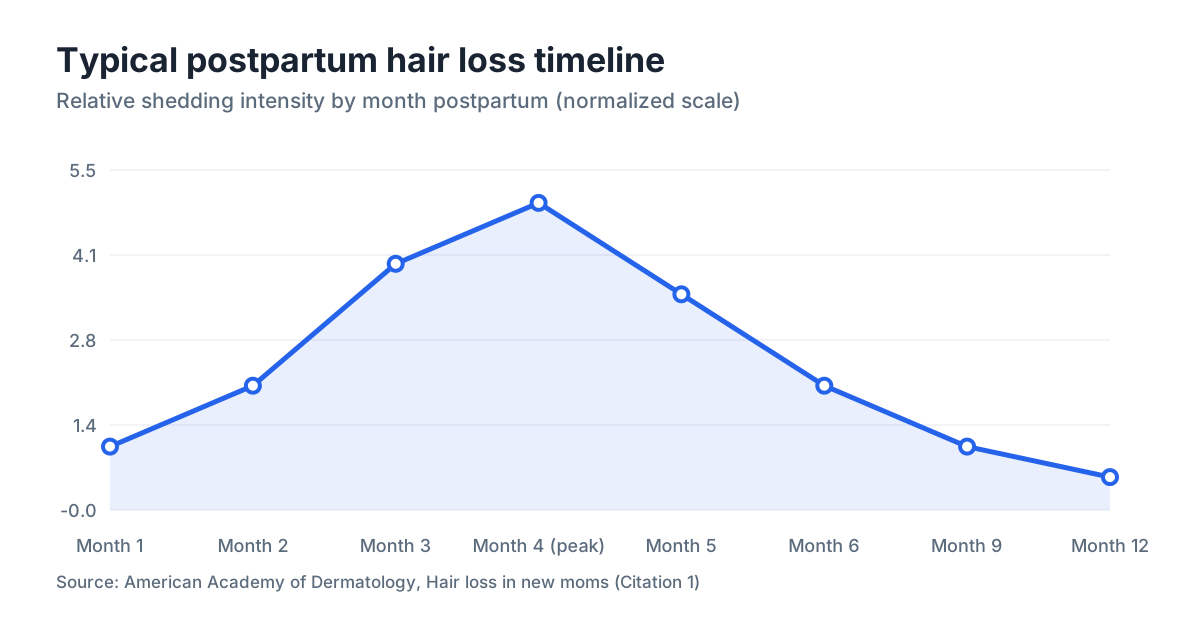
The shed peaks around 3 to 4 months postpartum [1]. At peak it can feel severe. Some women see scalp through the hair, or real thinning at the temples and the top of the head. The temples and frontal hairline show it most because those hairs are fine to begin with.
The peak lasts about 4 to 8 weeks. That window feels endless while you're in it, but it has a ceiling.
One benchmark to hold onto: if you're counting more than 150 to 200 hairs a day, consistently, over multiple days, and it's run longer than 2 to 3 months, book a doctor visit. Something may be riding alongside the effluvium, like thyroid dysfunction or low ferritin.
When does the shedding stop?
Postpartum shedding stops by month 6 for most women. By the time the baby hits 6 months, the shed has usually resolved and regrowth is visibly underway. The American Academy of Dermatology says most women see their hair return to normal fullness by their child's first birthday [1].
Some women, particularly those breastfeeding, find the shed lingers a bit longer, maybe into month 7 or 8. This probably tracks the hormonal shifts of lactation, though the evidence isn't solid.
A smaller group keeps shedding past 6 months. When that happens, the cause is usually something other than plain postpartum effluvium. The usual suspects: hypothyroidism (especially postpartum thyroiditis, which hits roughly 5 to 10% of postpartum women) [3], iron deficiency from delivery blood loss, or androgenetic alopecia that the hormonal drop unmasked [4]. None of these fix themselves the way classic postpartum effluvium does.
When will your hair fully grow back?
Regrowth starts as the shedding slows. Short, wispy hairs show up along the hairline and part line first, usually between months 4 and 6. By months 9 to 12, most women have close to their pre-pregnancy density back.
The catch is texture. Regrowth can feel slightly different from your original hair at first, and that's normal. Cycling through telogen and back into anagen can produce temporary shifts in curl, texture, or thickness. It usually settles over the next growth cycle.
Full recovery takes time because hair grows only about half an inch a month [5]. A new 3-inch hair needs roughly 6 months to get that long. So even after the shed stops at month 6, visible density takes several more months to show.
No regrowth by 12 months postpartum is a flag. So is regrowth that comes in notably thinner or finer than before pregnancy. Both are worth raising with a dermatologist, because either can signal a shift into pattern hair loss, and there are real treatments to discuss at that point.
What does the recovery timeline look like, month by month?
Here's an honest timeline built on the typical postpartum effluvium pattern [1][2]:
| Months postpartum | What's usually happening |
|---|---|
| 1-2 | Little to no unusual shedding; hair may still look full |
| 2-4 | Shedding begins, often gradually then more noticeably |
| 3-4 | Peak shedding, temples and hairline most affected |
| 4-6 | Shedding begins to slow; short regrowth hairs appear |
| 6-9 | Shedding has stopped for most women; regrowth continues |
| 9-12 | Density returning toward pre-pregnancy levels |
| 12+ | Full or near-full recovery expected in most cases |
This is a median, not a promise. Individual variation is real. But if your experience runs dramatically outside this window, specifically shedding that keeps going well past month 6 without slowing, that's the signal to get tested instead of wait.
What makes postpartum hair loss worse or last longer?
A few things stretch or intensify the shed beyond the typical window.
Iron deficiency is the biggest one. Delivery means blood loss, and postpartum iron stores can drop hard, especially in women who were already borderline before pregnancy. Low ferritin (stored iron) drives telogen effluvium on its own, delivery or not [4]. A ferritin below 30 ng/mL is tied to chronic telogen effluvium across multiple studies, and some dermatologists target above 70 ng/mL for hair recovery specifically. Ask your OB or GP to check ferritin, more than hemoglobin.
Postpartum thyroiditis affects 5 to 10% of women and usually shows up 1 to 6 months after delivery [3]. It can run hypothyroid or hyperthyroid, and both phases can drive shedding [10]. Request a TSH test at your postpartum checkup if the shed seems excessive.
Chronic stress, poor sleep, and aggressive postpartum dieting can all extend an effluvium episode. Your body needs resources to push hair back into anagen.
A genetic tendency toward androgenetic alopecia is the last one. The postpartum hormonal drop can unmask it. That pattern looks different from effluvium: diffuse thinning that doesn't recover, with miniaturization at the crown or a receding hairline rather than an acute shed that resolves.
Does breastfeeding make postpartum hair loss worse?
Probably not by much, but it's complicated.
Breastfeeding keeps prolactin elevated and holds some hormonal differences relative to women who don't nurse. Some women who breastfeed report the shed lasts longer, maybe into months 7 or 8 versus the more typical 5 to 6 month resolution. There's no large controlled trial pinning down that difference, so treat any precise claim about breastfeeding and shedding with real skepticism.
What breastfeeding clearly does is raise nutritional demand. Making milk burns roughly 500 extra calories a day. If you're not eating enough protein, iron, and zinc for both your needs and milk production, your hair notices. Protein deficiency is a known effluvium trigger [4]. Guidelines put protein around 65 to 71 grams a day during lactation [6].
One more thing. Don't wean specifically to slow hair loss. The hormonal shift from stopping can set off another round of shedding on its own.
What actually helps during postpartum hair loss?
Nothing has been proven to stop postpartum telogen effluvium faster. It resolves on its own because it's a physiological response to a hormonal event, not a disease.
There are still things worth doing, and things that mostly waste your money.
Worth doing: get ferritin tested and supplement iron if it's low. Eat enough protein. Sleep when you can. Use a wide-tooth comb, skip tight hairstyles that pull on follicles, and be gentle with your hair while it's fragile. A volumizing shampoo can make the hair you have look fuller, with no medical claim attached.
Weak evidence: biotin gets marketed hard for postpartum hair loss, but biotin deficiency is rare in anyone eating a varied diet. Biotin helps hair only if you're actually deficient [7]. High doses when you're not deficient do nothing for growth. The same caveat covers most hair loss supplements, which are largely unregulated and lean on low-quality evidence.
Minoxidil is FDA-approved for female pattern hair loss, but postpartum effluvium is a different condition. Applying topical minoxidil while breastfeeding needs specific medical guidance because safety data is thin. If your loss is still significant at 12 months postpartum and looks more like pattern loss than effluvium, that's a reasonable time to discuss minoxidil with a dermatologist. If you go that route, reading up on minoxidil side effects first is sensible.
Finasteride is off the table postpartum, especially while breastfeeding, given its mechanism as a DHT blocker and its established teratogenic risk.
To figure out which category your hair loss falls into, the free AI hair analysis at MyHairline can help you read your hairline pattern before you book a dermatology appointment.
When should you see a doctor about postpartum hair loss?
Most postpartum shedding needs no medical intervention. It stops on its own. See a doctor if:
- Shedding is severe and shows no sign of slowing by month 5 or 6
- You're still shedding heavily at month 6 or beyond
- You have other symptoms with the hair loss: fatigue, cold intolerance, rapid heartbeat, or unexplained weight changes (thyroid signs)
- Regrowth hasn't started by 9 to 12 months
- Hair is coming back miniaturized or in a patterned way rather than at normal thickness
- You're seeing patchy bald spots rather than diffuse shedding, which points to alopecia areata rather than effluvium
The blood tests worth asking for: TSH, free T4, ferritin, a complete blood count, and, if your doctor agrees and pattern loss is suspected, total and free testosterone. These are straightforward and often covered at a postpartum visit.
A dermatologist can also run trichoscopy (dermoscopy of the scalp) to check for miniaturization and tell resolving effluvium apart from early androgenetic alopecia. That distinction matters, because the treatment paths split.
What if your hair never fully came back after a previous pregnancy?
Some women notice their hair didn't return to pre-pregnancy density after a first or second delivery. Take that seriously.
A few explanations. The effluvium may have been complicated by untreated iron deficiency or thyroid dysfunction that nobody caught, so the ongoing deficiency kept driving shedding. Or the pregnancy hormonal drop unmasked underlying female pattern hair loss (androgenetic alopecia), which doesn't reverse on its own the way effluvium does.
Androgenetic alopecia in women usually shows as diffuse thinning at the crown and a widening part, not the frontal recession more common in men. It's driven by DHT sensitivity at the follicle and typically needs treatment to stop progressing. The bigger picture is covered in what causes hair loss.
If that's you, a dermatology referral is the right next step. Topical minoxidil is FDA-approved for women with androgenetic alopecia and has a real evidence base [8]. For severe cases that don't respond to medication after adequate trials, a consultation about hair transplant options is reasonable, though most surgeons want the loss to stabilize first.
Tracking your hairline over time with the MyHairline AI scan gives you a baseline to compare against before your appointment.
Does post-pregnancy hair loss happen with every pregnancy?
Usually, yes. Postpartum telogen effluvium tends to recur with each pregnancy because the trigger, a sharp postpartum estrogen drop, repeats every time. Some women say it's more noticeable with later pregnancies, possibly because cumulative nutritional depletion across multiple pregnancies and nursing periods leaves fewer reserves.
If you're planning another pregnancy and had a rough postpartum shed before, go in with iron stores and nutrition in good shape. There's no guarantee it changes the outcome, but it's a reasonable precaution.
One more thing worth knowing: stopping hormonal birth control can trigger a similar effluvium for the same reason, an estrogen drop that shifts follicles into telogen. So a woman who restarts and then stops contraception soon after delivery can hit two effluvium episodes close together.
Sources
- American Academy of Dermatology Association, Hair loss in new moms
- StatPearls (NCBI Bookshelf), Telogen Effluvium
- American Thyroid Association, Postpartum Thyroiditis
- Journal of the American Academy of Dermatology, Trost LB et al., The diagnosis and treatment of iron deficiency and its potential relationship to hair loss
- National Institutes of Health, National Library of Medicine (NCBI Bookshelf), Hair and nail growth
- National Academies of Sciences, Engineering, and Medicine, Dietary Reference Intakes for Energy, Carbohydrate, Fiber, Fat, Fatty Acids, Cholesterol, Protein, and Amino Acids
- National Institutes of Health Office of Dietary Supplements, Biotin Fact Sheet for Health Professionals
- American Academy of Dermatology Association, Female pattern hair loss diagnosis and treatment
- American Academy of Dermatology Association, Causes of hair loss
- MedlinePlus (NIH National Library of Medicine), Postpartum thyroiditis