
TL;DR: Hard water (water high in calcium and magnesium) makes hair brittle, increases breakage, and can trigger temporary shedding. It does not cause permanent, follicle-level hair loss like androgenetic alopecia. A 2016 randomized controlled trial of 70 men found no significant difference in hair tensile strength between hard and soft water after 30 days. The hairs hard water costs you are broken ones, not dead roots.
What is hard water and how common is it?
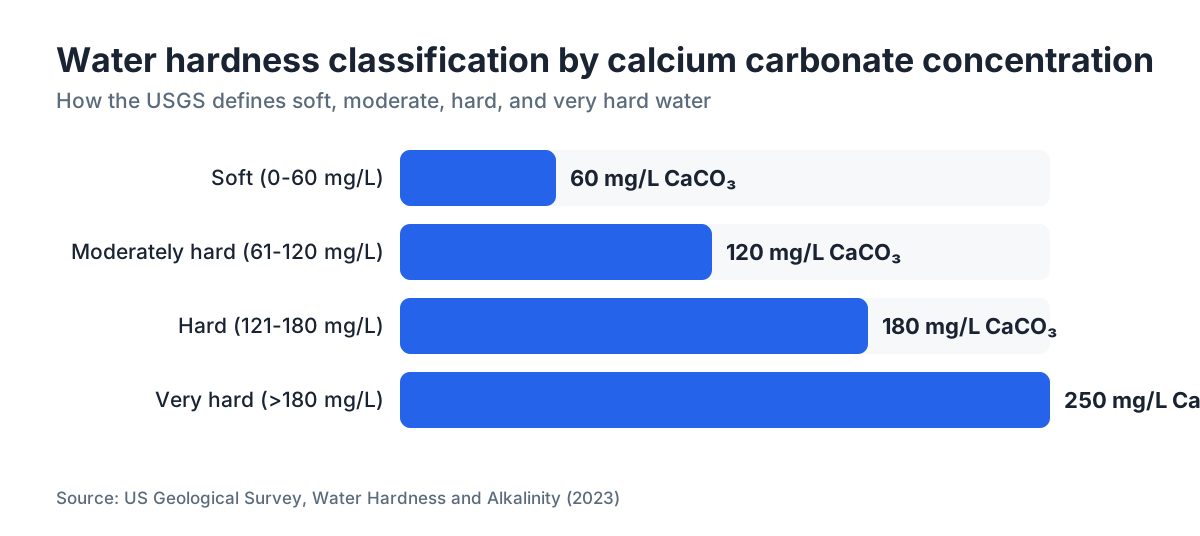
Hard water is water carrying elevated concentrations of dissolved minerals, mostly calcium and magnesium bicarbonates. The US Geological Survey grades hardness by the milligrams of calcium carbonate dissolved per liter: soft water runs below 60 mg/L, moderately hard sits between 61 and 120 mg/L, hard falls between 121 and 180 mg/L, and very hard exceeds 180 mg/L. [1]
About 85 percent of American homes get hard water, according to the USGS. So most people reading this are washing their hair in hard water every single day. The worst regions are the Southwest, the Great Plains, and the Midwest, where groundwater filters through limestone and chalk. Coastal cities pulling from surface reservoirs usually have softer water.
The minerals are harmless to drink. The question is what they do sitting on your scalp and hair shaft.
Does hard water actually cause hair loss?
Probably not permanent hair loss. It can make things worse cosmetically and set off temporary shedding, and those two things get confused with real loss all the time.
The strongest study on this is a 2016 randomized controlled trial in the Journal of Cosmetic Science. Researchers had 70 male volunteers wash their hair for 30 days in either hard water or deionized soft water, then measured tensile strength (the force it takes to break one strand) and elasticity. They found no statistically significant difference between the groups. [2] That is the closest thing to a definitive experiment, and it is not alarming news.
A 2014 study in the International Journal of Dermatology compared hair immersed in hard water versus distilled water and did find reduced tensile strength and rougher cuticles under a scanning electron microscope. [3] But soaking hair in a lab dish is not a 30-day real-world wash cycle, which is why the 2016 trial carries more weight.
Both studies agree on one thing: hard water changes the surface of the shaft. Calcium coats the cuticle, roughens it, and makes hair tangle. Tangled hair breaks when you brush it. That breakage lands in your drain and can look exactly like hair loss. It is not follicular miniaturization from androgens, and it does not produce the receding pattern of androgenetic alopecia.
The scalp is where the story gets murkier. Some evidence suggests mineral buildup can disrupt the skin barrier and feed seborrheic dermatitis, which inflames the area around the follicle. Chronic scalp inflammation is a genuine, if secondary, driver of telogen effluvium style shedding. Nobody has clean trial data quantifying that pathway for hard water specifically, so treat it as plausible rather than proven.
How does hard water damage hair differently from causing hair loss?
Hair loss and hair damage are two different problems, and the difference is the whole point here.
Real hair loss means the follicle stops making a terminal fiber or makes a thinner, shorter one each cycle. That is what DHT blockers like finasteride target, because the driver is hormonal shrinkage. Hard water does not touch the follicle.
Hard water damage is a shaft problem, not a root problem. Here is the mechanism. Calcium and magnesium ions bind to negatively charged proteins on the cuticle. Over time that builds a mineral film that stiffens the cuticle scales and stops them lying flat. Rough scales snag on each other, create friction, and break. High-pH hard water also swells the cuticle, which piles on the roughness.
The result is hair that feels dry, looks dull, tangles, and breaks more than it should. Move from a soft-water city to a hard-water one and you may see more hairs in the drain. That uptick is real. But those broken fibers are not miniaturized hairs from dying follicles. With time and better water (or a good chelating shampoo), the hair usually recovers.
The table below sets hard water damage next to the two main causes of real hair loss so you can see the split at a glance.
Hard water vs. other causes of hair loss: a quick comparison
| Factor | What it damages | Reversible? | Proven treatment |
|---|---|---|---|
| Hard water | Hair shaft (cuticle) | Yes, with soft/filtered water or chelating shampoo | Chelating shampoo, water softener |
| Androgenetic alopecia (genetic) | Follicle (miniaturization via DHT) | Partial, if caught early | Minoxidil, finasteride, hair transplant |
| Telogen effluvium (stress/nutritional) | Hair cycle (pushes hairs into rest phase) | Yes, once trigger removed | Address root cause, sometimes minoxidil |
Not sure which category your shedding falls into? The pattern and timeline are your best clues. Hard water breakage is diffuse, shows up as shorter broken pieces rather than full hairs with a white root bulb, and tracks with moving to a new place or changing water source. Androgenetic alopecia has a pattern, front and top in men, diffuse crown in women, and it progresses no matter where you live. Telogen effluvium typically follows a stressful event by two to four months, then recovers.
Working out what causes hair loss in your specific case comes before you spend a dollar on anything.
What does the scalp science say about mineral buildup?
The scalp is skin, and skin reacts to chronic mineral exposure in ways the shaft research does not capture.
A 2010 study in the International Journal of Trichology measured calcium and magnesium in scalp biopsies and found higher mineral deposits in patients with scalp disorders than in controls. [4] The researchers noted that calcium-rich conditions can disrupt keratinocyte differentiation, which changes how the scalp sheds dead cells. When shedding slows or turns irregular, you get the flaking and seborrheic buildup that clogs follicular openings.
None of that proves a direct line from hard water to follicular death. But the barrier-disruption angle is real enough that dermatologists treating seborrheic dermatitis in hard-water regions sometimes add a water softener alongside medicated shampoos, not as a cure on its own.
The American Academy of Dermatology does not list hard water as a confirmed cause of hair loss in its public guidance. [5] That is a useful calibration point when you see hard water blamed for everything online.
How can you tell if hard water is affecting your hair?
A handful of observable clues point at hard water rather than something more serious.
Start with geography. The USGS keeps a national water hardness map. If you live in Phoenix, Las Vegas, or anywhere in the Texas panhandle, your water is very likely above 200 mg/L calcium carbonate. [1]
Next, look at what you are actually losing. Short hairs snapped mid-shaft with no white bulb at the root end are breakage, not shedding. Full hairs with a white translucent bulb at the base came from the root, which is the kind you see in telogen effluvium or androgenetic alopecia.
Third, run a cheap test. The USGS notes that hard water leaves white scaly deposits around faucets and makes soap lather poorly. Crusty showerhead, shampoo that barely foams? You have hard water.
Fourth, watch the timing. Did your shedding or texture shift when you moved, or after weeks somewhere else? That location correlation points at water quality far more than genetics or hormones ever would.
If none of these match and you are seeing real thinning (scalp showing through, hairline creeping back), that needs a closer look. MyHairline's free AI hair scan at /scan maps your current hairline and tracks changes over time, so you get an actual baseline before you spend money on treatments.
Can a water softener or filter fix hair loss from hard water?
If hard water is genuinely driving your breakage, a water softener works. That part is not up for debate.
Ion-exchange softeners swap calcium and magnesium for sodium ions, which do not deposit on the shaft. A whole-house softener typically costs $800 to $2,500 installed, depending on system size and local labor. A showerhead filter using a KDF media stage runs $20 to $80 and needs cartridge changes every three to six months. Neither range comes from a single authority; they reflect what you find across plumbing retailers, and prices swing hard by brand and region.
Showerhead filters are the easier place to start. They cut mineral content at the point of use without raising drinking-water sodium, which matters if you are on a low-sodium diet or have certain heart conditions.
Don't want to touch the plumbing? A chelating shampoo is the most studied topical fix. Chelating agents (EDTA is the common one) bind mineral ions and strip them off the shaft. A 2022 review in Skin Appendage Disorders concluded that chelating shampoos meaningfully reduce mineral buildup when used regularly, though it flagged that most supporting studies were industry-funded. [6]
What will not fix it: standard clarifying shampoos. Those strip product buildup with surfactants, but calcium and magnesium ions need a chelating agent specifically.
And if your shedding keeps going after you switch water or add a chelating shampoo, the water was probably not the main driver.
Are there any proven treatments if hard water is part of the problem?
Hard water damage responds to mechanical and chemical fixes. Real hair loss, if it is happening at the same time, needs entirely different tools.
For the shaft side, a chelating shampoo followed by a protein-containing conditioner covers most of what you can do topically. Leave-in conditioners with cationic surfactants (look for ingredients ending in -trimethylammonium chloride) help by smoothing lifted cuticles temporarily.
For follicle-level loss, the FDA-approved options are minoxidil (topical and oral) and finasteride (for men). These work on the follicle, not the water. [7] If your dermatologist finds androgenetic alopecia sitting alongside hard water damage, treating the water fixes cosmetic texture while treating the follicle preserves the actual hair count. Two problems, two solutions.
The combination of finasteride and minoxidil is the most evidence-backed medical approach to androgenetic alopecia. Hair transplants are the surgical route for advanced cases. Neither is needed if your only issue is mineral buildup on the shaft.
If you are eyeing hair loss supplements, no supplement has been shown in rigorous trials to reverse hard-water breakage specifically. Biotin gets marketed for hair quality constantly, but the evidence for biotin in people without a deficiency is weak.
One more thing to track: on minoxidil, hard water may reduce how well the topical absorbs, because mineral deposits on the scalp can interfere with penetration. Wash with a chelating shampoo before applying minoxidil if your water is very hard. That is a practical tip, not a proven protocol, but it is mechanistically sensible.
Does hard water affect men and women differently?
The biology is identical regardless of sex. Calcium and magnesium do not discriminate.
What differs is how much it gets noticed. Longer hair means more cumulative water exposure across the shaft. Hair down to the shoulders has strands two to four years old at the tips, washed in hard water hundreds of times. The breakage and dullness stack up in a way that shows far more than on someone with short hair who trims often.
For men watching a receding hairline, hard water often takes the blame for something almost certainly genetic. Androgenetic alopecia in men follows the Norwood scale and starts at the temples and crown, not diffusely across the scalp. Hard water breakage is diffuse. If your hairline is moving back in a defined pattern, hard water is almost certainly not the cause, and you need a different conversation.
Women tend to catch hard water effects sooner, because they expect a certain texture and investigate when it changes. That is not a knock. It is useful. Catching the split between shaft damage and real thinning early is what saves money.
What else could be causing your hair shedding?
Ruled out hard water and still shedding? The list of real contributors runs long.
Androgenetic alopecia is the most common cause of hair loss in both sexes, affecting roughly 50 percent of men by age 50 and about 40 percent of women by age 70, according to NIH MedlinePlus. [9] It is genetic and driven by DHT's effect on susceptible follicles.
Telogen effluvium is the second most common type. It is temporary, diffuse shedding that shows up two to four months after a stressor like illness, surgery, crash dieting, childbirth, or severe psychological stress. Most cases clear on their own within six months.
Nutritional deficiencies, especially low ferritin (stored iron), low zinc, and low vitamin D, are documented contributors to diffuse loss. A simple blood panel from your GP catches these.
Scalp conditions including seborrheic dermatitis, psoriasis, and tinea capitis (fungal infection) can all cause hair loss if left untreated. These need a dermatologist's eyes.
Some medications list hair loss as a side effect. Started a new drug and noticed shedding two to three months later? That timing is a clue. Check the FDA prescribing information for your medication. [7]
The most useful move if you are genuinely worried: document what you see, photograph your part width and hairline the same way each time, and bring the record to a dermatologist or trichologist. Patterns over time beat any single glance in the mirror.
The bottom line on hard water and hair loss
Hard water is real, the damage is real, and the frustration of bad hair days in a hard-water city is completely legitimate.
Calling it a cause of hair loss overstates the evidence. The best controlled trial found no significant difference in tensile strength after 30 days of hard versus soft water washing. [2] Hard water damages the shaft. It does not reliably kill follicles. The hairs it costs you are broken ones, not dead roots.
Switch to a chelating shampoo or a shower filter and the shedding stops? Good. You had a water problem. If shedding continues or you see a receding pattern, you have a different problem and deserve a different answer.
MyHairline's free AI scan at /scan is a reasonable place to start if you want to track your hairline over time and see whether what you are watching matches androgenetic alopecia. It does not replace a dermatologist. It gives you something concrete to hand one.
Spending money on hard water fixes when you have androgenetic alopecia is the wrong move. Spending money on finasteride and minoxidil when you have a mineral buildup problem is also the wrong move. Getting the diagnosis right first is the only thing that makes the rest sensible.
Sources
- US Geological Survey, Water Hardness and Alkalinity
- Journal of Cosmetic Science, Srinivasan et al. 2016, Effect of hard water on hair
- International Journal of Dermatology, Luqman et al. 2014, Hair and hard water
- International Journal of Trichology, Mamtora & Bhatt 2010, scalp mineral deposits
- American Academy of Dermatology, Hair Loss overview
- Skin Appendage Disorders, review on chelating shampoos and mineral buildup, 2022
- FDA, Drug approvals and databases
- National Institutes of Health, MedlinePlus, Androgenetic alopecia