TL;DR: The FDA-approved dose for male pattern hair loss is 1 mg finasteride a day. The 10 mg dose isn't approved for anything, including the prostate condition finasteride treats at 5 mg. Taking ten times the hair-loss dose doesn't grow more hair. At 1 mg, scalp DHT is already suppressed about 64%, near the practical ceiling. More drug means more side-effect risk, no extra benefit.
What is the approved finasteride dose for hair loss?
The FDA-approved dose for male pattern hair loss is 1 mg of oral finasteride a day, sold as Propecia and approved in 1997 [1]. That approval rested on randomized, placebo-controlled trials showing 1 mg daily raised hair counts and slowed loss over two to five years. The 5 mg tablet (Proscar) came earlier, in 1992, for benign prostatic hyperplasia [2]. No dose of 10 mg is approved for anything.
So a question about 10 mg is already off-label twice over. It's not that regulators studied 10 mg and cleared it for hair. They never approved it because there was never a clinical reason to. The absence of approval isn't a technicality here. It reflects an absence of any data showing the higher dose does something 1 mg doesn't.
Why was 1 mg chosen instead of a higher dose?
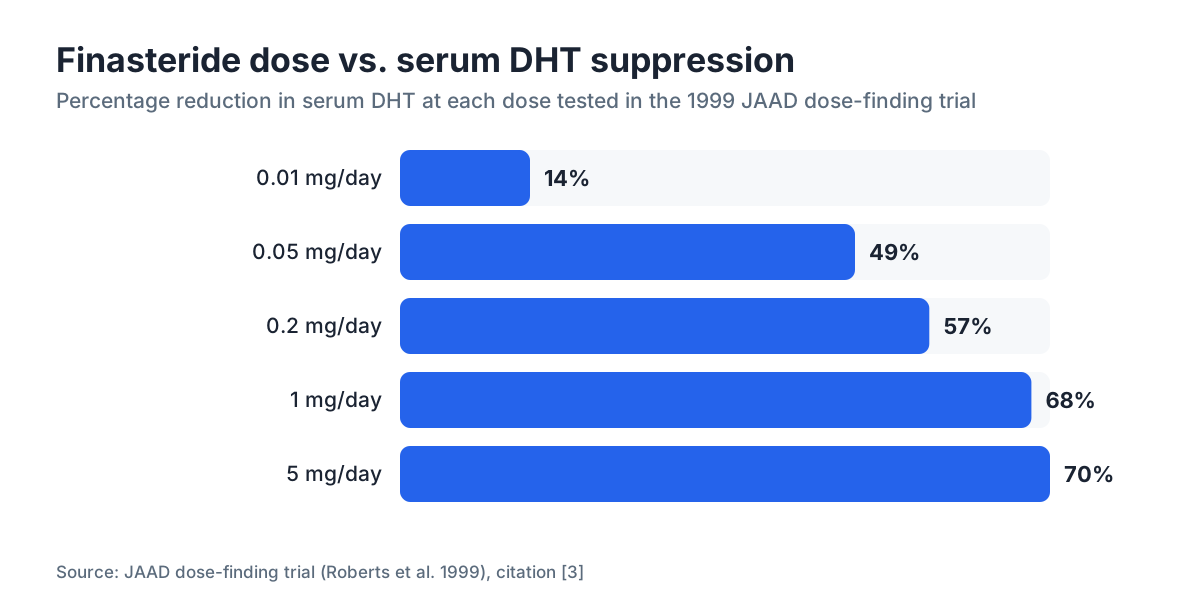
Because the dose-response curve for hair growth goes flat at 1 mg. A dose-finding study published in the Journal of the American Academy of Dermatology in 1999 tested 0.01 mg, 0.05 mg, 0.2 mg, 1 mg, and 5 mg daily in men with androgenetic alopecia and measured scalp DHT and hair counts at 42 weeks [3].
At 1 mg, scalp DHT dropped about 64% and serum DHT about 68%. At 5 mg, serum DHT fell about 70%. That's a two-point difference for five times the drug. Hair counts followed the same shape: barely any gap between 1 mg and 5 mg, and nothing above 1 mg worth chasing.
The mechanism explains why. Finasteride blocks the type II 5-alpha reductase enzyme that turns testosterone into dihydrotestosterone (DHT). At 1 mg, the follicle already sits in a low-DHT environment. You can't suppress DHT past 100%, and by 1 mg you've captured most of what enzyme inhibition can give a follicle. Pushing to 5 or 10 mg deepens the number in your blood a little and changes the follicle almost not at all.
If you want the full picture of how finasteride acts on DHT, including the split between type I and type II inhibition, that piece walks through the enzyme mechanism.
Does 10 mg finasteride work better for hair loss than 1 mg?
No. No published randomized trial has shown 10 mg finasteride beats 1 mg for male pattern hair loss. The dose-finding data, and the 1999 JAAD trial specifically, found no meaningful hair count gain above 1 mg [3]. Studies comparing 1 mg to 5 mg landed the same way: similar results, more side effects at the higher dose.
The ceiling effect is the whole story. Miniaturization in androgenetic alopecia comes from cumulative DHT exposure. Cut scalp DHT by 60 to 70% and the follicles still able to respond have gotten most of the help enzyme inhibition offers. The ones too far gone to recover won't come back whether DHT falls 65% or 85%.
There's one place clinicians reach for higher doses off-label: women with pattern hair loss, where 2.5 mg or 5 mg sometimes gets prescribed because the dosing evidence in women is thin and some prescribers suspect more is needed. Even there, nobody studies 10 mg, and finasteride carries a hard contraindication for women who are or may become pregnant because of the risk to a male fetus [1].
So 10 mg isn't stronger medicine. It's a bigger dose of a drug whose hair benefit already leveled off well below it.
What are the side effects of taking too much finasteride?
More finasteride means more systemic DHT suppression, and that's where the risk sits. The Propecia (1 mg) label lists sexual side effects, decreased libido, erectile dysfunction, and ejaculatory disorder, in 1.8 to 3.7% of men in trials, with rates running higher in the 5 mg BPH studies [1][2]. Ten milligrams wouldn't scale that risk in a clean, predictable way, but you'd be feeding more drug through a pathway that already produces these effects at 1 mg.
The bigger worry at any dose is post-finasteride syndrome (PFS): persistent sexual, neurological, and psychological symptoms some men report after quitting. The FDA revised the Propecia label in 2012 to add persistent sexual dysfunction after discontinuation [1]. How often it happens is genuinely disputed in the literature, but the signal convinced the FDA to change the label. The mechanism still isn't understood.
DHT isn't purely a problem hormone, either. It has jobs in red blood cell production, bone density, and mood. What years of very deep DHT suppression does to a young man's body hasn't been mapped.
Other reported effects across finasteride studies include gynecomastia (breast tissue growth), breast tenderness, and depression. A 2017 study in JAMA Internal Medicine linked finasteride use to higher rates of depression diagnosis, though it was observational and can't prove cause [4].
If you're comparing finasteride against alternatives, the dht blocker article lines up finasteride next to other DHT-blocking approaches and their side-effect profiles.
What about the 5 mg dose, is that a reasonable middle ground?
For most men it isn't a middle ground, it's a cost hack. Generic 5 mg finasteride tablets cost much less per milligram than 1 mg tablets, so some patients split a 5 mg tablet into quarters to land near 1.25 mg for less money. This is off-label but widely discussed. A smaller group of dermatologists prescribe full 5 mg doses to patients who didn't respond to 1 mg, though the evidence that it rescues non-responders is weak.
Cutting tablets adds imprecision. Finasteride tablets aren't scored for quartering, and the dose per piece drifts. If you're thinking about it, have that conversation with a prescriber, not a comment section.
Eight milligrams, ten milligrams, anything above 5 mg is uncharted for hair loss. No rationale, no trial data, no approval.
How does finasteride compare to other doses and treatments at a glance?
Here's the data across finasteride doses and the treatment most often stacked with it:
| Treatment | Approved dose (hair loss) | DHT suppression | Hair count benefit vs. placebo | Notes |
|---|---|---|---|---|
| Finasteride 0.2 mg | Not approved | ~57% serum [3] | Below threshold | Dose-finding only |
| Finasteride 1 mg | FDA-approved | ~68% serum, ~64% scalp [3] | +9-14% hair count at 1 year [1] | Standard of care |
| Finasteride 5 mg | Approved for BPH only | ~70% serum [3] | Not significantly better than 1 mg | Off-label for hair loss |
| Finasteride 10 mg | Not approved for any hair use | Unknown (estimated >70%) | No RCT data for hair | No clinical rationale |
| Minoxidil 5% topical | FDA-approved (men) | No DHT effect | ~18-25% increase in hair weight [5] | Different mechanism, combines well |
Read the DHT column top to bottom. Between 1 mg and 5 mg, suppression moves about two percentage points. Ten milligrams might nudge it higher still, but you spent most of the biological opportunity at 1 mg.
Can women take 10 mg finasteride?
No. Finasteride is contraindicated in women who are pregnant or may become pregnant because it can cause genital abnormalities in a male fetus [1]. The label carries a specific warning, and the drug holds a Pregnancy Category X rating, meaning the risk clearly outweighs any benefit during pregnancy.
For postmenopausal women with pattern hair loss, some dermatologists prescribe finasteride off-label at 1 mg to 5 mg, and a few small trials show modest benefit. The evidence is thinner than for men. Ten milligrams has no studied or defensible role in women.
Women have other options worth a look, including topical minoxidil for men data that maps onto women too (the FDA approved a 2% solution for women in 1991), plus low-dose oral minoxidil, which has a growing evidence base.
What happens if you accidentally take 10 mg finasteride once?
A single accidental 10 mg dose is unlikely to cause acute harm. Finasteride has a wide margin for one-time exposures. Someone who mistakenly takes two 5 mg tablets, or ten 1 mg tablets, in a single slip isn't in the danger you'd face taking ten times a blood thinner dose.
Still, call your pharmacist or physician to report it, and call Poison Control (1-800-222-1222 in the US) if you're unsure. The real concern with finasteride is chronic cumulative exposure, not one bad morning.
Deliberate self-escalation is the riskier pattern: men who decide more is better and run 5 mg, 10 mg, or higher for weeks. The sexual and hormonal effects track with higher doses in the BPH data, and nobody has characterized what daily 10 mg does to a young man's endocrine system over years.
Is there any research on high-dose finasteride in prostate cancer?
Yes, and it shows what aggressive finasteride dosing really involves. The Prostate Cancer Prevention Trial gave 5 mg daily for seven years to men over 55 [6]. It cut prostate cancer prevalence by 24.8% but showed a higher rate of high-grade tumors in the finasteride group, which set off years of regulatory debate. The FDA updated the Proscar label in 2011 to note the high-grade prostate cancer risk [2].
Some prostate research has gone above 5 mg, but that's a different patient population, a different risk-benefit math, and close medical supervision. None of it justifies a hair loss patient taking 10 mg.
The trial is also a reminder that finasteride is a real systemic drug, not a cosmetic supplement. Men treat it casually because it's been around since the 1990s and gets prescribed constantly. Longevity on the market doesn't make higher doses safe.
What should you actually do if 1 mg finasteride isn't working?
This is the fork in the road, and dose escalation is the wrong turn. If you've run 1 mg for six to twelve months with no results, the first honest question is whether you actually have androgenetic alopecia. Other causes, telogen effluvium, alopecia areata, nutritional deficiency, thyroid problems, can mimic pattern loss and won't answer to finasteride at any dose.
With the diagnosis confirmed, the better next step is adding topical or oral minoxidil, since it works through a mechanism unrelated to DHT and the effects look additive in trials. The finasteride and minoxidil article covers the actual combination data.
For men who can't tolerate finasteride or don't respond, dutasteride blocks both type I and type II 5-alpha reductase and suppresses serum DHT roughly 90 to 95% at 0.5 mg, against finasteride 1 mg's 68% [7]. Dutasteride isn't FDA-approved for hair loss in the US (it is approved in Japan and Korea for this) but gets prescribed off-label by some dermatologists. That's a more rational escalation than more finasteride.
If medical therapy has truly failed after a fair trial, a hair transplant consultation is worth having. A transplant doesn't stop future loss, which is why most surgeons keep patients on medical therapy afterward, but it can restore density where follicles are gone.
Want an objective baseline before you decide anything? MyHairline's free AI hair scan (/scan) reads your current pattern and stage, which gives you a cleaner starting point for a provider conversation.
How do you talk to a doctor about finasteride dosing concerns?
Be direct. Tell your provider you've read about dosing and want to know why 1 mg is the target, what monitoring they'd do, and what the plan is if you stop responding. Any clinician comfortable treating androgenetic alopecia can walk you through that without getting defensive.
Good questions: Will you check my hormone levels? Which side effects should make me call you? How long before we reassess this dose? Is dutasteride on the table if this fails?
If a provider recommends 10 mg finasteride for hair loss without a specific clinical reason you can follow, get a second opinion. It falls outside the evidence-based standard of care for pattern hair loss.
You can also check the labeling yourself. The Propecia label is public in the FDA's drug database at Drugs@FDA [1], and the clinical trial section takes about ten minutes to read. The data isn't hard.
Sources
- FDA, Propecia (finasteride 1 mg) prescribing information, via Drugs@FDA
- FDA, Proscar (finasteride 5 mg) prescribing information, via Drugs@FDA
- Journal of the American Academy of Dermatology, Roberts et al. 1999 dose-finding study
- JAMA Internal Medicine, Nguyen et al. 2017, finasteride and depression
- FDA, Rogaine (minoxidil 5%) drug information, via Drugs@FDA
- New England Journal of Medicine, Thompson et al. 2003, Prostate Cancer Prevention Trial
- Journal of the American Academy of Dermatology, Olsen et al. 2006, dutasteride vs finasteride
- American Academy of Dermatology, clinical guidelines for androgenetic alopecia
- FDA, Drug Safety and Availability
- National Library of Medicine, MedlinePlus, finasteride drug information