TL;DR: Apply topical minoxidil to a dry scalp. The FDA-approved label and manufacturer instructions both say so. A wet scalp dilutes the solution, slows absorption, and sends more of the drug dripping onto your face and pillow. Your scalp doesn't need to be bone-dry for hours, but it should be genuinely dry when you apply. Then wait at least 4 hours before washing.
What do minoxidil's official instructions actually say about hair and scalp dryness?
Apply to a dry scalp. That's the instruction on every FDA-approved version of this drug. The Rogaine 5% topical solution label reads: "Before applying, shampoo and thoroughly dry your hair and scalp." [1] The word "thoroughly" is doing real work there. The label isn't telling you to towel-blot and go. It's telling you the scalp should be genuinely dry before the dropper touches it.
The foam labels (Rogaine 5% topical foam) say the same thing: apply to a dry scalp. [1] Both formats carry that line because the pharmacology makes it non-negotiable if you want the drug to work.
Some people read "dry scalp" and assume it means dry everywhere. It doesn't. A slightly damp hair shaft is far less of a problem than wet scalp skin. The scalp is where the drug absorbs. If the skin itself is wet, you're working against yourself.
Why does a wet scalp actually reduce how much minoxidil gets absorbed?
Minoxidil crosses into skin by passive diffusion, and a wet scalp fights that process on two fronts. The formulation is built with set concentrations of propylene glycol (in solutions) or alcohol and water (in foams) to push the drug across the stratum corneum at a predictable rate. [2] Wet the scalp and both the concentration and the driving force drop.
First, dilution. The vehicle (the liquid carrier) is tuned to a precise drug concentration. Water from wet hair mixes into it on contact, cutting the effective concentration before absorption even starts.
Second, the gradient. The drug wants to move from high concentration (the formulation) to low concentration (the tissue below the skin). Wet skin has higher surface water activity, which partially closes that gradient and slows the whole thing down.
A 2004 penetration-enhancer review in the Journal of Investigative Dermatology describes propylene glycol, the main penetration enhancer in minoxidil solution, working best across an intact, dry stratum corneum. [2] This isn't a subtle effect. It's the reason every version of the drug says to use it on dry skin.
Here's the practical version: wait 20 to 30 minutes after a shower before you apply. That dries most scalps. If you blow-dried, apply right away, but give the scalp two or three minutes to cool first, because heat can sting on contact.
Does it matter whether you use minoxidil solution vs. minoxidil foam when hair is damp?
Yes. Foam is a little more forgiving on a slightly damp head, but neither one is meant for a wet scalp.
Minoxidil solution contains propylene glycol, a liquid that mixes with water instantly. Apply it to a damp scalp and it runs, spreads unevenly, and dilutes on contact.
Foam behaves differently. It collapses into liquid when it hits the warmth of your scalp, but it starts as a semi-solid that sits on the skin for a few seconds before soaking in. That short delay means a little residual dampness causes less immediate dilution. "A little more forgiving" is not "safe on wet hair," though. On a genuinely wet scalp, absorption suffers with both.
If propylene glycol in the solution irritates your scalp, the minoxidil for men guide breaks down foam vs. solution in more detail. The dryness rule holds for both.
How long should you wait after washing your hair before applying minoxidil?
Twenty to 30 minutes of air-drying after a towel-dry works for almost everyone. Blow-dry instead and you can apply right away. There's no single universal number because drying time depends on hair density, hair length, humidity, and whether you use a dryer.
The reliable test beats any clock: touch your scalp at the spot you're about to treat. Damp means wait. Dry to the touch means go.
Some dermatologists suggest washing at night, letting hair dry, and applying right before bed. That routine also buys the drug a full 4-hour absorption window before you're near water again, which is what the FDA label asks for. [1]
Things that shorten the wait: a blow dryer on low heat, a well-ventilated room, a vigorous towel-dry followed by 15 minutes in most climates. Things that stretch it: thick or long hair, high humidity, conditioner (it can leave a film on the scalp), and cold air.
Can wet hair increase the risk of minoxidil side effects?
Yes, in one specific way: runoff. When minoxidil solution runs, it doesn't only dilute, it travels. On a dripping-wet head, the drug can migrate down onto your forehead, temples, and neck. Minoxidil absorbed through facial skin can grow hair where you don't want it. That's a documented side effect, not a theory. [3]
Foam was partly designed to solve this. It stays put better than solution. But solution on wet hair is a runoff problem waiting to happen, and it's the most clinically meaningful consequence of ignoring the dryness instruction.
The minoxidil side effects article covers the full picture. Facial hair growth from off-scalp contact is the one most directly tied to how you apply it.
Cardiovascular effects (a racing heart, chest tightness) show up more with oral minoxidil than topical, and those risks don't shift with how wet your scalp is. [4]
What if you accidentally applied minoxidil to wet hair? Should you reapply?
No. Don't reapply, and don't panic. One application to a slightly damp scalp didn't zero out your dose. It lowered absorption efficiency, but some drug still crossed the barrier.
What you should not do is fire off a second dose the same session because you're worried the first one flopped. Even topical minoxidil builds up systemically in small amounts, and doubling up pushes you toward side effects without a matching gain in hair benefit. The FDA label says plainly not to use more than directed. [1]
Apply correctly next time. If wet-hair application has been your habit for weeks, you may have been getting less than you thought. That's worth a hard look if you haven't seen the expected response after 4 to 6 months.
For context: the American Academy of Dermatology says it usually takes about 4 months of consistent use before you see measurable regrowth, and 6 to 12 months before peak results. [3] Correct technique across that whole window matters far more than one sloppy application.
How long after applying minoxidil should you wait before getting your hair wet?
Wait at least 4 hours before water touches your scalp. The FDA solution label says: "Allow the solution to dry completely before going to bed." [1] The 4-hour figure comes from absorption studies that used four hours as the minimum post-application window before water contact, and it carried into everyday clinical advice. [5]
Wash before those 4 hours are up and you strip drug off the scalp surface and cut the absorption short. This bites people who apply at night, oversleep, then rush a morning shower, and anyone showering often for sports.
Some sources say 2 hours is enough. The honest answer: nobody has run a clean head-to-head trial of 2 hours vs. 4 hours in humans measuring actual regrowth. The 4-hour number is conservative and built on in-vitro absorption kinetics, not proof that 2 hours fails. If 2 hours is all you can manage, you're probably still getting meaningful absorption. If you can hit 4, do it.
Sleeping on it is the simplest fix. Apply at night, sleep, shower in the morning.
Does hair length or thickness change whether you can apply to damp hair?
No. Length and thickness change how long you wait after washing, not whether the dryness rule applies. The rule is the same either way.
Short hair dries fast. Ten minutes of air-drying after a towel-dry usually does it. Long, thick hair traps moisture near the scalp for 30 to 40 minutes even after a hard towel-dry, so patience or a blow dryer matters more.
Heavy thinning actually helps here. Where the scalp is largely bare, it air-dries faster and the drug reaches the skin with less hair in the way. If you're at a later Norwood stage and thin on top, your scalp dries quicker than a full head of hair and takes the drug more directly. That's one small practical upside of applying to bare areas.
If you're earlier in the process and working on a receding hairline up front, foam is easier to aim precisely without runoff.
Can you apply minoxidil before bed without fully drying your hair?
Depends on the scalp, not the hair. If your scalp skin is dry but the hair shaft is still slightly damp, you're probably fine, because hair-shaft moisture doesn't directly block scalp absorption. If your scalp itself is still wet (common after a night shower with long, thick hair), wait or use a dryer.
People ask this because the nighttime routine gets recommended so often. The appeal is obvious: apply at night, absorb for 8 hours while you sleep, skip the morning rush.
The catch with wet hair at night is transfer. Sleep on a damp, freshly treated scalp and the drug moves onto your pillowcase, which then presses against your face for hours. That's the facial hair growth scenario again. [3] Foam on a dry scalp transfers very little to the pillow. Solution on a damp head sets up steady facial contact all night.
Using oral minoxidil instead? The whole scalp-drying question disappears. That's a separate risk-benefit call.
Does water temperature matter? What about applying after a hot shower?
A little, and less than people think. A very hot shower dilates scalp blood vessels and briefly opens follicular pores. Whether that boosts minoxidil absorption isn't well studied in direct trials. Some dermatologists float the idea that it might help slightly in the short window after a hot shower. That "might" is carrying the sentence. The evidence is thin.
What matters more is sweat. Heat makes the scalp sweat, and sweat dilutes and moves the drug the same way shower water does. Apply to a warm, sweating scalp and you undercut yourself. Let it cool to normal temperature first.
Same goes after blow-drying. The dryer pulls water off but heats the skin. Give it two or three minutes to cool. A hot scalp stings more, especially with propylene glycol solutions, and can flash-evaporate some of the drug off the surface before it soaks in.
A cool, dry scalp at room temperature is the ideal setup. Boring advice. Still right.
Is minoxidil working for hair loss in general, and does technique actually matter for results?
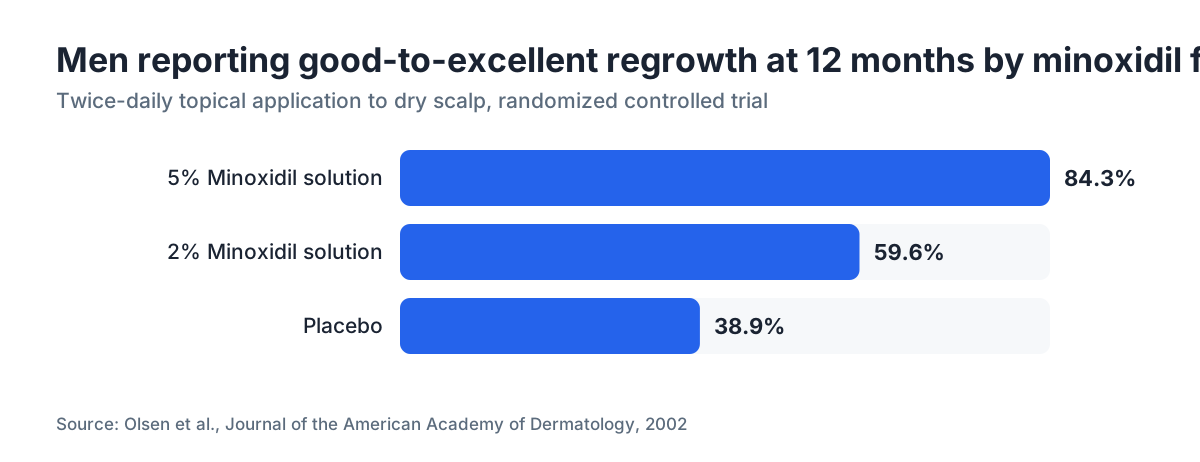
Minoxidil is one of only two drugs with FDA approval for androgenetic alopecia, the other being finasteride. [6] In randomized trials, 5% topical minoxidil beat placebo for regrowth at 48 weeks in men with androgenetic alopecia. One trial reported 84.3% of men on 5% solution rating their regrowth good to excellent at 12 months, versus 59.6% on the 2% solution. [5]
Real numbers, real trial, and every one of those patients followed the application instructions. Technique isn't a footnote. The concentration gradient that drives absorption, the twice-daily consistency, the dry scalp, the 4-hour no-wash window: all of it changes how much drug reaches the follicle.
Six months in with no results, and you've been applying to a wet scalp? Fix that before you write minoxidil off.
Some people do everything right and still don't respond, because response depends partly on sulfotransferase, the scalp enzyme that converts minoxidil to its active form, minoxidil sulfate. [7] That's biology you can't control. Technique is the part you can.
Want a baseline before you spend months on treatment? The free AI hair analysis at MyHairline gives you a Norwood stage estimate from photos. It doesn't replace a dermatologist, but it's a useful starting point.
If minoxidil alone isn't cutting it, the finasteride and minoxidil combination has stronger evidence than either drug on its own.
Minoxidil application timing: a quick reference table
The table pulls timing and dryness guidance from FDA labeling and published absorption studies.
| Scenario | What to do | Why |
|---|---|---|
| Just showered, hair wet | Wait 20-30 min or blow-dry | Wet scalp dilutes drug, reduces diffusion gradient |
| Towel-dried, scalp feels dry | Fine to apply | Scalp skin dryness is what matters most |
| Hair still damp, scalp dry | Probably fine (foam preferred) | Hair shaft moisture matters less than scalp wetness |
| After blow-drying | Wait 2-3 min for scalp to cool | Hot skin can increase evaporation and stinging |
| Post-application: going swimming | Wait at least 4 hours | Water removes surface drug before full absorption |
| Post-application: light sweat | Not a major issue | Minimal drug displacement if scalp was dry at application |
| Nighttime application routine | Apply to dry scalp, let dry before pillow contact | Limits transfer to pillowcase and facial skin |
Sources: FDA approved labeling for Rogaine 5% [1], Olsen et al. 2002 clinical trial [5].
Technique matters, but don't let perfect kill consistent. Applying correctly 80% of the time beats applying wrong every single day.
Sources
- FDA, Rogaine 5% Topical Solution and Foam Approved Labeling
- Journal of Investigative Dermatology, Williams & Barry 2004, penetration enhancers review
- American Academy of Dermatology, Hair Loss: Diagnosis and Treatment
- FDA, Oral Minoxidil Prescribing Information (Loniten)
- Olsen EA et al., Journal of the American Academy of Dermatology, 2002
- FDA, Drug Approvals for Androgenetic Alopecia
- Buhl AE et al., Journal of Investigative Dermatology, 1990
- NIH National Library of Medicine, MedlinePlus: Minoxidil Topical
- Rossi A et al., Dermatology and Therapy, 2022, minoxidil foam vs solution comparison