

TL;DR: Topical minoxidil at standard hair-loss doses (2% or 5% solution, 5% foam) is unlikely to cause meaningful weight gain or fluid retention. Systemic absorption is low but not zero. Fluid retention is a known side effect of oral minoxidil and high-dose topical use, so any sudden weight gain, swollen ankles, or puffiness warrants stopping the drug and calling a doctor.
What does minoxidil actually do in the body?
Minoxidil started as a blood pressure drug. Doctors in the 1970s gave it orally to patients with severe hypertension, and one side effect kept showing up: fluid retention and weight gain, sometimes bad enough to need a diuretic to control [1]. The FDA approved topical minoxidil for hair loss in 1988 for a simple reason. Rubbing it on the scalp keeps most of the drug local and cuts the systemic load compared to swallowing a pill [9].
The mechanism matters here. Minoxidil is a potassium-channel opener. It relaxes smooth muscle in blood vessel walls, which lowers blood pressure. When enough of it reaches your bloodstream, the body compensates by holding onto sodium and water, and that is the fluid retention you hear about. It also triggers a reflex bump in heart rate. These effects are dose-dependent, meaning they get worse as blood levels climb [1].
So the real question for topical use is narrow. How much actually crosses the scalp into circulation? Less than you might fear. More than zero.
How much topical minoxidil actually absorbs into your bloodstream?
About 1.4% of a topically applied dose gets into your bloodstream through normal, intact scalp skin, according to the FDA prescribing information for topical minoxidil [2]. Independent pharmacokinetic studies put the range wider, roughly 0.3% to 4.5%, depending on the formulation, the vehicle (propylene glycol solution versus foam), skin condition, and whether the scalp has any inflammation or abrasion [3].
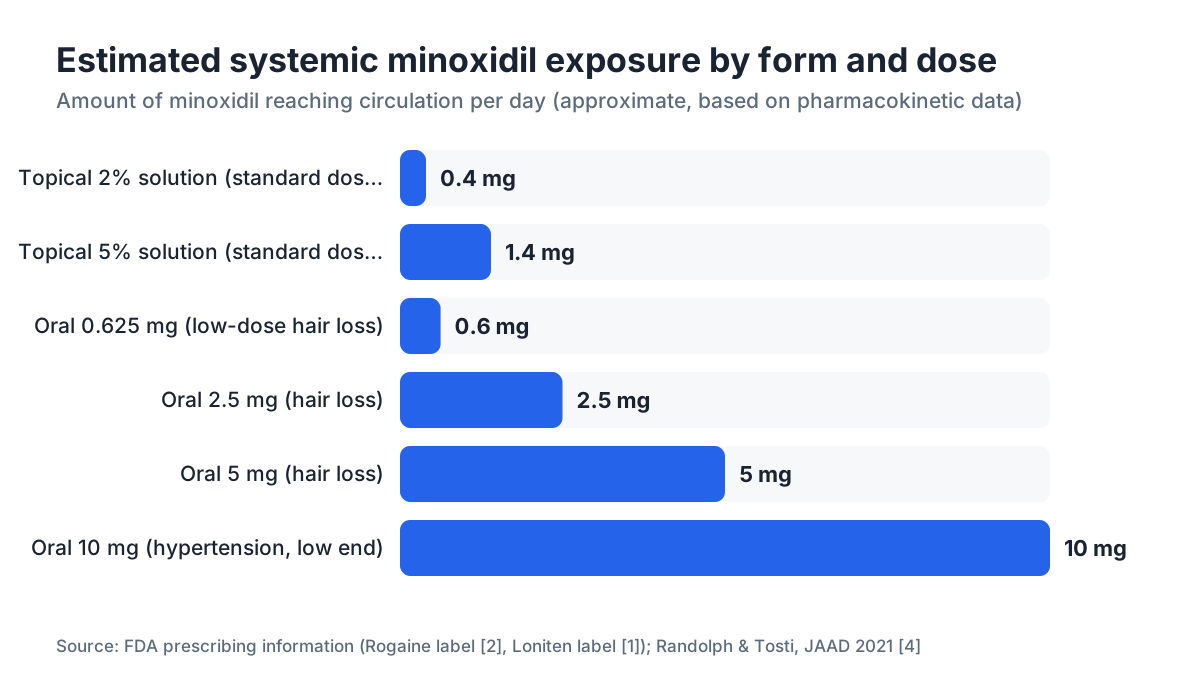
Here is what that means in real numbers. A standard twice-daily dose of 5% solution is about 1 mL per application, which puts roughly 50 mg of minoxidil on the scalp per day. If 1.4% absorbs, that is about 0.7 mg reaching your circulation. Oral minoxidil for hypertension was typically dosed at 10 to 40 mg per day, and oral minoxidil for hair loss now runs off-label at 0.625 to 5 mg per day [4]. The systemic exposure from topical use is genuinely small for most people using standard doses correctly.
That word "correctly" is carrying weight. People who apply more than directed, apply to broken or irritated skin, or stack multiple minoxidil products absorb more. That is when side effects get plausible.
See oral minoxidil for a direct comparison of systemic exposure between the oral and topical forms.
Can topical minoxidil cause fluid retention or edema?
Yes, but it is uncommon at approved doses. The FDA prescribing information for topical minoxidil lists fluid retention and edema as possible adverse reactions and puts them under cardiovascular warnings that call for medical attention [2]. The label tells patients to stop using the product and contact a physician if they get sudden unexplained weight gain, swelling of the hands or feet, or a rapid heartbeat.
Post-marketing reports and case reports in the dermatology literature do document fluid retention with topical minoxidil. Most fit one of three patterns: use in people who already had reduced kidney or heart function, use at higher-than-labeled concentrations (compounded formulas at 10% or above), or accidental or intentional ingestion [5].
A 2019 case series in the Journal of the American Academy of Dermatology reported a small number of patients who developed peripheral edema on topical minoxidil, most of whom cleared up completely after they stopped [5]. The authors concluded that clinicians should ask about topical minoxidil when working up unexplained edema, because patients often do not count it as a "real" medication.
People with heart failure, kidney disease, or who are already on other vasodilators carry a meaningfully higher risk. The FDA label flags these groups by name [2].
For a broader look at what topical minoxidil can and cannot do to your body, minoxidil side effects covers the full picture.
Is weight gain from topical minoxidil real weight or just water?
Almost entirely water. Minoxidil does not increase appetite, does not touch fat storage pathways, and has no known mechanism for adding body fat. The weight gain described in the clinical literature and on the FDA label is fluid retention, not fat [2].
Here is how that plays out. If someone gains two or three pounds on topical minoxidil and it lands suddenly over a few days, especially with ankle or foot swelling, that is a water signal. Fat gain creeps in over weeks to months. It is rarely what is behind a fast jump on the scale.
The distinction matters because the fix is completely different. Fluid retention from minoxidil clears when you stop the drug. It sometimes needs a short course of diuretic, mostly in people with cardiovascular conditions. Weight from lifestyle is a separate conversation entirely.
If the weight came on slowly over months and you have no swelling, topical minoxidil is probably not the reason. Look elsewhere: diet, activity, thyroid function, other medications, hormonal shifts.
What are the warning signs that something is wrong?
The FDA label lists specific symptoms that should make you stop topical minoxidil immediately and get medical attention [2][9]:
- Sudden unexplained weight gain (the labeling cites 5 pounds or more as a threshold worth taking seriously)
- Swelling of hands, feet, or lower legs
- Chest pain or difficulty breathing, especially when lying down
- Rapid or irregular heartbeat
- Faintness or dizziness
These are not common. Most people on topical minoxidil at standard doses never hit any of them. But they are the signals that systemic absorption has reached a level where your cardiovascular system is reacting.
Scalp irritation, dryness, and an early jump in shedding (often called telogen effluvium when it happens at the start of treatment) are far more common and far less alarming. That initial shed is a normal hair cycle reset and usually settles within a few months.
One practical test: step on a scale every morning under the same conditions for a week. If your weight creeps up steadily with no change in diet or activity, and you also see puffiness around the ankles or face, take it to your doctor. Don't wait and see.
Who is most at risk for fluid retention from topical minoxidil?
Risk is not spread evenly. Certain people face a meaningfully higher chance of fluid retention even from topical use [2][6]:
People with kidney disease. Minoxidil is cleared through the kidneys. If kidney function is reduced, the drug can build up over time, and even low systemic doses may accumulate.
People with heart failure or reduced cardiac function. The vasodilating and fluid-holding effects add stress to a system that is already stretched. Oral minoxidil in hypertension trials often required a beta-blocker and a diuretic alongside it for exactly this reason [1].
People using compounded high-concentration topical minoxidil. The compounding market has produced 10%, 15%, and higher. These are not FDA-approved, and absorption data at those strengths is thin. The risk of systemic effects scales with dose [2].
People applying minoxidil to broken, sunburned, or inflamed scalp skin. Damaged skin absorbs far more of any topical drug. A 2022 review in the International Journal of Dermatology noted absorption can rise several-fold when the skin barrier is compromised [6].
Older adults. Renal clearance drops with age, which stretches minoxidil's half-life and raises the odds of accumulation with repeated dosing.
If you fall into any of these groups, have the conversation with your doctor before you start, not after a problem shows up.
Does topical minoxidil affect blood pressure?
At standard doses, the effect on blood pressure is minimal for most people. Systemic absorption is low enough that meaningful hemodynamic changes are uncommon [2][3].
Still, several case reports and the FDA labeling acknowledge that clinically significant blood pressure drops can happen, mostly in people already on antihypertensive medication or who run naturally low. Topical minoxidil plus another vasodilator can occasionally be additive.
If you feel lightheaded after applying minoxidil, especially standing up fast, mention it to a doctor. It is not an emergency. It is a sign that more systemic drug is reaching you than the average person.
For the group most often asking this, healthy adults using 2% or 5% topical minoxidil twice daily, blood pressure effects are generally not detectable. A 1990 study in the Journal of the American Academy of Dermatology found no significant change in blood pressure or heart rate in healthy volunteers using topical 2% minoxidil [7]. The 5% formulation was studied along the same lines with comparable findings, though it does push slightly higher peak plasma levels [3].
How does topical minoxidil compare to oral minoxidil for fluid retention risk?
The gap is big. This table lays it out plainly:
| Form | Typical hair-loss dose | Systemic exposure | Fluid retention rate |
|---|---|---|---|
| Topical 2% solution | 1 mL twice daily (20 mg/day to scalp) | ~0.3-0.7 mg absorbed | Rare (<1% of users in trials) |
| Topical 5% solution | 1 mL twice daily (50 mg/day to scalp) | ~0.7-2.3 mg absorbed | Rare, slightly higher than 2% |
| Oral 2.5 mg | 2.5 mg/day swallowed | ~2.5 mg absorbed | Reported in roughly 5-10% of patients in observational studies [4] |
| Oral 5 mg | 5 mg/day swallowed | ~5 mg absorbed | Higher; some studies report edema in up to 20% [4] |
Oral minoxidil puts a fully bioavailable dose straight into the bloodstream. The FDA-approved oral tablet for hypertension (Loniten) carries a black box warning specifically for fluid retention and pericardial effusion [1]. Off-label oral minoxidil for hair loss at low doses runs a much lower but still real rate of these effects compared to hypertension doses.
Topical minoxidil was built to give the hair follicle its benefit while dodging most of the systemic risk. It mostly succeeds. But "mostly" is not "completely," which is why the FDA labeling still carries cardiovascular warnings for the topical form.
More detail on oral minoxidil and its distinct side effect profile is worth reading if you are weighing the two forms.
Can topical minoxidil affect the heart or cause palpitations?
Heart palpitations show up as a possible adverse effect on the topical minoxidil FDA label [2]. The mechanism matches fluid retention: when enough drug reaches circulation, the reflex response to vasodilation raises sympathetic tone, which speeds the heart.
In practice, palpitations from topical minoxidil at standard doses are rare and usually settle on their own. The scarier cardiac complication tied to high-dose systemic minoxidil is pericardial effusion, fluid around the heart, which sits in the black box warning on oral Loniten [1]. It has not been documented with standard topical use in people with healthy hearts.
If your heart races or skips after applying topical minoxidil, especially in the first few hours when plasma levels peak, report it. It does not automatically mean stop. It does mean you want a medical opinion, not a Reddit thread.
Your overall cardiovascular health frames all of this. A 25-year-old with no cardiac history noticing an occasional flutter is in a different situation than a 55-year-old with hypertension and a pre-existing arrhythmia.
What should you do if you think topical minoxidil is causing weight gain or swelling?
First, confirm it is real. Weigh yourself at the same time each day, after waking and before eating, for a week. Note any visible swelling, particularly around the ankles, feet, and lower legs. If the weight gain is real and sticking around, and especially if swelling is present, stop the minoxidil and call your doctor. Do not wait for a scheduled appointment if you have trouble breathing, chest pain, or significant swelling.
Tell your doctor exactly what you are using: the concentration, how much you apply, how often, and for how long. Many physicians have no idea their patients are using over-the-counter topical minoxidil, because it needs no prescription, and people often forget to mention it.
In most cases, fluid retention from topical minoxidil clears within a few days of stopping. If it does not, or if it is severe, a short course of diuretic therapy may be needed. Your doctor makes that call, not you.
If the side effect traced back to a compounded high-concentration product, you might discuss switching to an FDA-approved formulation at a lower dose, or looking at alternatives like finasteride or finasteride and minoxidil combination therapy, which work through a different mechanism and carry no fluid retention risk.
If you want to understand your hair loss pattern before picking a treatment, a free AI scan at MyHairline.ai can help you place yourself on the Norwood scale and see what options might fit.
Are some formulations or delivery methods riskier than others?
Yes. Not every topical minoxidil product carries the same absorption risk.
FDA-approved products (2% solution, 5% solution, 5% foam) have published pharmacokinetic data and labeled absorption estimates [2][3]. Compounded products at higher concentrations lack that data, and there is real uncertainty about how much more drug crosses the skin at, say, 10% versus 5%.
The vehicle matters too. Propylene glycol, used in the solution forms, is a penetration enhancer. It helps minoxidil cross the skin barrier, which is exactly what you want for hair follicle exposure, but it also means more drug can reach circulation than with the foam, which uses no propylene glycol [3]. The 5% foam tends to be kinder on the scalp, and some pharmacokinetic data suggests slightly lower systemic absorption than the matching solution dose, though the difference is modest.
Topical minoxidil plus microneedling is getting popular. Microneedling opens micro-channels in the scalp that sharply increase drug penetration, potentially pushing systemic absorption well past the 1.4% baseline figure. There is essentially no published safety data on the cardiovascular or fluid-retention effects of that combination, which is a gap worth naming out loud. If you microneedle alongside minoxidil, treat yourself as a higher-absorption case.
For men weighing their full range of options, minoxidil for men covers the evidence on efficacy alongside these safety questions.
Is initial hair shedding from minoxidil different from fluid retention?
Completely different, and worth pulling apart because both can spook you in the first few weeks.
The early shed many people hit when starting minoxidil is a hair cycle event, not a cardiovascular one. Minoxidil pushes resting (telogen) hairs into an active shedding phase so new anagen hairs can grow in behind them. You lose more hair temporarily before you gain it back. This is well documented and not a sign of a drug problem [8].
Fluid retention shows up on the scale and on your body, not in your shower drain. The two do not overlap. If the shed is what worries you, read about telogen effluvium. If weight or swelling is what worries you, that is a different concern that traces to cardiovascular physiology.
The confusion comes from timing. Both can hit in the first one to three months, so people bundle the worries together. Keep them apart. One is expected and temporary. The other is a signal that needs medical attention.
Sources
- FDA, Loniten (oral minoxidil) prescribing information with boxed warning, via DailyMed
- FDA, topical minoxidil (Rogaine 2% and 5%) drug label, via DailyMed
- DailyMed, NIH National Library of Medicine, minoxidil topical solution pharmacokinetics
- Randolph M, Tosti A. Oral minoxidil treatment for hair loss: A review of efficacy and safety. Journal of the American Academy of Dermatology, 2021
- Sinclair R, et al. Peripheral edema associated with topical minoxidil. Journal of the American Academy of Dermatology, 2019
- International Journal of Dermatology, review of percutaneous absorption enhancement, 2022
- Headington JT et al. Topical minoxidil 2% cardiovascular effects in healthy volunteers. Journal of the American Academy of Dermatology, 1990
- American Academy of Dermatology Association, hair loss treatment resources
- NIH MedlinePlus, minoxidil topical drug information
- Olsen EA et al. The importance of dual 5-alpha reductase inhibition in the treatment of androgenetic alopecia. Journal of the American Academy of Dermatology, 2006