TL;DR: Caffeine can slow DHT-driven hair follicle shrinkage in lab studies, and a small randomized trial found a 3% caffeine solution roughly matched topical minoxidil for reducing hair loss over 6 months. But no shampoo-specific trial has proven regrowth in androgenetic alopecia. Treat it as a low-risk add-on, never a standalone treatment.
What is caffeine shampoo supposed to do for hair loss?
The theory is simple. Caffeine on the scalp is thought to reach hair follicles and block phosphodiesterase, an enzyme whose suppression raises cyclic AMP inside follicle cells. Higher cyclic AMP keeps follicles in the growth phase (anagen) longer. The bigger claimed effect is that caffeine counteracts dihydrotestosterone (DHT), the androgen most responsible for shrinking follicles in androgenetic alopecia [1].
So caffeine shampoo is more than a cleanser with a marketing angle. There's a real proposed biological mechanism. The open question is whether that mechanism means anything when the product sits on your scalp for two or three minutes and then goes down the drain.
This matters because what causes hair loss in most men and many women is a mix of genetic DHT sensitivity and follicle miniaturization that plays out over years. Any topical that wants to interrupt that process has to reach the follicle bulb, which sits a few millimeters below the scalp surface. Getting caffeine down there from a rinse-off product is a genuine pharmacological challenge, even though the molecule is small and fat-soluble enough to cross skin.
Can caffeine actually penetrate the scalp from a shampoo?
This is the first real evidence question, and the answer is yes, with caveats.
A 2007 ex-vivo study by Fischer et al. in the International Journal of Dermatology tested caffeine penetration through human scalp skin samples [1]. Caffeine reached the hair follicle within two minutes of contact, and the follicle acted as a preferred route compared with the surrounding skin. That's promising for a shampoo, because shampoo makes sustained contact with open follicular openings during washing.
The same study detected caffeine in follicular tissue even after a simulated rinse. So some caffeine stays behind. How much, and whether it's pharmacologically meaningful, is where the honest uncertainty starts.
A 2014 review in Skin Pharmacology and Physiology noted that caffeine concentrations needed to produce in-vitro effects on follicle cells ran from 0.001% to 0.005% [2]. Most commercial caffeine shampoos list caffeine between 0.2% and 1%. The starting number sounds higher, but rinse-off dilution, short contact time, and the winding path from the follicular opening to the bulb all cut effective delivery. Nobody has published a clean human pharmacokinetic study measuring bulb-level caffeine from a commercial shampoo at real-world use. Keep that gap in mind.
What do the clinical trials actually show?
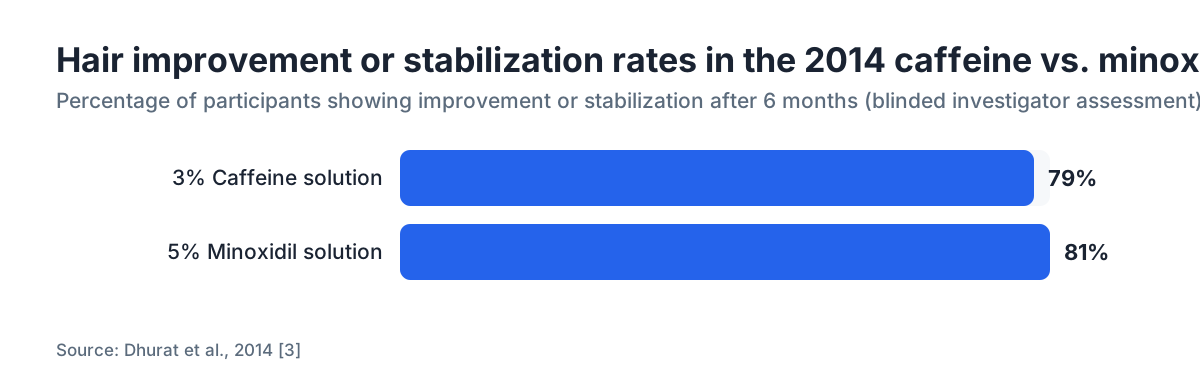
The best evidence comes from a randomized controlled trial published in 2014 by Dhurat et al. [3]. It enrolled 210 men and women with androgenetic alopecia and compared a 3% caffeine topical solution against 5% minoxidil topical solution over 6 months. The primary outcome was global photographic assessment scored by blinded investigators.
Results: the caffeine solution was rated "not inferior" to minoxidil for the share of subjects showing improvement or stabilization. Roughly 79% of the caffeine group improved or held steady versus 81% in the minoxidil group, a difference that wasn't statistically significant [3].
That headline sounds impressive. Read the fine print. This was a non-inferiority design, which sets the bar at showing the treatment isn't dramatically worse than the comparator, not that it's equally effective in absolute terms. Absolute hair counts and density measurements showed smaller numerical gains in the caffeine group. And the trial used a 3% leave-on solution, not a rinse-off shampoo, so it doesn't transfer directly to shampoo products.
An earlier in-vitro study by Fischer et al. from 2007 showed caffeine at 0.001% to 0.005% counteracting DHT-induced suppression of hair shaft elongation in cultured human follicles [1]. Follicles treated with DHT grew about 40% less than controls; caffeine partially reversed that. A petri dish isn't a human scalp, but the mechanistic signal is real.
A smaller 2019 randomized trial in 30 men compared a caffeine-containing shampoo plus conditioner against a placebo shampoo over 6 months, measuring hair density by phototrichogram [4]. The caffeine group showed a statistically significant rise in anagen hair ratio (from about 82% to 87%) and a modest density gain versus placebo. The effect size was small and the trial was too tiny to draw strong conclusions, but it's the closest published evidence for a shampoo rather than a leave-on solution.
How does caffeine shampoo compare to minoxidil and finasteride?
This is the comparison most people need before deciding where to spend money.
| Treatment | Form | Evidence strength | Regrowth shown | Prescription needed |
|---|---|---|---|---|
| Finasteride 1 mg | Oral tablet | Large RCTs, FDA-approved | Yes, in 60-80% of men | Yes |
| Minoxidil 5% | Topical solution | Large RCTs, FDA-approved | Yes, modest | No |
| Minoxidil 2%/5% | Foam or liquid | FDA-approved | Yes | No |
| Oral minoxidil | Tablet | Growing RCT data | Yes, stronger than topical in some trials | Yes |
| Caffeine 3% | Leave-on solution | 1-2 small RCTs | Stabilization, modest growth | No |
| Caffeine shampoo | Rinse-off | 1 small RCT, mechanism studies | Modest anagen ratio improvement | No |
Finasteride has the strongest evidence base for male androgenetic alopecia. It reduces DHT by about 60-70% and, in the trials that got it FDA-approved, raised hair counts around 10% above baseline over 2 years [5]. For how it works and its sexual side effect profile, see the finasteride and DHT blocker articles.
Minoxidil works differently (vasodilation and potassium channel opening rather than DHT suppression), and its evidence base is strong too. For the full breakdown, see minoxidil for men. The minoxidil side effects article covers the shedding phase and cardiovascular points that matter if you take blood pressure medication.
Caffeine shampoo sits well below both on evidence. No FDA approval or clearance for hair loss, no large randomized trial, no long-term data. What it has: a plausible mechanism, no known systemic side effects at shampoo concentrations, and a low price next to prescription treatments. That makes it a reasonable add-on for someone already on an evidence-based treatment, not a replacement for one.
For women the hierarchy is similar. Minoxidil 2% is FDA-approved for female pattern hair loss. Finasteride gets used off-label in postmenopausal women. Caffeine shampoo has the same thin evidence in women as in men.
How long does caffeine shampoo take to show results?
The only shampoo-specific trial ran 6 months and found modest improvements by that point [4]. Hair biology sets a floor on speed. The average anagen phase lasts 2 to 6 years, and you need a whole population of follicles to shift behavior, which takes at least 3 to 6 months to show up on a phototrichogram.
If you try a caffeine shampoo and see no change in shedding or density at 6 months, that's a fair signal it isn't working for you. Don't expect anything dramatic at 4 weeks.
The 2019 shampoo trial by Bussoletti et al. measured at baseline, 3 months, and 6 months [4]. The significant improvement in anagen ratio showed up by 3 months and was larger at 6. That timeline matches what you'd expect from any treatment that nudges follicles from telogen back toward anagen.
Are there any side effects from caffeine shampoo?
Topical caffeine at shampoo concentrations has a clean safety record in published studies. No serious adverse events were reported in any of the trials above [3][4].
The worries people raise are allergic contact dermatitis (possible with any cosmetic ingredient, though rarely reported with caffeine specifically) and scalp irritation. Caffeine is generally considered non-irritating below 1%.
Systemic absorption from a rinse-off shampoo is negligible. The Fischer et al. penetration study found follicular deposition but no meaningful transdermal systemic delivery [1]. Washing your hair won't make you jittery.
Where these shampoos cause trouble is the other ingredients. Many combine caffeine with biotin, zinc pyrithione, saw palmetto, or botanical extracts. Some of those carry their own sensitization risk. If you develop scalp itching or a rash, don't blame the caffeine by default. Patch testing or ingredient-by-ingredient elimination is the right move.
Which caffeine shampoos have actual evidence behind them?
The only branded product with direct clinical trial data is Alpecin, a German brand tied to several of the Fischer et al. studies [1][2]. That sponsorship is a source of potential bias, and independently funded trials of caffeine shampoo are sparse.
Alpecin C1, the most widely sold product, uses caffeine as its main active at concentrations the company states sit above the in-vitro effective threshold. There's no independent verification of the final follicle-level concentration after rinsing.
Other brands, including some Nioxin formulations, Viviscal Shampoo, and various pharmacy-label caffeine shampoos, contain caffeine but carry no product-specific trial data. They're riding the category evidence, not their own formulation evidence.
The honest read: if you want to try a caffeine shampoo, the one with the most direct (if industry-sponsored) evidence is Alpecin C1. If you'd rather buy an independent option, you're choosing on ingredient list and price, not on trial data.
If you're also taking supplements and wondering how they stack up, the hair loss supplements article covers biotin, zinc, iron, and saw palmetto with the same evidence-first approach.
Should you use caffeine shampoo alongside minoxidil or finasteride?
There's no interaction data specifically studying caffeine shampoo with minoxidil or finasteride. Pharmacologically, the mechanisms don't obviously clash: caffeine (phosphodiesterase inhibition, DHT antagonism at the follicle), minoxidil (potassium channel opening, vasodilation), and finasteride (5-alpha reductase inhibition that lowers systemic DHT) work through separate pathways.
For combination treatment with evidence behind it, see finasteride and minoxidil, which covers the studies showing the two together beat either alone.
Adding a caffeine shampoo on top of evidence-based treatment is low-risk and low-cost. The catch is false confidence: you feel like you're doing something meaningful when the prescription medication is doing the real work. Don't swap it in for a treatment with stronger evidence if your hair loss is progressing.
People whose hair loss comes from nutritional deficiency, thyroid disease, or a recent physical stress should read telogen effluvium before spending anything on caffeine shampoo. If the root cause isn't DHT, the caffeine mechanism is mostly beside the point.
Does caffeine shampoo work for women with hair loss?
The Fischer et al. ex-vivo studies used both male and female scalp tissue and found similar caffeine penetration in each [1]. The 2014 Dhurat trial included men and women (though male-dominant) and didn't report sex-stratified results in a way that lets us draw firm conclusions for women alone [3].
For women with androgenetic alopecia (female pattern hair loss), the DHT-follicle relationship is messier than in men. DHT sensitivity exists but isn't the only driver; estrogen withdrawal, prostaglandin imbalance, and other factors contribute. A caffeine mechanism that partly blocks DHT effects at the follicle could still matter, but the effect size might differ.
Women dealing with a receding hairline or diffuse thinning should get a proper diagnosis first. Alopecia areata, hypothyroidism, iron deficiency, and other causes won't respond to caffeine shampoo no matter what the label promises. The American Academy of Dermatology recommends a full workup, including thyroid function and ferritin, before assuming pattern hair loss [6].
Is caffeine shampoo worth the money?
Most caffeine shampoos cost $10 to $25 for a 250 ml bottle, lasting roughly 4 to 8 weeks depending on use. That's $60 to $150 a year.
Compare that. Generic finasteride runs about $15 to $30 a month without insurance (roughly $180 to $360 a year), and topical minoxidil 5% solution costs about $20 to $40 for a three-month supply ($80 to $160 a year).
Caffeine shampoo is cheap enough that "probably not harmful and possibly helpful" is a fair reason to try it if your budget allows for it alongside a primary treatment. As a standalone treatment for progressive androgenetic alopecia, the evidence doesn't justify making it your main spend.
If you're early in evaluating your hair loss and want a starting point before committing to prescription treatments, the free AI hair analysis at MyHairline gives you a baseline picture of your hairline and recession pattern, which helps you track whether any treatment is actually working over time.
The worst outcome from a caffeine shampoo isn't side effects. It's spending two years washing with it while your hairline keeps receding, because you thought you were covered.
What does the research still not know about caffeine and hair loss?
Several real questions remain open as of mid-2025.
There's no published dose-response study in humans. We don't know how much caffeine has to reach the follicle bulb to produce a measurable effect on hair cycling, or whether shampoo hits that threshold. The in-vitro numbers suggest a low bar, but converting petri dish concentrations to scalp levels in a living person isn't straightforward.
There's no long-term data. The longest published trial ran 6 months [3][4]. Hair loss is a chronic, progressive condition. A treatment that stabilizes things at 6 months might be working, or it might just be a natural plateau in hair cycling. Without a 2-year or 5-year trial, we can't tell.
No one has published a rigorous head-to-head between a caffeine shampoo and a leave-on caffeine solution at the same concentration, isolating rinse-off versus leave-on delivery. That comparison would answer the pharmacokinetic question directly.
And the effect of common shampoo additives (surfactants, silicones, zinc pyrithione) on caffeine's follicle penetration hasn't been studied in any systematic way. These aren't exotic gaps. They're standard pharmacology questions that simply haven't attracted enough independent research funding.
For context on where unexplained hair loss sometimes comes from, the does creatine cause hair loss article shows how even widely used supplements have surprisingly thin mechanistic evidence, which mirrors the caffeine shampoo situation.
If you want a data-driven baseline on your own hair before committing to any treatment, MyHairline's free AI hair scan at /scan takes a photo of your hairline and maps it against Norwood stages, giving you a starting point to track change over time.
Sources
- Fischer TW et al., International Journal of Dermatology 2007 – caffeine penetration via hair follicle
- Fischer TW et al., Skin Pharmacology and Physiology 2014 – caffeine and hair follicle biology review
- Dhurat R et al., 2014 – 3% caffeine vs 5% minoxidil RCT in androgenetic alopecia
- Bussoletti C et al., Journal of Applied Cosmetology 2019 – caffeine shampoo RCT in 30 men
- U.S. National Library of Medicine, MedlinePlus – finasteride drug information
- American Academy of Dermatology – hair loss diagnosis and treatment guidance
- U.S. FDA – Drugs@FDA database of approved drug products
- U.S. FDA – cosmetics laws and regulations overview
- Trüeb RM, International Journal of Trichology 2010 – caffeine and hair review
- Blumeyer A et al., Journal of the German Society of Dermatology 2011 – evidence-based guideline for androgenetic alopecia treatment