

TL;DR: Early hair loss rarely announces itself loudly. The first signs are usually a slightly wider part, more hairs in the shower drain, a hairline that seems higher than it used to be, or hair that feels finer. Most people lose around 100 hairs a day normally; consistently losing more, or seeing scalp where you didn't before, is the signal to pay attention.
What are the very first signs of hair loss most people notice?
The earliest signs are almost always subtle enough that most people dismiss them. You glance at an old photo and think your hairline looks different. Your shower drain collects a clump that seems larger than usual. Your part, which used to be a thin line, looks noticeably wider when you pull your hair to one side.
Those are the three most common early signals across both male-pattern and female-pattern hair loss. None of them look alarming in isolation, which is exactly why so many people catch hair loss late.
The American Academy of Dermatology (AAD) notes that it is normal to shed between 50 and 100 hairs per day as part of the natural hair growth cycle [1]. The problem starts when shedding consistently outpaces regrowth, or when hair that regrows comes in thinner than what fell out. At first this just means less volume. Over months, it means visible scalp.
For men, the temples and the crown tend to thin first, following the Norwood scale of male-pattern baldness. For women, the center part widens and the front hairline usually stays intact, following what dermatologists call the Ludwig pattern. Knowing which pattern you're in matters because it shapes which treatments actually work.
One more early sign that often gets ignored: hair breakage. Hair that's thinning at the follicle level often becomes fragile, so you'll see shorter broken pieces on your pillow or in your brush rather than full-length hairs with a white bulb at the root. Full-length hairs with a white bulb mean shedding from the root. Short broken pieces usually mean structural damage from styling or a nutritional gap.
How much hair shedding is normal, and when is it too much?
Normal daily shedding sits between 50 and 100 hairs, a number the AAD publishes and dermatology textbooks repeat [1]. Some sources put the upper limit closer to 150 hairs on wash days, since wetting and combing dislodge hairs that piled up over the past day or two.
Counting every shed hair is impractical. A more reliable home test: the pull test. Grip a small section of hair, about 40 to 60 strands, between your thumb and forefinger and run your fingers from the root toward the tip with gentle but firm tension. If more than 6 hairs come out in a single pull, that suggests active shedding above baseline [2]. Dermatologists use this in clinic. It is not a diagnosis, but it is a useful signal.
Context matters too. A stressful event, a high fever, surgery, childbirth, crash dieting, or stopping hormonal contraception can trigger a wave of shedding called telogen effluvium two to three months after the event. That shedding can be dramatic, handfuls in the shower, but it usually reverses on its own within six months once the trigger resolves [3]. If shedding started without any obvious trigger, or if it has run longer than six months, the more likely explanation is pattern hair loss, and it will not reverse without treatment.
The honest answer to "when is it too much" is this: when shedding clearly outpaces regrowth for weeks at a stretch, more than one bad shower day.
What does a receding hairline look like in early stages?
Early hairline recession in men almost always starts at the temples, not the center front. The corners pull back first, creating a slight M-shape where the hairline used to be a straighter arc. Most men in their late teens and early twenties develop what's called a "mature hairline," a slight recession of about a centimeter from the juvenile hairline they had as a child. That's normal and not hair loss.
The distinction that matters: a mature hairline recedes evenly and then stops. A receding hairline driven by androgenetic alopecia keeps moving back, and the miniaturized hairs at the temples look finer and shorter over time rather than holding their original texture.
For women, the front hairline usually holds, but the hair directly behind it thins. A useful self-check is to part your hair down the center and compare the width of the part in a photo from a few years ago versus today. A noticeably wider center part that wasn't there before is one of the earliest visible signs of female-pattern hair loss.
Photography is underrated as a tracking tool. Take the same photo every three months under the same lighting. Progression that's invisible week to week becomes obvious over a year.
What does miniaturization mean and why does it matter for early detection?
Miniaturization is the biological process that separates normal shedding from progressive hair loss. In androgenetic alopecia, dihydrotestosterone (DHT) binds to receptors in genetically susceptible hair follicles and gradually shrinks them. Each successive hair that grows from that follicle comes in slightly shorter, thinner, and lighter in color than the one before. Eventually the follicle produces only a fine vellus hair, essentially peach fuzz, and then nothing at all [4].
This matters for early detection because miniaturized hairs are still there. A dermatologist looking at your scalp under a dermoscope, a handheld magnifying device, can spot follicles in various stages of miniaturization long before you'd notice them in a mirror. Some clinics now offer trichoscopy or phototrichogram analysis for exactly this purpose.
At home, you can notice a crude version of this. Run your fingers across your temples or the crown and compare the hair texture there to the hair at the back of your head. Thinner, softer, finer hair in the areas where pattern baldness typically progresses is a meaningful early signal, not proof but a reason to pay attention.
Understanding DHT's role here also explains why DHT blockers like finasteride work: they interrupt the miniaturization process before follicles go dormant permanently. The earlier you intervene, the more follicles you preserve.
What are the early symptoms specific to women?
Female hair loss gets less attention than male-pattern baldness, but it is extremely common. The AAD estimates that female-pattern hair loss affects about 30 million women in the United States, with prevalence climbing after menopause [1].
The early symptoms in women are different enough from men's that they deserve their own list:
- A center part that looks wider than it did a year or two ago
- Hair that feels less dense when gathered into a ponytail (the ponytail circumference shrinks noticeably)
- A visible scalp when hair is wet or in bright overhead lighting
- Hair that takes less time to blow dry because there is simply less of it
- More hair on pillows, in shower drains, and in hairbrushes without any obvious stress trigger
Women are also more likely than men to have hair loss driven by thyroid disorders, iron deficiency, or hormonal shifts from pregnancy, postpartum recovery, or perimenopause [5]. These causes are treatable but different from androgenetic alopecia, and they require blood work to distinguish. If you're a woman noticing early hair loss, a basic panel including TSH, ferritin, and a complete blood count is a reasonable first step before assuming it's genetic.
Diffuse thinning without a defined pattern, combined with fatigue or cold intolerance, points toward thyroid. Diffuse thinning that started two to four months after childbirth or a major illness is almost certainly telogen effluvium and will likely resolve. A steadily widening part without a clear trigger in a woman over 30 is more likely female-pattern hair loss and does better with earlier treatment.
What causes early hair loss in your 20s?
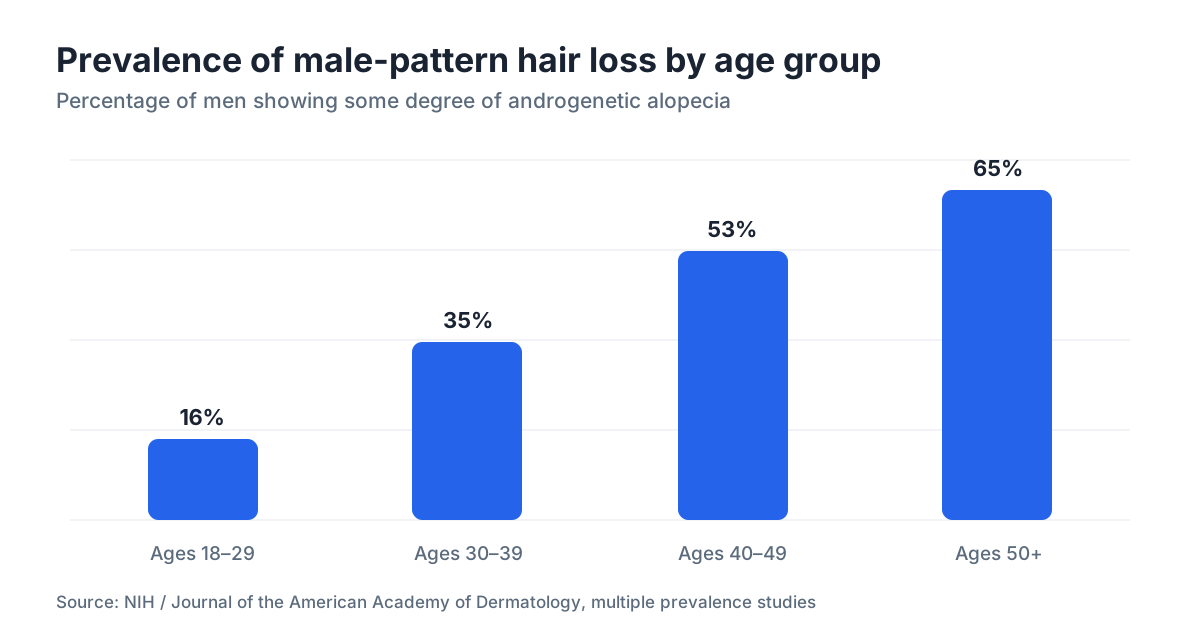
Androgenetic alopecia can start well before 30, even in the late teens. A study published in the Journal of the American Academy of Dermatology found that roughly 16% of men aged 18 to 29 showed some degree of male-pattern hair loss [6]. The genetic predisposition is there from birth; what varies is when DHT exposure starts pushing susceptible follicles toward miniaturization.
Other causes of hair loss in your 20s include:
Nutritional deficiencies. Low ferritin (stored iron) is the most common and the most frequently missed. Hair follicles are among the fastest-dividing cells in the body and are sensitive to micronutrient shortfalls. Ferritin below 30 ng/mL is associated with increased shedding in some studies, though the threshold is debated [7]. Zinc, biotin, and vitamin D shortfalls can also contribute, but biotin deficiency severe enough to cause hair loss is rare outside specific medical conditions, despite how often it shows up on supplement labels.
Stress. Telogen effluvium triggered by psychological or physical stress is common in your 20s, a decade not short on either kind.
Scalp conditions. Seborrheic dermatitis, scalp psoriasis, and fungal infections can inflame the scalp and disrupt hair growth. These tend to come with itching, flaking, or redness that makes them easier to spot.
Traction alopecia. Tight hairstyles (high ponytails, braids, locs pulled tightly) put mechanical stress on follicles, and early traction alopecia shows up as recession along the hairline with small broken hairs at the margins. It's reversible early. Ignored for years, it can cause permanent follicle damage.
To understand the full picture of what causes hair loss, the answer is almost always a mix of genetic susceptibility and one or more triggers.
How do I know if my hair loss is temporary or permanent?
Temporary hair loss generally has a clear timeline and a cause that resolves. Telogen effluvium from a high fever, surgery, or nutritional deficiency typically peaks around three months after the trigger and fills back in by nine to twelve months [3]. The hair that comes back grows in at normal thickness. If you've had a clear stressor, the hair loss started two to three months after it, and it's been less than six months, temporary is the more likely answer.
Permanent hair loss (androgenetic alopecia) has a different fingerprint. It progresses slowly rather than shedding all at once. The hair that comes back is finer than what fell out. It tends to follow a pattern (temples and crown in men, widening part in women) rather than being uniformly diffuse. And it doesn't stop after a few months. It keeps going year after year without treatment.
The practical test: take photos now, and again in six months. If hair density recovered, it was likely temporary. If density is the same or worse, and the pattern matches androgenetic alopecia, you're looking at something that needs treatment to arrest.
A dermatologist can use dermoscopy to check for miniaturization and give you a much faster answer than waiting six months. If early treatment access matters to you, a free AI hair analysis tool like the one at MyHairline can give you a structured starting point before booking a clinic appointment, though it's no substitute for an in-person diagnosis.
What early treatments actually work and what is a waste of money?
Two treatments have real, replicated evidence behind them for androgenetic alopecia. Everything else is either unproven, marginally effective, or useful only for specific non-genetic causes.
Minoxidil is the first-line topical treatment, approved by the FDA for hair loss [8]. It works by extending the anagen (growth) phase of the hair cycle and increasing blood flow to follicles. It does not block DHT, so it slows loss and can regrow some hair, but it doesn't touch the underlying hormone-driven miniaturization. The 5% foam or solution applied twice daily is the standard dose for men; 2% or 5% for women. Results take four to six months to show and require ongoing use. Stop using it, and any regrowth reverses within a few months.
Finasteride (1 mg daily, oral) blocks the enzyme that converts testosterone to DHT, directly addressing the cause of androgenetic alopecia in men. A 1998 placebo-controlled trial found that 83% of men taking finasteride maintained hair count over two years compared to 28% of those on placebo [9]. It is approved by the FDA for male-pattern hair loss. It is not approved for premenopausal women and carries a pregnancy risk category X. Using finasteride and minoxidil together is the most effective combination available without a procedure.
What's a waste of money: Most shampoos marketed for hair loss have no replicated clinical evidence of affecting hair count. Biotin supplements help if you're actually deficient; they do nothing otherwise, and the bar for genuine biotin deficiency is high. Laser combs and helmets (low-level laser therapy) have some weak positive data but small effect sizes, and devices cost hundreds of dollars. Hair loss supplements are a growing category, but the regulatory bar for supplement claims sits far below the bar for drugs, and most studies are small and industry-funded.
If you're in the early stages and the cause is androgenetic alopecia, starting minoxidil and talking to a doctor about finasteride is the evidence-based path. The earlier you start, the more you preserve. Once follicles go fully dormant, medication cannot revive them, and hair transplant surgery becomes the only way to restore density in those zones.
What does a doctor look for during an early hair loss evaluation?
A dermatologist evaluating early hair loss will typically start with a detailed history: when you first noticed it, what pattern it follows, family history on both sides (maternal and paternal), any recent stressors, medications, or diet changes. Hair loss is often multifactorial, and the history narrows it fast.
The physical exam includes the pull test described earlier, assessment of the hairline and part width, and often a dermoscopic exam. Dermoscopy lets the physician see hair shaft diameter variation, follicle density, and the ratio of terminal to vellus hairs without a biopsy. A high ratio of miniaturized follicles confirms androgenetic alopecia with reasonable confidence.
Blood work is ordered when the pattern or history suggests a systemic cause. A typical early panel includes:
| Test | What it rules out |
|---|---|
| TSH | Thyroid dysfunction |
| Ferritin | Iron deficiency (stored iron, more than hemoglobin) |
| Complete blood count | Anemia |
| Total testosterone / DHEA-S (women) | Androgen excess, PCOS |
| Vitamin D | Deficiency linked to some alopecia types |
| ANA | Autoimmune conditions like lupus |
If blood work comes back normal and the pattern matches androgenetic alopecia, the diagnosis is usually clinical. A scalp biopsy is reserved for uncertain or atypical cases. Most people with textbook male- or female-pattern hair loss don't need one.
Can stress cause permanent hair loss, or does it always grow back?
Stress-related hair loss is almost always the telogen effluvium type: a sudden push of follicles from the growth phase into the resting (telogen) phase, followed by a wave of shedding two to three months later. The key word is "almost."
In most cases, once the stressor resolves, follicles return to the growth phase and hair fills back in. A 2013 review in the Journal of Clinical and Aesthetic Dermatology described telogen effluvium as typically self-limiting, with full recovery expected within six to twelve months of the trigger's resolution [3].
The exception: chronic, unrelenting stress sustained over years can, in some people, speed up the onset of genetic pattern hair loss. The mechanism isn't perfectly understood, but stress hormones change the signaling environment around follicles and may lower the threshold at which genetically susceptible follicles begin miniaturizing. Stress isn't the root cause, but it can pull forward the timing in someone who was already predisposed.
So: a single stressful event almost certainly causes temporary loss that reverses. Years of chronic stress in someone with the genetic predisposition may shift the timeline earlier. If your hair hasn't started recovering six months after a known stressor resolved, see a dermatologist to rule out concurrent androgenetic alopecia.
When should you see a dermatologist about early hair loss?
The honest answer is earlier than most people do. The window during which medication can meaningfully preserve follicles is wide open in the early stages and narrows over time. Once follicles go dormant, you're looking at a procedure rather than a pill.
See a dermatologist if:
- You've noticed progressive thinning for more than three to six months without a clear resolving trigger
- The pull test consistently yields more than six hairs per pull
- Your part is visibly wider than it was a year ago
- You have significant family history of early pattern baldness on either side and your hairline is starting to change
- You're a woman with diffuse thinning that isn't explained by a recent pregnancy, illness, or dietary change
- Hair loss comes with scalp pain, itching, burning, or redness (which suggests an inflammatory cause that needs its own treatment)
There's no downside to being seen early. The worst outcome is that the doctor tells you it's normal shedding and sends you home. The best outcome is that you catch androgenetic alopecia while enough follicles are still viable to respond to minoxidil for men or finasteride.
For people who want a structured first look before booking an appointment, the free AI scan at MyHairline analyzes photos for hairline pattern and density changes, which can help you frame the conversation with your doctor more precisely.
Sources
- American Academy of Dermatology (AAD), Hair Loss Overview
- Journal of Clinical and Aesthetic Dermatology, Telogen Effluvium: A Review (2013)
- NIH National Library of Medicine, Androgenetic Alopecia (StatPearls)
- Journal of the American Academy of Dermatology, Prevalence of Male-Pattern Hair Loss in Men 18 to 49
- NIH National Library of Medicine, Iron Deficiency and Hair Loss (PubMed review)
- FDA, Minoxidil Drug Information (Hair Loss Indication)
- New England Journal of Medicine, Finasteride in Male-Pattern Baldness (Kaufman et al., 1998)
- NIH National Library of Medicine, Prevalence of Androgenetic Alopecia by Age (PubMed)