

TL;DR: Health insurance almost never covers cosmetic hair loss treatments like minoxidil, finasteride for pattern baldness, or hair transplants. Coverage kicks in when hair loss comes from a documented medical condition, cancer treatment, or an autoimmune disease like alopecia areata. Even then, you're usually fighting for partial reimbursement, not a free pass. Your diagnosis code decides almost everything.
Why does insurance almost never cover hair loss treatment?
The short answer: insurers classify most hair loss as cosmetic. Androgenetic alopecia (male and female pattern baldness) is the most common cause of thinning hair, affecting roughly 50 million men and 30 million women in the United States [1], and most carriers treat it as a variation of normal aging rather than a disease. That single classification is the biggest barrier you'll face.
Insurance in the US runs on a mix of federal law, state mandates, and individual plan language. None of those require plans to cover cosmetic conditions. The Affordable Care Act (ACA) mandates coverage for certain preventive services and essential health benefits, but hair loss treatments don't appear on either list [2]. Your insurer has almost complete discretion here.
This matters because the treatments that actually work for pattern baldness, mainly minoxidil and finasteride, are cheap enough that most people can pay out of pocket without much pain. The coverage question gets hard when hair loss turns severe, needs specialist care, or comes from a medical condition the patient can't control. That's the situation worth fighting for.
One thing to know before you read on: coverage varies wildly by state, by employer plan, and by whether you have ACA marketplace insurance or a self-funded employer plan. A rule that binds a fully insured plan in New York may not touch your employer's self-funded plan in Texas. Read your Summary of Benefits and Coverage document, not the marketing brochure.
Which hair loss diagnoses actually qualify for insurance coverage?
Coverage almost always hinges on the diagnosis code your dermatologist submits, not the treatment itself. This is the question most people should ask first.
Conditions with the best chance of getting coverage:
Alopecia areata, totalis, and universalis. These are autoimmune conditions where the immune system attacks hair follicles. The FDA approved baricitinib (Olumiant) in 2022 for severe alopecia areata in adults [3], and ritlecitinib (Litfulo) followed in 2023 [4]. Because these are FDA-approved drugs treating an FDA-recognized disease, insurers face more pressure to cover them. Prior authorization is almost universal, though, and many plans still deny the first submission. Out-of-pocket costs for JAK inhibitors stayed a real barrier for alopecia areata patients even after FDA approval.
Chemotherapy-induced alopecia. Hair loss from cancer treatment is medically caused, and many oncology protocols include scalp cooling devices to reduce it. The FDA cleared the DigniCap and Paxman scalp cooling systems, and some insurers now cover them, though coverage stays inconsistent. If you're in active cancer treatment, your oncology billing department is your best ally.
Telogen effluvium from an underlying condition. If hypothyroidism, iron deficiency anemia, lupus, or another documented condition is driving your shedding, treating that condition is covered. The hair loss itself may not get its own billing line, but the root cause does. Learn more about what triggers this pattern.
Traction alopecia or scarring alopecias. These can sometimes be coded as medical rather than cosmetic, but coverage depends heavily on how hard your doctor documents medical necessity.
Conditions that will almost certainly not get coverage:
- Androgenetic alopecia (pattern baldness) in otherwise healthy adults
- Age-related diffuse thinning with no documented underlying cause
- Hair loss the treating physician describes as cosmetic in nature
Does insurance cover minoxidil or finasteride?
For pattern baldness, no, not typically.
Minoxidil sells over the counter in 2% and 5% concentrations, so insurers have never been expected to cover it the way they cover prescription drugs. A month of generic OTC minoxidil runs roughly $10 to $25, which is part of why carriers feel no pressure to pay [5]. Prescription-strength topical minoxidil (compounded above 5%) or oral minoxidil sometimes gets written for hair loss, but when it's prescribed for androgenetic alopecia, it's coded as off-label and cosmetic. Most plans deny it.
Finasteride (Propecia or generic) is FDA-approved for male androgenetic alopecia at 1 mg/day [6]. Sounds like that should help. It usually doesn't. Plans distinguish between an FDA-approved drug and an FDA-approved drug for a condition they're obligated to cover. Finasteride 1 mg for hair loss gets excluded as cosmetic routinely. Generic finasteride now costs roughly $15 to $40 a month without insurance, so this is an argument you'll almost never win.
The exception: finasteride 5 mg is FDA-approved for benign prostatic hyperplasia (BPH). Prescribed for BPH, it's covered by most plans. Some men on it for BPH notice hair preservation as a side effect. That's a clinical decision between you and your doctor, not something to engineer for coverage.
One narrow path exists. If your hair loss is documented as caused by an underlying covered condition, like a hormonal disorder, and your doctor writes that treating the condition requires a specific medication, that medication may be covered as part of the treatment. The hair benefit would be incidental. This takes detailed documentation and usually a fight.
Are hair transplants ever covered by insurance?
Almost never for cosmetic reasons. A hair transplant for androgenetic alopecia costs between $4,000 and $15,000 or more depending on graft count and surgeon, and every insurer files this under elective cosmetic surgery [7]. There's no workaround.
The real exceptions are narrow:
Reconstructive surgery after trauma, burns, or cancer. If hair loss comes from documented physical trauma (a severe burn, an accident, surgical scarring from cancer resection), reconstructive procedures including hair restoration may be covered under the same logic as other reconstructive surgery. The Women's Health and Cancer Rights Act requires coverage for reconstruction after mastectomy, and some plans extend similar reasoning to other trauma-related reconstruction. Document everything.
Scarring alopecias. In a small number of documented cases, surgeons have argued successfully that follicular unit transplantation into scarred areas is reconstructive rather than cosmetic. This needs a very specific physician letter, a dermatologist's diagnosis of a scarring alopecia (lichen planopilaris, frontal fibrosing alopecia, and the like), and an insurer willing to engage. Expect a fight and prepare for denial.
If you're paying out of pocket, HSA and FSA funds can cover medically necessary procedures, but the IRS has ruled that cosmetic surgery generally doesn't qualify [8]. Hair transplants for pattern baldness land on the wrong side of that line.
What about FSA and HSA? Can I use pre-tax money for hair loss?
Yes, and this is the part that helps most people. Flexible Spending Accounts (FSAs) and Health Savings Accounts (HSAs) let you pay for qualified medical expenses with pre-tax dollars, which works out to a 22% to 37% discount depending on your tax bracket. The IRS defines qualified medical expenses in Publication 502 [8].
OTC minoxidil became FSA and HSA eligible after the CARES Act of 2020, which expanded qualified medical expenses to include most OTC drugs without a prescription [9]. You can buy Rogaine or generic minoxidil at a pharmacy and pay with your FSA or HSA card. Most people miss this.
Prescription hair loss medications, including prescription finasteride, oral minoxidil, or compounded topical formulations, are also FSA and HSA eligible when a physician prescribes them. The cosmetic-vs-medical debate doesn't apply here the way it does for insurance reimbursement.
What you can't use FSA or HSA funds for: hair transplants classified as cosmetic, over-the-counter hair loss supplements like biotin or saw palmetto (dietary supplements, not medications), and hair loss shampoos or topicals not classified as drugs.
If you're buying OTC minoxidil anyway, put it on your FSA or HSA card. It's the simplest money-saving move on this whole list.
How do I actually appeal an insurance denial for hair loss treatment?
Insurance denials for hair loss are common, and many can be overturned, especially for alopecia areata or documented medically-caused loss. The process is real work. It's worth doing.
Step 1: Understand why you were denied. Your insurer has to send a denial explanation. Common reasons include "not medically necessary," "cosmetic exclusion," or "not a covered benefit." Each one calls for a different appeal strategy.
Step 2: Get your dermatologist to write a letter of medical necessity. This letter needs to name the diagnosis with an ICD-10 code (more than "hair loss"), describe the functional or psychological impact, cite published clinical evidence for the requested treatment, and explain why alternatives failed or don't fit. Vague letters get denied again.
Step 3: File the internal appeal within your plan's deadline. The ACA requires all non-grandfathered plans to offer at least one internal appeal [2]. Your insurer must review it within 30 days for prospective requests (treatment not yet started) or 60 days for retrospective ones.
Step 4: Request an external review if the internal appeal fails. Federal law requires plans to offer external review through an independent organization for most coverage disputes [2]. This is where you have a real shot if the denial was "not medically necessary" on a condition with published clinical support. The external reviewer doesn't work for the insurer.
Step 5: Contact your state insurance commissioner if the plan isn't following its own rules. State departments of insurance are real enforcement bodies. If your insurer is breaking state mandates or ACA requirements, a complaint creates a paper trail and sometimes resolves the issue faster than another appeal round.
Success rates vary, but a 2011 report from the Government Accountability Office found consumers who pursued external reviews prevailed in roughly 40% of cases [10]. Not a guarantee. Still meaningful.
Does Medicaid or Medicare cover hair loss treatment?
Medicaid coverage depends entirely on your state, because states run Medicaid inside broad federal guidelines. Most states exclude cosmetic treatments, which means pattern baldness gets nothing. A few states run more generous drug formularies that include finasteride for prostate indications, which helps some men indirectly. Medicaid coverage for the newer JAK inhibitors is rare, because baricitinib and ritlecitinib are expensive and most Medicaid formularies restrict them hard.
Medicare Part D (prescription drug coverage) covers some hair-related prescriptions, but androgenetic alopecia treatments are almost universally excluded as cosmetic. Finasteride 5 mg for BPH is covered under most Part D formularies. The 1 mg formulation for hair loss is not.
Medicare Part B can cover some medically necessary services, including dermatology visits. If you have an autoimmune hair loss condition needing ongoing specialist care, those visits are Part B services. The drugs prescribed at those visits still have to clear Part D formulary rules.
If you have alopecia areata and Medicare, the best path is a referral to a dermatologist who specializes in hair disorders, thorough documentation of severity (SALT score, photos), and a prior authorization request from the prescribing physician. It's a long road. It's the right one.
Are there any state laws that require hair loss coverage?
Yes. A small number of states have enacted mandates for hair prostheses (wigs) for patients with medically caused hair loss, most often people undergoing chemotherapy.
As of 2024, more than 20 states have laws requiring insurance plans to cover or contribute toward cranial prostheses (wigs) for hair loss from cancer treatment or other covered medical conditions [11]. These are real reimbursements, typically $350 to $500 per prosthesis, sometimes more. The list includes California, Connecticut, New Hampshire, New York, and Virginia, among others. Check your state insurance commissioner's website for the current mandate where you live.
Here's the caveat that trips people up: these mandates apply to state-regulated plans. If your employer self-funds its health plan (most large employers do), it operates under ERISA federal rules and is exempt from state insurance mandates [12]. Self-funded plans can follow state mandates voluntarily, but they don't have to.
For hair loss outside cancer treatment or other covered medical causes, no state currently mandates coverage of minoxidil, finasteride, or hair transplants for androgenetic alopecia. Some advocacy groups have pushed to add alopecia areata to state mandate lists, and a few states have introduced related bills, but none had passed broad mandates as of mid-2025.
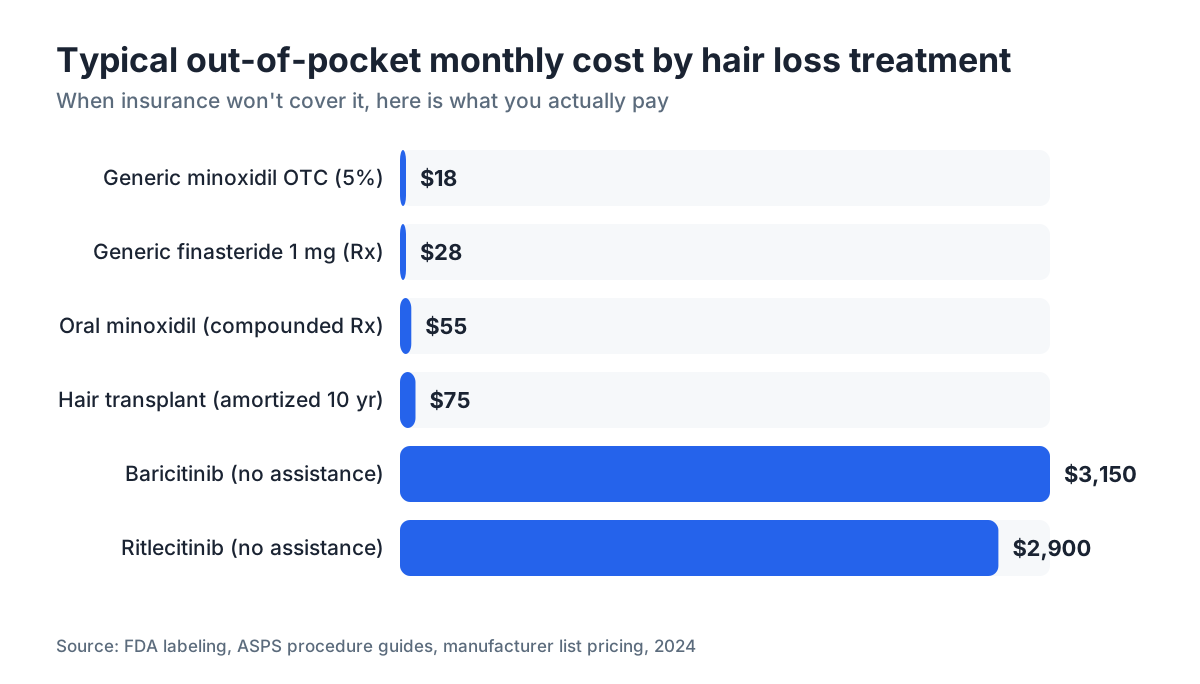
What does treatment actually cost out of pocket if insurance won't pay?
Knowing what you're spending helps you decide where to fight for coverage and where to just pay and move on.
| Treatment | Typical monthly or one-time cost | Insurance outlook |
|---|---|---|
| OTC minoxidil 5% (generic) | $10-$25/month | Not applicable (OTC); FSA/HSA eligible |
| Oral minoxidil (Rx, compounded) | $30-$80/month | Usually denied as cosmetic |
| Finasteride 1 mg (generic) | $15-$40/month | Usually denied as cosmetic |
| Baricitinib (alopecia areata) | $2,800-$3,500/month list price | Prior auth required; sometimes covered |
| Ritlecitinib (alopecia areata) | $2,800+/month list price | Prior auth required; sometimes covered |
| Hair transplant (FUE, 2000 grafts) | $6,000-$12,000 one-time | Denied for cosmetic; may cover trauma cases |
| Cranial prosthesis (wig) | $300-$3,000+ | Covered in 20+ states for medical causes |
| Scalp cooling (chemo) | $1,500-$3,000 per course | Some coverage after FDA clearance |
For most people with androgenetic alopecia, the math isn't bad. Generic finasteride plus generic minoxidil runs $25 to $65 a month combined, less than a gym membership. The coverage fight is worth having for alopecia areata or chemotherapy-related loss, where costs climb into thousands of dollars a month.
If you're not sure what type of hair loss you have, a clear diagnosis is the first step. The free AI hair analysis at MyHairline can help you see whether your pattern looks like androgenetic alopecia or something that warrants a dermatology referral before you spend money on treatments that may not fit.
How does my doctor's diagnosis code affect what gets covered?
This is the most underrated factor in the whole coverage question. Insurance companies don't read narratives, they read codes. Your physician submits an ICD-10-CM diagnosis code with every claim, and that code decides whether the claim gets processed as medical or bounced as cosmetic.
The relevant ICD-10 codes for hair loss:
- L64.9: Androgenic alopecia, unspecified (cosmetic, almost always denied)
- L63.0: Alopecia totalis (autoimmune, better coverage prospects)
- L63.1: Alopecia universalis (autoimmune, better coverage prospects)
- L63.9: Alopecia areata, unspecified (autoimmune, coverage depends on plan)
- L66.1: Lichen planopilaris (scarring, medical)
- T71 codes: Hair loss associated with trauma
- L67.8: Other specified hair color and hair shaft abnormalities
If your dermatologist codes your visit as L64.9 when you actually have L63.9, that's a billing error that costs you coverage. Before the visit ends, ask your doctor what diagnosis code they plan to submit and whether your condition might qualify under a more specific one. Physicians are busy and sometimes default to general codes.
This isn't about gaming the system. It's about making sure your real diagnosis shows up on the claim. If you have alopecia areata, that's what belongs on the claim, and it opens doors L64.9 never will.
For a receding hairline that's purely androgenetic, expect L64.9 and no coverage. If there's a scarring component or an autoimmune trigger, document it carefully.
What are manufacturer patient assistance programs, and do they help?
When insurance says no and the drug costs thousands a month, manufacturer patient assistance programs (PAPs) are sometimes the only realistic option. For the JAK inhibitors used in severe alopecia areata, both Eli Lilly (baricitinib/Olumiant) and Pfizer (ritlecitinib/Litfulo) run assistance programs.
Eli Lilly's Lilly Cares Foundation provides baricitinib to eligible uninsured or underinsured patients at no cost [13]. Pfizer's patient assistance program similarly covers ritlecitinib for qualifying patients. Eligibility rules vary, typically including income thresholds and proof of insurance status.
For patients with commercial insurance who still face high cost-sharing, manufacturer copay cards can cut out-of-pocket costs a lot. These don't work for Medicare or Medicaid patients (federal anti-kickback rules prohibit it), but for commercially insured patients they're real.
Generic minoxidil and finasteride are cheap enough that PAPs aren't usually needed. If you're paying more than $50 a month combined for both, you're probably overpaying at your current pharmacy. GoodRx and similar discount programs can bring finasteride under $10 for a 30-day supply at certain pharmacies.
The combination of finasteride and minoxidil is the most evidence-backed approach for androgenetic alopecia. Both are generic and cheap. The coverage fight isn't worth your time for these two.
What if my hair loss is from stress, diet, or another reversible cause?
Hair loss triggered by stress, crash dieting, surgery, childbirth, or illness falls under telogen effluvium. The insurance picture here is mixed but better than for pattern baldness.
Treating the underlying cause (nutritional deficiency, thyroid disease, autoimmune condition) is covered when those conditions are documented. Blood tests to diagnose iron deficiency, thyroid dysfunction, or hormonal imbalances are routine medical workups covered by essentially all plans. If treating those conditions helps your hair recover, you've gotten covered treatment that happens to improve hair loss as a secondary benefit.
The hair loss itself may not get a separate covered treatment, but the diagnostic workup should. If your dermatologist finds a correctable cause, push for thorough documentation of the underlying diagnosis, not the symptom.
For hair loss from medications you're already taking, talk to your prescribing doctor about alternatives. Medication-induced hair loss is a documented side effect of many drugs, including anticoagulants, beta blockers, retinoids, and some antidepressants. Switching to an equally effective alternative might be covered entirely. The causes of hair loss are broader than most people realize, and finding a correctable one changes the insurance math completely.
Sources
- American Academy of Dermatology, Hair Loss Overview
- HealthCare.gov, ACA Essential Health Benefits and Appeals Rights
- FDA, Olumiant (baricitinib) Approval for Alopecia Areata, 2022
- FDA, Litfulo (ritlecitinib) Approval for Alopecia Areata, 2023
- FDA, Minoxidil OTC Drug Facts Label
- FDA, Propecia (finasteride) Prescribing Information
- American Society of Plastic Surgeons, Hair Transplant Procedure Guide
- IRS Publication 502, Medical and Dental Expenses
- IRS, CARES Act OTC Drug HSA/FSA Eligibility Guidance
- U.S. Government Accountability Office, Consumer Protections for Insurance External Reviews, 2011
- National Alopecia Areata Foundation, State Insurance Mandates for Cranial Prostheses
- U.S. Department of Labor, ERISA Overview: Self-Funded Plans and State Mandates
- Eli Lilly, Lilly Cares Foundation Patient Assistance Program