

TL;DR: Hairline transplants almost always produce better aesthetic results than crown transplants. The hairline frames your face and shows up in every conversation, so even modest density there creates dramatic impact. Crown transplants need far more grafts, results are harder to predict, and ongoing hair loss can leave a transplanted island surrounded by bald scalp. Most surgeons restore the hairline first.
Why does the choice between crown and hairline transplant matter so much?
Where you put your grafts is the biggest call you make before surgery. Get it wrong and you end up with a result that looks fake, burns through a donor supply you can never replace, or ages badly as your hair loss keeps going.
Every person has a limited number of donor follicles at the back and sides of the scalp, and once they're used, they're gone. Depending on your head size and donor density, that number usually falls between 4,000 and 8,000 total grafts over a lifetime [1]. Spend a big chunk of that budget on the crown, which can swallow 2,000 to 4,000 grafts and still not look full, and you may have nothing left if your hairline keeps receding.
Surgeons who specialize in hair restoration almost always say the same thing: restore the hairline first. The hairline is what other people see when they look at you. It frames the face in conversation, in photographs, in every social interaction. The crown, by contrast, is mostly visible from above, and plenty of men with heavy crown loss still read as having a full head of hair face-to-face. That gap in social visibility is why the two areas are not equal choices.
Which area produces more noticeable aesthetic improvement: crown or hairline?
Hairline transplants produce more noticeable improvement for the large majority of patients. The reason is geometric. A receding hairline changes the whole proportion of the face, making the forehead look bigger and the face longer. Rebuild even a modest, natural-looking hairline and that perception snaps back. Patients and the people around them both register the change fast.
Crown restoration is different. The crown sits at the top and back of the head, so you often can't see it without mirrors, and people at eye level may not notice it at all. Studies on patient satisfaction after transplantation consistently rate hairline procedures higher than vertex (crown) procedures [2]. A 2016 study in the International Journal of Trichology found that patients who had anterior scalp (hairline and midscalp) restoration reported significantly higher satisfaction than those who had vertex work alone [11].
Crown restoration is not worthless. For a man who has lost hair mainly at the vertex with an intact hairline, a crown procedure can shrink the bald spot in a real way. The catch is that crown results are harder to make look natural, they eat more grafts to hit even moderate density, and the payoff per graft is lower. Hairline work gives you more result per follicle.
How many grafts does each area need, and why does that change the math?
Graft count is the currency of hair transplantation, and the crown spends it fast.
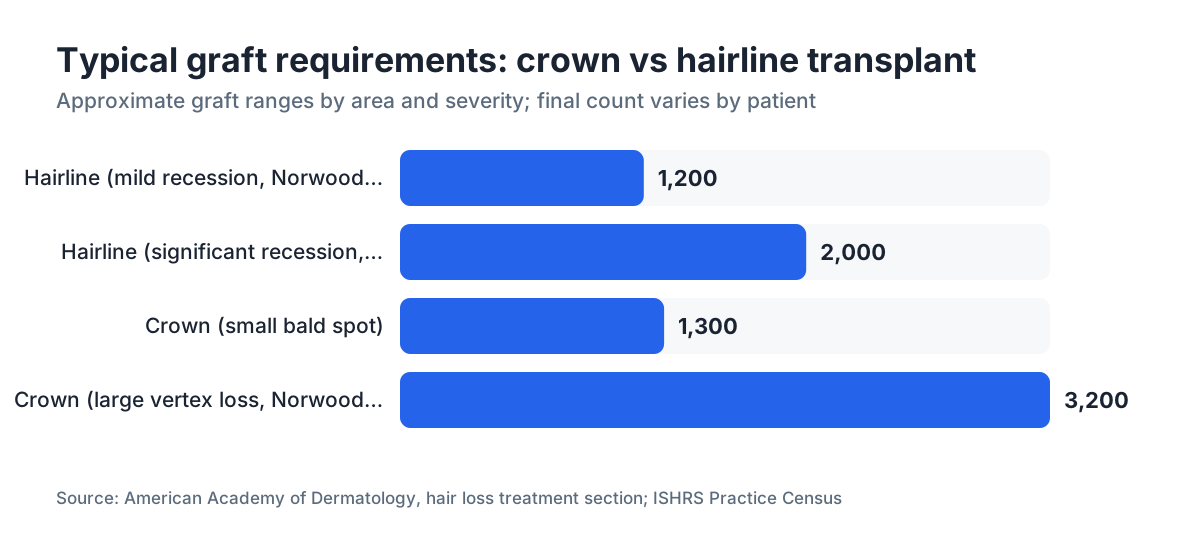
A conservative hairline restoration from Norwood stage 2 to 3 might need 800 to 1,500 grafts. A bigger rebuild for a Norwood 4 or 5 patient might need 1,500 to 2,500 grafts. Those numbers move with the density you want and the width of the hairline, but the hairline zone stays fairly contained [3].
The crown is another story. The vertex is basically a circle that widens as loss goes on. A small crown bald spot might close with 1,000 to 1,500 grafts. A larger Norwood 6-level crown can easily demand 2,500 to 4,000 grafts to look even moderately dense [3]. And because hair grows in a spiral radiating out from the crown's whorl, a natural swirl needs very precise graft angles. Put grafts in at the wrong angle and the hair grows in rows instead of a natural pattern.
| Area | Typical graft range | Avg. cost at $4 to 7 per graft | Social visibility | Risk if loss progresses |
|---|---|---|---|---|
| Hairline | 800 to 2,500 | $3,200 to $17,500 | Very high (face-level) | Hairline can be extended naturally |
| Crown | 1,500 to 4,000 | $6,000 to $28,000 | Low (seen from above) | Transplanted island becomes visible |
Those cost estimates use the per-graft pricing range reported by the American Society of Plastic Surgeons [4]. Your real quote depends on the clinic, the technique (FUE vs FUT), and where you get it done.
If you have roughly 5,000 grafts available in your lifetime and spend 3,500 on the crown, you've left almost nothing for a hairline that may keep receding.
What are the specific risks of a crown transplant that don't apply to the hairline?
The biggest crown-specific risk is what surgeons call the "halo effect" or "transplanted island." Transplant hair into the crown, then keep losing native hair around it, and the transplanted patch sits alone in bald scalp like an island. It looks obviously fake and often draws more attention than the original bald spot [5]. Avoiding it means either committing to long-term medical therapy (finasteride, minoxidil, or both) to slow surrounding loss, or accepting that more surgery may come.
Finasteride matters a lot here. Multiple randomized controlled trials show that finasteride 1mg daily significantly slows vertex hair loss [6]. The FDA approved finasteride for male pattern hair loss based on vertex outcomes, and the trials used vertex hair count as the primary endpoint. So the crown is the area where medical therapy has the strongest evidence behind it. Running a finasteride and minoxidil for men protocol before or alongside a crown transplant changes the risk math in a real way.
The hairline has its own progression risk, but the arithmetic is kinder. If your hairline recedes further after a transplant, a surgeon can add grafts to extend it, and the earlier transplanted zone blends into the new work. The hairline has a leading edge you can build on. The crown does not.
There's also the donor depletion problem. Because the crown demands so many grafts, patients who treat it first often find they don't have enough donor hair left for the hairline if loss keeps going. The American Hair Loss Association recommends that patients with early-to-moderate loss start with medical management and conservative anterior restoration before committing large graft numbers to the vertex [7].
Does the technique (FUE vs FUT) change which area is easier to treat?
Both follicular unit excision (FUE) and follicular unit transplantation (FUT, strip surgery) work for either area. But technique matters more for the crown in one specific way: angulation.
In the hairline, grafts go in at sharp angles, often 15 to 30 degrees, to copy the way natural hairline hairs lie flat against the forehead. That's demanding, but the geometry is predictable. FUE and FUT both handle it in skilled hands.
In the crown, every graft has to follow the spiral of the whorl. The angle shifts gradually as you move out from the center. FUE has an edge here because each graft goes in one at a time, giving the surgeon fine control over direction. FUT can hit the same result but needs the same skill and care. Either way, the crown demands more precision per graft than a straightforward hairline.
For FUT (strip), the linear donor scar at the back of the scalp is the same no matter where the grafts land. If you like very short hair, that scar may show more than the small circular scars from FUE. That isn't crown-specific, but it shapes overall planning.
If you're comparing hair transplant techniques, the crown's technical demands make surgeon experience count even more. A well-placed hairline from an average surgeon still looks natural. A poorly angled crown looks wrong in a way that's hard to fix.
What does the evidence say about patient satisfaction after crown vs hairline transplants?
Direct head-to-head randomized trials comparing crown versus hairline satisfaction don't exist, because you can't ethically randomize patients to a procedure they don't need. What we have is observational data and surgeon-reported outcome series.
A 2016 study in the International Journal of Trichology surveyed patients after transplantation and found that those who had anterior scalp (hairline and midscalp) restoration reported significantly higher satisfaction than patients who had vertex work alone [11]. The authors tied that partly to greater social impact and partly to how predictable the hairline zone is.
The International Society of Hair Restoration Surgery (ISHRS) tracks member survey data and consistently finds that patients presenting mainly for crown loss are more likely to be steered toward medical management first, with surgery deferred or limited [8]. That's not because surgeons refuse crown work. It's because experienced surgeons know the satisfaction odds favor the hairline.
Patient forums and long-term follow-up point to one repeated finding: men who got aggressive crown transplants in their 20s and 30s, before their loss pattern settled, show up disproportionately among the "bad transplant" cases discussed in the literature and in patient communities. The crown is where a visually bad outcome is most likely when the patient is young and loss is still moving.
Are there situations where treating the crown first actually makes sense?
Yes, and a good surgeon will tell you so.
The strongest case for crown-first is a patient with a stable, intact hairline and isolated vertex loss. If your hairline hasn't moved in a decade, you're on finasteride, and your crown bald spot bothers you far more than your hairline (which may be barely touched), a focused crown procedure is reasonable. The island risk shrinks when the surrounding hair is stable and medical therapy is running.
Age matters too. A patient over 50 or 60 whose loss has stabilized across the whole scalp faces a different math than a 28-year-old with active progression. In a stable older patient, a crown transplant carries far less island risk because there isn't much native hair left to lose around it anyway.
Some patients genuinely don't care about their hairline. They live in hats, style their hair with the hairline hidden, and the crown is their only real concern. This is where surgeon-patient conversation counts. The surgeon's job is to lay out the risk-benefit picture honestly, not to push a preference.
If you're unsure about your progression risk, a receding hairline assessment and some what causes hair loss research help clarify whether loss is likely to keep going. If you haven't tried a DHT blocker yet and you're eyeing crown surgery, most surgeons will ask for at least a year of medical therapy first.
How do surgeons decide which area to prioritize in a consultation?
A thorough consultation weighs five things: current Norwood stage, donor density, projected future loss, patient priorities, and medical therapy history.
Norwood staging is the starting frame. Norwood 1 to 3 patients with hairline recession and intact crowns get pointed to hairline work almost every time. Norwood 5 to 7 patients with both areas hit face a graft allocation talk where the surgeon maps what's achievable with the donor supply on hand [9]. Norwood staging exists to help surgeons and patients predict this progression, and using it right is how you avoid a result that looks good at 35 and terrible at 45.
Donor density gets measured with trichoscopy or a densitometer. A patient with high donor density (more than 90 follicular units per square centimeter) has more room to move than someone with sparse reserves. Sparse donors should be spent carefully, which usually means the hairline first.
Projected future loss is the hardest variable. Family history, age, rate of current loss, and response to finasteride all feed in. This is where honest uncertainty matters. Nobody can tell you exactly how much hair you'll lose by 55. A surgeon who claims certainty here is either naive or selling you something.
If you want a preliminary read on your own pattern before a consultation, the free AI scan at MyHairline.ai can flag your approximate Norwood stage and which areas show active thinning. It doesn't replace a clinical exam. It gives you a foundation for a smarter conversation with your surgeon.
What does a successful hairline transplant look like, and what makes it fail?
A successful hairline transplant looks like a hairline nobody notices. The goal isn't density. It's naturalness. A real hairline has irregular micro-transitions, single-hair follicular units at the very edge, and a slight temporal recession that fits the patient's age. Surgeons who build a perfectly straight, maximally dense hairline are making something that looks fake, because no natural hairline looks like that.
The most common hairline failures: placing the line too low (which looks odd as the face ages and skin loosens), using multi-hair grafts at the leading edge (a pluggy look), and cutting a perfectly straight line instead of a feathered, irregular border.
A properly placed hairline uses single-hair grafts at the transition zone, moving to 2 and 3-hair grafts behind it. The temporal points (the corners) need specific attention because they frame the face. An aggressive square hairline looks unnatural. A slightly receded, age-appropriate hairline looks like the patient just has good hair.
Recovery is similar for both areas: transplanted hairs shed at weeks 2 to 6, regrowth begins at months 3 to 4, and final results land at 12 to 18 months [10]. The crown often looks thinner at the 6-month check than the hairline because the wide surface area dilutes visual density even when the graft count was right. Warn patients about this so they don't panic.
Should you use finasteride or minoxidil before or after a hair transplant?
Short answer: yes, especially if you're treating the crown.
Finasteride blocks the conversion of testosterone to DHT, the hormone that miniaturizes follicles in genetically susceptible hair [6]. The FDA approved it for male pattern baldness at 1mg daily. The registration trials showed vertex hair count improvements in roughly 65 to 80 percent of men after two years [6]. The crown is where most men are most DHT-sensitive, which means it's also where finasteride shows its strongest measurable effect.
Get a crown transplant without finasteride and keep losing the native hair around it, and you're spending tens of thousands of dollars on a result that may look worse in five years than before surgery. The transplanted follicles resist DHT (they came from the back of the scalp), but the native hairs around them don't. Finasteride protects the native hairs that make the transplant look dense and integrated.
Minoxidil helps too, mostly in the post-operative window. Some surgeons recommend topical or oral minoxidil after transplantation to support graft survival and speed regrowth, though the evidence for improved graft survival specifically is thin. The better-supported job of minoxidil is keeping the native hairs next to the transplant zone. Read the minoxidil side effects profile before starting, especially for the oral form.
If you want both drugs, the finasteride and minoxidil combination has better trial evidence than either alone and is worth discussing with a dermatologist before or alongside transplant planning.
What is the realistic cost difference between crown and hairline transplants?
Crown transplants cost more, usually a lot more, because they need more grafts.
The American Society of Plastic Surgeons reported that hair transplantation procedures averaged about $10,000 in 2022, though that figure hides a wide range [4]. Per-graft pricing usually runs $4 to $10 in the United States, with higher-end FUE clinics charging at the top. FUT (strip) procedures often run $1 to $2 cheaper per graft.
Using midpoint pricing ($6 per graft), a 1,500-graft hairline procedure costs around $9,000. A 3,000-graft crown procedure runs about $18,000. A combined session covering both areas for a Norwood 5 patient might need 4,000 to 5,000 grafts and cost $24,000 to $35,000 at those rates.
Medical tourism drops the per-graft cost hard. Clinics in Turkey, for instance, advertise all-inclusive packages (accommodation, procedure, aftercare) for $2,000 to $5,000 regardless of graft count. The ISHRS has published guidance warning patients about variable quality in medical tourism, noting that complication and revision rates run higher when the choice is driven mainly by price [8]. The savings are real. So is the risk.
One number worth holding onto: a 2022 ISHRS member survey found the average FUE procedure worldwide involved roughly 2,000 to 2,500 grafts [8]. Procedures needing more than 3,500 grafts in a single session, as large crown restorations often do, push the technical limits of what can be transplanted safely in one day while keeping grafts viable.
Can you get a crown and hairline transplant in the same session?
Yes, and many surgeons do combined sessions. Whether it's right for you depends on how many grafts each area needs and how much donor hair you have.
For a patient with high donor density and moderate loss in both areas, a single session of 3,000 to 4,000 grafts might send 1,500 to 2,000 to the hairline and the rest to a partial crown fill. This is common for Norwood 3 to 4 patients with good donor reserves who want both areas addressed at once.
The worry with large combined sessions is donor site recovery. Pulling 4,000 or more grafts in a single FUE session puts real trauma on the donor zone, and some surgeons argue that splitting big requirements across two sessions months apart produces better graft survival and better donor healing. There's no definitive trial data on this specific question.
A sensible path for most patients with both areas affected: do the hairline fully in the first session, wait 12 to 18 months for full results and to see how loss is trending, then decide about the crown. That keeps your options open. If your loss stabilizes or finasteride holds the crown, you may never need the second procedure.
If you're early in mapping out your situation, reading about telogen effluvium helps you tell temporary shedding (which won't benefit from transplantation) from permanent pattern loss that surgery might address.
Sources
- International Society of Hair Restoration Surgery (ISHRS)
- Journal of Cutaneous and Aesthetic Surgery, 2018: Patient satisfaction in hair transplantation (PMC)
- American Academy of Dermatology, hair loss treatment section
- American Society of Plastic Surgeons, plastic surgery statistics
- National Center for Biotechnology Information, review of hair restoration complications (PMC)
- FDA Drugs@FDA, Propecia (finasteride 1mg), NDA 020788
- American Hair Loss Association
- ISHRS, Practice Census and World Hair Transplant surveys
- Norwood classification, original description: O'Tar Norwood, Southern Medical Journal 1975 (PubMed)
- American Academy of Dermatology, hair loss treatment section
- International Journal of Trichology, 2016: Outcomes after hair restoration surgery (PMC)