

TL;DR: A hair transplant in Turkey, Thailand, or Eastern Europe usually costs $1,500 to $4,000 against $10,000 to $25,000 in the US or UK. The savings are real. So are the risks: infection, graft failure, and scalp necrosis all show up in published case reports, and fixing bad work often costs more than doing it right the first time. The math only works if you vet the clinic as hard as you'd vet a surgeon at home.
How much cheaper is a hair transplant abroad, really?
The price gap is big and well-documented. A follicular unit extraction (FUE) in the United States runs $8,000 to $25,000 depending on graft count and city [1]. The same procedure at a reputable Istanbul clinic costs roughly $1,500 to $4,000 all-in, often with hotel and airport transfers thrown in [2]. That's not a minor discount. On a 3,000-graft case, the difference can hit $12,000 to $18,000.
The table below shows published average costs by country for a mid-range FUE (2,500 to 3,000 grafts):
| Country | Avg. total cost (USD) | Includes hotel? |
|---|---|---|
| United States | $12,000 to $20,000 | No |
| United Kingdom | $8,000 to $15,000 | No |
| Turkey | $1,800 to $4,000 | Often yes |
| Thailand | $3,000 to $6,000 | Varies |
| Poland | $3,500 to $6,500 | Varies |
| India | $2,000 to $5,000 | Varies |
Why the gap? Labor costs, clinic overhead, and currency differences do most of the work. A surgical technician in Istanbul earns a fraction of what one earns in New York. That's not a quality statement. It's economics. The real question is whether lower labor cost means lower quality care, and the honest answer is sometimes yes, sometimes no.
Travel adds some cost back. A round-trip to Istanbul from the US runs $700 to $1,200. Budget a week's recovery stay at $50 to $100 per night and you add $1,000 to $1,900 more. Even then, the net saving against a US procedure sits at $8,000 to $15,000 for most patients. That's real money, and it's the reason 500,000-plus people fly to Turkey for this every year.
What are the actual medical risks of going abroad for a hair transplant?
The risks of hair transplantation don't change with geography. Infection, scarring, folliculitis, graft shock loss, and poor aesthetic results are possible anywhere [3]. What changes abroad is your ability to assess those risks up front and get follow-up care if something goes sideways.
Infection is the most reported serious complication in medical tourism case series. Published dermatology case reports document scalp necrosis after hair transplants at unregulated clinics, especially where huge sessions (over 5,000 grafts in a single day) get done by technicians instead of physicians. Scalp necrosis, where tissue dies because the blood supply is compromised, can be permanent and disfiguring.
Graft yield failure is less dramatic but far more common. Poor planning, bad graft handling, or technician-led extractions can drop survival rates well below what a well-run clinic achieves, and the International Society of Hair Restoration Surgery has flagged exactly this pattern [5]. You won't know until 9 to 12 months post-op, when the final result comes in.
The ISHRS ran its "Fight the FIGHT" campaign warning against what it calls black market hair restoration, singling out unlicensed technicians who perform most of the surgical work while a physician signs the paperwork [5]. That setup is widespread in some high-volume clinics in Turkey and elsewhere.
The most underrated risk is revision. If a procedure abroad goes wrong aesthetically (an unnatural hairline, thin density, a visible scar), fixing it at home means paying full price again, often more, because corrective work is harder. Some surgeons charge a premium for it. One bad outcome erases the entire $10,000 saving.
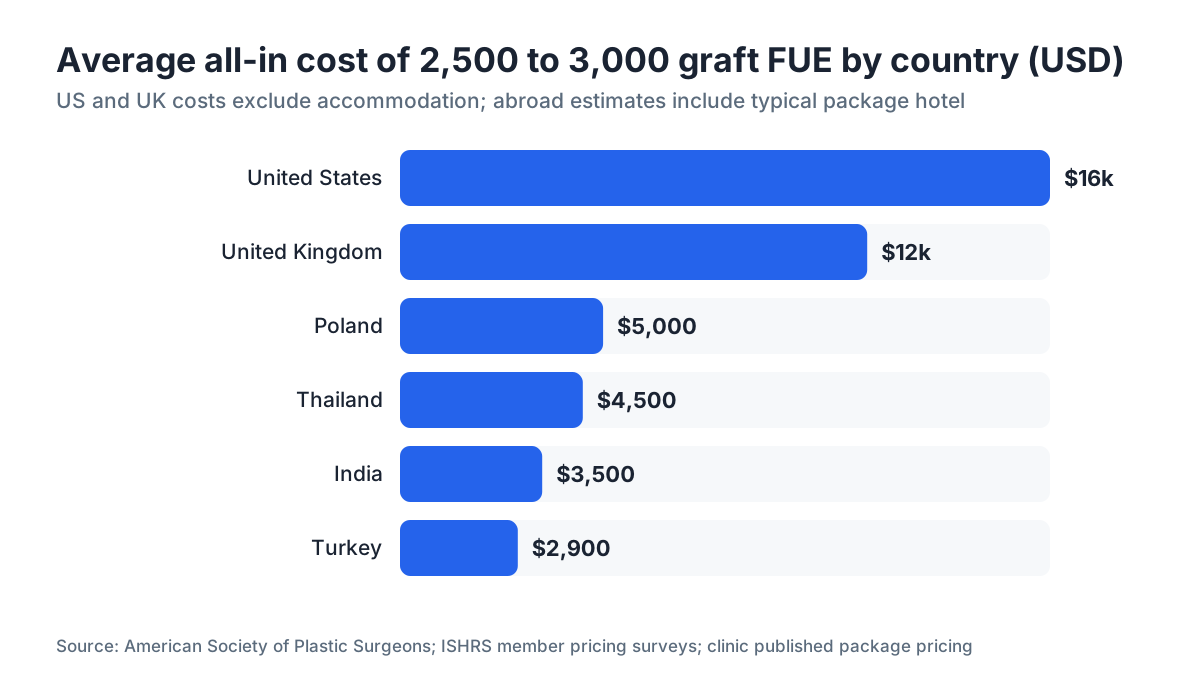
Which countries are most popular for hair transplants and how do they compare?
Turkey, and Istanbul in particular, runs the medical tourism market for hair transplants. The country has hundreds of clinics and performs an estimated 500,000 to 700,000 procedures a year, more than anywhere else [2]. Regulation sits under the Turkish Ministry of Health, which requires a licensed physician to lead procedures on paper, but enforcement is patchy and the ISHRS has documented violations [5].
Thailand has a smaller, older medical tourism industry. Joint Commission International (JCI) accredits hospitals there, which is a real quality signal. JCI accreditation means a facility meets standards comparable to those used for US hospitals [6]. Not every hair clinic in Thailand carries it, so check each one.
Poland and other Central and Eastern European destinations pull UK and Western European patients because they're close. Regulatory frameworks track EU medical device and practice standards, which gives you a baseline of protection.
India has plenty of qualified dermatologists and plastic surgeons doing hair restoration. The quality range is enormous. Mumbai and Delhi have internationally trained surgeons with strong track records sitting alongside budget operations that cut corners.
The country isn't the deciding factor. What matters is whether the clinic is physician-led, whether that physician is board-certified in dermatology or plastic surgery, and whether the before-and-after portfolio and reviews are verifiable somewhere other than the clinic's own marketing.
How do you vet a hair transplant clinic abroad?
Start with credentials, not the website. Look the physician up on the national medical board registry. In Turkey, check the Turkish Medical Association. In Thailand, look for the doctor with the Medical Council of Thailand. This takes twenty minutes and filters out a lot of problem operations.
Check ISHRS membership. The society keeps a searchable directory of member physicians at ishrs.org. Membership is no guarantee of quality, but it means the surgeon has committed to ethical guidelines that flatly prohibit handing surgical tasks to unlicensed staff [5].
Ask specific questions before you book:
- Who performs the extractions? Who makes the incisions? If the answer is "our technicians" with no physician present, walk away.
- What's the maximum grafts you'll do in a single day? Anything above 3,500 to 4,000 grafts in 8 hours should make you ask hard questions about graft handling.
- What's your graft survival rate, and how do you measure it? A legitimate clinic can answer this.
- What happens if I need follow-up or revision? Do you have a contact in my home country?
Look at before-and-after photos with suspicion. Third-party forums like the Hair Restoration Network host unfiltered patient result threads. Search the clinic name there. A clinic with testimonials only on its own site and zero independent forum presence should worry you.
Get the medical records package in writing. You need the operative report, graft count, placement map, and post-op protocol before you fly home. Without those documents, any physician treating a complication back home is working blind.
What happens if something goes wrong after you're home?
This is the part most people skip before booking. Once you're back home, the clinic abroad has limited legal and practical responsibility. Malpractice claims across international borders are extraordinarily hard and expensive to pursue, and the legal costs usually exceed anything you'd recover [7].
Your home-country dermatologist or surgeon handles the complications, and they charge full rates. A scalp infection needs antibiotics and possibly debridement. Necrosis needs specialist wound care and maybe reconstructive work. Poor graft yield needs another procedure. None of it is covered by your original package price.
Health insurance in the US and UK generally won't touch elective cosmetic procedures or their complications. The FDA hasn't approved hair transplant surgery as a treatment for any condition; it's a surgical procedure governed by state licensing, not federal FDA approval [8]. No federal safety net here.
A serious infection sends you to the ER, and the ER bills you. For complications that aren't life-threatening but need specialist follow-up, expect out-of-pocket dermatology visits of $200 to $500 each in the US, with no insurance covering a cosmetic complication.
The practical move: before you travel, find a dermatologist or hair restoration surgeon in your city who agrees to provide follow-up care if you need it. Have that conversation first, not after.
Are the savings worth it? The honest cost-benefit math
Here's a realistic scenario for a US patient looking at a 2,500-graft FUE.
At home (US): $14,000 average total, one consultation, local follow-up included, legal recourse available.
Abroad (Istanbul), best case: $2,500 procedure + $900 flight + $700 accommodation (7 nights) + $200 incidentals = $4,300 total. Net saving: about $9,700.
Abroad (Istanbul), complication scenario: $4,300 base + $1,500 home-country dermatology follow-up + $3,000 to $8,000 for partial revision if yield is poor = $8,800 to $13,800. The saving vanishes or goes negative.
The math favors going abroad if you pick a well-vetted, physician-led clinic and get an uncomplicated outcome, which is the majority of cases. The math turns ugly fast in the tail scenario.
One cost people underrate: the psychological hit of a bad outcome. Hair loss is already stressful. A botched procedure, a visible scar, or a hairline that reads as fake takes a real toll before it's fixed. You can't put a number on it, but it's there.
If you're early in the process and still working out whether you even need a transplant, or whether finasteride or minoxidil for men might handle it, get that assessment first. A transplant is permanent surgery. The MyHairline free AI scan (/scan) helps you read your current hair loss stage before you commit to anything, so you're not paying for surgery when a pill might do the job.
For a fuller picture of what a hair transplant involves (graft counts, technique differences, realistic outcomes), read that before you start comparing clinics.
What does regulation look like for hair transplants in the US vs. abroad?
In the United States, hair transplantation is surgery regulated at the state level. Every state medical board requires a licensed physician to perform surgery. The FDA doesn't regulate the surgical act, but it does regulate the devices used, like FUE punches and the ARTAS robotic system, under the 510(k) clearance pathway [8].
The American Board of Hair Restoration Surgery (ABHRS) offers board certification for the specialty, and the American Academy of Dermatology (AAD) publishes practice guidelines on hair loss evaluation and surgical treatment [9]. Neither body has legal enforcement power, but their standards define what competent US practice looks like [12].
In Turkey, the Ministry of Health issued regulations in 2011 and has updated them since, restricting hair transplants to licensed physicians in approved facilities [2]. Enforcement is the weak point. The ISHRS has documented widespread violation of these rules by surveying members who treated patients arriving with complications from Turkish clinics [5].
In EU member states (Poland, Hungary, the Czech Republic), the EU Medical Devices Regulation and national practice laws set a baseline. Physicians have to be licensed by national medical councils, and enforcement is generally steadier than in Turkey or parts of Southeast Asia.
The takeaway: rules on paper don't mean individual clinics follow them. Credentialing the specific physician beats trusting the country's regulatory reputation.
What red flags should make you walk away from a clinic?
Price is the easiest red flag to spot and the most misread. Rock-bottom prices (under $1,000 for any meaningful procedure) are a warning. But price alone doesn't disqualify a clinic. A $2,500 all-in package in Istanbul from a solid clinic is realistic given local labor costs. What matters is what that price buys.
The flags that actually matter:
No named surgeon. If the site only talks about "our team" and never names the physician who'll do your procedure, that's a problem.
Unlimited grafts packages. "All the grafts you need for one price" sounds great. It rewards overextraction, which wrecks the donor area and produces lower-quality grafts.
Technician-led procedures. If the consultation reveals that technicians do extractions and incisions while a physician supervises remotely or drops in briefly, that breaks good-practice standards and, in many countries, the law.
No real consultation. A reputable clinic offers at least a video consult with the physician, more than a sales coordinator.
Pressure tactics. "Book this week for the discount" is a sales move, not medicine. A surgeon who pushes you to commit before you've done your homework isn't one you want.
Unverifiable reviews. If the only reviews you can find live on the clinic's own site or paid review platforms, that tells you something. Search the clinic name on independent forums instead.
Does going abroad affect your post-op care and long-term results?
Post-operative care matters more than most people expect. The first 10 to 14 days after a transplant decide a lot: how grafts settle, whether infection sets in, how the scalp heals. Clinics abroad usually give 1 to 3 days of in-person post-op care before you fly home [3]. That covers the immediate recovery, but it leaves the critical healing weeks to you and whatever instructions you were handed.
Flying itself isn't dangerous for grafts after 48 to 72 hours, but low cabin humidity dries the scalp and travel stress doesn't help healing. Most surgeons want you to wait at least 5 to 7 days before flying, though protocols vary by clinic.
Long-term results ride on the same factors no matter where surgery happens: graft survival, donor management, and whether the hairline design accounted for future loss. That last point is the one people miss. A hairline drawn for your current age can look wrong in 10 to 15 years as loss progresses. A surgeon who plans around your likely long-term hair loss trajectory instead of your current state is thinking about your outcome the right way.
If you're managing progressive androgenetic alopecia, the finasteride and minoxidil conversation matters after a transplant too. Transplanted hairs resist DHT, but your native hairs stay susceptible. Skip the medication and ongoing native loss can leave a transplanted hairline stranded over time [10].
Are there things medical tourism packages often don't include?
Yes. Read the package terms line by line.
Most all-inclusive packages cover the procedure, hotel, and airport transfers. They often leave out:
- Pre-operative blood tests (required by most clinics, $50 to $200 at home or on arrival)
- Post-op medications (antibiotics, pain relief, topicals, $50 to $150)
- PRP (platelet-rich plasma) sessions pushed after the procedure (often upsold at $200 to $500 each)
- Any follow-up treatment if results come up short
- Revision procedures (some clinics offer free touch-ups within a year; get it in writing)
- Your time off work (recovery is typically 10 to 14 days before you look presentable, longer for FUT strip procedures)
The pre-op workup deserves attention. A responsible clinic requires bloodwork checking clotting factors, a CBC, and sometimes hepatitis and HIV status before surgery [3]. A clinic that skips this is showing you its safety standards.
Medical travel insurance is worth buying for any international procedure. Policies built for medical tourism exist and can cover complications that surface after you get home. Standard travel insurance usually excludes elective procedures. Read the exclusion clauses before you pay.
How does a hair transplant abroad compare to non-surgical alternatives?
Before you commit to surgery anywhere, be honest about whether surgery is the right tool for your situation.
Finasteride (1 mg daily, prescription) stops or slows androgenetic alopecia in roughly 83 to 90% of men and produces visible regrowth in about 66% after two years, per the original approval trial data [10]. It costs $20 to $60 a month in the US with a prescription. For men in earlier Norwood stages, especially Norwood 1 to 3, medication can deliver meaningful results without surgery.
Topical minoxidil (2% or 5%) applied twice daily has FDA approval for androgenetic alopecia and sells over the counter [11]. Results are modest next to finasteride for most men, but the two stack well together. If you haven't tried either, or you're unsure of your hair loss stage, that's the starting point, not surgery. Read up on minoxidil for men or finasteride while you weigh it.
Surgery makes the most sense when loss is stable rather than racing along, donor density is adequate, and expectations about coverage and density are realistic. A transplant moves existing hairs. It doesn't make new ones. If donor supply is thin relative to the area you need to cover, even a flawless procedure won't reach full density.
The MyHairline AI scan (/scan) gives you a starting read on your Norwood stage and coverage pattern, which frames whether surgery is a reasonable next step before you spend a dime.
For women reading this: hair transplantation for female pattern hair loss follows different rules. Donor supply, diffuse versus patterned loss, and candidate selection all differ from the male case. The AAD recommends specialist evaluation for women before any surgical recommendation [9].
Sources
- American Society of Plastic Surgeons, Procedural Statistics
- American Academy of Dermatology, Hair Loss: Diagnosis and Treatment
- International Society of Hair Restoration Surgery (ISHRS), Fight the FIGHT campaign
- Joint Commission International, Accreditation Standards
- U.S. Department of State, Your Health Abroad
- U.S. Food and Drug Administration, Medical Devices
- American Academy of Dermatology, Clinical Guidelines: Hair Loss
- New England Journal of Medicine, finasteride clinical trial data
- U.S. Food and Drug Administration, Drugs
- American Board of Hair Restoration Surgery, Certification Standards