

TL;DR: Most people need 7 to 14 days off work to hide a hair transplant from coworkers. Redness, scabbing, and a swollen forehead are the hardest parts to hide. With the right timing, a loose hat, and a believable excuse, most patients get back to the office without anyone catching on. Unshaved FUE cuts that visible window to 5 to 7 days.
Why is hiding a hair transplant from coworkers so hard?
A hair transplant is surgery. The scalp bleeds, swells, forms scabs, and then sheds every transplanted hair before anything grows back. That whole run of visible events is what makes concealment tricky, not some faint pinkness you could powder over.
The first 24 to 72 hours are the worst. The forehead and sometimes the area around the eyes swell as anesthetic fluid and surgical edema drift down with gravity. Some patients wake up on day two with eyelids so puffy they look like they lost a fight. [1] After the swelling settles, a crust of tiny dried blood dots covers the recipient zone for roughly 7 to 10 days. Those crusts fall off on their own. Pick them early and you can pull grafts loose and wreck the result.
The donor area, usually a shaved strip or the buzzed FUE harvest zone at the back and sides, has its own problem. If you normally wear your hair long, a suddenly bare or stubbly nape is hard to explain without a story.
Here's the honest part. You cannot fully hide a fresh transplant from someone who sees you every day and pays attention. What you can do is control the timeline and the story well enough that most coworkers never put the pieces together.
How long do you actually need off work to hide a hair transplant?
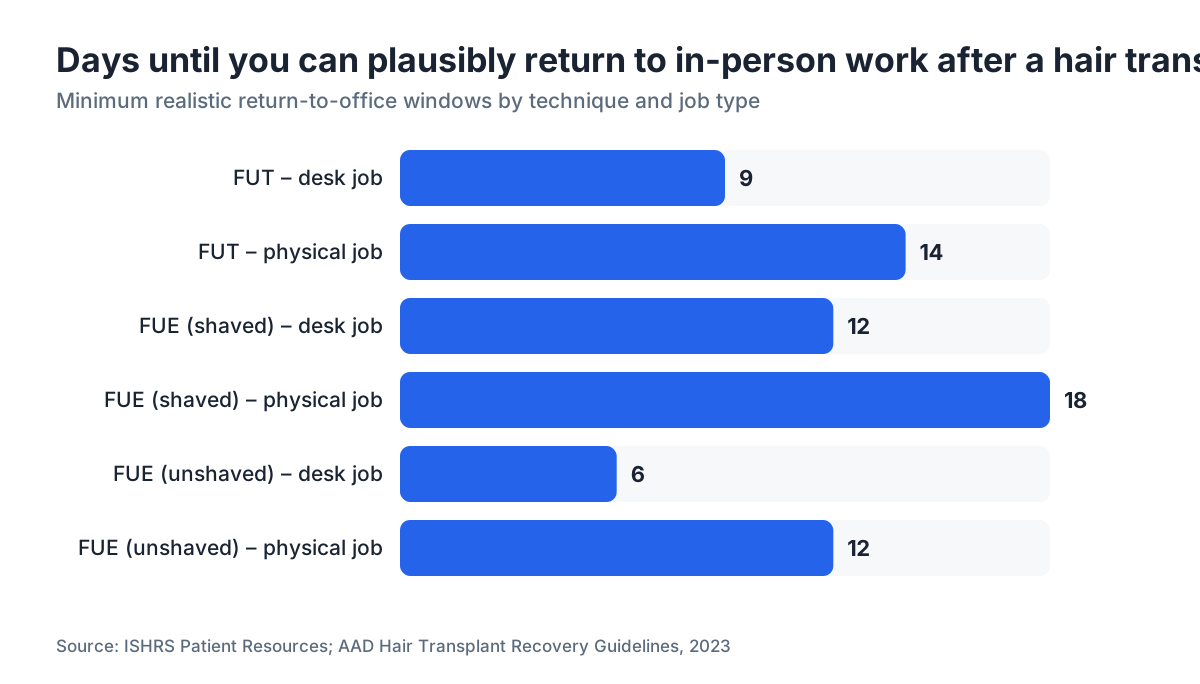
The number most surgeons use is 7 to 14 days. That window gets you past the worst swelling (days 1 to 3), through the active scabbing phase (days 4 to 10), and into the point where the scalp looks pink but not obviously post-op. [1]
The type of transplant changes the math:
| Technique | Visible donor area | Crusting duration | Realistic return to office |
|---|---|---|---|
| FUT (strip) | Linear scar, hidden by hair | 7 to 10 days on top | 7 to 10 days |
| FUE (shaved donor) | Buzzed look, obvious if hair was long | 7 to 10 days on top | 10 to 14 days |
| FUE (unshaved/long hair) | Nearly invisible donor | 5 to 7 days on top | 5 to 7 days |
Unshaved FUE is a real option at select clinics. The surgeon leaves the surrounding hairs long and shaves only the individual extraction sites, so the donor area looks normal from arm's length almost right away. The tradeoff is a longer procedure and a surgeon who has genuinely done a lot of them. [2]
If your job is physical, add another week. Sweating, bending, or lifting in the first 7 to 10 days raises scalp blood flow and risks dislodging fragile grafts before they anchor. [3] Desk workers have it easier, though a Zoom-heavy job puts your face on camera all day, which is its own scrutiny.
The safest buffer for a desk job is 10 days. Book it, commit to it, and don't let a work deadline shrink it.
What does the scalp look like at each stage, and when is it safe to be seen?
Knowing the visual timeline lets you pick your return date with real precision.
Days 1 to 3: Swelling runs the show. The recipient area looks pinkish-red and slightly matted from dried blood and anesthetic fluid. Forehead swelling peaks around day 2 and clears by day 3 to 4 in most people. Sunglasses help outdoors. Nothing hides it indoors. Stay home.
Days 4 to 7: The swelling goes down. Small brown-red crusts form around each graft site. From a few feet away the top of the scalp looks dotted or textured. A loose hat covers this almost completely. [4]
Days 7 to 14: The crusts shed. The scalp underneath is pink. Most transplanted hairs start to fall out (called shock loss or post-transplant effluvium), which is normal and temporary. [5] The recipient zone can look thinner than it did before surgery during this phase, which is psychologically brutal but nothing to panic about. This is also the easiest stretch to hide cosmetically, because the scalp surface has mostly healed.
Weeks 3 to 12: The ugly phase. Most transplanted hairs have shed. The scalp looks roughly like it did before surgery, or a touch thinner. Nobody would guess you had surgery. You also won't look like you did anything good yet.
Months 4 to 6: Regrowth begins. Thin, fine hairs push through. Progress is slow and uneven. [6]
Months 9 to 18: The result fills in. The American Academy of Dermatology says final results from a hair transplant can take up to 18 months to fully mature. [6]
The practical takeaway: days 1 to 10 are the window you have to control. After that, the surgery is basically invisible to coworkers, and you have months before there's any result to explain.
What are the best physical strategies for hiding the signs?
Hats are the blunt and effective tool. A loose baseball cap or beanie goes over gauze or a breathable surgical cap without touching the grafts, as long as you're careful putting it on and taking it off. Most surgeons clear patients for a loose hat by day 2 or 3. [4] A tight-banded hat that presses on the recipient zone is a graft-dislodging risk in the first week.
Styling bridges the gap for people with longer surrounding hair. Your own hair, combed gently over the recipient zone, can mask the crusting almost completely on days 4 to 10. No heat tools for the first two weeks. The scalp is healing and the grafts are delicate.
Sun protection matters past cosmetics. Newly transplanted scalp is unusually sensitive to sun, and UV damage in the first months can cause permanent pigment changes. [3] SPF 50+ or a physical cover is worth it whether or not you're hiding anything.
Scalp concealers (fibers, powders, sprays) don't belong on your head in the first two weeks. They need rubbing or firm pressure to remove, which risks graft damage. Once the grafts anchor, usually around day 10 to 14, keratin fiber concealers become an option to fill in the texture difference.
If you can work from home for the first week or two, do it. Video calls let you control the camera angle, wear a hat, and skip the scrutiny of someone sitting two feet away.
What excuse should you give coworkers for taking time off?
You don't owe your coworkers a medical explanation. Full stop. Employment law in the US and UK treats medical leave as private, and you can legally use PTO, vacation, or FMLA without naming the procedure. [7]
Still, a vacuum invites gossip. Most people find a vague but plausible reason easier to hold than total silence. Realistic options:
The travel excuse. "Taking a week off, going somewhere warm." Nobody demands an itinerary. When you come back in a hat looking slightly different, they assume a tan.
The minor surgery excuse. "Had a minor procedure, nothing serious, fully recovered." All true. It deflects curiosity without giving specifics.
The skin condition excuse. "Been dealing with a scalp thing, got it treated." Broad, accurate, boring enough that people drop it.
The family obligation. "Family stuff, all good." No follow-up expected.
For the return-to-office hat, a casual mention up front helps. "Scalp's still a little irritated from the treatment, so I'm keeping it covered a couple weeks" lands flat. People nod and move on. What they picture is almost always duller than the truth.
Skip the elaborate cover story. Detail invites detail questions. The simpler the story, the easier it is to keep straight.
Can you wear a hat at work after a hair transplant, and for how long?
Yes. A loose, clean hat is fine at most workplaces during recovery, and few employers have hat policies built for medical recovery. If your workplace is formal, a head covering described as a post-procedure medical requirement almost always gets accommodated without a fight.
The medical side has its own timeline. In the first 48 to 72 hours, a surgical cap or the dressing your clinic gives you is standard. After that, surgeons generally approve a loose, clean baseball cap or beanie once the grafts are past the most fragile phase. [4] Tight hats, brimless knit caps that cling to the scalp, and anything with an internal sweatband touching the recipient zone should wait until day 10 to 14.
By week two, the grafts are anchored and hat pressure is no longer a graft-safety concern. At that point the hat is purely cosmetic cover, and you can keep it as long as you like. Most people only need it for 1 to 2 weeks at the office before the scalp looks normal enough (or different enough from surgery) that cover isn't necessary.
What about video calls and remote work during recovery?
Video calls in the first two weeks are manageable with a little thought.
Camera angle matters more than anything else. A slightly raised camera (laptop on a stack of books) plus soft front-facing light hides most scalp visibility with zero cosmetic help. Avoid overhead lighting, which throws shadows and highlights texture on the scalp.
A hat on camera is completely normal in 2024 to 2025. Most people won't say a word. If your culture is formal and a hat would itself draw eyes, the scalp-condition story covers it.
Audio-only calls are nothing to worry about. Plenty of people book surgery to overlap with a stretch of planned calls or internal work that doesn't need video.
One real thing to plan for: you'll likely feel tired and maybe have a mild headache for the first few days. Working from home during recovery is not as easy as it sounds. Build in actual rest. Running calls while your scalp is actively healing helps neither you nor the result, and most surgeons want you resting for real in the first 48 to 72 hours. [3]
What are the biggest mistakes people make when trying to hide a hair transplant?
Going back too soon. The pull to return after five or six days, once you feel physically okay, is strong. Don't. The scalp still has active scabs, the forehead may still be puffy, and a coworker who sees you daily will notice something's off even if they can't name it. Ten days is the realistic minimum for most FUE and FUT procedures.
Telling too many people. Every person you tell is a variable you can't control. Want privacy? Tell nobody at work. Want a small support circle? One trusted colleague, max. "It stays between us" rarely does.
Building an overly specific cover story. A named holiday destination, a specific diagnosis, a detailed treatment plan, all of it creates facts that can be checked or accidentally contradicted. Vague is safer.
Forgetting the donor area. People burn so much worry on the recipient zone that they overlook how the back and sides look post-FUE. If you normally wear your hair in a way that shows the nape, adjust before you go back. A higher collar, or a different part, handles it.
Using products too early. Some people reach for concealer fibers, sprays, or styling products before the 10 to 14 day anchoring window closes. That risks pulling grafts loose and pushing bacteria into healing follicle sites. [3]
Having no answer for the eventual result. Six to twelve months out, you may have noticeably more hair. That's when someone says, "did you do something different?" A casual answer ready now ("changed my haircut," "using something new," "eating better") saves you a fumble later.
Should you tell HR or your manager about the procedure?
You are not legally required to disclose the specific nature of a hair transplant to take medical leave in the US. Under the Family and Medical Leave Act, employees at covered employers can take up to 12 weeks of unpaid, job-protected leave for a serious health condition, and the employer is entitled to medical certification that leave is needed, not to a diagnosis. [7] A hair transplant generally counts as a planned elective procedure, and your doctor can provide certification without naming it.
For shorter absences on PTO or vacation, no medical disclosure is needed at all.
The real question is whether your manager needs anything to approve the leave. Most people take one to two weeks of vacation or PTO. A simple request, filed with enough notice to manage the workload, is all it takes. No PTO form has a box that says "reason for vacation."
If your employer requires documentation for medical leave, your surgeon's office will provide paperwork stating you had a surgical procedure and recommending a recovery period, without naming it. Ask the clinic for this when you book. Experienced hair transplant practices handle the request all the time.
How do you handle the awkward phase when results are growing in?
The months-long wait for results is a second visibility problem most people never plan for. Around months 3 to 5, you may have patchy, thin, unevenly growing hairs that look stranger than your pre-surgery hairline did. [6] If you've kept the procedure private, this phase is awkward to explain.
The simplest move is to let the result show up slowly on its own. Growth at this stage reads as natural variation to anyone who doesn't know what they're watching. Coworkers see you every weekday; they adapt to gradual change without registering it.
If someone comments positively, "looks like your hair is filling in" or similar, you have options. A neutral "yeah, been doing some things differently" is truthful and unspecific. A confident "thanks, I've been seeing a dermatologist" is also true. You decide how much to share. There's no social obligation to explain your medical choices.
For a fuller look at what to expect from a hair transplant from booking through final results, the whole process is worth understanding before surgery, well beyond the recovery phase. And if you're still on the fence about whether a transplant is your best option right now, compare it against medications like finasteride or finasteride and minoxidil together, with a dermatologist. Those have no recovery period to hide.
If you're not sure how far along your hair loss actually is, get an objective baseline before spending five figures on surgery. MyHairline's free AI scan at /scan gives you a Norwood stage read and flags whether your loss pattern is even transplant-appropriate, which saves a lot of consultation time.
How much does a hair transplant cost and does the secrecy factor affect your options?
Cost matters here because the cheapest options often need the most recovery and produce the most visible post-op look, which is exactly what makes concealment hard.
In the US, hair transplant costs typically run $4,000 to $15,000 depending on graft count, technique, and surgeon experience. [8] Overseas procedures in Turkey, which handles a large share of global hair transplant volume, typically run $1,500 to $4,000 all-in, accommodation included. [9]
The concealment catch: overseas clinics often shave the whole donor area as standard practice because it speeds the surgery. If your hair was long before, coming back from "vacation" with a buzzed back of the head is a giveaway. Some clinics offer unshaved FUE, but you have to ask for it and confirm the surgeon's experience. It costs more because it takes longer.
High-graft-count sessions (3,000+ grafts) also tend to produce more post-op swelling and a more obvious recipient zone than smaller sessions, which matters if you're trying to keep the visible window short.
For context on what treatments cost at different stages, understanding what causes hair loss and the range of options helps you decide whether surgery is the right step or whether medications are worth trying first.
An early-stage receding hairline, for example, often responds well to medication, which has no recovery period and no coworker explanation required.
What should you do in the months before surgery to make concealment easier?
Prep before the procedure is where most people leave easy wins on the table.
Grow your hair longer first. Longer hair on top and the sides hides donor-zone changes and gives you more styling room to cover the recipient area during recovery. Start growing 2 to 3 months out.
Build the hat habit. If you never wear hats to work and suddenly show up in a cap, people notice. Wear one occasionally for a month before surgery to make it normal. Nobody thinks twice about the cap when you're back from leave.
Book surgery for a natural low-visibility stretch. The week around a major holiday, a company shutdown, or a season when travel is common means your absence is unremarkable and your return in a hat reads as jetlag.
Schedule around important work events. Don't book a transplant two weeks before a big presentation, client event, or review where being present and looking sharp counts. Give yourself the 10 to 14 day buffer with a clear calendar after it.
Tell your surgeon you want to minimize post-op visibility. Some choices, including unshaved FUE, smaller sessions, and graft placement, are driven partly by the surgeon's aesthetic preferences. Your preference for a faster-concealing recovery is a legitimate input. A surgeon who won't discuss it isn't listening.
Read up on telogen effluvium, the temporary shedding phase that follows a transplant. Understanding it beforehand means the two-month stretch where you look no better (or slightly worse) than before won't send you into a panic, or make you blurt something at work that gives the whole thing away.
Sources
- International Society of Hair Restoration Surgery (ISHRS), Patient Resources
- ISHRS, Hair Restoration Techniques Overview
- American Academy of Dermatology (AAD), Hair Transplant Overview
- American Academy of Dermatology (AAD), Hair Transplant Recovery Guidelines
- Mysore V, Nandini A. Journal of Cutaneous and Aesthetic Surgery, 2010
- American Academy of Dermatology (AAD), Hair Loss Treatment, Hair Transplant
- US Department of Labor, Family and Medical Leave Act (FMLA) Overview
- American Society of Plastic Surgeons (ASPS), Plastic Surgery Statistics
- ISHRS, Global Hair Transplant Cost and Access Survey
- FDA, Approved Hair Loss Treatments (Minoxidil, Finasteride labeling)