

TL;DR: Hair transplants for men permanently move follicles from a donor zone (usually the back of the scalp) to thinning areas. FUE and FUT are the two main techniques. US costs run $4,000 to $15,000+, Toronto clinics roughly $3,500 to $12,000 CAD. Graft survival is high, but the procedure works best when your underlying hair loss is stabilized first.
What is a hair transplant and how does it work for men?
A hair transplant moves hair follicles from a part of your scalp that still grows well, usually the back and sides, to areas that are thinning or bald. Those donor follicles are genetically resistant to DHT, the hormone that drives male pattern baldness, so they keep growing after they move. That's the whole principle. It's redistribution, not creation.
The transplanted hairs fall out within a few weeks of surgery. That's expected and normal. The follicle itself stays alive under the skin and starts producing new hair around the 3 to 4 month mark. Most men see real cosmetic improvement by month 8 to 12, and the final result takes up to 18 months to show fully [1].
No transplant creates new hair. If you're losing ground faster than you're transplanting, the result looks worse over time, not better. That's why good surgeons talk at length about where your hair loss is headed before they agree to operate. Men with active, fast-moving loss are risky candidates without medical treatment running alongside the surgery.
For more on the underlying biology, see our guide to what causes hair loss and how DHT blockers fit into the picture.
FUE vs FUT: which technique is right for you?
These are the two main surgical approaches, and the difference shapes your recovery, your scar, and your cost. FUE leaves scattered dot scars and heals faster. FUT leaves one linear scar but can harvest more grafts in a single session. Graft survival is comparable in skilled hands.
FUE (Follicular Unit Extraction) removes individual follicular units one by one using a small punch tool, usually 0.8 to 1.0 mm across. There's no linear incision, so you end up with tiny scattered dot scars instead of one long line. Healing is faster, most men can wear their hair short without visible scarring, and discomfort is lower. The downside: harvesting is slower, so very large sessions (over 3,000 grafts) get expensive fast.
FUT (Follicular Unit Transplantation) removes a strip of scalp from the donor area, the wound is stitched closed, and the strip is dissected under a microscope into individual grafts. You get one linear scar at the back of your head. Short hairstyles will show it. But FUT can yield more grafts in a single session, and many experienced surgeons argue transection rates (accidentally cutting the follicle) are lower than FUE when a skilled technician does the dissection.
A 2019 review in the Journal of Cutaneous and Aesthetic Surgery found both techniques produce comparable graft survival when performed by experienced teams, though FUE showed slightly higher transection rates in some operator hands [2].
| Feature | FUE | FUT |
|---|---|---|
| Scarring | Scattered dots | One linear scar |
| Recovery time | 7 to 10 days | 10 to 14 days |
| Max grafts per session | ~2,500 to 3,500 | ~3,000 to 4,500 |
| Best for | Short hair styles, smaller sessions | Large coverage, budget-per-graft |
| Typical US cost per graft | $5 to $10 | $4 to $8 |
Robotic FUE (ARTAS and similar systems) is available at some clinics. It automates the harvesting punch. The marketing runs heavier than the evidence. The technology can be consistent, but outcomes still hang on the surgeon selecting and placing grafts. Don't pay a $3,000 premium for a robot if the surgical team is mediocre.
How much does a hair transplant cost for men?
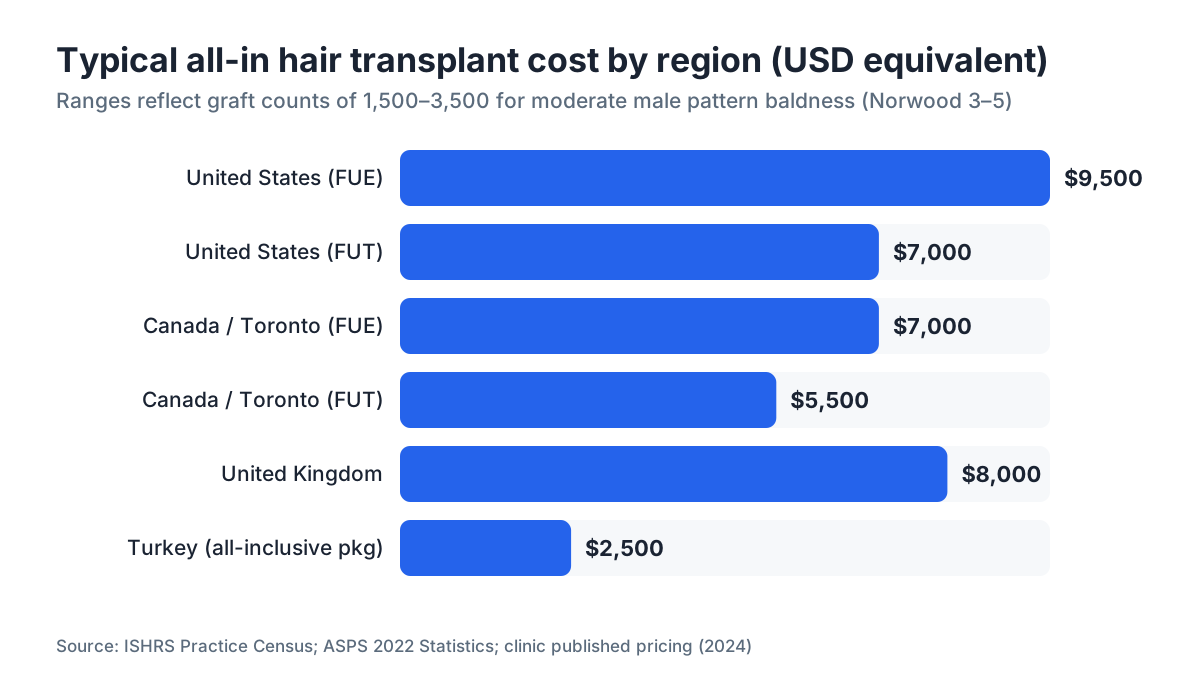
Everybody searches this and nobody gets a straight answer. Here it is: a men's hair transplant in the US runs roughly $4,000 to $15,000+ all in, and most reputable clinics price at $5 to $10 per graft. That's the number to anchor on.
The low end (around $4,000) buys a small FUE session of 1,000 to 1,500 grafts. The high end (over $15,000) covers a large multi-session FUT procedure at a premium practice. The American Society of Plastic Surgeons 2022 statistics listed the average surgeon fee for hair transplantation at roughly $3,500 to $4,000, but that figure leaves out facility fees, anesthesia, aftercare products, and sometimes the graft fee itself [3]. Real all-in quotes land higher.
Most clinics price by the graft. A typical Norwood 3 to 4 patient needs roughly 1,500 to 2,500 grafts. A Norwood 5 to 6 might need 3,000 to 4,500 grafts over one or two sessions. Multiply your graft estimate by the per-graft price before you ever walk into a consultation.
Hair transplant cost in Toronto runs roughly $3,500 to $12,000 CAD depending on technique and graft count, which often works out to a real saving in USD terms for American patients even after travel. Canadian clinics vary widely in quality, though, and cheaper isn't always better.
Turkey has become a major destination for budget transplants, with all-inclusive packages commonly advertised at $1,500 to $3,000 USD. Some clinics there are genuinely skilled. Others run high-volume mills where the surgeon marks the hairline and technicians do most of the work. That's legal in some jurisdictions, but it means the person doing the extraction may not be a licensed physician. Investigate heavily before booking abroad.
Hair transplants are rarely covered by insurance in the US or Canada because they're classified as elective cosmetic procedures. A few plans cover transplants for documented medical causes like trauma or burns, but that's uncommon. Budget accordingly.
The cost comparison chart below breaks the ranges down by region and technique.
What Norwood stage do you need to be for a hair transplant?
The Norwood scale runs from 1 (no loss) to 7 (only a horseshoe of hair left). Where you fall on it shapes your candidacy more than almost anything else. Norwood 2 to 3 is the best window for a first transplant. Norwood 6 to 7 is where surgeons have to be blunt about limits.
Norwood 2 to 3 gives you meaningful donor supply, a manageable area to cover, and a result that can look completely natural. Norwood 4 to 5 is still workable but needs more grafts and careful planning so the donor zone isn't depleted. Norwood 6 to 7 is the hard case: you may not have enough donor hair to cover what's gone, and body hair transplants (beard, chest) sometimes get discussed as supplements but carry lower survival rates.
A good surgeon calculates your donor density, usually expressed as follicular units per cm², and your projected lifetime loss before quoting a plan. Average donor density is around 65 to 85 follicular units per cm² [4]. If your density is low or your loss is heading downhill fast, a surgeon who recommends operating quickly without medical stabilization isn't protecting your long-term result.
Age matters too. Operating on a 22-year-old with Norwood 3 loss is a different calculation than operating on a 40-year-old with stable Norwood 4. The younger patient's future loss pattern is unknown, so an aggressive transplant can end up stranded as native hair keeps falling behind the transplanted zone. Many experienced surgeons won't operate on men under 25 without a strong reason.
Our explainer on receding hairlines covers the early Norwood stages in detail if you're trying to figure out where you stand.
Does a hair transplant actually work? What do the success rates look like?
Yes, transplants work. Graft survival at reputable clinics runs 90 to 95% when the surgical team handles grafts properly, which means minimizing time out of the body, keeping them hydrated, and avoiding crush injury during placement [5]. Put 2,000 grafts in at 90% survival and you get roughly 1,800 productive follicles in the recipient area.
Patient satisfaction data is harder to find in peer-reviewed form, but a 2016 study in Dermatologic Surgery found 80 to 85% of patients rated themselves satisfied or very satisfied at 12 months post-FUE [6]. Dissatisfaction tied most often to unrealistic expectations about density, not graft failure.
Density is the real conversation. A transplant rarely restores the density of your teenage scalp. It builds an illusion of fullness by placing grafts to maximize coverage and how light scatters across the scalp. Hairline design matters enormously here. A naturally irregular, non-straight hairline reads as real. A ruler-straight one at exactly the right height reads as done.
The procedure does nothing to stop ongoing loss in the native hair around it. Men who skip finasteride or minoxidil after a transplant often watch the surrounding native hair thin over the years, which leaves the transplanted zone looking like an island. The International Society of Hair Restoration Surgery recommends medical therapy alongside surgery for men with active androgenetic alopecia [7].
Learn more about the options in our finasteride and minoxidil guide.
What should you do before getting a hair transplant?
Stabilize first. If your hair loss is still moving, putting grafts in now is like painting a wall that's still crumbling. Most dermatologists and hair surgeons want you on finasteride or minoxidil for at least 6 to 12 months before surgery to see what holds and what doesn't [8].
Get blood work done. Low ferritin, thyroid problems, or vitamin D deficiency can drive diffuse shedding that mimics male pattern baldness but isn't. You want to be sure you're treating the right thing. A dermatologist can order a basic hair loss panel.
Research your surgeon carefully. The ISHRS keeps a member directory and certifies fellows (the FISHRS designation). Board certification in dermatology or plastic surgery with subspecialty hair restoration training is worth more than any clinic's marketing. Ask to see before-and-after photos of patients with your Norwood stage and hair texture. Ask who actually does the extraction and placement during surgery, the surgeon or the technicians.
Stop certain medications and supplements before surgery, exactly as your surgeon directs. Blood thinners, aspirin, NSAIDs, and some supplements (fish oil, vitamin E, ginkgo) raise bleeding risk. Finasteride and minoxidil should usually be continued.
Set honest time expectations. You will look worse before you look better. Shock loss, where existing hair in the recipient area temporarily sheds, hits in the first 4 to 6 weeks and can be alarming. It's almost always temporary. Budget time off for the first week of obvious redness and scabbing.
What is the hair transplant recovery timeline like?
The first 72 hours are the most sensitive. You'll be told to sleep elevated, avoid touching the grafts, and skip anything that spikes your blood pressure. The grafts aren't anchored yet and can be dislodged.
Days 3 to 10: Scabs form around each graft. That's normal and protective. Don't pick them. Most clinics start gentle washing on day 3 to 4. Visible redness fades in 1 to 2 weeks for most men, though people with fair or sensitive skin sometimes stay pink for 3 to 4 weeks.
Weeks 2 to 6: The transplanted hairs fall out. Nearly all of them. This phase panics first-time patients, but it's completely expected. The follicle is alive; the hair shaft is just cycling out.
Months 3 to 6: New hair starts to emerge, often fine and slightly wavy at first. This is when progress becomes visible.
Months 8 to 12: Most of the cosmetic improvement shows. Hair thickens and natural texture returns.
Month 12 to 18: Final result. Most surgeons ask you to wait a full 12 months before judging the outcome or planning a second session.
| Timeline | What's happening |
|---|---|
| Days 1 to 3 | Grafts vulnerable, sleep elevated, no exercise |
| Days 4 to 10 | Scabbing, gentle washing begins |
| Weeks 2 to 6 | Transplanted hairs shed (normal) |
| Months 3 to 6 | New hair emerges |
| Months 8 to 12 | Main cosmetic result visible |
| Month 12 to 18 | Final result, touch-up possible |
What are the risks and side effects of hair transplant surgery for men?
This is where honest clinics earn your trust and bad ones lose it. Most side effects are common and temporary. A few are rare and serious. Knowing the difference tells you whether a surgeon is leveling with you.
Common, expected effects: swelling of the forehead and around the eyes in the first 2 to 3 days, scabbing at graft sites, temporary shock loss, and scalp itching during healing. These happen in most patients and resolve on their own.
Less common but real: folliculitis (infected follicles that look like small pimples), ingrown hairs, and hypertrophic scarring at the donor site. Folliculitis usually clears with topical or oral antibiotics. Hypertrophic scarring shows up more in FUT and in people with a history of keloids.
Rare but serious: a wide donor scar if sutures go in under tension, nerve damage causing temporary or (rarely) permanent scalp numbness, and poor graft survival from ischemia when too many grafts get packed into too small an area too densely. Arteriovenous fistula and significant bleeding are extremely rare with an experienced team. Hair transplant surgery is done under local anesthesia, and MedlinePlus lists infection, scarring, and uneven growth among the known risks [11].
The FDA has approved minoxidil and finasteride for androgenetic alopecia and regulates devices used in hair restoration, but surgical hair transplantation itself falls under state medical licensing, not direct FDA oversight [9]. Regulation quality varies state to state, which is one more reason to scrutinize your surgeon's credentials.
If you're curious about side effects of the medications used alongside surgery, our minoxidil side effects piece covers them honestly.
Should you use finasteride or minoxidil with a hair transplant?
Almost certainly yes, if you have male pattern baldness. The native hair around your transplanted zone is still vulnerable to DHT, and protecting it is what keeps the result from looking isolated in a decade.
Finasteride (Propecia, 1 mg oral daily) cuts scalp DHT by about 70% and has been shown in randomized controlled trials to slow or halt androgenetic alopecia in most men [10]. Skip it and many men watch the hair around their grafts thin year after year, until the transplanted patch stands alone.
Minoxidil, applied topically (2% or 5% solution, or 5% foam) or taken orally (0.625 to 1.25 mg/day, off-label), can help preserve existing hair and may improve graft survival in the early post-operative window, though the evidence for that last point is still building. The FDA has approved 5% topical minoxidil for men with androgenetic alopecia [9].
Some men are uneasy with finasteride's side effect profile, which includes sexual side effects in a minority of users. That's a legitimate conversation to have with a physician. The data puts sexual side effects at around 2 to 4% of men in clinical trials, with most resolving after stopping the drug [10]. Our full finasteride guide walks through the evidence without minimizing the benefits or the risks.
Oral minoxidil is gaining traction as an alternative or add-on. Read our oral minoxidil overview for doses and what the current evidence supports.
If you're early in your hair loss and not yet surgery-ready, minoxidil for men explains what non-surgical options can realistically do.
How do you choose a hair transplant surgeon?
Start with credentials, not the before-and-after gallery. Look for board certification in dermatology or plastic surgery, then check for additional fellowship or certification from the ISHRS. These designations don't guarantee a great result, but they show the surgeon has invested in the subspecialty.
Ask exactly who performs each step. In many clinics, the surgeon marks the hairline, does the punch extractions, then hands placement to trained technicians. That's common and can produce excellent results when the technicians are skilled. What you want to avoid is a clinic where a physician consultant meets you for 10 minutes and technicians do nearly everything with no meaningful surgical oversight.
Look at photos from patients with hair type, skin tone, and Norwood stage close to yours. Coarse, dark hair on light skin looks denser than it is. Fine, light hair on light skin is the hardest scenario to make look full. A surgeon whose gallery is all easy cases isn't showing you the full range of their skill.
Get at least two consultations. Surgeons disagree on graft counts, hairline design, and technique, and hearing different views helps you calibrate. Be suspicious of any clinic that pressures you to book same-day or dangles a big discount for doing so.
If you want to understand your loss pattern before booking consultations, MyHairline's free AI hair analysis at /scan gives you a quick read on where you fall on the Norwood scale, which makes those conversations more productive from the start.
Are hair transplants a permanent solution for men?
The transplanted follicles are permanent in the sense that they keep their DHT resistance and grow for life in most cases. The hair you successfully transplant stays. What isn't permanent is the native hair around it.
Male pattern baldness is a progressive condition for most men. The area you transplant today may look great in year 3 but sit surrounded by thinning native hair by year 10 if you're not managing the ongoing loss medically. Planning a transplant means thinking about where your hair loss will be in 20 years, more than where it is today.
This is the reason surgeons keep talking about donor supply management. You have only so many usable follicles in the donor zone, and once they're spent, they're gone. A surgeon who places 3,500 grafts on a 27-year-old with Norwood 3 loss and no medical plan may leave that patient short on donor supply for the Norwood 5 or 6 he reaches in his 40s.
The honest framing: a well-planned transplant paired with finasteride or minoxidil can be a long-term, satisfying solution for most men with androgenetic alopecia. Without medical management, it's a one-time fix that ages badly against progressive loss.
What questions should you ask at a hair transplant consultation?
Walk in with these and watch how the surgeon responds. Evasive or vague answers are information.
- What is my donor density per cm² and how many usable grafts do I have total?
- Based on my family history and current loss trajectory, what does my hair loss look like in 10 to 15 years?
- Who physically performs the extractions and placements, you or your technicians?
- What is your transection rate and graft survival rate, and how do you measure it?
- How many grafts do you recommend, and why that number specifically?
- Do you recommend finasteride or minoxidil alongside surgery, and why or why not?
- What is your revision policy if I'm unhappy with density after 12 months?
- Can I speak with a previous patient who has similar hair type and Norwood stage?
A surgeon who gives confident, specific answers to all of these, especially the first two, is engaged with your individual situation. One who pivots straight to package pricing is not.
Sources
- American Academy of Dermatology (AAD), Hair loss: Diagnosis and treatment
- Journal of Cutaneous and Aesthetic Surgery, FUE vs FUT comparative review, 2019
- American Society of Plastic Surgeons, 2022 Plastic Surgery Statistics Report
- International Society of Hair Restoration Surgery (ISHRS), Patients section
- Dermatologic Surgery, Patient satisfaction after FUE hair transplantation, 2016
- International Society of Hair Restoration Surgery (ISHRS), Patients section
- American Academy of Dermatology (AAD), Hair loss: Types
- U.S. Food and Drug Administration (FDA)
- New England Journal of Medicine, Finasteride in the treatment of men with androgenetic alopecia, Kaufman et al.
- National Institutes of Health (NIH), MedlinePlus: Hair transplantation