

TL;DR: A hair transplant surgeon should be a board-certified dermatologist or plastic surgeon with documented FUE or FUT volume, graft survival above 90 percent, and a portfolio matching your hair type and Norwood stage. Expect $4,000 to $15,000 in the US. Overseas clinics cost less, but quality control ranges from excellent to dangerous.
What does a hair transplant surgeon actually do?
A hair transplant surgeon moves living follicles from a donor area, usually the back and sides of the scalp where DHT-resistant follicles grow, into a thinning or bald recipient area. That sounds mechanical. The craft is in three things: designing a hairline that still looks natural in 20 years and more than today, extracting follicles without cutting them (a transected follicle is a dead graft), and placing each graft at the right angle and density so the result doesn't read as a row of plugs.
The surgeon usually designs the hairline and makes the recipient-site incisions personally. Extraction and placement are often handled partly by trained technicians under supervision, which is legal and common. The amount of hands-on surgeon time varies a lot between clinics. More on that in the red-flags section.
Two techniques dominate. FUE (follicular unit excision) removes follicular units one at a time with a small punch, leaving tiny circular scars. FUT (follicular unit transplantation, also called the strip method) removes a strip of scalp and dissects it into grafts, leaving a linear scar but often yielding more grafts per session. Neither wins on paper. The right choice depends on your donor density, how short you wear your hair, and how many grafts you need. A surgeon who only does one technique and calls it always superior is selling you their workflow, not their judgment.
Hair transplantation is regulated at the state level in the US. Any licensed physician can legally perform it, which is part of why the quality range is so wide. Board certification in dermatology or plastic surgery is not legally required. It's the closest proxy you have for standardized training.
What credentials should a hair transplant surgeon have?
Board certification is the floor, not the ceiling. In the US, the two boards that matter are the American Board of Dermatology and the American Board of Plastic Surgery. Both require residency training, written and oral exams, and ongoing maintenance of certification [1][2]. Neither has a subspecialty certificate specifically for hair restoration, so certification alone won't tell you how much of a surgeon's practice is transplants.
The International Society of Hair Restoration Surgery (ISHRS) is the field's main professional body. Membership by itself is not a credential, but Fellowship status (FISHRS) requires peer review and proof of active practice. The ISHRS also publishes practice standards and a biennial census tracking surgeon volumes and technique trends [3].
The most useful credential is documented case volume. Ask directly: how many hair transplant procedures do you perform per year? A surgeon doing fewer than 50 cases a year isn't building the hand-speed and pattern recognition this procedure rewards. High-volume dedicated clinics often run 200 or more per surgeon per year.
Ask one more thing. Does the surgeon personally do the hairline design and the recipient-site incisions? Some clinics advertise a well-known physician while technicians do most of the work and the surgeon floats between rooms. That isn't automatically wrong. You still deserve to know exactly what you're paying for.
FUE vs FUT: which technique should your surgeon recommend?
The technique debate is real, and marketing usually makes it bigger than it is. Here's what the evidence shows.
FUT can pull more total grafts from the same donor area because the strip method wastes fewer follicles during extraction. A comparative study in the Journal of Cutaneous and Aesthetic Surgery reported FUT graft transection rates around 2 to 3 percent versus 5 to 10 percent for FUE, depending on surgeon experience [4]. That gap matters if you need a large session (3,000 or more grafts) or have a limited donor supply.
FUE leaves no linear scar, which counts if you ever want to buzz your hair short. Recovery is a little faster and less uncomfortable too. For patients needing 1,500 to 2,500 grafts who want to keep haircut length open, FUE is often the practical pick.
Robotic FUE systems like the ARTAS device are FDA-cleared for follicle harvesting [5]. They can improve extraction consistency. The outcome still rides on the surgeon's judgment in donor planning and recipient-site design. The robot is a tool, not a substitute for skill.
A good surgeon explains which technique fits your case and why. If they push one option without examining your donor density, hair texture, and Norwood stage, they're optimizing for their equipment, not your result.
Before you commit to anything, get clear on where you sit on the hair loss spectrum. Our guide on the receding hairline walks through Norwood stages in plain English and what each one means for transplant planning.
How much does a hair transplant surgeon cost in 2025?
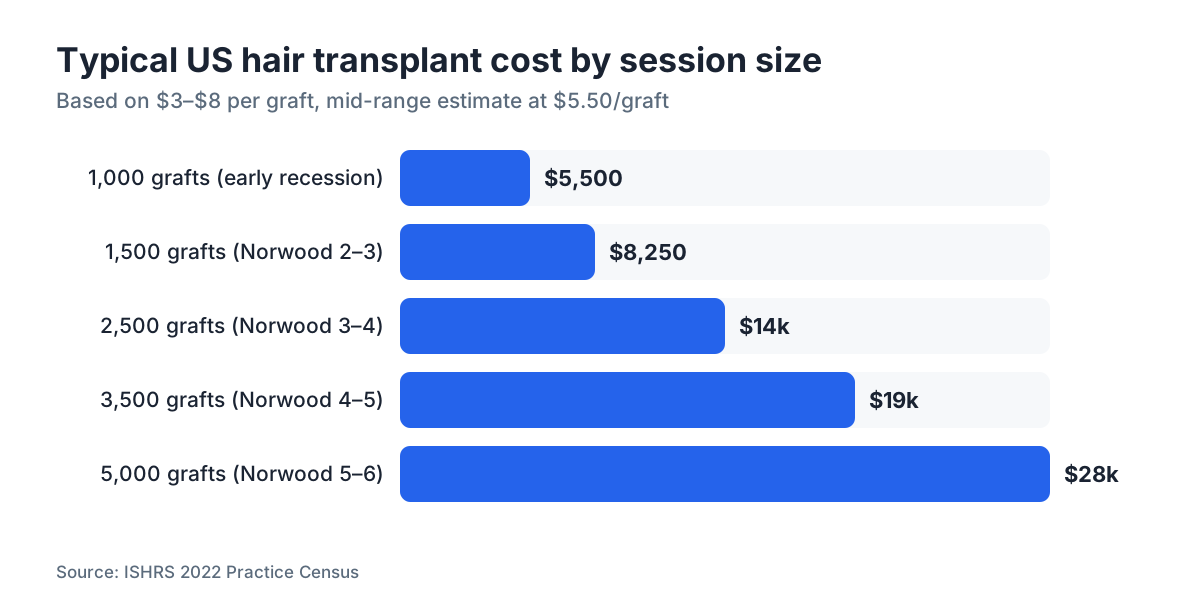
US pricing is almost always quoted per graft, not per procedure. The going rate is roughly $3 to $8 per graft, so a typical 2,000-graft session runs $6,000 to $16,000 before facility or anesthesia fees [6]. Some high-demand surgeons in major metros charge more. Some package clinics charge less and cut corners on technician training or graft handling time (grafts survive poorly when kept outside the body too long).
Overseas clinics, especially in Turkey, advertise all-inclusive packages of $1,500 to $4,000 for the same graft counts. The quality range is enormous. Some Turkish clinics produce results indistinguishable from top US surgeons. Others use poorly trained technicians, operate at unsafe volume, and offer no meaningful accountability if something goes wrong. The ISHRS has publicly warned about unlicensed practitioners performing hair transplants in unregulated settings, particularly abroad [3].
Insurance does not cover hair transplants. They're classified as cosmetic. No US insurer reimburses them under standard policies, and FSA/HSA eligibility is limited. IRS Publication 502 states that cosmetic surgery expenses generally don't count unless the procedure is "necessary to improve a deformity arising from, or directly related to, a congenital abnormality, a personal injury resulting from an accident or trauma, or a disfiguring disease" [7].
Financing through CareCredit or similar medical credit products is available at most US clinics. Read the interest terms. Deferred-interest plans convert to high rates if you don't pay in full by the promotional deadline.
What are the red flags to watch for when vetting a hair transplant surgeon?
Pressure to book during the consultation is the first one. Any surgeon who needs you to decide today before a price expires is putting their schedule ahead of your outcome. A hair transplant takes months to show results and years to fully mature. There is no real urgency.
No before-and-after photos of cases like yours. Every experienced surgeon has a portfolio. If they can't show documented results for someone with your hair texture, Norwood stage, and donor characteristics, they either haven't done many cases like yours or they're hiding weak ones. Ask specifically for cases with at least 12 months of follow-up, because that's when the real result shows.
Technician-heavy procedures with the surgeon barely present. Ask plainly: will you personally design my hairline and make the recipient-site incisions? A vague answer, or a description where the surgeon "oversees," means you should press for specifics on which steps they physically perform.
Unrealistic graft promises. Follicular density has physical limits. The donor scalp carries roughly 80 to 120 follicular units per square centimeter [4]. A surgeon promising 5,000 grafts in one session from a limited donor zone is probably transecting a high share of follicles or harvesting outside the safe zone, which produces grafts that shed as hair loss progresses anyway.
No disclosure of complication rates. Complications happen in even the best hands: infection, folliculitis, temporary shock loss, uneven growth, and rarely scarring or permanent donor thinning. A surgeon who claims zero complications should make you skeptical, not comfortable. Ask what their complication rate is and what they do when a result falls short.
How do you find and verify a qualified hair transplant surgeon?
Start with the ISHRS surgeon finder at ishrs.org, which lists members by location and technique. Cross-reference with your state medical board's license verification tool, which is public and free [8]. A clean license with no disciplinary actions is a minimum, not a distinction.
The American Board of Dermatology and the American Board of Plastic Surgery both run free online tools to confirm board certification in minutes [1][2]. Use them. Never take a clinic's word for it.
After credentials, read the photos critically. Real results show lighting variation between before and after shots, natural hair direction, and realistic density instead of perfectly uniform rows. Suspiciously flawless photos with identical lighting and staging deserve questions.
Forums like the Hair Restoration Network (hairrestorationnetwork.com) carry extensive user-documented results with unsponsored photos and long-term follow-up. These are some of the most useful real-world data points around, precisely because no clinic curated them.
Get at least two consultations before committing. Good surgeons expect it. If one seems offended that you're shopping around, that tells you how they'll react the day you question their judgment.
What results can you realistically expect, and how long does it take?
The timeline is predictable and frustrating in equal measure. Transplanted hairs usually shed within 2 to 6 weeks after surgery. That's normal. New growth from the transplanted follicles starts around 3 to 4 months. Real cosmetic coverage tends to show at 6 to 9 months. Full results take 12 to 18 months, sometimes longer for coarser hair [9].
Graft survival above 90 percent is achievable in skilled hands. A study in Dermatologic Surgery reported survival of 90 to 95 percent when grafts were kept in appropriate holding solution and implanted within 6 hours of extraction [9]. Rates drop when clinics rush, leave grafts out too long, or lean on poorly trained implanters.
Natural density is harder to hit than plain coverage. A transplanted area typically reaches 40 to 60 percent of original density. That's usually enough to look natural to the eye, but it won't feel as thick as it did before hair loss started. For heavier thinning, a second session is sometimes needed to add density once the first one matures.
Hair loss keeps going after a transplant. The transplanted follicles are DHT-resistant and stay put. The native follicles around them can keep miniaturizing and shedding. That's why most surgeons pair a transplant with a medical treatment like finasteride or minoxidil to slow ongoing loss. See our articles on finasteride and minoxidil for men for the evidence on both.
Want a baseline before your consultation? The free AI scan at MyHairline can help you estimate your Norwood stage and document current density.
Should you use finasteride or minoxidil alongside a hair transplant?
Probably yes, especially finasteride. Here's the logic.
A transplant addresses hair that's already gone. It does nothing to slow the miniaturization of native follicles driven by DHT. Transplant 2,500 grafts at 30 and skip treatment, and you might look great at 35, then watch the surrounding native hair thin out until the transplanted zone looks like an island of density surrounded by loss.
Finasteride (1 mg/day, oral) cuts scalp DHT by roughly 60 to 70 percent. In randomized controlled trials it slowed or stopped progression in about 83 to 90 percent of men with androgenetic alopecia [10]. The FDA approved finasteride 1 mg (Propecia) for male pattern hair loss in 1997. Most transplant surgeons want patients on it several months before surgery and continuing after, though plans vary.
Minoxidil also helps preserve native hair and may support transplant growth. The combination of finasteride and minoxidil beats either drug alone for most patients. If finasteride isn't an option because of side effects or other reasons, oral minoxidil at low doses (0.625 to 2.5 mg/day) is an emerging alternative with a growing evidence base.
These are separate decisions from the surgery itself. A surgeon who never raises them during a consultation may not be thinking about your result five years out.
What questions should you ask during a hair transplant consultation?
Walk in with a list and don't apologize for it. A surgeon irritated by thorough questions is not someone you want cutting your scalp.
The questions that carry the most weight:
Are you board-certified in dermatology or plastic surgery? (Verify independently.)
How many hair transplant procedures did you personally perform in the last 12 months?
Which steps of the procedure will you do yourself versus your technicians?
What technique do you recommend for my case, and why?
How many grafts do you estimate I need, and how did you reach that number?
What is your graft transection rate?
Can I see before-and-after photos of patients with similar hair type, texture, and Norwood stage, with at least 12 months of follow-up?
What is your complication rate, and what happens if I end up in that group?
Do you recommend any medical treatment to preserve native hair alongside the transplant?
What does the quoted price include, and what could add to it?
Specific, unbothered answers are a good signal. Vague replies or pivots to marketing lines are a bad one.
Is a hair transplant the right choice, or should you try other treatments first?
Surgeons generally recommend a transplant only after hair loss has stabilized, because operating on actively thinning hair needs a larger safety margin in donor planning and often leads to revision surgery. Most prefer patients to be at least 25 to 30 years old for that reason, though there's no hard cutoff.
If your loss is early, Norwood 1 to 3, the evidence favors trying finasteride and minoxidil first. They're cheap, reversible, and effective for a large share of men. A transplant is permanent and expensive. Starting with the reversible option is just sensible sequencing.
For women the decision tree looks different. Female pattern hair loss usually shows as diffuse thinning rather than a receding hairline, which makes transplant planning more complicated. Women also cannot take finasteride during pregnancy or while planning one because of teratogen risk [11]. Minoxidil is the first-line medical option for women, and the FDA has approved the 2% and 5% topical formulations for female use [11].
Some hair loss isn't androgenetic at all. Telogen effluvium, thyroid problems, iron deficiency, and other systemic causes produce shedding that resolves once the underlying issue is treated. A transplant on reversible shedding is money burned. If you're not sure what causes your hair loss, a dermatologist consultation and basic bloodwork should come before any transplant consultation.
For an objective starting point, the MyHairline AI scan can document your current hair state and flag whether the pattern looks like androgenetic alopecia before you book.
What are the risks and complications of hair transplant surgery?
No surgery is risk-free, and hair transplants are no exception. The complication profile is well-described in the literature.
Temporary shock loss (effluvium) hits transplanted and native hairs near the recipient zone in a meaningful minority of patients. It's alarming and almost always temporary, clearing within 3 to 6 months as new growth arrives [9].
Infection occurs in roughly 1 percent of cases and is usually treatable with antibiotics when caught early [4]. Surgeons often prescribe prophylactic antibiotics around the procedure date.
Folliculitis, inflammation of the follicles that looks like small pimples in the transplant zone, is common in the first weeks and usually clears on its own.
Permanent donor scarring is rare with well-done FUE but grows more likely with overharvesting, especially past 50 percent of the safe donor zone. With FUT the linear scar is permanent, though usually hidden under hair of normal length.
Unnatural appearance, meaning visible scarring, plug-like clusters, or poor hairline design, is the most common reason for revision surgery. It's the complication tied most directly to surgeon skill, and it's almost entirely preventable with the right surgeon.
Nerve damage causing temporary scalp numbness is common and typically resolves. Permanent sensory changes are rare.
Getting the full picture of your hair loss before you proceed helps you choose surgery for the right reasons and with expectations that match reality.
Sources
- American Board of Dermatology, Certification Verification
- American Board of Plastic Surgery, Certification Verification
- International Society of Hair Restoration Surgery (ISHRS), Practice Standards and Member Directory
- Journal of Cutaneous and Aesthetic Surgery, FUE vs FUT comparative study
- US Food and Drug Administration, Medical Devices
- ISHRS, 2022 Practice Census (biennial survey of member surgeons)
- IRS Publication 502, Medical and Dental Expenses
- Federation of State Medical Boards, DocInfo Physician Profile
- Dermatologic Surgery, graft survival and hair transplant outcomes review
- New England Journal of Medicine, finasteride for androgenetic alopecia RCT (Kaufman et al.)
- US Food and Drug Administration, Drugs