
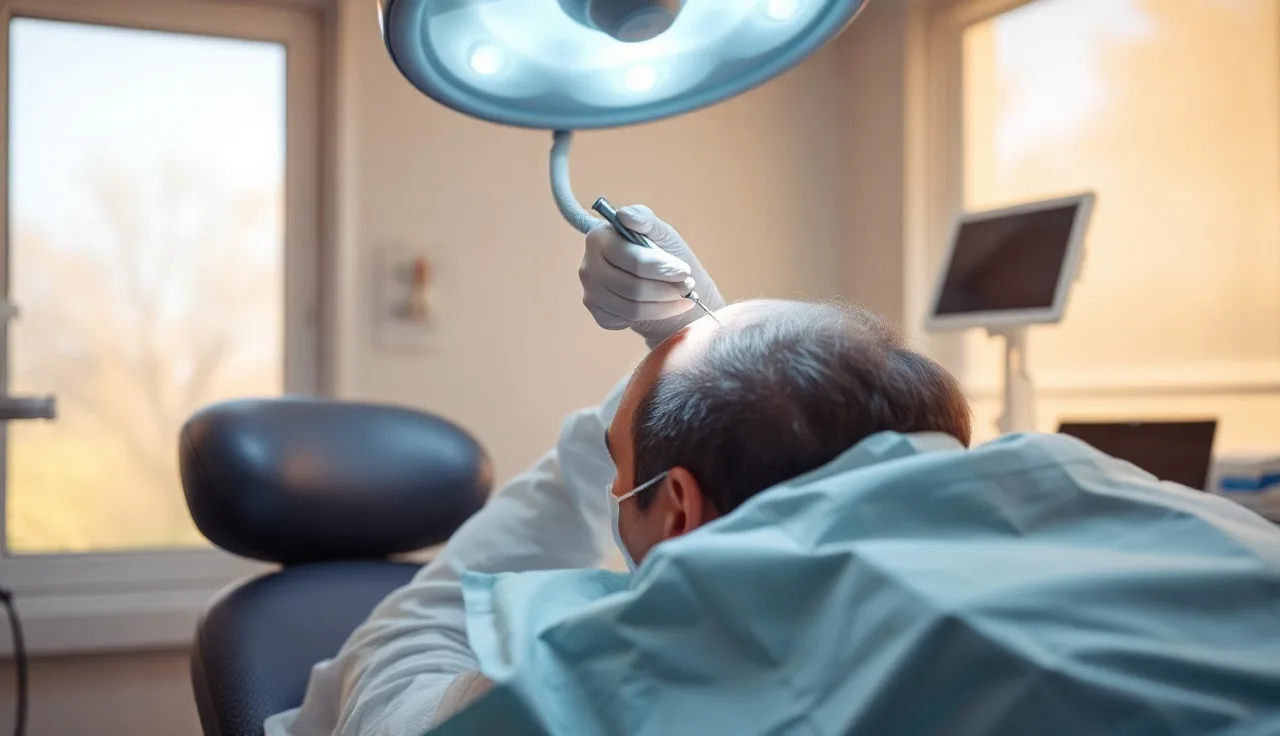
TL;DR: Hair transplant surgery moves permanent follicles from the back and sides of your scalp to thinning areas. FUE and FUT are the two main techniques. Costs run $4,000 to $15,000 or more in the U.S., results take 12 months to fully show, and the best candidates have stable hair loss with a strong donor area.
What exactly is hair transplant surgery?
A hair transplant moves follicles from a donor zone, usually the lower back and sides of your scalp where hair resists DHT, into areas that are thinning or bald. Those follicles keep their original genetic programming. They grow for life in their new spot.
Here's the one thing to understand about how transplants work. You're not creating new hair. You're relocating hair you already have. The result depends almost entirely on how much healthy donor hair you have to work with. Run out of donor supply, and there's nothing left to move.
The two main techniques, FUE (follicular unit extraction) and FUT (follicular unit transplantation), differ in how follicles are harvested. Everything after harvest, recipient site creation, graft placement, healing, is largely the same. The American Academy of Dermatology recognizes both as established treatments for androgenetic alopecia [1].
This surgery does not cure hair loss. The transplanted grafts are safe, but the native hair around them can still miniaturize and fall out if you're not managing the underlying cause. Most surgeons will tell you that a transplant plus a maintenance medication, like finasteride or minoxidil for men, produces better long-term outcomes than surgery alone.
What's the difference between FUE and FUT?
FUT, the strip method, removes a thin strip of scalp from the donor area, usually 15 to 30 cm long. A technician dissects that strip under a microscope into individual follicular units of 1 to 4 hairs each. The donor wound gets closed with stitches or staples, leaving a linear scar.
FUE pulls each follicular unit one at a time using a small circular punch, typically 0.8 to 1.0 mm across. No strip comes out, so there's no linear scar. Healing is faster and you can buzz your hair short without visible scarring. The trade-off: FUE takes longer, costs more per graft at most clinics, and carries a slightly higher transection rate, meaning more follicles get accidentally cut during harvest if the surgeon's team isn't skilled.
Here's the head-to-head:
| Factor | FUT | FUE |
|---|---|---|
| Scar type | Linear (hidden by longer hair) | Scattered dots (invisible at most lengths) |
| Grafts per session | Up to 3,000 to 4,000 | Up to 2,000 to 3,000 (more sessions possible) |
| Downtime | 10 to 14 days | 7 to 10 days |
| Cost per graft | Generally lower | Generally higher |
| Follicle survival rate | Slightly higher in expert hands | Variable; technique-dependent |
| Best for | Large coverage needs, budget-conscious patients | Patients who wear hair short, smaller procedures |
Neither technique wins on its own. A surgeon who does 2,000 FUE grafts a year will produce worse results than one who does 500 FUT cases a year on the right patients. Volume and specific experience with your hair type matter more than the method label.
A third option, DHI (direct hair implantation), uses a pen-like tool to place grafts without pre-made recipient sites. It's a variant of FUE, marketed hard in Turkey. The peer-reviewed evidence comparing DHI to standard FUE is thin. The technique may cut graft drying time, but independent data showing meaningfully better survival is lacking [2].
How much does hair transplant surgery cost in the U.S.?
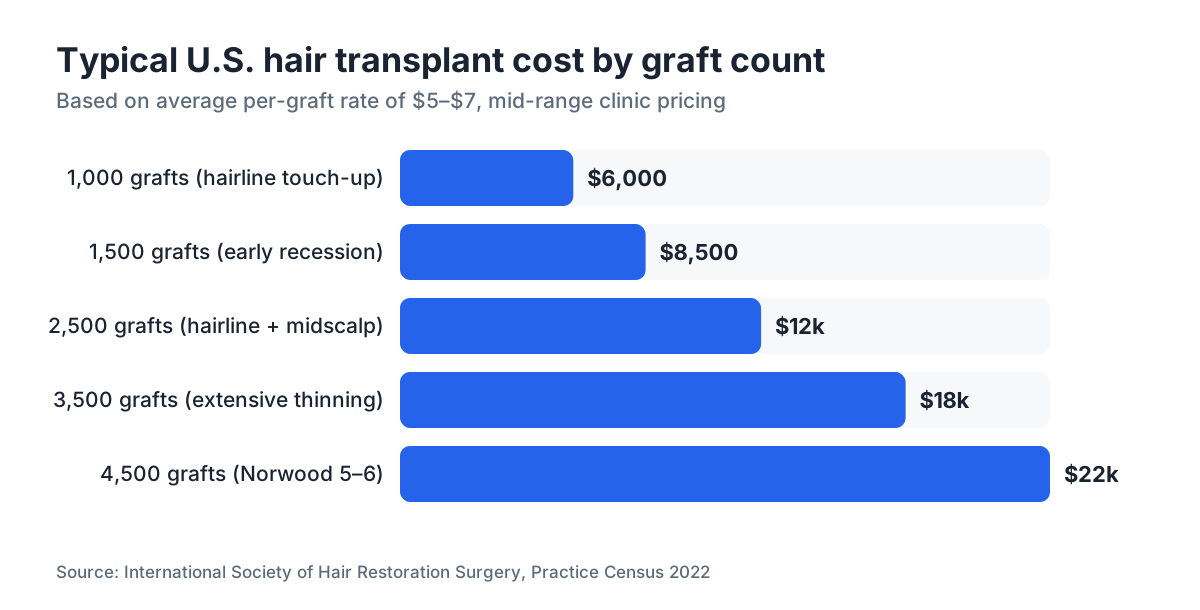
Most U.S. clinics price by the graft, not the session. Typical per-graft rates run $3 to $10. A meaningful procedure needs at least 1,500 to 2,000 grafts for a receding hairline, up to 4,000 or more for advanced baldness. That puts the realistic total between $4,000 and $15,000 for most patients, with outliers on both ends [3].
Geography moves the number a lot. A board-certified surgeon in New York City or Beverly Hills charges more than one in the Midwest or South. If you're pricing hair transplant surgery in NJ or a Denver hair transplant, expect figures near the national average, roughly $6,000 to $12,000 for a mid-range session, depending on graft count and clinic reputation.
Insurance almost never covers hair transplants because they're classified as cosmetic. Financing through CareCredit or clinic payment plans is common.
What drives the price up: high graft counts, body hair used as supplemental donor material, repairs of previous bad transplants, and clinics where the surgeon (not technicians) handles every step of graft placement. What drives it down: choosing FUT over FUE, needing fewer grafts, and picking a less-experienced or newer clinic.
Be careful with prices that look too good. Clinics advertising $1,500 to $2,500 total procedures often cut corners on technician training, graft out-of-body time, or the number of staff handling your grafts. Damaged or badly stored grafts don't survive. You'll pay twice to fix a bad result.
Hair restoration falls outside the Affordable Care Act's essential health benefits [4], and FSA/HSA funds generally can't cover cosmetic surgery. Confirm with your plan administrator.
Who is actually a good candidate for a hair transplant?
The ideal candidate has androgenetic alopecia (genetic pattern baldness) that's been stable for at least one to two years, a strong dense donor area, realistic expectations, and no active scalp condition or systemic disease that would slow healing.
The Norwood scale is the standard tool surgeons use to grade male pattern baldness. Patients at Norwood 2 through 5 generally have enough donor hair for meaningful coverage. Norwood 6 and 7 patients have less donor supply and may not cover their full area of loss. If you're not sure where you land, reading about receding hairline staging is a good starting point.
Age matters too. Operating on a 22-year-old with early loss is risky because the progression is unpredictable. A surgeon might place grafts in an area that hasn't thinned yet, creating an unnatural island of hair surrounded by future baldness. Most experienced surgeons prefer to wait until loss stabilizes, or at minimum insist the patient is on finasteride first.
Women can be candidates, but the evaluation differs. Female pattern hair loss usually shows up as diffuse thinning rather than discrete bald zones, and many women have lower donor density. Conditions like telogen effluvium, thyroid disease, or iron deficiency need ruling out before anyone operates.
People with very curly or tightly coiled hair face higher transection risk during FUE harvest. Surgeons who work with these hair types regularly can get good results, but it takes specific expertise.
What happens during the procedure and how long does it take?
Most hair transplants are outpatient procedures under local anesthesia. You're awake the whole time, and aside from the numbing injections, the procedure itself isn't painful for most people.
A typical session runs 4 to 8 hours. Larger sessions of 3,000 or more grafts can stretch to 10 hours or split across two days. Here's roughly how it goes.
The donor area gets shaved or trimmed. Your surgeon injects local anesthetic. Grafts come out (FUE punch by punch, or FUT via strip removal and dissection). While a technician team processes and sorts grafts by follicle count, your surgeon creates recipient sites, tiny incisions in the thinning area, angled to match your natural hair direction. Grafts go in one by one. You leave with the implanted hairs visible but fragile.
Graft survival hangs heavily on how long grafts spend outside the body. Best practice is to hold them in a chilled solution (HypoThermosol or saline) and finish placement within 6 to 8 hours. Clinics that rush or run short on staff see worse survival rates.
You go home the same day. Most people take 3 to 5 days off work, though desk workers often return sooner. Physical labor, gym sessions, and anything that spikes your blood pressure should wait at least two weeks.
How long does recovery take and what does it look like?
The first two weeks hold the most visible recovery. The recipient area will be red and slightly swollen, with small scabs forming around each graft. Those scabs fall off on their own by day 10 to 14. Do not pick them. Dislodging a graft in the first week can mean losing it for good.
Then comes the part nobody warns you about clearly enough: shock loss. Between weeks 2 and 8, most of the transplanted hairs shed. This is normal. The follicle survives underground and restarts its growth cycle. Panicking during this phase is the most common patient experience, and it's almost always unwarranted.
New growth usually starts at 3 to 4 months. It looks thin and fine at first. By 6 months you'll see real improvement. Full results take 12 to 18 months [5]. Any before-and-after photo shot at 6 months is showing you about 60 to 70% of the final result.
If your native hair shed from the trauma of surgery (a phenomenon called effluvium from surgical stress), it usually recovers on its own within the same window.
Skip sun exposure, harsh chemicals, and tight hats for the first month. After that, treat the transplanted area like normal scalp.
What are the real risks and complications?
Hair transplant surgery is low-risk by surgical standards, but complications do happen, and patients deserve an honest accounting.
Infection occurs in roughly 1% of cases according to the International Society of Hair Restoration Surgery [6]. Antibiotics treat it, and it rarely costs you grafts if caught early. Folliculitis, small pimples from ingrown hairs during the growth phase, is more common and usually clears on its own.
Numbness or altered sensation in the donor or recipient area is common in the first few months and usually fades. Numbness that lasts beyond 12 months is rare.
Cyst formation can happen when a graft gets buried under the skin. Surgeons drain or excise these as needed.
The most financially painful complication is a poor aesthetic result. That covers an unnatural hairline design, grafts placed at the wrong angle so hair grows the wrong direction, a plug-like look from too many multi-hair grafts in the front hairline, or thin density. These often need corrective surgery, which costs more and is harder than the original.
Scalp necrosis is extremely rare but has been reported in patients with previous scalp procedures or very tight closures. Scarring beyond the expected linear (FUT) or dot-pattern (FUE) marks is uncommon with skilled surgeons.
One more worth naming: growth failure. If grafts get mishandled, stored poorly, or traumatized during placement, they simply don't grow. You won't know for certain until the 12-month mark. A reputable clinic documents your expectations before surgery and discusses options if the outcome falls short.
How do you find a qualified hair transplant surgeon?
Look for board certification in dermatology or plastic surgery, plus fellowship training or a clear subspecialty focus in hair restoration. Membership in the International Society of Hair Restoration Surgery (ISHRS) is a useful signal, since the group publishes standards of practice and ethics guidelines [6].
Ask to see at least 20 to 30 before-and-after photos of patients with your hair type, your degree of loss, and your target area (hairline vs crown). Ask how many procedures the surgeon personally performs per year, not the clinic total.
Here's an uncomfortable reality in this industry. Many clinics have a physician who consults with you and designs the hairline, while technicians do most of the extraction and placement. That's legal in most U.S. states, but you should know it and ask exactly who handles your grafts. In NJ or any other state, scope-of-practice laws vary, so ask your surgeon directly what they personally do during the procedure.
Before you book anything, get a baseline read on your own loss pattern. The free AI hair analysis at MyHairline can help you place your hairline on the Norwood scale before you walk into a consultation, so you're not starting from zero.
Avoid clinics that guarantee a specific graft number without seeing you in person, quote prices far below market, or push you to book same day. Good surgeons have waiting lists for a reason.
Does hair transplant surgery actually work? What do the studies show?
In well-selected patients, with a skilled surgeon, hair transplants work well. Graft survival rates of 90 to 95% are achievable under good conditions [7]. A 2021 systematic review in the Journal of Plastic and Reconstructive Surgery found high patient satisfaction across both FUE and FUT groups, with most patients reporting improved quality of life and saying they'd recommend the procedure [8].
The FDA does not approve or regulate hair transplant techniques as devices, since they're surgical procedures, but the FDA has cleared several devices used in assisted FUE extraction [9]. So the safety and efficacy data rests largely on surgeon case series and observational studies rather than randomized controlled trials, which is normal for surgery.
A realistic expectation: a well-done transplant adds density and restores a natural hairline in the treated area. It does not hand you back your 18-year-old head of hair. If you're a Norwood 5 with limited donor hair, you might get coverage in one zone but not everywhere. A good surgeon sets that expectation before you ever book.
Pairing a transplant with medical maintenance, specifically finasteride and minoxidil used long term, sharply lowers the chance that surrounding native hair keeps thinning after surgery. That thinning is the main reason transplant results can look worse over time without medication.
If you don't want surgery yet, understanding what causes hair loss and trying a DHT blocker first is a legitimate step.
How do hair transplants in Turkey compare to U.S. clinics?
Turkey, Istanbul especially, has become the world's highest-volume destination for hair transplants, driven by prices that often run $1,500 to $4,000 all-inclusive versus $6,000 to $15,000 in the U.S. The price gap is real. It comes mainly from lower labor costs and a weak lira, not from lower-quality materials.
There are genuinely excellent surgeons in Turkey. There are also clinics running factory-style operations where one physician supervises 5 to 10 procedures at once while technicians do most of the work. The hard part is vetting from a distance.
If a complication hits after you fly home, follow-up care is on you and your local doctors. Corrective surgery for a bad result adds cost that quickly erases the savings. The ISHRS has documented what it calls "black market" hair mills operating in several countries including Turkey [6], though plenty of reputable Turkish clinics exist too.
If you're seriously weighing medical tourism, at minimum: verify the surgeon's credentials through Turkish medical boards, ask for video consultations, request references from patients who are 18 to 24 months post-op, and budget for at least one return visit or plan local follow-up care.
For a Denver hair transplant or one in NJ, the local advantage is exactly what you'd expect: easier follow-up, clear recourse if something goes wrong, and the chance to meet your surgeon in person before committing.
Should you try medications before surgery?
Yes, if you haven't already. This isn't the timid opinion. It's what most hair restoration surgeons tell you themselves.
Finasteride (Propecia, 1mg daily) is FDA-approved for male pattern hair loss and has been shown in clinical trials to halt or reverse miniaturization in most men who use it long term [10]. Minoxidil 5% (Rogaine) is FDA-approved for men and, in some formulations, for women, and works through a different mechanism to stimulate follicle activity [11]. Neither is permanent, and both need ongoing use, but they can slow the progression that would otherwise erode your transplant results.
Using finasteride for 12 months before surgery also gives you and your surgeon a clearer picture of where your loss is actually headed. That helps in designing a hairline that won't look strange 10 years from now.
Finasteride plus surgery in stable patients generally produces the best long-term outcomes. Running minoxidil for men after surgery, starting around 2 to 4 weeks out once scabs have healed, may support the growth of both transplanted and native hair. Some patients get mild side effects from these drugs, so read up on minoxidil side effects and finasteride's risk profile before starting either.
Surgery isn't a shortcut around medication. It's a tool that works best alongside it.
What questions should you ask at your consultation?
A consultation is your main shot at judging whether this surgeon is right for you. Here are the questions that actually separate good clinics from mediocre ones.
How many procedures do you personally perform per year? (Under 50 a year for an established surgeon is a low number.)
Who in the room will perform the extractions and placements, and what are their training and credentials?
What's your transection rate for FUE? (Under 5% is good; over 10% is concerning.)
Can you show me 20+ patient photos at 12 months post-op with a hair type and loss pattern like mine?
What happens if I don't hit the promised graft count or density? Is there a policy for re-dos or refunds?
Do you recommend I start or continue medical treatment alongside surgery, and why?
Where will my grafts be stored during the procedure, and for how long?
If you ask these questions and the surgeon or staff gets defensive or rushes past them, that tells you something. Good surgeons welcome the scrutiny. They've had to think hard about these answers themselves.
One more: never base your decision on a 3D simulation or software rendering of what you'll look like. Those are marketing tools. Look at real photographs of real patients.
Sources
- American Academy of Dermatology, Hair loss: diagnosis and treatment
- PubMed, Journal of Cosmetic Dermatology: DHI vs FUE comparative review
- International Society of Hair Restoration Surgery, Practice Census 2022
- HealthCare.gov, What Marketplace health insurance plans cover
- American Academy of Dermatology, Hair transplants: what to expect
- International Society of Hair Restoration Surgery, standards of practice and consumer alerts
- PubMed, Dermatologic Surgery: graft survival rates in hair transplantation
- PubMed, Journal of Plastic and Reconstructive Surgery: systematic review of hair transplant outcomes, 2021
- U.S. Food and Drug Administration, Medical Devices
- FDA, Drugs@FDA: Propecia (finasteride 1mg) prescribing information
- FDA, Drugs@FDA: Rogaine (minoxidil) OTC labeling