

TL;DR: A natural widow's peak is a V-shaped point on the center hairline that holds steady for years. Hair loss that fakes a widow's peak works differently: the temples retreat inward and leave the center point looking sharper. The test that settles it is photos taken six months apart. Retreating temples plus a stationary peak means androgenetic alopecia is underway.
What exactly is a widow's peak, and why does it look like hair loss?
A widow's peak is a downward V-shaped point where the hairline dips toward the center of the forehead. The name traces back to the peaked mourning caps widows wore in 18th-century Europe. The shape depends on where your follicles happen to sit along the hairline, and that placement is mostly genetic.
Here's where the confusion starts. Male pattern hair loss, technically androgenetic alopecia, usually begins at the temples. The temples recede while the center of the hairline holds its ground. That leaves the center point looking more prominent, even pointy. Someone who never had much of a widow's peak can suddenly seem to have one. And someone who always had one can't tell whether it's sharpening because they're losing hair or because they simply never looked closely before.
The shape by itself tells you almost nothing. You need context: photos, a timeline, and a close look at what's happening at the temples specifically.
What does a natural, genetic widow's peak look like?
A genetic widow's peak has a handful of tells that set it apart from hair loss. The hairline stays dense all the way to the edge of the point. Run your fingers along it and you'll feel hair right up to the tip of the V. No thinning at the temples. No soft, vellus (miniaturized) hairs where thick terminal hairs used to be.
Genetic widow's peaks hold steady. If your childhood photos show a V-shaped hairline and it looks the same now at 30 or 40, that's a strong sign it's just your anatomy. A widow's peak is a dominant genetic trait, meaning one copy of the relevant gene variant is enough to express it [1]. It shows up in men and women at roughly equal rates, and the shape ranges from a soft curve to a sharp, defined point.
One more sign: a natural peak has a clean edge. The hair at the temples hasn't pulled back far enough to leave a gap or a bare stretch of skin on either side.
How does hair loss create a false or worsening widow's peak?
Androgenetic alopecia follows a predictable route because dihydrotestosterone (DHT) acts on follicles that are genetically sensitive to it. Those sensitive follicles cluster at the temples and crown first, not at the center-front hairline. So the temples go, the center stays, and the widow's peak looks like it's sharpening [2].
This is the Norwood Hamilton scale in action. Norwood Type 2 shows recession at the temples with the front hairline largely intact. Type 3 deepens those temporal bays. At each step the center point looks more like a widow's peak, even though it's really just the last stretch of hairline standing firm while everything around it retreats [3].
You can read more about the full pattern in our receding hairline guide, which walks through each Norwood stage in detail.
Female pattern hair loss behaves differently. It usually spreads across the top and crown instead of receding at the temples. So in women, a worsening widow's peak is less likely to be female androgenetic alopecia and more likely a coincidence. Women can, of course, have a genetic widow's peak and also develop thinning from other causes like telogen effluvium, which is worth ruling out.
What are the clearest signs that a widow's peak is actually hair loss?
Five things point toward hair loss rather than a stable genetic trait:
1. Temple recession is happening alongside it. If the skin on your temples is more exposed than it was two or three years ago, that sharpening V is almost certainly hair loss, not anatomy.
2. The hairline has changed since your teens or twenties. Pull up old photos. A genuine widow's peak looks the same at 19 as it does at 35. One that appeared or sharpened in your late twenties or thirties is suspicious.
3. Miniaturized hairs at the edges. Up close, or under a dermatoscope in a dermatologist's office, early androgenetic alopecia produces shorter, finer, lighter hairs (vellus hairs) at the hairline edge before those follicles quit for good. A natural widow's peak has uniform terminal hair right to the edge [4].
4. Family history of male pattern baldness. Androgenetic alopecia is polygenic, meaning many genes contribute, inherited from both parents. If your father, maternal grandfather, or older brothers show real recession, your risk climbs.
5. It's progressing. This is the single most reliable sign. A natural widow's peak is static. Hair loss moves. Photograph your hairline every three to six months, and if the temples are creeping back, that's real data.
None of these alone settles it. Three or more pointing the same way makes the answer pretty clear.
How do I use photos to tell the difference?
The photo test is the most useful thing most people can do at home before spending a dollar on anything.
Take a photo from the same angle every two to three months. Face the camera directly, good lighting, hair pushed back off the forehead. The comparison you're making is the width of exposed skin at each temple and the distance from your brow to the hairline at the temples versus the center point.
If those temple measurements hold across six photos over a year, you almost certainly have a stable natural widow's peak. If the temples retreat while the center stays put, that's classic male pattern recession making the peak look more defined.
A dermatologist can also photograph your scalp under a dermatoscope, which magnifies the follicles and catches miniaturization before visible thinning shows up. That's worth the cost of one appointment if you're genuinely unsure, because starting treatment earlier usually gets better results.
Does a widow's peak always mean you'll go bald?
No. A genetic widow's peak is a hairline shape, nothing more. It has no established link to higher androgenetic alopecia risk. Plenty of people keep their widow's peak exactly as-is for life.
That said, a widow's peak and male pattern baldness can coexist, and when they do, the baldness makes the peak look more dramatic. If you have both, early treatment for the hair loss won't change the shape of the peak, but it can keep it from appearing to sharpen further as the temples hold.
For a broader look at what drives changing hairlines, the what causes hair loss article covers genetic, hormonal, nutritional, and medical triggers.
Can a widow's peak get more or less pronounced over time without hair loss?
Yes, in a few scenarios. Big weight changes can slightly shift how the scalp sits and how prominent the hairline looks. Hairstyles that slick hair back or to one side throw the peak into sharper relief than loose or forward-falling styles. Pregnancy-related changes in women can temporarily alter how thick the hairline reads, then return to baseline.
None of that is the same as actual follicle loss. If the peak looks more pronounced because of styling or lighting, that becomes obvious once you measure from photos taken in consistent conditions. Hormonal shifts during pregnancy, postpartum, or menopause can trigger temporary shedding (telogen effluvium) that makes any widow's peak stand out more, but the hair typically regrows within six to twelve months once the trigger clears [5].
What should you do if you think it's hair loss, not a natural peak?
The first move is a proper diagnosis, not a shopping cart full of products. See a dermatologist or a physician who works with hair loss. They can use a dermatoscope to check for follicle miniaturization, ask about your family history, run bloodwork (thyroid, ferritin, androgens), and confirm whether you're looking at androgenetic alopecia or something else.
If it is androgenetic alopecia, two treatments have solid evidence and FDA approval for hair loss. Minoxidil (applied topically or taken orally) and finasteride (an oral DHT blocker taken daily) are the front-line options [6][7]. They don't work identically, and plenty of people get better results combining them, which the finasteride and minoxidil article covers in detail.
If you want to understand what DHT does and how blocking it preserves follicles, the DHT blocker guide covers the mechanism.
For men considering topical minoxidil, the minoxidil for men article covers dosing, formulations, and realistic expectations. There are real side effects worth knowing before you start, covered in minoxidil side effects.
If the loss has progressed and you want to consider restoration, hair transplant explains the surgical options, typical costs, and who is and isn't a good candidate.
One shortcut before your dermatologist appointment: the free AI hair analysis at MyHairline (/scan) can compare your hairline to known Norwood patterns and flag whether your temples look stable or show early recession. It's not a diagnosis, but it gives you something concrete to bring to a doctor.
Is a widow's peak more common in men or women?
Widow's peaks show up in both sexes at similar rates. Studies of hairline shape in children and adults find no strong sex difference in how often the V-shape appears [1]. The reason widow's peaks get pinned on men is that male pattern baldness accentuates them so visibly, while female pattern hair loss tends to spread across the top rather than carving deep temporal recession.
In women, a widow's peak is usually just a widow's peak. It earns a closer look when it's new, when the frontal hairline has moved back overall (more than the temple shape), or when it comes with diffuse thinning across the crown. Those signs in women often point toward telogen effluvium, nutritional deficiencies, or hormonal changes rather than androgenetic alopecia, though female androgenetic alopecia is real and often missed.
What do dermatologists actually look for when evaluating a hairline like this?
A dermatologist running a proper hair loss workup looks well past the shape of the hairline.
Dermatoscopy is the main tool. Under 10x to 70x magnification, the doctor can see whether follicles are producing normal terminal hairs (thick, pigmented, uniform diameter) or showing miniaturization (progressively thinner, shorter hairs from the same follicle). Hair diameter variability over 20 percent across a region is a diagnostic marker for androgenetic alopecia [4].
They'll also assess density in hairs per square centimeter and whether that density is even across the scalp or lower at the temples and crown compared to the back and sides. The donor area at the back (the occipital scalp) is usually spared by androgenetic alopecia because those follicles aren't DHT-sensitive, which is why hair transplants pull grafts from there.
Bloodwork rules out non-androgenetic causes. Ferritin below about 40 nanograms per milliliter has been tied to hair shedding in some studies, thyroid dysfunction is a common culprit, and androgens like DHEA-S and free testosterone matter especially for women.
A pull test (grasping 40 to 60 hairs and pulling gently) shows whether there's active shedding beyond the normal 50 to 100 hairs a day most people lose. More than 6 hairs from that pull suggests active effluvium.
None of this demands a specialist if cost is a barrier. A general practitioner can order the bloodwork and refer onward if needed.
Are there any other conditions that affect the hairline shape near the temples?
Yes, a few. Traction alopecia, caused by tight hairstyles (braids, tight ponytails, cornrows), can pull the hairline back at the edges including the temples, which in theory can make a widow's peak look more pronounced. It's usually reversible early on but turns permanent if the traction runs for years [8].
Frontal fibrosing alopecia is a scarring condition that recedes the front hairline in a band-like pattern. It's more common in postmenopausal women but can hit men too. Unlike androgenetic alopecia, it tends to take out the sideburns and eyebrows as well. A dermatologist has to diagnose it because the treatment is different from androgenetic alopecia.
Alopecia areata can cause patchy loss anywhere including the hairline, though it usually shows up as distinct round patches rather than temple recession.
If your recession doesn't match the typical temple-back pattern of androgenetic alopecia, or if you have scalp redness, itching, or scaling, see a dermatologist before you assume it's pattern baldness and start self-treating.
What does the science say about when pattern hair loss actually begins?
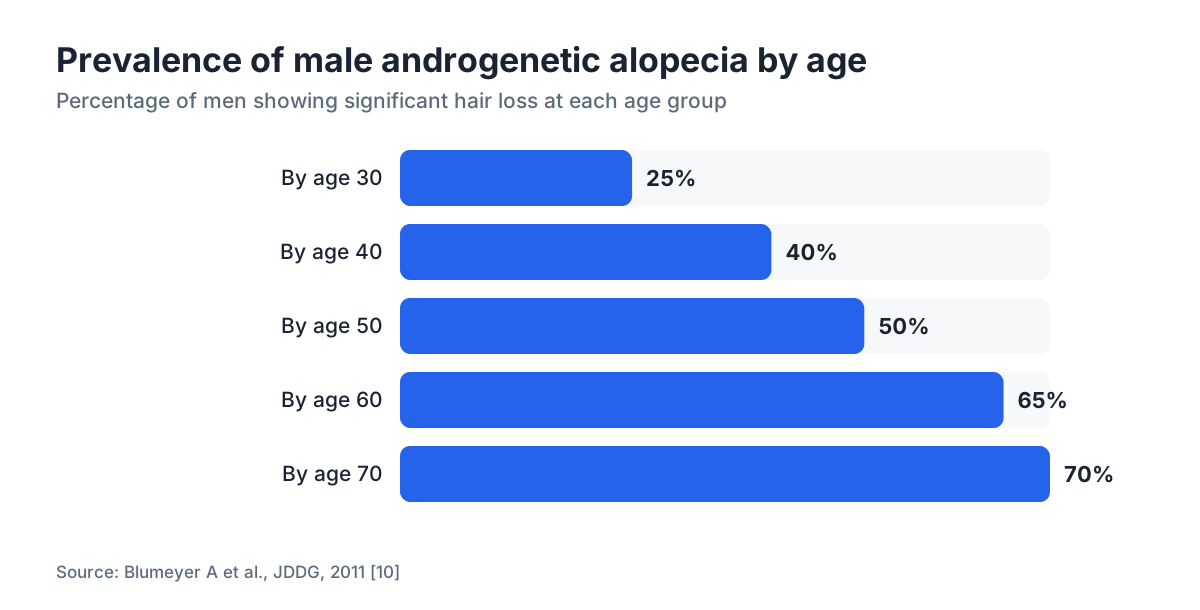
Androgenetic alopecia can start surprisingly early. Scalp biopsy work published in the Journal of the American Academy of Dermatology documented follicle miniaturization in men in their late teens [9]. By age 50, roughly 50 percent of men show significant hair loss, climbing to about 70 percent by 70 [10].
The American Academy of Dermatology reports that male pattern hair loss affects more than 50 million men in the United States, and female pattern hair loss affects more than 30 million women [11].
Early onset, before 25, tends to track with more significant eventual loss because the progression has more runway. That's one reason dermatologists often push not waiting on treatment if you're in your early-to-mid twenties and see clear recession, rather than monitoring for another two years while more ground disappears.
The FDA approved finasteride for male androgenetic alopecia in 1997, and topical minoxidil earlier in 1988, which makes these two of the most studied hair loss treatments in existence [6][7].
Sources
- Online Mendelian Inheritance in Man (OMIM), Johns Hopkins University, entry on widow's peak
- American Academy of Dermatology, Hair Loss Overview
- Norwood OT, 'Male Pattern Baldness: Classification and Incidence,' Southern Medical Journal, 1975
- Rudnicka L et al., 'Atlas of Trichoscopy,' Springer; trichoscopy criteria for androgenetic alopecia including hair diameter variability
- American Academy of Dermatology, Hair Loss Overview (telogen effluvium)
- FDA Drug Label, Finasteride 1 mg (Propecia), NDA 020788
- FDA Drug Label, Minoxidil Topical Solution (Rogaine), OTC monograph
- American Academy of Dermatology, Hairstyles That Pull Can Cause Hair Loss
- Whiting DA, 'Diagnostic and predictive value of horizontal sections of scalp biopsy specimens in male pattern androgenetic alopecia,' Journal of the American Academy of Dermatology, 1993
- Blumeyer A et al., 'Evidence-based (S3) guideline for the treatment of androgenetic alopecia in women and men,' JDDG, 2011
- American Academy of Dermatology, Hair Loss Statistics
- van der Merwe J et al., 'Three weeks of creatine monohydrate supplementation affects dihydrotestosterone to testosterone ratio,' Clinical Journal of Sport Medicine, 2009