

TL;DR: Placebo response rates in hair loss trials run as high as 30% for perceived improvement, yet actual hair counts rarely change. To know if your treatment is working: photograph the same spots monthly under the same light, track global hair counts at 6 and 12 months, and look for quantifiable changes like reduced shed counts and measurable density, more than how it feels.
Why placebo effects hit hair loss treatments especially hard
Hair loss is slow, emotionally loaded, and hard to measure with the naked eye. That combination is a perfect setup for placebo response. When you spend money on a product and want it to work, your brain genuinely perceives improvement even when the mirror disagrees.
In a 2018 review published in the Journal of the American Academy of Dermatology, placebo arms in androgenetic alopecia trials showed subjective improvement rates of up to 30% despite negligible objective hair count changes [1]. People felt their hair was fuller. They just couldn't prove it.
The mechanics matter. Hair growth is cyclical. Every scalp has natural fluctuations in density across the year. Starting a treatment often coincides with an already-improving period, so the timing looks like cause and effect when it isn't. Add in the shedding phase that both minoxidil and finasteride can trigger in the first 6-12 weeks, and the psychological rollercoaster becomes extreme. You panic, you persevere, then hair comes back on its own schedule, and you credit the pill.
None of this means your treatment isn't working. It means you need a measurement system, more than a feeling.
What does a real treatment response actually look like?
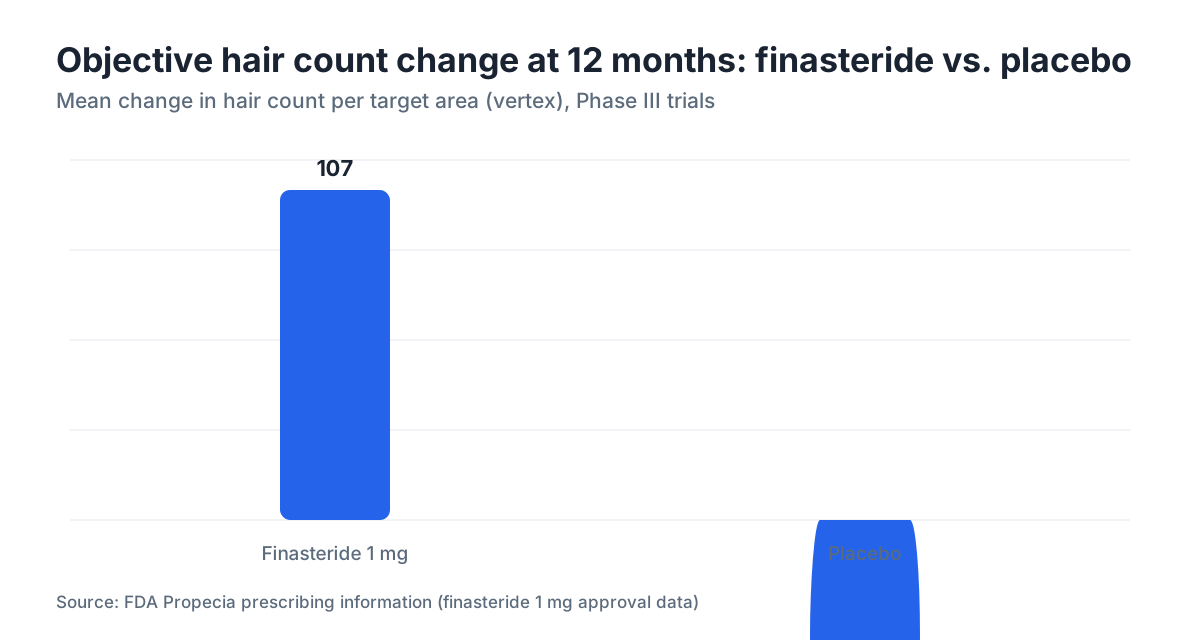
Real responses show up as numbers, not vibes. The FDA-required endpoint for finasteride approval was hair count per square centimeter measured by phototrichogram at 12 months [2]. In the registration trials, men on 1 mg finasteride gained a mean of 107 hairs per square inch at the vertex versus a loss of 75 in the placebo group. That's a spread of 182 hairs per square inch you can count.
Minoxidil 5% topical in its approval trials showed statistically significant increases in nonvellus hair count at 32 weeks compared to vehicle (placebo) [3]. The effect was real but modest: roughly 15-17% more hairs per target area on average.
Here's what a genuine responder tends to notice, in rough order:
- Reduced daily shed count at weeks 8-16 (though an initial shed spike often comes first).
- Slower recession at the hairline or vertex at months 3-6.
- Visible terminal hair density increase at months 6-12.
- A maintained result at 12-24 months.
If you're only at week 8 and you think your hairline looks great, that's probably placebo territory. If you have side-by-side photos from month 1 and month 12 that any neutral observer would call denser, that's signal.
How do you measure hair density at home without a clinic?
You don't need a trichoscope. You need a protocol.
The most reliable DIY method is the consistent-conditions photograph. Pick two spots: your most affected zone and a control zone (usually the back, which shouldn't change). Every 30 days, on the same day of the week, in the same bathroom with the same light source, wet your hair, part it the exact same way, and take a photo from the same distance. Natural light from a window behind you, not overhead, works best. Overhead light creates shadows that make hair look thinner some months and fuller others. That single lighting variable fools more people than anything else.
From those photos, count the visible scalp area. Yes, literally draw a 2 cm x 2 cm square on a printed photo and count the hairs crossing into it. Do it twice to average out counting error. It sounds tedious. It takes 10 minutes. It is the only way to know.
A second method is the pull test. Grasp about 60 hairs between thumb and forefinger and pull with gentle, firm traction. Fewer than 6 hairs coming out is normal. Consistently pulling 10 or more suggests active shedding [4]. Track the count every few weeks. If your treatment is working, active shedding should slow by month 4-6.
The third method is the drain count. Place a white mesh drain cover for 30 days and count shed hairs per shower session. The average person loses 50-100 hairs daily [4]. If your baseline count is 120 and drops to 70 by month 6, that's a real signal. If it stays at 120, the treatment isn't reducing shedding.
If you want a structured AI-assisted baseline before you start, MyHairline's free hair scan can map your density zones and give you a reference point to compare against later.
What timelines should you expect from proven treatments?
This is where most people go wrong. They expect results in 6 weeks and quit at 10 weeks, right before the treatment would have shown effect.
| Treatment | First objective signal | Meaningful density change | Maximum effect |
|---|---|---|---|
| Topical minoxidil 5% | Reduced shed: 8-16 wks | New terminal hairs: 16-32 wks | 12 months [3] |
| Oral minoxidil 2.5-5 mg | Reduced shed: 4-12 wks | Density: 16-24 wks | 12 months [5] |
| Finasteride 1 mg | Slowed loss: 3-6 months | Visible regrowth: 6-12 months | 24 months [2] |
| Finasteride + minoxidil combo | Slowed loss: 2-4 months | Density: 6-9 months | 24 months [6] |
| Low-level laser therapy | Density: 16-26 wks | Moderate gains: 6-12 months | 12 months [7] |
| Hair supplements (biotin, etc.) | Largely unproven in non-deficient patients | Unclear | Unclear [8] |
The honest read: if you're not deficient in iron, zinc, or biotin, hair loss supplements probably won't move the needle measurably. The studies that show benefit are mostly in people who were deficient to begin with.
For any treatment, 12 months is the minimum before you can fairly judge it. At 6 months you can judge trajectory. At 3 months you can judge tolerability. Before 3 months, you're just watching your anxiety.
What are the most common ways people fool themselves into thinking it's working?
A few patterns come up constantly.
The lighting shift. You started using a lamp in your bathroom and the warm light fills in shadows. Your hair looks exactly the same. The light changed.
The haircut effect. A good trim or new styling product redistributes existing hair. Coverage looks better for weeks. Then it fades back to baseline and you think the treatment "stopped working." It never started.
The seasonal cycle. Hair density naturally peaks for many people in late summer and early fall, then sheds more in autumn [9]. If you start a treatment in July and evaluate it in October, you may be comparing a peak to a trough and misreading the treatment as failing. Or you start in February, evaluate in August, and credit the treatment for a seasonal improvement.
The sunk cost perception. You spent $80 a month for 8 months. Of course it's working. The brain is protecting the decision, not evaluating the hair.
The social compliment effect. Someone says "your hair looks good today." That comment rides in your head for weeks and recolors every mirror glance.
The fix is simple: blind evaluation. Print your monthly photos, remove the dates, and ask someone who doesn't know your treatment schedule to rank them from thinnest to densest. If they can't correctly identify the most recent photo as the densest, you don't have a real response yet.
Are there any blood or clinical tests that confirm a treatment is working?
Yes, and they're underused.
A trichogram or phototrichogram done by a dermatologist measures hair density, hair caliber (shaft diameter), and the ratio of growing (anagen) to resting (telogen) hairs in a defined scalp area. The anagen-to-telogen ratio is probably the most sensitive early signal of treatment response. A healthy scalp runs roughly 85-90% anagen hairs [4]. A ratio improving from 70% toward 85% after 6 months of finasteride is a real, measurable result even before you can see it clearly.
Trichoscopy (dermoscopy of the scalp) can quantify miniaturized hairs (vellus) versus terminal hairs. Treatment success in androgenetic alopecia looks like a shift from vellus to terminal hairs over time. Most academic dermatology clinics can do this. The cost runs roughly $100-300 per session depending on location, though pricing varies widely.
Blood work can rule out confounding issues. Low ferritin (under 30 ng/mL is often cited as a threshold for hair loss, though some research suggests under 70 ng/mL may matter [4]), thyroid dysfunction, and low vitamin D can all independently cause or worsen shedding. If these are the underlying drivers, no amount of minoxidil fixes the problem. Treating the right cause is what works, not treating the symptom.
For anyone with a receding hairline or diffuse thinning who suspects something other than androgenetic alopecia, a dermatologist visit before starting any treatment is worth it. Conditions like telogen effluvium can mimic pattern loss and respond to completely different interventions.
How do placebo effects in hair loss trials compare to other conditions?
The hair loss placebo rate is notably high compared to most dermatology conditions, and the reasons are instructive.
In a meta-analysis examining placebo response in androgenetic alopecia RCTs, subjective global assessment scores improved in placebo groups at rates between 13% and 30% across trials [1]. In pain trials, placebo rates average around 27%, which is comparable. In antidepressant trials, placebo response runs 30-40%. So hair loss sits in the same range as emotionally significant conditions.
The specific mechanism is partly expectation and partly natural hair cycling. A study published in the British Journal of Dermatology found that hair count in placebo groups actually decreased over 12 months on objective phototrichogram measurement even when subjects reported subjective improvement [10]. The feeling and the fact were going in opposite directions.
That gap, between how hair feels and what cameras count, is exactly why the FDA requires objective phototrichogram-based endpoints in approval studies rather than patient self-report. Self-report alone is not reliable enough to distinguish treatment from placebo in hair loss.
Does the initial shedding phase mean the treatment is or isn't working?
This confuses almost everyone.
Both topical and oral minoxidil can trigger increased shedding in the first 2-8 weeks of use. Finasteride occasionally does the same in the first month or two. This is called a telogen effluvium-type response: the drug pushes resting hairs out of the telogen phase to make room for new anagen growth [3]. It's not guaranteed to happen, but when it does, it's a good sign the follicles are responding, not a sign the treatment is failing.
The problem is that initial shedding is also what happens when a treatment genuinely isn't working and hair loss continues. The two look identical in the first 6-8 weeks.
How to tell them apart: the treatment-response shed usually resolves by week 12-16 and is followed by a net improvement in density. An ongoing loss that persists past month 4-5 without any density improvement is more likely real failure or untreated underlying cause. If you're unsure whether your shedding is a good sign or a bad one, read more about telogen effluvium and its timelines.
What's the honest track record for treatments people often overpay for?
Some things work. Some things are expensive placebos.
Finasteride 1 mg daily is the most evidence-backed oral treatment for male androgenetic alopecia. Two large Phase III trials covering 1,553 men showed it significantly outperformed placebo on hair count, photographic assessment, and patient self-assessment at 12 months, with continued improvement at 24 months [2]. It doesn't work for everyone, but it works for most men who have androgenetic alopecia and use it consistently. Learn more about how it works and who it's for.
Minoxidil 5% topical is the most evidence-backed topical. It outperformed placebo in multiple FDA-reviewed trials [3]. Real. The combination of finasteride and minoxidil together shows additive benefit in some trials.
DHT-blocking shampoos, peptide serums, stem-cell conditioners, and most "clinically tested" topicals that haven't gone through placebo-controlled RCTs are in murky territory. "Clinically tested" does not mean "placebo-controlled RCT." It often means a small open-label study where everyone knew they were using the product. That's almost guaranteed to produce placebo-inflated results. Read more about DHT blockers and what the evidence actually says.
Hair loss supplements like biotin, saw palmetto, and collagen peptides have varying evidence. Biotin deficiency is rare in people eating a normal diet, and supplementing in non-deficient people has not been shown to improve hair growth in rigorous trials [8]. Saw palmetto has weak evidence for mild benefit in androgenetic alopecia but nothing close to finasteride's effect size.
Hair transplants are the one intervention that doesn't need a placebo comparison: they physically move follicles. The result is real or it's visible. The outcome quality varies enormously by surgeon and technique, but the basics of what to expect are well documented.
When should you actually give up on a treatment?
This is the question nobody answers clearly. Here's the honest framework.
At 3 months: evaluate tolerability only. If side effects are intolerable, stop. If you can manage them, continue.
At 6 months: evaluate trajectory. Your photos should show at least a slowing of loss even if density hasn't fully recovered. If you're losing ground at the same rate as before, the treatment isn't working.
At 12 months: evaluate result. Do your standardized photos show measurable improvement versus month 1? Would a neutral observer rank month 12 as denser? If yes, the treatment is working. If photos are flat or worse, the treatment hasn't helped and you should consult a dermatologist about alternatives.
One thing that matters a lot: what causes your hair loss in the first place. Not all hair loss is the same, and treatments for androgenetic alopecia don't fix nutritional deficiency, thyroid problems, or autoimmune causes. If your diagnosis is wrong, no timeline will give you a good outcome.
At MyHairline, the free AI scan can help you map your current hair zones and flag patterns worth investigating, but it's a starting point, not a substitute for a dermatologist's opinion on diagnosis.
If a treatment has genuinely failed at 12 months and you've confirmed your diagnosis is androgenetic alopecia, escalation options include switching from topical to oral minoxidil, adding finasteride if you're only on minoxidil, or getting a hair transplant consultation if the loss has stabilized.
Can psychological factors actually change hair growth, or just perception?
Mostly perception, with one real exception.
Chronic psychological stress genuinely affects the hair cycle through cortisol and stress hormones that push follicles into telogen prematurely [11]. So stress doesn't just make you feel like you're losing more hair. It can actually increase shedding. Starting a treatment and simultaneously reducing stress (because you feel like you're doing something) could produce real improvement through both the treatment and the stress reduction. The two effects are genuinely hard to disentangle.
But outside of stress-driven shedding, the placebo effect changes perception, not follicle biology. Your follicles don't have a belief system. The treatment either reaches them at adequate concentration and duration to affect the hair cycle, or it doesn't. No amount of positive thinking converts vellus hairs back to terminal hairs.
Sources
- Journal of the American Academy of Dermatology, Gupta et al. 2018, placebo response in androgenetic alopecia trials
- FDA, Propecia (finasteride 1 mg) prescribing information and approval label
- FDA, Rogaine (minoxidil 5% topical) prescribing information and approval data
- American Academy of Dermatology, hair loss overview and diagnosis guidance
- Journal of the American Academy of Dermatology, Randolph & Tosti 2021, oral minoxidil for hair loss review
- Journal of Dermatology, Hu et al. 2015, finasteride plus minoxidil combination versus monotherapy RCT
- American Journal of Clinical Dermatology, Avci et al. 2014, low-level laser therapy for hair loss review
- Skin Appendage Disorders, Patel et al. 2017, role of vitamins and minerals in hair loss
- PLOS One, Kunz et al. 2009, seasonal changes in human hair growth
- British Journal of Dermatology, Price et al. 1999, minoxidil efficacy and placebo comparison
- National Institutes of Health, MedlinePlus, telogen effluvium overview