

TL;DR: Shed hairs have a small white or pigmented bulb at the root end, meaning the follicle released the strand on its own. Broken hairs taper or fray at both ends with no bulb. Losing 50 to 100 hairs a day is normal shedding. Short, ragged strands on your pillow or brush almost always mean breakage from heat, tension, or chemicals, not true hair loss.
What is the actual difference between shedding and breakage?
Shedding and breakage look identical in your brush and come from completely different places. Shedding is biology: your follicle finishes its growth cycle, lets the hair go, and starts a new one. Breakage is a structural failure. The strand snaps somewhere along its length because something weakened it.
The fastest way to tell them apart takes ten seconds. Pick up a fallen hair and look at both ends. A shed hair has a small club or bulb at the root end, often white or lightly pigmented. That bulb is the root sheath, the physical proof the follicle released the hair voluntarily [1]. A broken hair has no bulb at all. One or both ends will be tapered, frayed, split, or cut off blunt, depending on how it snapped.
That's the whole test. Everything else (where the hair falls, how much, how it feels) is extra information that helps you find the cause.
How many hairs falling out per day is normal?
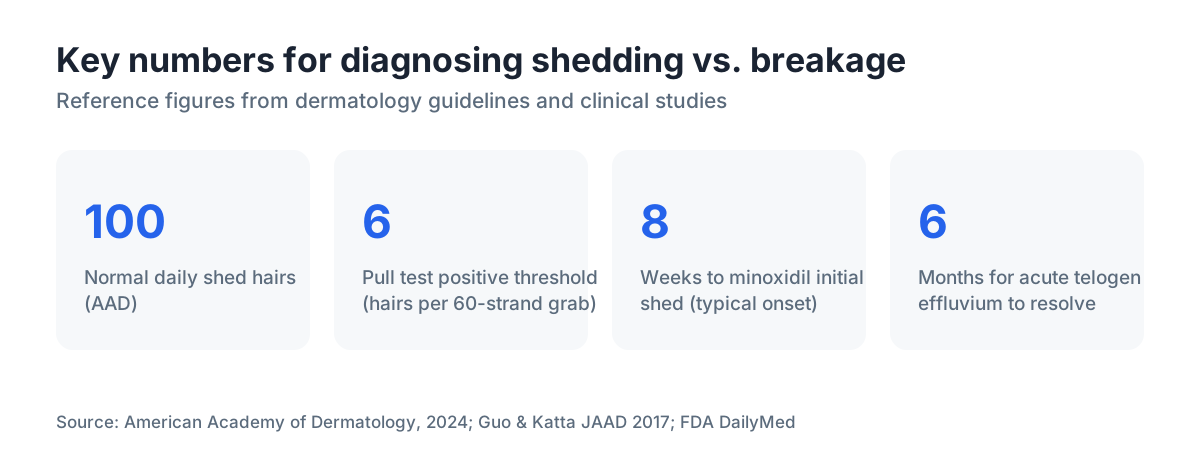
The American Academy of Dermatology puts normal daily shedding at 50 to 100 hairs [2]. Some dermatologists stretch that to 150 on wash days, because hairs that would have shed across the week get dislodged all at once when you shampoo.
Those numbers count true shed hairs with bulbs. Breakage is harder to tally because short fragments slip down the drain unnoticed. If you're regularly seeing long shed hairs and lots of short broken pieces, your daily count can look terrifying even when your follicles are perfectly healthy.
Context matters. Someone with thick, dense hair may shed 150 hairs and notice nothing. Someone with fine hair may shed 60 and feel like they're going bald. Volume in the drain is not the same as follicle health.
What does a shed hair look like vs. a broken hair?
Here's a side-by-side you can use right now:
| Feature | Shed hair | Broken hair |
|---|---|---|
| Root end | White or pigmented bulb | No bulb; tapered or blunt |
| Tip end | Tapered, sometimes split | Tapered, frayed, or split |
| Length | Full hair length for you | Shorter than your hair, often much shorter |
| Texture at break point | N/A | Rough, frayed, or sharp |
| Where you find it | Brush, pillow, shower drain | Brush, collar, pillowcase (short pieces) |
| What it means | Normal cycle or excess shedding from a trigger | Structural damage from heat, tension, chemicals, dryness |
The length clue is underrated. Find dozens of pieces that are 2 to 4 inches long when your hair is 12 inches, and those are breaks, not sheds. Short strands can't come from shedding unless your hair has always been that short.
One more clue: run a strand between your fingers from root to tip. Shed hairs feel smooth and even. Broken hairs feel rough at the break point, and the strand often weakens or snaps under light tension [3].
What causes excessive hair shedding?
True shedding spikes happen when something pushes a large batch of follicles into the resting (telogen) phase at the same time. Dermatologists call this telogen effluvium, and it usually shows up 2 to 3 months after the trigger, not the day after [4].
Common triggers include:
Fever or illness (COVID-19 research documented significant telogen effluvium in recovered patients [5]). Rapid weight loss or crash dieting. Childbirth. Major surgery. Thyroid disorders, either under or over active. Severe emotional or physical stress. Starting or stopping certain medications, including hormonal birth control [10].
Iron deficiency earns its own mention. A serum ferritin below roughly 30 to 70 ng/mL tracks with diffuse shedding in some studies, though the exact threshold is argued in the literature [6]. If your shedding crept in without an obvious stress event, ask your doctor to check ferritin, thyroid-stimulating hormone, and a basic metabolic panel before you assume it's genetic.
Genetic hair loss (androgenetic alopecia) involves shedding too, but the hairs from miniaturized follicles come out thinner and shorter than normal terminal hairs. If the shed strands are getting progressively finer over months or years, that points toward what causes hair loss through hormonal pathways, specifically DHT acting on genetically susceptible follicles.
What causes hair breakage?
Breakage is almost always a mechanical or chemical story. The hair shaft is dead protein. It can't repair itself. Every insult stacks up.
Heat is the usual suspect. Flat irons and curling wands above 365°F (185°C) cook the keratin proteins inside the shaft and fracture the cortex [3]. Use heat tools daily with no protectant and find short broken pieces? That's probably your answer.
Chemical processing adds to the load. Bleaching breaks the disulfide bonds that hold hair's protein structure together. Relaxers do the same thing harder. Coloring again and again without enough recovery time weakens the shaft from the outside in. Each process makes the next one bite deeper.
Tension gets underestimated constantly. Tight ponytails, braids, and extensions pull on both the follicle and the shaft. The breakage tends to show up at the hairline and temples where tension is highest, which people mistake for a receding hairline. If short pieces appear specifically at your edges, tension is a serious candidate [11].
Dryness and porosity matter too. Low-humidity climates, over-washing, and sulfate-heavy shampoos strip the oils that give hair flexibility. Dry hair snaps instead of bending. And protein-moisture imbalance, where the hair carries too much protein treatment relative to moisture, leaves a brittle texture that breaks under everyday handling.
Can you have shedding and breakage at the same time?
Yes, and it happens more than people think. Someone going through postpartum telogen effluvium while also bleaching their hair at home is fighting both battles at once. The shed hairs with bulbs are the effluvium. The short jagged pieces are the bleach.
This is exactly why diagnosing yourself from the drain fails. You have to examine the actual strands. Grab a handful from your brush and sort them: bulb vs. no bulb, full length vs. short. That ratio tells you far more than a vague sense that a lot of hair is coming out.
If you want an objective starting point, a free AI hair analysis like the one at MyHairline helps you photograph and document your scalp and hair pattern over time, so you're not relying on memory.
Is the pull test a reliable way to check for shedding?
The pull test has real clinical history, though it works better in a dermatologist's hands than at your bathroom mirror. The method: grasp 40 to 60 hairs between your fingers, apply firm tension from root to tip, and count how many come out. More than 6 hairs (roughly 10% of the grabbed sample) counts as a positive test suggesting active shedding [4].
At home, most people pull too hard or too gently. And the test means nothing if you've washed or brushed in the last day or two, because loose telogen hairs are already gone. The pull test tells you the most 2 to 3 days after your last wash.
A positive pull test tells you shedding is elevated. It doesn't tell you whether the cause is temporary (telogen effluvium that resolves) or ongoing (androgenetic alopecia that progresses). Sorting those two apart means looking at whether the shed hairs are full-caliber or miniaturized, and often needs trichoscopy or a scalp biopsy from a dermatologist to confirm.
When should you see a dermatologist about hair loss?
See a board-certified dermatologist if your shedding has run more than 6 months with no obvious trigger, you're losing more than 150 hairs a day consistently, your part is widening or your ponytail is thinning over months, you find patchy bald spots, or you have scalp pain, itch, or burning alongside the loss.
Shedding that follows a clear trigger (illness, surgery, childbirth, crash diet) usually clears up on its own within 3 to 6 months of removing that trigger [10]. No need to rush to a specialist for that. But if you're still not recovering after 6 months, something else may be at play.
Breakage severe enough to create visible thinning, especially at the crown or hairline, can look identical to genetic loss in a photo. A dermatologist can use trichoscopy (a dermatoscope and camera) to look at individual follicle openings and tell you whether the follicles are intact and just making weak hair, or actually shrinking.
What treatments work for shedding vs. breakage?
The treatments are close to opposite, which is the whole reason getting the diagnosis right matters.
For excess shedding from androgenetic alopecia, the evidence points to minoxidil for men (FDA-approved topical at 2% and 5%) and finasteride (FDA-approved oral DHT blocker at 1mg/day for men) as the two options with the strongest clinical backing [7][8]. Some people use finasteride and minoxidil together. The FDA label for finasteride 1mg states it is indicated "for the treatment of male pattern hair loss" and warns that "patients should be cautioned about the possibility of decreased libido, erectile dysfunction and ejaculation disorder" [7]. A DHT blocker goes after the hormonal driver at the root. Oral minoxidil at low doses (0.25 to 1.25mg for women, 2.5 to 5mg for men) is used off-label more and more when topical doesn't fit someone. None of these fix breakage.
For breakage, the fix is removing the damage source and rebuilding structural integrity. Drop heat tool temperatures under 300°F when you can. Space out chemical treatments. Add a humectant-rich conditioner and cap protein treatments at every 4 to 6 weeks unless your hair is badly damaged. Look for hydrolyzed keratin, panthenol, and ceramides, which temporarily fill gaps in the cuticle.
For shedding from a nutritional cause, treat the deficiency itself. If ferritin is low, iron (dosed with your doctor's guidance) can slow the shedding, but growth takes 3 to 4 months to catch up. Hair loss supplements that aren't fixing a real deficiency do almost nothing, in my honest view. If your ferritin, iron, thyroid, and vitamin D all come back normal, more biotin is a waste of money.
Does diet or nutrition affect shedding differently from breakage?
Yes, in two different ways. Nutritional deficiencies hit the follicle itself and cause shedding. The hair machinery inside the follicle needs amino acids (especially lysine and cysteine), iron, zinc, and B vitamins to run. When those run low, the follicle downshifts into telogen and drops the hair [6].
Nutrition affects breakage more indirectly. A diet very low in fat, for example, can cut the sebum that coats and lubricates the shaft, leaving hair drier and quicker to snap. But breakage from diet alone is far rarer than breakage from external mechanical and chemical damage.
The clearest nutritional picture: eat under 1,000 to 1,200 calories a day, or cut out a whole macronutrient group, and expect shedding to follow 2 to 3 months later. That shedding shows up as full-length hairs with bulbs, not short broken fragments.
Can minoxidil side effects cause shedding or breakage?
Minoxidil triggers an initial shed in many users, usually 2 to 8 weeks after you start. This is the dread shed. It's a real biological event: minoxidil pushes follicles out of a prolonged telogen phase and into anagen (growth), and the old telogen hairs have to exit first [9].
These shed hairs will have bulbs. They are true sheds, not breakage. That distinction is a big deal because people quit minoxidil right when this happens, which is the worst possible moment to stop. The shed usually settles within 2 to 3 months, and regrowth follows.
Minoxidil itself doesn't cause breakage. But the propylene glycol in some topical formulas can dry out the scalp and hair over time for sensitive people, which may indirectly raise brittleness. Switching to a foam or a lower concentration helps. See the minoxidil side effects page for the full rundown of what actually warrants attention.
What are the early signs of hair loss you shouldn't ignore?
There's a line between normal variation and a real signal. Here are the signs worth taking seriously.
Your part is getting wider. Photograph it in the same lighting every month. If the scalp shows more at the crown or part line over 3 to 4 months, that's a real change, not a trick of the light.
Your ponytail circumference is shrinking. Loop a hair tie the same number of times each time. Fewer loops over the months means you're losing density.
Shed hairs are getting thinner and shorter. Full-caliber sheds are a good sign. Fine, wispy, almost translucent shed hairs point to follicle miniaturization from androgenetic alopecia.
Your hairline is moving back. Compare photos. A receding hairline almost always starts at the temples. If the corners are softer or further back than they were two years ago, get it evaluated.
Spot any of these alongside heavy shedding and you should get a professional opinion rather than wait it out. Early treatment with proven options beats starting late by a wide margin, because miniaturized follicles that sit dormant long enough stop responding at all.
How do you do the at-home strand test for shedding and breakage?
You don't need a lab. Here's a protocol you can run in five minutes.
Step one: Don't wash or brush for 24 to 48 hours before the test. This lets naturally shed hairs pile up.
Step two: Run your fingers through a section about 60 strands wide, scalp to tip, with moderate tension. Collect what comes free.
Step three: Lay the hairs on a white surface. A sheet of printer paper works. Look at both ends of each hair under good light, near a window or a bright lamp.
Step four: Sort. Bulb on one end, full length: shed hair. No bulb, shorter than your average length: broken hair. Both types present: you've got both problems.
Step five: Count. Pulling 6 or more from a 60-strand grab means your shedding is elevated. If most of the pile is short fragments with no bulb, breakage is your bigger issue.
Run the test on three different days and average it. Hair loss swings day to day. One bad day means nothing. A consistent pattern over a week means something.
If you want objective tracking over time, the MyHairline AI scan tool lets you photograph your scalp the same way each time and compare over months, which takes the guesswork out of "is this actually getting worse."
Sources
- American Academy of Dermatology (AAD), Hair loss: Who gets and causes
- American Academy of Dermatology (AAD), Do you have hair loss or hair shedding?
- Journal of the Society of Cosmetic Chemists, Heat effects on hair (heat damage and keratin)
- American Academy of Dermatology (AAD), Hair loss: Diagnosis and treatment
- Journal of the American Academy of Dermatology, COVID-19 and telogen effluvium (Recker et al., 2021)
- Journal of the American Academy of Dermatology, Nutritional deficiencies and hair loss review (Guo & Katta, 2017)
- FDA Drug Label, Finasteride 1mg (Propecia), FDA label via DailyMed
- FDA Drug Label, Minoxidil Topical Solution 2% and 5%, FDA via DailyMed
- Dermatology and Therapy, Minoxidil: A comprehensive review (Suchonwanit et al., 2019)
- National Institutes of Health, MedlinePlus, Hair loss
- American Academy of Dermatology (AAD), Traction alopecia