
TL;DR: Minoxidil is an FDA-approved topical (and off-label oral) treatment that can regrow hair in androgenetic alopecia, mainly at the crown. Studies show visible improvement in about 40-60% of users after 4-6 months of daily use. It doesn't fix a receding hairline as reliably as it treats crown thinning, and results reverse if you stop.
What is minoxidil and how does it work on hair loss?
Minoxidil is a vasodilator that was originally an oral pill for high blood pressure back in the 1970s. Doctors noticed patients grew hair in odd places while taking it, and that side effect eventually got turned into the topical product you now see in drugstores. The FDA approved topical minoxidil for androgenetic alopecia (male and female pattern hair loss) starting in 1988 for men and 1991 for women [1].
Nobody has a complete mechanistic answer for why it works.
The leading theory is that minoxidil shortens the telogen (resting) phase of the hair growth cycle, pushes more follicles into anagen (growth) phase, and dilates blood vessels around the follicle to improve blood flow and nutrient delivery. It may also open potassium channels in hair follicle cells, which is thought to help enlarge miniaturized follicles. It doesn't touch the hormonal cause of pattern hair loss (that's what finasteride is for), which is why the two are often paired. You can read more on how the two work together in finasteride and minoxidil.
Minoxidil works best on follicles that are miniaturized but still alive. Once a follicle is scarred over or fully dormant for years, minoxidil generally can't bring it back. That's why timing matters more than most people expect. If you want a read on the biology of what's actually happening to your follicles before you commit to a product, what causes hair loss is a good place to start.
Does minoxidil actually work? What the studies show
Yes, for a real chunk of users, but 'works' means different things depending on where the hair is thinning. The core trials for topical minoxidil are decades old now, and the numbers hold up reasonably well across newer meta-analyses.
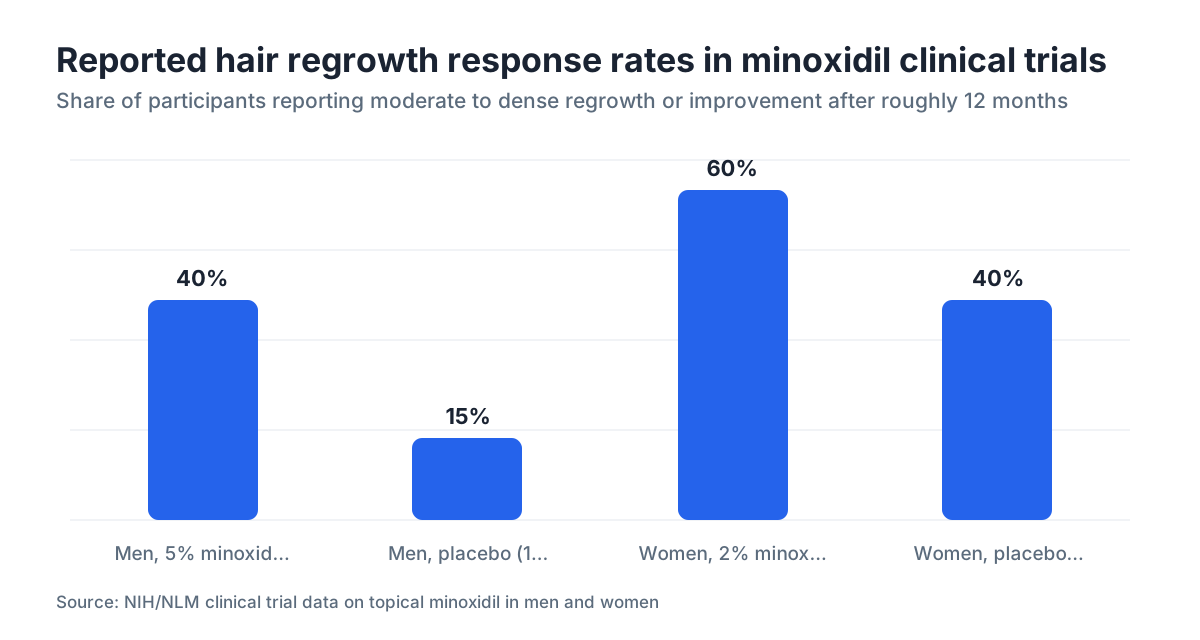
In the original manufacturer-sponsored trials submitted to the FDA, about 40% of men using 5% topical minoxidil for 12 months reported moderate to dense regrowth, versus roughly 15% on placebo [2]. In women, a 12-month trial of 2% minoxidil found roughly 60% of users reported at least some regrowth versus about 40% on placebo, using patient self-assessment as the measure [3]. A 2019 systematic review in the Journal of the American Academy of Dermatology on minoxidil for androgenetic alopecia concluded that both 2% and 5% formulations increase hair count and hair thickness compared to placebo, with 5% generally outperforming 2% in men [4].
The honest caveat: most of these trials measure hair count in a photographed target area, not 'looks noticeably better to a stranger.' Patient-reported satisfaction is usually lower than the hair-count numbers suggest. If you want the deeper breakdown of trial data and response rates by Norwood stage, see does minoxidil work.
Minoxidil is far better documented for crown (vertex) thinning than for a receding hairline or temple recession. The FDA label itself specifically studied the vertex, and dermatologists commonly say frontal hairline response is less predictable. If your main concern is your hairline specifically, read receding hairline before you assume minoxidil alone will fix it.
Minoxidil for women: what's different about dosing and formulation?
Minoxidil for women is FDA-approved at 2% liquid and 5% foam, both applied once or twice daily depending on the product's label. The 2% solution was the original women's formula approved in 1991; the 5% foam (once-daily) got FDA approval for women in 2014 based on a 24-week trial showing it was non-inferior to twice-daily 2% solution, with slightly better results in some measures [5].
The practical question most women ask is whether to use the men's 5% product or a women's-labeled one. The active ingredient is identical.
The difference is formulation and instructions: many women's products are once-daily 5% foam, while some men's 5% products are twice-daily. Twice-daily use of 5% can increase the odds of unwanted facial hair growth (hypertrichosis) in women, which is the most commonly reported cosmetic complaint. That's why most dermatologists steer women toward once-daily 5% foam rather than twice-daily men's liquid.
Androgenetic alopecia in women usually shows up as diffuse thinning across the crown and a widening part line, not a receding hairline like the male pattern. Minoxidil is well suited to that pattern since it's a crown-focused treatment. Women with hairline recession specifically should get evaluated for traction alopecia or other non-pattern causes before assuming minoxidil is the fix; a lot of frontal thinning in women isn't androgenetic at all.
A 2004 study directly comparing minoxidil formulations in women found the 5% foam produced greater hair growth than 2% solution at 48 weeks, without a meaningful increase in side effects when used once daily [6]. That's the basis for most dermatologists now recommending 5% foam as the default first choice for women rather than the older 2% liquid.
Minoxidil foam vs liquid: which should you actually buy?
Foam and liquid contain the same active ingredient; the vehicle is what differs. Liquid solution contains propylene glycol, which helps absorption but is also the main cause of scalp itching, flaking, and contact dermatitis that some users report. Foam generally doesn't contain propylene glycol, dries faster, and leaves less residue, which is why it has become the more popular format for both men and women in the last decade.
| Feature | 2% Liquid | 5% Foam |
|---|---|---|
| FDA approval (women) | 1991 | 2014 |
| Typical dosing | Twice daily | Once daily (women's product) |
| Propylene glycol | Usually yes | Usually no |
| Drying time | Slower, can drip | Faster |
| Scalp irritation risk | Higher | Lower |
| Best for | Budget, sensitive to foam texture | Most users, especially women or those with scalp sensitivity |
For most people starting out, 5% minoxidil foam is the better default, especially for women who want once-daily dosing and lower irritation risk. If you have a known sensitivity to propylene glycol or you get contact dermatitis from liquid, switching to foam often resolves it without giving up the treatment entirely.
How long does minoxidil take to work and when will you see results?
Most people need to commit to at least 4 to 6 months before judging whether minoxidil is working, and 12 months to see the full effect. The FDA-reviewed trials measured outcomes at 4 months and 12 months, not at 6 weeks [2][3].
There's also a well-documented early phase called 'shedding' that confuses a lot of new users. Somewhere between 2 and 8 weeks in, some people notice more hair falling out, not less. This happens because minoxidil pushes resting (telogen) follicles into the growth phase faster, which forces the old resting hair out to make room for a new hair. It's usually a sign the product is working, not a sign to quit. You can read more about the phases of the hair cycle at hair loss telogen.
If you see zero change after 6 months of consistent daily use, most dermatologists would call that a non-response, and it's reasonable to talk to a doctor about oral minoxidil, finasteride, or other options rather than continuing to wait. Applying it inconsistently (missing days, using less than the labeled amount) is one of the most common reasons people conclude 'it doesn't work' when they never gave it a fair trial.
What happens if you stop using minoxidil?
Any hair minoxidil helped you grow will likely be shed within a few months of stopping. This is one of the most important things to know before you start, because minoxidil isn't a cure, it's maintenance. The FDA label for topical minoxidil states it is intended for continued use to maintain results, and discontinuation typically leads to loss of the regrowth within 3 to 4 months [1].
This isn't unique to minoxidil; it's true of most treatments for pattern hair loss, including finasteride. The underlying miniaturization process driven by genetics and hormones (DHT) keeps happening in the background regardless of what minoxidil is doing on the surface. Stop the drug, and the follicles go back to whatever trajectory they were already on.
That's a real cost consideration people underweight when they start. A bottle of minoxidil is cheap, but paying for it every month for the next 20 or 30 years is not nothing, and it's worth budgeting for that reality rather than treating minoxidil as a one-time fix.
What are minoxidil's side effects, and what's common vs rare?
The most common side effects of topical minoxidil are scalp irritation, itching, dryness, and flaking, reported in a meaningful minority of users, particularly with the liquid formulation's propylene glycol base. Unwanted hair growth on the face or other areas the product accidentally touches (hypertrichosis) is the next most common complaint, especially in women using higher concentrations or applying it more often than directed.
Less common but worth knowing about: some users report a temporary increase in resting heart rate, lightheadedness, or swelling, which relates to minoxidil's original job as a blood pressure drug. The FDA label warns that topical minoxidil should be avoided if you have a known scalp condition, are pregnant or breastfeeding, or have heart disease, without talking to a doctor first [1].
Oral (low-dose) minoxidil, prescribed off-label by dermatologists, carries a broader side effect profile because it affects the whole body, more than the scalp. That includes more systemic hypertrichosis, potential fluid retention, and effects on blood pressure that need monitoring in some patients. For the full rundown, see minoxidil side effects and oral minoxidil.
If you get chest pain, rapid heartbeat, sudden weight gain, or swelling in your hands and feet while using minoxidil in any form, that's a reason to stop and call a doctor, not push through.
Is minoxidil safe for women, and does it affect pregnancy or hormones?
Topical minoxidil is FDA-approved for women and is not a hormonal treatment; it doesn't touch estrogen, testosterone, or DHT pathways, which is a genuine advantage over finasteride for women who can't or don't want to use hormone-altering drugs. That said, safety data during pregnancy and breastfeeding is limited, and the FDA label advises against use during pregnancy without medical supervision [1], largely because minoxidil is absorbed systemically in small amounts and animal studies raised some concern.
Women using minoxidil sometimes worry it will 'unbalance' their hormones the way they've heard finasteride can. It doesn't.
Its mechanism is vascular and cellular at the follicle, not hormonal, which is part of why it's approved for women in the first place while oral finasteride generally is not (except in specific off-label cases in postmenopausal women under a dermatologist's care).
The practical concern for most women is cosmetic: getting the foam or liquid precisely on the scalp and not on the forehead or temples, since stray product on facial skin is the main cause of unwanted facial hair growth.
Topical vs oral minoxidil: which works better?
Oral (low-dose) minoxidil is prescribed off-label, usually at doses far lower than the blood pressure version (commonly 0.25mg to 2.5mg daily versus 10-40mg for hypertension). It's grown in popularity because it skips the scalp irritation problem entirely and some patients find it more convenient than a daily topical routine.
A 2021 systematic review in the Journal of the American Academy of Dermatology on low-dose oral minoxidil for hair loss found it was generally well tolerated and effective, with hypertrichosis (unwanted body hair) as the most frequently reported side effect, occurring in a meaningful percentage of patients, particularly women [7]. Direct head-to-head trials against topical minoxidil are still limited, so nobody can say with certainty that oral beats topical or vice versa across the board; the honest answer is that response varies by individual and dermatologists often choose based on tolerability rather than proven superiority.
The tradeoff: oral minoxidil requires a prescription and, since it's absorbed systemically, needs a doctor watching for blood pressure and heart rate changes, especially in patients with existing cardiovascular issues. Topical stays on the scalp (mostly) and is available over the counter. For most first-time users without cardiovascular risk factors, starting with topical is the lower-risk, lower-commitment option; oral is worth discussing with a dermatologist if topical irritation is a dealbreaker or adherence to a twice-daily topical routine is a problem.
What's the best minoxidil for women, and how do you choose a product?
For most women starting treatment, once-daily 5% minoxidil foam is the reasonable default: it has FDA approval specifically for women, better absorption without propylene glycol irritation, and once-daily dosing improves the odds you'll actually stick with it for the 12 months it takes to know if it's working.
A few practical buying notes. Generic 5% minoxidil foam (store brand or otherwise) contains the identical active ingredient as brand-name products; the FDA requires generics to meet the same bioequivalence standards, so there's no clinical reason to pay a premium for a brand name here. What matters more is consistency of use and correct application (a capful or the labeled dose, applied to a dry scalp, not washed for at least 4 hours).
Women with sensitive skin who react to foam vehicles sometimes do better on 2% liquid instead, even though the data slightly favors 5% foam on average, because tolerability that lets you use it every day beats a marginally more effective product you keep skipping.
Minoxidil doesn't fix every kind of hair thinning. If your pattern doesn't match typical female pattern hair loss (diffuse crown thinning, widening part), or you're also dealing with clumps of shedding, scalp pain, or patchy bald spots, get that evaluated before assuming minoxidil is the answer. A free option to start narrowing down what's actually happening with your hair is an AI scan, which can help flag whether your pattern looks like typical androgenetic thinning before you spend months on a product.
Minoxidil vs hair transplant: when do you need more than a bottle?
Minoxidil can slow thinning and regrow some hair in miniaturized follicles, but it cannot restore hair in areas that are already fully bald with no living follicles, and it does not create new hairline density the way a transplant does. If you're already at an advanced Norwood stage with visible scalp showing through and no fine 'peach fuzz' hairs left in the area, minoxidil alone is unlikely to give you a dramatic change.
A hair transplant moves your own follicles (usually from the back and sides, which are typically resistant to DHT) into the thinning or bald areas. It's a permanent, surgical solution with real costs; you can see current pricing ranges at hair transplant expenses and a general overview at hair transplant. Many surgeons actually recommend continuing minoxidil after a transplant to protect the surrounding native hair that's still miniaturizing, since a transplant doesn't stop the underlying pattern hair loss process elsewhere on the scalp.
The realistic way to think about it: minoxidil is a maintenance and partial-regrowth tool for follicles that are struggling but alive. Once follicles are truly gone, only a transplant restores hair in that spot.
Does anything unrelated make minoxidil less effective, like diet or supplements?
People often ask whether things like creatine use, biotin, or other supplements interfere with or compound hair loss while using minoxidil. Creatine specifically has one small 2009 study in rugby players showing an increase in a hormone called DHT, which is the driver of pattern hair loss, but that study didn't measure actual hair loss outcomes, and no follow-up study has confirmed a real-world hair loss effect from creatine. If you're curious about that specific question, does creatine cause hair loss covers what the evidence actually says.
Supplements marketed for hair loss (biotin, saw palmetto, various vitamin blends) have much weaker evidence behind them than minoxidil or finasteride, and biotin deficiency severe enough to cause hair loss is genuinely rare outside specific medical conditions. If you're using minoxidil and also taking hair supplements hoping for an extra boost, know that you're layering an unproven intervention onto a proven one; it's not harmful in most cases, just not something with strong data behind it. See [hair loss supplements](https://myhairline.ai/blog/hair loss-supplements) for a rundown of what's actually been studied versus what's just marketed well.
Minoxidil for men vs women: is the treatment really different?
The active ingredient and mechanism are identical for men and women; what differs is the typical pattern of hair loss being treated and the approved dosing. Men's pattern loss usually starts at the hairline and crown (classified by Norwood stage), while women's pattern loss is usually diffuse thinning across the crown with a preserved hairline. That's why women's products emphasize once-daily 5% foam while men's products often include twice-daily options and higher-strength formulations aimed at both hairline and crown, even though minoxidil's real evidence base is strongest for the crown in both sexes.
Men also have finasteride as a first-line hormonal option, which women generally don't (outside specific off-label, post-menopausal use), so minoxidil often carries more of the treatment weight for women, making correct product choice and consistency even more important. For a deeper breakdown by Norwood stage and male-specific dosing norms, see minoxidil for men.
Sources
- U.S. FDA, drug label/monograph information for minoxidil topical solution
- U.S. National Library of Medicine / NIH, clinical trial data on topical minoxidil in men
- U.S. National Library of Medicine / NIH, clinical trial data on topical minoxidil in women
- Journal of the American Academy of Dermatology, systematic review of minoxidil for androgenetic alopecia
- U.S. FDA, approval record for 5% minoxidil foam once-daily in women (2014)
- Journal of the American Academy of Dermatology / clinical trial comparing minoxidil formulations in women
- Journal of the American Academy of Dermatology, systematic review of low-dose oral minoxidil for hair loss
- American Academy of Dermatology, patient guidance on minoxidil and hair loss treatment
- U.S. FDA, Orange Book / generic drug bioequivalence standards