
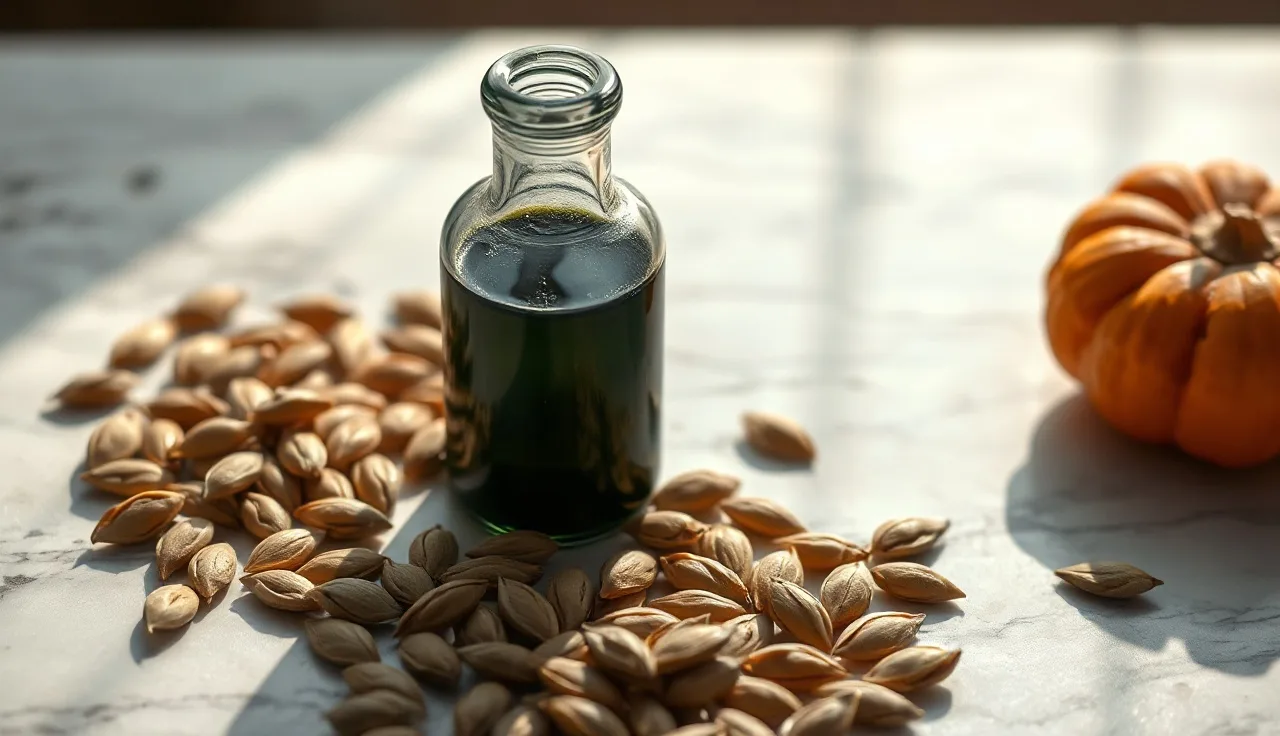
TL;DR: Pumpkin seed oil contains beta-sitosterol, a phytosterol that weakly blocks DHT. One randomized trial in men showed 40% more hair count after 24 weeks. No equivalent trial exists in women. The oil is cheap and low-risk, but it will not replace minoxidil or finasteride if your hair loss is more than mild.
What is pumpkin seed oil and why do people use it for hair loss?
Pumpkin seed oil is a dark green oil pressed from the seeds of Cucurbita pepo, the same pumpkin you carve every autumn. Central Europe has cooked with it for centuries. The hair loss interest is newer, and it comes down to one compound.
The logic is simple. Pumpkin seed oil is rich in phytosterols, especially beta-sitosterol, which looks structurally like cholesterol and can compete with testosterone at the enzyme 5-alpha reductase. That enzyme turns testosterone into dihydrotestosterone (DHT), the androgen tied most directly to androgenetic alopecia (pattern hair loss) in both men and women [1]. Slow that conversion even a little, and follicles that would otherwise shrink may hang on longer.
The oil also carries zinc, a cofactor in keratin synthesis that helps hair only when someone is genuinely deficient, plus tocopherols (vitamin E) that may cut oxidative stress in the scalp [2]. Do those secondary nutrients add anything on top of the phytosterol effect? Nobody knows. The data does not exist.
For women, the appeal is partly about the alternatives. Minoxidil means daily use for life. Finasteride is not FDA-approved for premenopausal women and can harm a developing fetus. So a cheap food oil that might nudge DHT down sounds great. The real question is whether the evidence earns that hope.
What does the clinical research actually show?
One decent trial exists, it was in men, and the female-specific evidence is close to nothing. That is the honest summary before any detail.
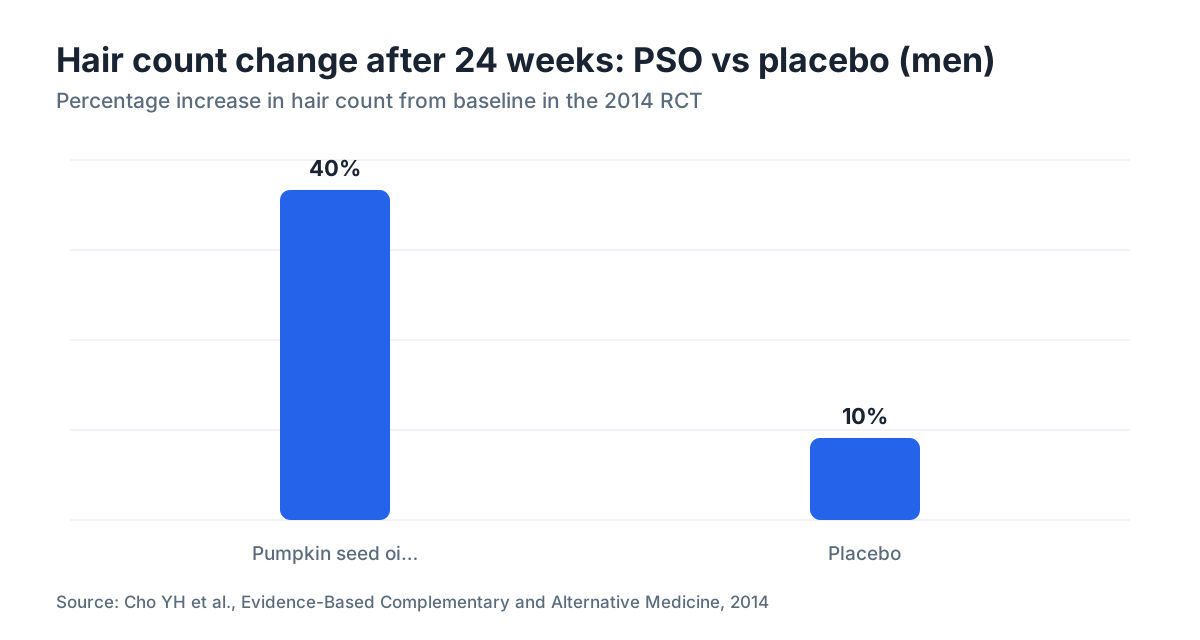
The most-cited study is a 2014 randomized, double-blind, placebo-controlled trial in Evidence-Based Complementary and Alternative Medicine. Researchers enrolled 76 men with androgenetic alopecia and gave half of them 400 mg of pumpkin seed oil supplement daily for 24 weeks. The oil group showed a 40% increase in hair count from baseline against 10% in the placebo group [3]. The authors wrote that "men who received PSO had a 40% increase in mean hair count as compared to a 10% increase in placebo-treated men." That is the single most concrete number in the entire pumpkin seed oil literature.
Here is the catch. The trial was in men. Hair loss patterns and androgen sensitivity differ between the sexes. Women with androgenetic alopecia usually thin diffusely across the crown instead of receding at the temples, and their baseline DHT tends to run lower. Whether a weak 5-alpha reductase inhibitor moves anything in women who start with less androgen activity is an open question.
As of mid-2025, no randomized trial has tested pumpkin seed oil in women with pattern hair loss. Small mechanistic and animal studies show phytosterols can inhibit 5-alpha reductase type II [4], the main isoform in scalp follicles, but that is not the same as a clinical result in women.
A 2021 lab study also found pumpkin seed oil extract lengthened hair shafts in cultured human follicles and stretched the anagen (growth) phase. In-vitro wins often fall apart on real scalps.
How does pumpkin seed oil compare to minoxidil and other proven treatments?
Honest perspective matters most right here. Pumpkin seed oil has one positive trial in men. Minoxidil has decades of trial data in women. Those are not the same tier of proof, and the table below shows why you cannot read the numbers side by side as equals.
| Treatment | Evidence tier | Typical hair count change | FDA status for women | Cost/month |
|---|---|---|---|---|
| Minoxidil 2% topical | Multiple large RCTs | +15 to +20% hair count at 32 weeks [5] | FDA-approved | $10-$30 |
| Minoxidil 5% topical | RCTs in women | Higher regrowth, more side effects | FDA-approved (off-label common) | $10-$35 |
| Oral minoxidil (low dose) | Growing RCT base | Meaningful regrowth at 6 months | Off-label | $15-$40 |
| Pumpkin seed oil (oral) | 1 RCT, men only | +40% hair count vs +10% placebo [3] | Not FDA-approved | $10-$25 |
| Finasteride | Multiple RCTs, men | ~12% hair count increase at 1 yr [6] | Not approved, premenopausal | $15-$60 |
| Low-level laser therapy | Several RCTs | Modest improvement | FDA-cleared devices | $200-$600 upfront |
Minoxidil is the first-line recommendation from the American Academy of Dermatology for female pattern hair loss [5]. Pumpkin seed oil's 40% figure sounds bigger than minoxidil's 15 to 20%, but the numbers come from different populations, different measurement scales, and very different rigor. Stacking them is a category error.
Mild loss and you want something low-risk while you weigh a prescription? Pumpkin seed oil is a fair add-on. Heavy shedding or visible scalp? The oil alone is not going to carry you. Read what causes hair loss before you pin everything on one supplement.
Rapid shedding rather than slow thinning usually points to telogen effluvium, a stress-driven shed where pumpkin seed oil has no working mechanism at all.
How does pumpkin seed oil block DHT, and does that matter for women?
DHT miniaturizes genetically vulnerable follicles. It binds androgen receptors in the dermal papilla and shortens the anagen (growth) phase with each cycle until the follicle stops making visible hair. That is the core engine of androgenetic alopecia in both sexes, though women usually carry lower circulating DHT and a wider mix of causes.
Beta-sitosterol competes with testosterone at 5-alpha reductase, which in theory trims DHT production. It is a weak inhibitor next to finasteride, which blocks 5-alpha reductase type II by roughly 70% at standard doses [6]. Think speed bump, not roadblock.
For women, this only helps a specific group: those with androgenetic alopecia confirmed by a dermatologist, where DHT-driven miniaturization is the actual problem. A woman with telogen effluvium from iron deficiency, thyroid disease, or a postpartum hormone crash gets essentially nothing from a DHT-adjacent oil. Diagnosis comes first. If you have not had basic labs (ferritin, TSH, free T4, complete blood count), start there before you spend a dollar on supplements.
Want the wider view? Read up on DHT blockers and the full set of agents that hit this pathway.
How do you use pumpkin seed oil for hair loss, oral or topical?
The only trial that showed a result used an oral supplement at 400 mg per day [3]. That is the dose most hair loss products copy. Capsules at that dose run about $15 to $25 a month depending on brand. Buy cold-pressed, hexane-free oil in dark gel capsules, because pumpkin seed oil oxidizes fast in light and heat.
Topical pumpkin seed oil sells as a scalp oil too. A 2021 pilot study suggested topical use may raise hair density in male pattern hair loss over three months, but it had no placebo group and only 60 participants [7]. People who use it topically massage 2 to 5 drops into the scalp before washing, or leave it on overnight and shampoo in the morning. No protocol here has strong evidence behind it.
Can you cook with it? Sure, but cooking temperatures break down the phytosterols, so drizzling pumpkin seed oil on a salad does not match a measured oral dose.
Thinking about pairing it with topical minoxidil? Read the documented minoxidil side effects first so you know what to watch for.
Is pumpkin seed oil safe for women, including during pregnancy?
For non-pregnant adults, oral pumpkin seed oil at supplement doses looks well-tolerated. The 2014 trial reported no significant adverse events [3]. The oil is food-grade and holds GRAS (Generally Recognized As Safe) status in the United States as a food ingredient.
Pregnancy and breastfeeding are different. There is no safety trial data for pumpkin seed oil supplementation in pregnant or nursing women. Because it touches androgen pathways, and because androgen balance shapes fetal development, most clinicians default to caution and advise against it during that window. The FDA's supplement framework does not require pregnancy safety testing before a product ships [8], so no warning label is not the same as a green light.
Women with hormone-sensitive conditions (estrogen-receptor-positive breast cancer, medically managed PCOS, or hormonal IUDs and birth control where androgen effects are part of the treatment) should ask their prescribing physician before adding any phytosterol supplement.
Allergy is worth a mention. Pumpkin seed allergy is uncommon but real. Known seed allergies mean you should skin-test before applying topically and add oral capsules slowly.
How long does it take to see results from pumpkin seed oil?
Six months is the minimum useful window. The only trial that measured results did so at 24 weeks, and that is when the 40% hair-count gap appeared [3]. At 12 weeks the difference between oil and placebo was smaller and shakier.
Biology explains the wait. A single follicle spends 2 to 7 years in anagen (growing), 2 to 3 weeks in catagen (transition), then 2 to 3 months in telogen (resting and shedding) [9]. Any treatment that shifts the cycle needs months to change visible density, because follicles are all out of phase with each other.
Take a photo under the same lighting at the start and every 8 weeks. Your eyes adjust over months, so subjective impressions lie.
No change after six months is meaningful information. Either your hair loss runs on a mechanism the oil cannot touch, or the dose or product quality was too weak. That is the point to talk to a dermatologist about first-line therapy instead of stretching an experiment that is going nowhere.
What type of female hair loss responds best to pumpkin seed oil?
Pumpkin seed oil's proposed mechanism, partial 5-alpha reductase inhibition, only matters for androgen-dependent hair loss. That means androgenetic alopecia (also called female pattern hair loss, or FPHL) is the target.
The American Academy of Dermatology calls female pattern hair loss the most common cause of hair loss in women, marked by progressive diffuse thinning over the crown with the frontal hairline usually preserved (unlike the male pattern, which often starts with a receding hairline) [5]. Diagnosis is clinical, often confirmed with dermoscopy or a scalp biopsy.
Where pumpkin seed oil is unlikely to help:
Telogen effluvium from nutritional deficiency, major surgery, thyroid disease, or a postpartum hormone shift. No mechanism here.
Alopecia areata, an autoimmune attack on the follicles. Phytosterols do nothing for autoimmune pathways.
Traction alopecia from tight hairstyles. This is mechanical, and it needs the tension removed.
Fungal scalp conditions. These need antifungal treatment.
Unsure which bucket fits you? That is exactly what a real evaluation sorts out. MyHairline's free AI hair scan at /scan gives you a preliminary read on your pattern before you spend on supplements or appointments. A dermatologist visit is the next step for a formal diagnosis.
Can pumpkin seed oil be combined with minoxidil or other hair loss treatments?
No trial has tested pumpkin seed oil alongside minoxidil, finasteride, or any approved therapy. Whether they add up, work together, or cancel out is genuinely unknown.
Mechanically, pairing a weak DHT inhibitor (the oil) with a vasodilator that extends anagen on its own (minoxidil) seems unlikely to cause harm and might give a small additive push. That is the same reasoning behind combining finasteride and minoxidil in men, where two different mechanisms beat either drug alone in RCTs.
For women on oral minoxidil, used off-label at low doses like 0.25 to 1.25 mg daily, adding 400 mg of pumpkin seed oil is unlikely to create a pharmacological conflict. But the oil is a supplement, and the FDA does not police supplement-drug interactions with the rigor it applies to drug-drug interactions [8].
On spironolactone (an androgen blocker often prescribed for FPHL) or any hormonal therapy? Check with your prescribing clinician. Spironolactone already hits the androgen pathway far harder than the oil, and piling androgen-pathway interventions on top of each other without guidance is a bad idea.
For the wider question of which supplements have real evidence in hair loss, the hair loss supplements overview is worth your time.
What should you look for when buying pumpkin seed oil for hair loss?
The supplement market is loosely regulated. The FDA does not approve dietary supplements for efficacy before they hit shelves, and third-party testing is voluntary [8]. Quality varies a lot between pumpkin seed oil products.
What to look for: cold-pressed, unrefined oil (sometimes labeled "virgin") from Cucurbita pepo specifically. Dark amber or green glass capsules or bottles to slow oxidation. A certificate of analysis (COA) from an independent lab like NSF International, USP, or Informed Sport. Check the label for phytosterol content, since the 2014 trial used 400 mg of standardized oil, not a fraction or extract.
What to be skeptical of: labels that shout "clinically proven" without citing the study (most ride the 2014 men's trial without saying so). Blends with ten ingredients where pumpkin seed oil sits fifth or lower, which usually means a trivial amount. Topical products that mix the oil with a dozen other oils and charge a premium for it.
A fair budget for a three-month oral trial from a reputable brand is roughly $30 to $75 total. Paying more does not buy you better phytosterol delivery.
Are there side effects or risks of pumpkin seed oil for women?
Side effects in the 2014 trial were minimal and no different from placebo [3]. The most common complaint in user reports is gastrointestinal: mild bloating or loose stools, mostly at full dose out of the gate. Starting at half dose for the first week and building up usually fixes it.
There is a theoretical worry about the phytosterol load for people with sitosterolemia, a rare inherited condition where phytosterols pile up in blood and tissue. It affects roughly 1 in 5 million people worldwide, so it is not a practical concern for almost anyone reading this, but it exists.
For women with PCOS, the oil's phytosterol and zinc content may actually help, since zinc has shown some benefit in easing androgen-related PCOS symptoms in small studies [11]. Pumpkin seed oil is not a PCOS treatment, but it is unlikely to worsen androgen symptoms.
One interaction to flag: phytosterols at high doses may slightly cut absorption of fat-soluble vitamins (A, D, E, K) taken with meals. The effect measured in studies is small, but people already at risk for fat-soluble vitamin deficiency should know it. Take the oil with a meal that has some fat for absorption, and if you want to be careful, separate it from vitamin supplements by an hour.
Sources
- NIH National Library of Medicine, StatPearls: Androgenetic Alopecia
- NIH Office of Dietary Supplements: Zinc Fact Sheet for Health Professionals
- Cho YH et al., Evidence-Based Complementary and Alternative Medicine, 2014: Effect of Pumpkin Seed Oil on Hair Growth in Men
- Marks LS et al., Journal of Urology, 2000: Effects of beta-sitosterol on 5-alpha reductase
- American Academy of Dermatology: Hair Loss in Women
- NIH National Library of Medicine, StatPearls: Finasteride
- Hajhashemi M et al., Skin Pharmacology and Physiology, 2021: Topical pumpkin seed oil in male androgenetic alopecia pilot study
- U.S. Food and Drug Administration: Dietary Supplements Overview
- NIH National Library of Medicine, StatPearls: Hair Follicle Structure and the Hair Cycle
- Lipner SR, Scher RK, Journal of the American Academy of Dermatology, 2018: Biotin for hair and nail growth review
- Rondanelli M et al., Archives of Dermatological Research, 2016: Zinc and androgenetic alopecia in PCOS