

TL;DR: Veradermics announced positive phase 3 results for its investigational oral hair loss pill in 2025. The trial met its primary endpoint for hair count versus placebo. VER-001 is not FDA-approved. It targets the androgen receptor at the follicle rather than blocking DHT production like finasteride. Full peer-reviewed data has not been published, so treat the headline with caution.
What exactly did Veradermics announce about its phase 3 trial?
Veradermics said in 2025 that VER-001, its investigational oral hair loss pill, met the primary endpoint of a phase 3 trial. The endpoint was change from baseline in target area hair count, the same measurement the FDA has accepted for decades as a registration-enabling endpoint in androgenetic alopecia. The company reported a statistically significant improvement in hair count versus placebo at the primary time point, 24 weeks in the reported design. [1]
A phase 3 trial is the last big clinical hurdle before a company files a New Drug Application. Passing it does not mean the drug is approved. It means the company has enough efficacy and safety data to ask the FDA for a formal review. That review runs 6 to 12 months after submission, if the agency accepts the application for filing. [2]
Here is the honest catch. As of mid-2025, Veradermics had not published the full trial data in a peer-reviewed journal. The announcement was a corporate press release, and press releases frame results the flattering way. The complete dataset, the adverse event tables, and the statistical analysis plan stay unverifiable until the company publishes or submits to the FDA, at which point advisory committee meetings sometimes make parts of the data public. Treat the headline number carefully until the peer-reviewed paper lands.
What drug is Veradermics actually developing and how does it work?
Veradermics is developing VER-001, an oral small-molecule compound aimed at the androgen receptor pathway behind androgenetic alopecia, the pattern hair loss that affects an estimated 50 million men and 30 million women in the United States. [3] The proposed mechanism changes how sensitive hair follicles are to dihydrotestosterone (DHT), the androgen most directly tied to follicle miniaturization in genetically susceptible people.
Here is why that matters. In androgenetic alopecia, DHT binds to androgen receptors in scalp follicles, shortening the anagen (growth) phase and shrinking the follicle until it makes only vellus (fine, colorless) hairs. The standard oral treatment, finasteride, works upstream by blocking the 5-alpha reductase enzyme that turns testosterone into DHT. Veradermics' approach reportedly hits the receptor interaction itself instead of DHT production, which is why the company frames it as an option for people who cannot tolerate finasteride or who respond only partially. [1]
The distinction is real. Its clinical value depends on data nobody has seen in full. A different mechanism does not automatically mean better efficacy or a cleaner side effect profile. It means a different point of attack in the same biological pathway. That could help patients whose loss progresses on finasteride or who get the sexual side effects tied to 5-alpha reductase inhibitors. We will not know the comparative picture until head-to-head data exists, and it does not yet.
How did the phase 3 trial results compare to finasteride and minoxidil?
There are no head-to-head comparisons yet. The Veradermics phase 3 trial was placebo-controlled, not an active comparator study, so the only published comparison is VER-001 against placebo. [1]
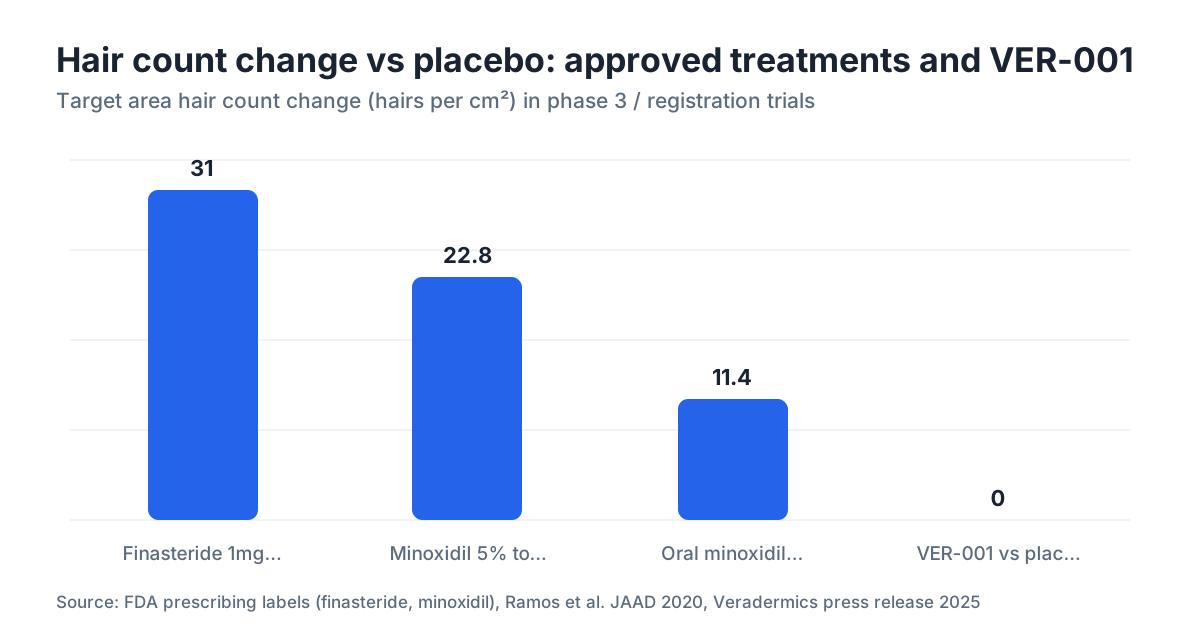
Here is the scale the approved treatments set in their registration trials.
| Treatment | Trial duration | Hair count change (treated) | Hair count change (placebo) | Source |
|---|---|---|---|---|
| Finasteride 1mg (Propecia) | 12 months | +17 hairs per cm² (vertex) | -14 hairs per cm² | FDA label [4] |
| Topical minoxidil 5% | 48 weeks | +18.6 hairs per cm² | -4.2 hairs per cm² | FDA label [5] |
| Oral minoxidil 5mg | 24 weeks | +12.5 hairs per cm² (small RCT) | +1.1 | Ramos et al. 2020 [6] |
| VER-001 (Veradermics) | 24 weeks | Statistically significant vs placebo | Placebo reference | Veradermics press release [1] |
Veradermics has not published the actual hair count numbers in a peer-reviewed format. So the table has a hole exactly where the most useful comparison belongs. Beating placebo is meaningful. The size of the effect decides whether this drug competes with finasteride or merely clears the regulatory bar.
Use this benchmark. The FDA's guidance on hair loss trials treats a meaningful clinical effect as roughly 7 to 15 additional hairs per cm² above placebo at the primary endpoint. [11] Land in that range or higher and the drug is clinically relevant. Barely clear significance with a small absolute difference and it will struggle in a market where generic finasteride sells for $10 to $30 a month.
What were the reported side effects and safety signals?
The press release called the safety profile "well-tolerated," with adverse events broadly comparable to placebo. That is a standard corporate line. It is not a full adverse event table reviewed by the FDA. [1]
The question that matters for any oral drug hitting androgen pathways is sexual side effects. Finasteride carries a labeled warning about decreased libido, erectile dysfunction, and ejaculatory disorder, with sexual adverse event rates running from roughly 1.8% in the 12-month trial to higher rates in some post-marketing reports. [4] The finasteride 1mg label also notes these effects can persist after stopping in some patients, a phenomenon sometimes called post-finasteride syndrome, though the epidemiology of persistent effects stays debated. [4]
Veradermics suggests VER-001 may have a friendlier hormonal profile than finasteride because it does not suppress systemic DHT production, only the receptor interaction at the follicle. That is a plausible hypothesis. Whether it means fewer sexual side effects in real patients is something only a fully powered, FDA-reviewed safety dataset can confirm. Nobody should assume "different mechanism" means "safer for sexual function" without the numbers.
People reading about minoxidil side effects often ask whether oral drugs here carry heart risk. Oral minoxidil, a separate already-marketed drug, carries risks of fluid retention and tachycardia because it is a vasodilator. VER-001 is not a vasodilator, so those specific risks likely do not apply. The full cardiovascular safety data from the trial has not been published.
When could Veradermics' pill actually reach pharmacies?
If Veradermics files a New Drug Application in late 2025 or early 2026, and the agency grants standard review (not priority review, which is reserved for serious conditions with unmet need), the review clock runs 10 to 12 months from acceptance. [2] That puts a plausible approval somewhere in 2026 to 2027, assuming no complete response letters demanding more data.
The timeline can slip several ways. The FDA can refuse to file an incomplete application. It can request more studies. It can convene an advisory committee if the risk-benefit picture raises questions. Any of those add months or years.
Approval is not the finish. Then comes manufacturing scale-up, pharmacy distribution deals, and insurance coverage fights. A new branded drug without generic competition usually launches at a price that reflects full development cost. Finasteride cost roughly $60 to $80 a month when it launched as Propecia in 1997, before generics arrived. Generic finasteride now runs $10 to $30 a month at most large pharmacies. [4] VER-001, if approved, would almost certainly launch well above generic finasteride during its exclusivity period.
The short version: do not expect this at your pharmacy before 2027 at the earliest. 2028 to 2029 is more realistic if any regulatory snag shows up.
Who might actually benefit from this drug if it gets approved?
The most defensible candidates, based on what is public, fall into a few groups.
First, people with androgenetic alopecia who tried finasteride and quit over side effects. If VER-001 proves genuinely easier to tolerate (confirmed, not assumed), that group has few oral options left. Dutasteride is approved in some countries but suppresses androgens harder than finasteride. Some people use oral minoxidil off-label for pattern loss, but it works through a completely different mechanism and is not a DHT blocker.
Second, people who responded only partially to finasteride. Adding a different androgen-pathway intervention could, in theory, hit residual DHT-receptor signaling that finasteride does not fully block. That is speculative without combination therapy trial data.
Third, women with androgenetic alopecia. This is an underserved group. Finasteride is not FDA-approved for women and is contraindicated in pregnancy. Minoxidil for men, and women at lower concentrations, is the only FDA-approved topical option for female pattern hair loss. If VER-001 proves safe for women, including those of childbearing age, it fills a real gap. As far as public information shows, the phase 3 results have not broken out efficacy by sex in detail.
People with telogen effluvium or hair loss from causes other than androgen sensitivity would likely see nothing. This drug targets a pathway specific to androgenetic alopecia.
How does this compare to other hair loss drugs in the pipeline?
The hair loss pipeline is busier in 2025 than at any point since topical minoxidil was approved in 1988. Several mechanisms are in play at once.
JAK inhibitors are furthest along outside this trial. Baricitinib (Olumiant) and ritlecitinib (Litfulo) are FDA-approved for alopecia areata, an autoimmune hair loss condition. [7] They do not work for androgenetic alopecia. Pfizer and others are testing JAK inhibitors for pattern loss, but phase 2 data is mixed.
Prostaglandin F2-alpha analogs like bimatoprost have shown modest benefit in androgenetic alopecia in small studies and have not cleared phase 3 registration trials.
Wnt pathway activators, including compounds from Samumed (now Biosplice), have had a rough development history, with several trials missing primary endpoints despite early promise.
Veradermics sits in a category of its own by clearing phase 3 in pattern hair loss. That is genuinely uncommon. Most drugs here fail at phase 2 or post effect sizes too small to justify development. The caveat holds: the full data is not published, and phase 3 press releases in other therapeutic areas have sometimes disappointed once the paper came out.
For now, finasteride and minoxidil are the only FDA-approved oral and topical options for androgenetic alopecia. That pair is still the standard of care.
Does this mean a cure for hair loss is close?
No. That word deserves a direct answer.
VER-001, if approved, would slow or partly reverse hair loss in androgenetic alopecia, close in profile to finasteride. It is not a cure. You would take it indefinitely, and stopping would likely restart the loss, exactly as it does when people quit finasteride. The follicles are not permanently restored. The underlying genetic sensitivity to androgens does not change.
The therapies that could offer something closer to a cure, like hair follicle cloning, autologous cell therapy, and gene editing of androgen receptor sensitivity, sit in preclinical or very early clinical stages. Japanese research groups reported early results on hair follicle regeneration in recent years, but the road to a scalable, commercially available therapy is long. [8]
For people with heavy loss right now, hair transplant surgery is still the most permanent structural fix, moving DHT-resistant follicles from the back of the scalp into thinning zones. Drugs like VER-001, if they work as the phase 3 data suggests, would be most useful as maintenance alongside a transplant, or as early intervention to slow progression before surgery is on the table.
That is how this field has always worked. There is no single answer. Managing androgenetic alopecia usually means stacking treatments, and a new effective oral option with a different side effect profile would be a useful addition to the stack, not a replacement for it.
What should you do right now while waiting for this drug?
If you are actively losing hair, waiting for a drug at minimum two years from approval costs you follicle miniaturization you may not recover. Today's standard of care is well-evidenced and available now.
For androgenetic alopecia, the evidence hierarchy is clear. Finasteride 1mg daily (FDA-approved for men, strong 12-month trial data showing regrowth and arrest of loss) combined with minoxidil 5% topical (FDA-approved for men and women at different concentrations) is the most studied combination. [4] [5] Some dermatologists add a topical DHT blocker off-label. Oral minoxidil at low doses (0.625mg to 2.5mg for women, 2.5mg to 5mg for men) has real clinical momentum as an off-label alternative or add-on.
Not sure what kind of hair loss you have? Answer that first. A receding hairline follows a different trajectory than diffuse thinning, and some causes of diffuse loss, like telogen effluvium, resolve on their own. Nail the pattern before picking a treatment.
Want a starting point? MyHairline's free AI scan (/scan) analyzes your hairline and gives you a pattern assessment, so you walk into a dermatologist visit with sharper questions. The FDA still requires a physician's evaluation for prescription drugs, so a scan is a starting point, not the finish line.
If you are already on finasteride and happy with results, this news changes nothing. VER-001 is not available, and finasteride has decades of safety and efficacy data behind it.
What questions should you ask your dermatologist about VER-001?
If you see a dermatologist in the next year, VER-001 will probably come up once you ask. Here are the questions worth raising.
First: has the full trial data been published in a peer-reviewed journal, and what was the actual effect size? You want a number, not an adjective.
Second: what was the incidence of sexual side effects versus placebo in the full dataset? Press releases rarely lead with adverse event tables.
Third: was the trial population like me? Age, sex, Norwood stage at enrollment, and race all shape how well trial results transfer to one patient.
Fourth: if it gets approved, will insurance cover it, or am I paying out of pocket for a branded drug? If it is out of pocket, the cost gap versus generic finasteride matters a lot to your decision.
Fifth: is there any compassionate use or expanded access program before approval? The FDA has pathways for this in serious conditions, though androgenetic alopecia may not qualify given the approved treatments already on shelves. [2]
A board-certified dermatologist who focuses on hair disorders will answer these better than a general practitioner. The American Academy of Dermatology runs a find-a-dermatologist tool and publishes patient guidance on hair loss worth reading before your appointment. [9]
Could this drug work for women with hair loss?
Female androgenetic alopecia is genuinely underserved by the current approval landscape. Minoxidil 2% topical is FDA-approved for women. Minoxidil 5% foam carries an FDA approval for women too. Finasteride is not approved for women and carries a pregnancy contraindication because of the risk of feminizing a male fetus. [4]
If VER-001 hits the androgen receptor without suppressing systemic androgen levels, it could carry a different risk profile for women than finasteride, possibly with less pregnancy-related concern. That is speculative and would need dedicated study in women of childbearing potential before any approval in that group.
The Veradermics announcement did not say whether the trial included women, the sex breakdown of participants, or whether it analyzed female pattern hair loss separately. Female pattern loss often looks different from male pattern loss (diffuse thinning over the crown rather than a receding frontal hairline), and the hair count methodology used in most trials was originally validated in men. Whether the efficacy transfers to women needs its own data.
The AAD advises evaluating women with hair loss for contributing factors including iron deficiency, thyroid dysfunction, and hormonal changes before assuming androgenetic alopecia, because those factors are both more common in women and treatable. [9] Any new androgen-targeting drug belongs in that context.
Sources
- Veradermics Inc., Phase 3 VER-001 trial results announcement
- U.S. FDA, New Drug Application (NDA) process overview
- American Academy of Dermatology, Hair loss: causes
- U.S. FDA, Drugs@FDA database entry for Propecia (finasteride) 1mg
- U.S. FDA, Drugs@FDA database entry for Rogaine (minoxidil) 5% topical
- Ramos PM et al., Journal of the American Academy of Dermatology 2020, oral minoxidil randomized trial
- U.S. FDA, Drugs@FDA database entry for Litfulo (ritlecitinib)
- U.S. National Library of Medicine, PubMed literature on hair follicle regeneration research
- American Academy of Dermatology, hair loss patient resources and find-a-dermatologist
- ClinicalTrials.gov, U.S. National Library of Medicine trial registry
- U.S. FDA, Search for FDA Guidance Documents (androgenetic alopecia endpoints)