
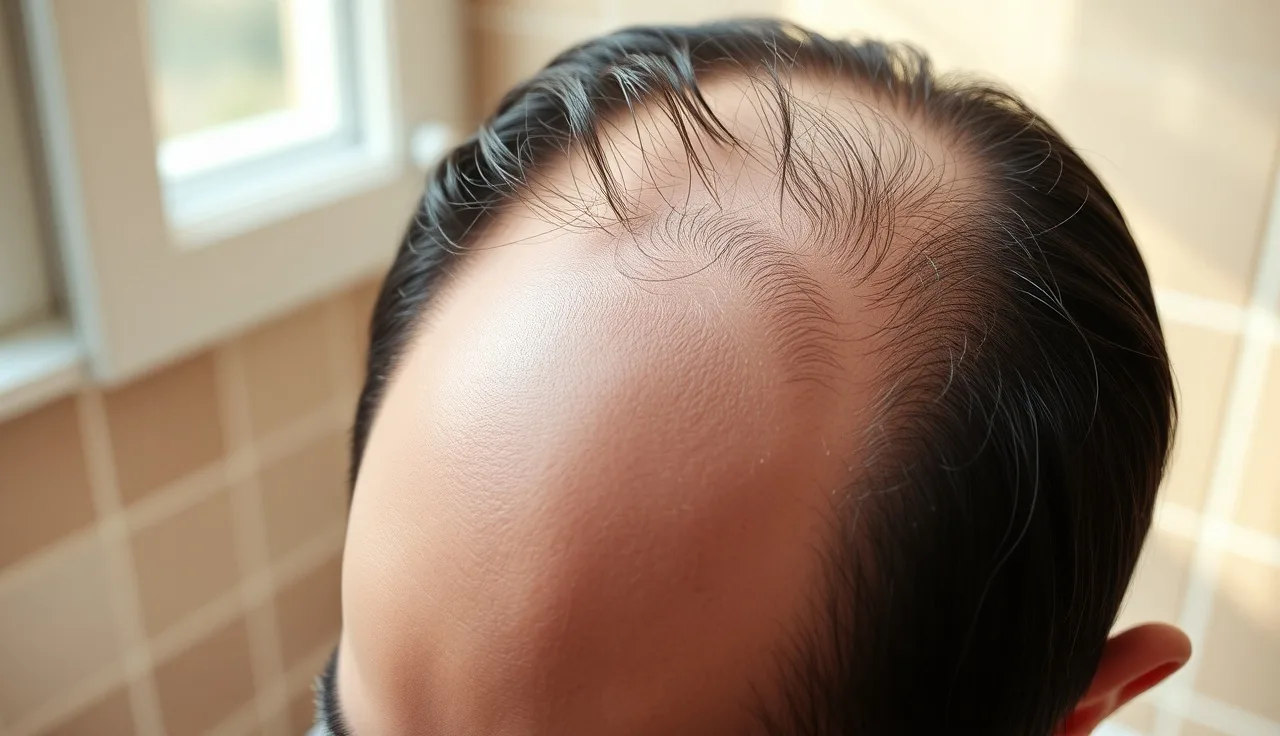
TL;DR: Alopecia areata is an autoimmune condition that causes patchy hair loss. Most people (roughly 80%) regrow hair within a year, but about 5 to 10% progress to alopecia totalis or universalis, which can become permanent. Early onset, nail changes, family history, and losing eyebrows or eyelashes are the main warning signs that your case is more likely to be severe.
What is alopecia areata and why does it cause hair loss?
Alopecia areata is an autoimmune disease. Your immune system mistakes the hair follicle, specifically the protein structures inside it, for a foreign threat and sends T-lymphocytes to attack it. The follicle doesn't die. It goes into a kind of forced hibernation called the dystrophic anagen phase, which halts hair production without destroying the follicle's stem cell reservoir [1].
That distinction changes everything. Because the follicle itself survives, hair regrowth stays biologically possible even after years without it. That's the good news. The bad news is that the immune attack can persist, widen, and in some people run so long that the follicle eventually loses its ability to respond.
The condition affects roughly 2% of the global population at some point, which makes it the second most common form of non-scarring hair loss after androgenetic alopecia [1]. It can start at any age. About 60% of first episodes happen before age 20 [2].
The classic presentation is one or more smooth, round or oval patches on the scalp, often discovered suddenly. No redness, no scaling, no scarring at the skin surface. Dermatologists sometimes spot "exclamation mark hairs" at the patch border: short, tapered hairs that are wider at the tip than at the base, which signal active immune attack [2].
Can alopecia areata become permanent?
Yes, it can. Not always, but for a meaningful minority of people, alopecia areata does not stay patchy and it does not reverse.
The progression looks like this. Patchy alopecia areata (one or more discrete bald spots) is the most common and most reversible form. When it spreads to cover the entire scalp, it's called alopecia totalis. When it extends to body and facial hair as well, it's called alopecia universalis. These two severe forms hit roughly 5% of people who develop alopecia areata [1].
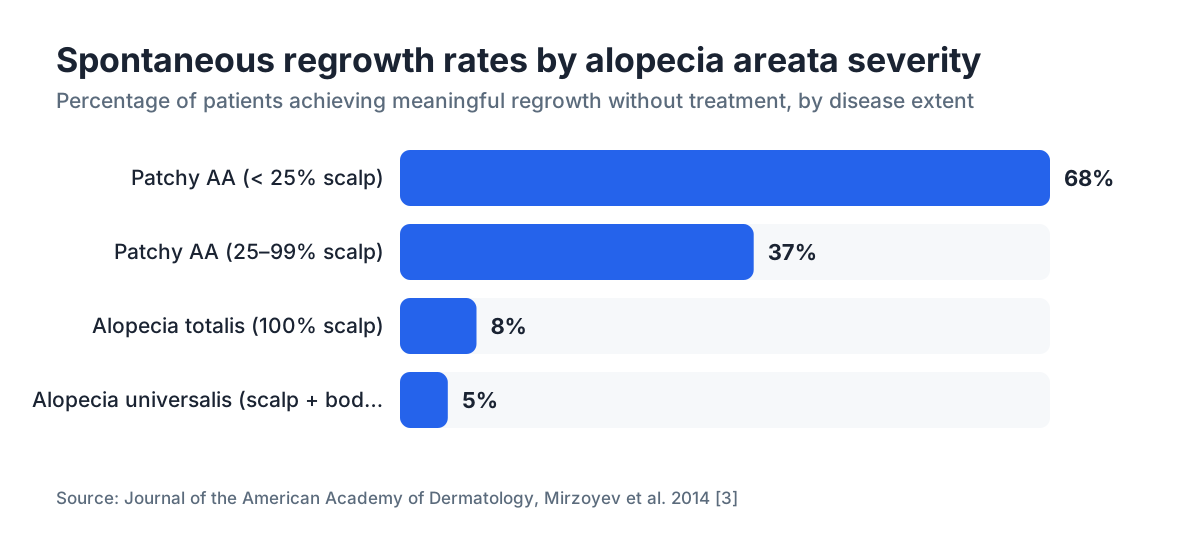
At those extremes, the outlook changes. A 2014 cohort study of patients published in the Journal of the American Academy of Dermatology found that patients with alopecia totalis or universalis had spontaneous regrowth rates below 10%, compared with about 50 to 80% for patchy disease [3]. Long-standing, extensive disease is linked to follicular fibrosis in some cases, a process that starts to look structurally more like scarring alopecia even though the condition itself is classified as non-scarring [4].
So here's the honest answer. Alopecia areata is reversible in theory, because the follicle isn't destroyed. In practice, once the disease has been severe and active for many years, regrowth becomes increasingly unlikely even with treatment.
Duration is its own risk factor. Hair that has been absent for more than 5 years, especially in alopecia totalis, has a poor outlook with any currently available treatment [3].
| Form | Hair Loss Extent | Estimated Spontaneous Regrowth Rate |
|---|---|---|
| Patchy AA (limited, < 25% scalp) | One or more discrete patches | ~50 to 80% within 12 months [3] |
| Patchy AA (extensive, 25 to 99%) | Large confluent areas | ~25 to 50% [3] |
| Alopecia totalis | 100% of scalp | < 10% [3] |
| Alopecia universalis | Scalp + body + face | < 10% [3] |
What are the signs that alopecia areata might get worse?
Not every patch of alopecia areata signals trouble. But certain features at diagnosis are consistently linked to a harder disease course. Here's what the evidence actually shows.
Age of first episode. Onset before puberty is one of the strongest predictors of severe, persistent disease. A 2017 review in Nature Reviews Disease Primers confirmed that childhood onset carries a significantly higher risk of progression to totalis or universalis compared with adult onset [4].
Nail changes. Around 10 to 66% of people with alopecia areata have nail abnormalities, ranging from fine pitting to total nail dystrophy [2]. Extensive nail pitting, trachyonychia (rough, sandpaper-like nails), and longitudinal ridging all correlate with more severe and chronic scalp disease. If your nails are affected, that's worth taking seriously.
Loss of eyebrows or eyelashes. This signals the disease has moved beyond the scalp and usually comes with more extensive immune activity. Most dermatologists treat eyebrow or eyelash involvement as a marker of higher severity.
Ophiasis pattern. Instead of random round patches, ophiasis describes a band of hair loss along the temporal and occipital margins of the scalp. This distribution resists treatment and predicts a worse outcome than centrally located patches [2].
Family history. Having a first-degree relative with alopecia areata raises your own risk and tends to predict more severe disease when it does appear [1].
Atopic disease. A personal or family history of asthma, eczema, or allergic rhinitis is linked to a more persistent course, especially when alopecia areata starts in childhood [4].
Duration and extent. Any episode lasting more than 12 months without meaningful regrowth, or involving more than 50% of the scalp, puts you in a higher-risk group regardless of other factors.
How likely is spontaneous regrowth without treatment?
For mild, patchy disease, reasonably likely. Studies consistently show that 50 to 80% of people with limited alopecia areata (under 50% scalp involvement) get spontaneous regrowth within 12 months [3]. Flip that number over and it tells you something useful: roughly 1 in 5 people with mild disease does not recover without some intervention.
For extensive disease, the numbers flip harder. The same cohort data puts spontaneous recovery in alopecia totalis and universalis below 10%, and long-term follow-up studies suggest that after 10 years of total hair loss, meaningful regrowth is exceedingly rare [3].
A few things complicate this picture. Alopecia areata relapses often. Even people who reach full regrowth, whether spontaneous or treatment-driven, have a lifetime recurrence rate estimated at 30 to 50% [1]. So "regrowth" doesn't mean the problem is solved. It means the disease is currently quiet.
The other complication is that most published regrowth data comes from people who sought medical care, which skews toward worse disease. People with one tiny patch who never see a dermatologist and whose hair grows back in six weeks never show up in clinical databases. The true spontaneous recovery rate for the mildest cases is probably higher than any study can measure.
When should you see a dermatologist? What are the red flags?
See a dermatologist if any of these apply.
You have more than two patches, or a single patch larger than 3 cm. You've had patchy hair loss for more than 8 weeks without any sign of regrowth at the borders. You're losing eyebrows, eyelashes, or body hair. You have nail changes. The bald area is expanding noticeably week over week. You first developed alopecia areata as a child or teenager.
None of those are panic situations on their own. But they are situations where waiting and watching costs you treatment time. The immune attack on follicles gets harder to interrupt the longer it runs.
If you're not sure whether what you're seeing is alopecia areata, telogen effluvium, or the early stages of a receding hairline, that's genuinely worth sorting out with a professional before spending money on the wrong treatment. A free AI hair analysis at MyHairline can help you identify your pattern before your appointment, so you go in with a clearer picture of what's happening.
One scenario should prompt a faster appointment. If you have alopecia areata and you develop widespread, rapidly progressing loss over a few weeks, that's the presentation most likely to become totalis. Early systemic treatment, now including JAK inhibitors, works much better in active, rapidly progressing disease than in long-standing stable loss.
Does alopecia areata cause scarring, or is the hair follicle still alive?
Classic alopecia areata does not cause scarring. The follicle goes dormant but is not permanently destroyed, which is why regrowth stays possible even after years of absence [1].
The mechanism matters here. In truly scarring conditions like lichen planopilaris or central centrifugal cicatricial alopecia, the follicle's stem cells in the bulge region get destroyed and replaced with fibrous tissue. Alopecia areata spares the bulge. The stem cells stay viable. They're simply suppressed by the ongoing immune attack [9].
There is evidence from biopsy studies, though, that in very long-standing, severe alopecia areata (particularly universalis lasting more than 10 years), secondary follicular fibrosis can develop around the follicle [4]. This is not identical to primary scarring alopecia, but it does compromise regrowth potential. Think of it less like a switch and more like a dial that, left in the wrong position for too long, eventually stiffens.
This is part of why dermatologists treat urgency differently for extensive versus limited disease. With limited patchy disease, waiting and watching is reasonable. With rapid progression toward totalis, moving to systemic treatment quickly matters.
What treatments exist, and which ones actually work?
The treatment landscape for alopecia areata changed a lot in 2022, when the FDA approved baricitinib (Olumiant) as the first systemic drug specifically indicated for severe alopecia areata, followed by ritlecitinib (Litfulo) in 2023 [5][6]. Both are JAK inhibitors, drugs that block the Janus kinase signaling pathway that drives the autoimmune attack on follicles.
The BRAVE-AA1 and BRAVE-AA2 trials for baricitinib showed that 38.8% of patients on the 4 mg dose reached a SALT score of 20 or less (meaning 80% or more scalp coverage) at 36 weeks, versus 6.6% on placebo [5][10]. That's a real and meaningful difference for people with severe disease, though it also means most patients don't hit that benchmark.
The main ritlecitinib trial showed 23% of adults with severe alopecia areata reached at least 80% scalp coverage at 24 weeks on the 50 mg dose [6].
For mild to moderate patchy disease, the treatments used most are:
Intralesional corticosteroids. Injections of triamcinolone acetonide directly into bald patches, typically every 4 to 6 weeks. This is still the standard first-line treatment for limited disease according to the American Academy of Dermatology [2]. It works well for small patches but isn't practical for extensive disease.
Topical corticosteroids and topical minoxidil. Used together or separately for mild disease. Minoxidil for men is sometimes added to speed regrowth in patches responding to steroid treatment, though minoxidil alone doesn't suppress the immune attack [7].
Contact immunotherapy (DPCP or SADBE). Applied to the scalp to create a controlled allergic reaction that appears to redirect immune activity away from follicles. Used in specialist centers, not widely available, but with reasonable evidence for extensive disease.
Systemic corticosteroids. They can produce rapid regrowth, but high relapse rates after stopping and significant side effects with long-term use limit their role.
For people whose hair has been completely absent for years, JAK inhibitors are the best currently available option. For people with mild, patchy disease, intralesional steroids remain the most evidence-backed first step.
One thing worth saying plainly: none of these treatments cure alopecia areata. They suppress the immune attack while active. Relapse on stopping is common, and the underlying autoimmune predisposition stays.
Are certain people more genetically likely to get severe alopecia areata?
Yes. Alopecia areata has a clear genetic component. Having a first-degree relative with the condition roughly triples your lifetime risk [1]. Twin studies show a concordance rate of about 55% in identical twins and near 0% in fraternal twins, which tells you genes matter a lot but immune triggers and environment matter too [4].
Genome-wide association studies have identified multiple susceptibility loci, many of them shared with other autoimmune conditions including type 1 diabetes, rheumatoid arthritis, and celiac disease [4]. This is why people with alopecia areata carry modestly elevated rates of thyroid disease, vitiligo, and atopic dermatitis compared with the general population.
The ULBP3 gene region is one of the more interesting findings. Variants here appear to make follicles more visible to the NKG2D-expressing T-cells that drive the attack [4]. This is part of the mechanism JAK inhibitors interrupt.
What this means in practice: if you have alopecia areata and a parent or sibling had severe disease, your own risk of severe disease is meaningfully higher. Family history isn't destiny, but it should lower your threshold for seeking early treatment rather than waiting things out.
How is alopecia areata different from other types of hair loss?
Telling alopecia areata apart from other forms of hair loss matters because the treatment pathways are completely different.
Androgenetic alopecia (male or female pattern hair loss) is driven by dihydrotestosterone (DHT) and genetic sensitivity of follicles to it. It's gradual, follows a predictable pattern (Norwood scale for men, Ludwig scale for women), and responds to finasteride, DHT blockers, and minoxidil. Alopecia areata does not respond meaningfully to finasteride because DHT isn't driving it.
Telogen effluvium causes diffuse shedding after physical or emotional stress. It looks different under a dermoscope and resolves when the trigger resolves. Alopecia areata tends to cause discrete patches rather than diffuse thinning.
Tinea capitis (fungal infection) can also cause patchy hair loss, but it includes scaling, redness, and sometimes broken-off hairs, none of which are typical of alopecia areata.
Traction alopecia from tight hairstyles follows the hairline or parts. Trichotillomania (compulsive hair pulling) produces irregular patches with broken hairs of different lengths.
A dermatologist can usually tell these apart by clinical examination and dermoscopy. If there's doubt, a scalp biopsy gives a definitive answer. Getting the right diagnosis before choosing a treatment is the only approach that makes financial and medical sense.
| Feature | Alopecia Areata | Androgenetic Alopecia | Telogen Effluvium |
|---|---|---|---|
| Pattern | Discrete oval patches | Gradual recession/thinning | Diffuse shedding |
| Scarring | No | No | No |
| Follicle destruction | No | Miniaturization | No |
| Autoimmune mechanism | Yes | No | No |
| Responds to finasteride | No | Yes | No |
| Responds to JAK inhibitors | Yes | Not established | Not relevant |
What does recovery look like, and how long does it take?
For limited patchy disease, regrowth often shows up within 3 to 6 months of the episode starting, even without treatment. The new hair sometimes comes in white or lighter before returning to its original color. That's normal and not a sign of permanent damage.
With intralesional steroids, many dermatologists see initial regrowth within 4 to 8 weeks of the first injection. Full patch recovery typically takes 3 to 6 months of treatment [2].
With JAK inhibitors for severe disease, the BRAVE-AA trials showed meaningful improvement beginning around 12 weeks and continuing through 36 weeks [5]. Treatment is usually ongoing. Stopping leads to relapse in most patients.
The hardest conversations in alopecia areata involve people who have had totalis or universalis for 5 or more years. JAK inhibitors can still produce regrowth in some of these patients, but the response rates run lower and slower. A 2022 real-world retrospective of patients on baricitinib published in JAMA Dermatology found that those with disease duration over 10 years had significantly lower rates of meaningful regrowth than those treated within 2 years of onset [8].
For people at the severe end who haven't responded to systemic treatments, a hair transplant is generally not appropriate. Transplanted follicles face the same autoimmune attack as native ones, and most experienced hair restoration surgeons decline to operate while alopecia areata is active.
What can you do right now if you're worried about your hair loss?
First, get an accurate diagnosis. Self-diagnosing from photos is unreliable, and treatment for alopecia areata is different enough from treatment for androgenetic alopecia or telogen effluvium that choosing the wrong path wastes time and money.
If you have patchy hair loss and you're not sure which type, take photos in good lighting now and again in the same lighting in 4 weeks. Documenting the size and location of patches is genuinely useful when you do see a dermatologist. You can also use MyHairline's free AI scan at /scan to get an initial pattern read before your appointment.
If you have limited patchy disease, one episode, less than 25% of scalp involved, no nail changes, no eyebrow or eyelash loss, and no family history of severe disease: watching for 8 to 12 weeks is reasonable. Most mild cases resolve.
If you have any of the warning signs covered above, make an appointment now rather than waiting.
If you're already on treatment and not seeing results at 6 months, that's the moment to ask your dermatologist about switching to a different approach. Staying on a treatment that isn't working is one of the most common ways people lose years they could have spent on something more effective.
For people managing androgenetic alopecia alongside alopecia areata, understanding the side effects of minoxidil or considering oral minoxidil as an adjunct are separate conversations worth having with your prescribing doctor. The two conditions can coexist, and treatment plans for both need to account for that.
Sources
- National Institute of Arthritis and Musculoskeletal and Skin Diseases (NIAMS) – Alopecia Areata
- American Academy of Dermatology (AAD) – Alopecia Areata: Diagnosis and Treatment
- Mirzoyev SA et al. – Journal of the American Academy of Dermatology, 2014 – Lifetime incidence risk of alopecia areata estimated at 2.1%
- Pratt CH et al. – Nature Reviews Disease Primers: Alopecia Areata, 2017
- FDA – Olumiant (baricitinib) approval for severe alopecia areata, 2022 (Drugs@FDA)
- FDA – Litfulo (ritlecitinib) approval for severe alopecia areata, 2023 (Drugs@FDA)
- MedlinePlus – Minoxidil Topical
- King BA et al. – JAMA Dermatology: real-world outcomes with baricitinib in alopecia areata, 2022
- National Institutes of Health – MedlinePlus: Hair Loss
- ClinicalTrials.gov – BRAVE-AA1 trial registration (NCT03570749)