TL;DR: Minoxidil can stimulate some hairline regrowth, but it works better on the crown than the temples. Clinical trials show 5% minoxidil produces meaningful regrowth in roughly 30-40% of men after 4-6 months of daily use. Results at a receding hairline are real but modest, and they disappear within months if you stop. Combining minoxidil with finasteride improves the odds considerably.
What does minoxidil actually do to hair follicles?
Minoxidil is a vasodilator. It was originally developed as an oral blood pressure medication in the 1970s, and the hair growth side effect was noticed in patients taking it systemically before anyone thought to apply it to the scalp [1]. The topical version works by widening blood vessels around follicles, which improves the delivery of oxygen and nutrients, and by extending the anagen (growth) phase of the hair cycle while shortening the resting telogen phase.
The molecule itself does not block DHT, the hormone responsible for androgenetic alopecia, which is why it treats the symptom rather than the cause. Follicles that are miniaturized by DHT can still respond to minoxidil if they are not completely dead. The medical term for a follicle that is gone is "permanently scarred," and even high doses of minoxidil cannot wake those up. The window of opportunity matters enormously here, and we will come back to that.
Minoxidil is available in 2% and 5% topical solutions and foam, and more recently as a low-dose oral tablet (0.625 mg to 2.5 mg daily off-label, sometimes higher). The FDA approved the topical 2% formula for women and the 5% formula for men under the brand name Rogaine, specifically for androgenetic alopecia [1]. That approval covers vertex (crown) hair loss, which is where most of the trial data was collected. The hairline is a different story, and the evidence is thinner there.
Does minoxidil work specifically on a receding hairline?
Less reliably than on the crown, and it helps to say that plainly. The large randomized controlled trials that led to FDA approval focused on the vertex, not the frontal hairline or temples [2]. So when we talk about hairline regrowth specifically, we are working with off-label extrapolation and smaller observational studies.
The mechanism is the same wherever you apply it. Hair follicles at the temples and frontal hairline are androgen-sensitive and miniaturize via the same DHT pathway as vertex follicles. If those follicles are still alive, minoxidil can extend their growth cycles and reverse some miniaturization. Case series and dermatologist experience consistently show that at least a subset of patients get visible frontal regrowth.
A 2019 review published in the Journal of the American Academy of Dermatology found that minoxidil works across multiple hair loss patterns but that frontal fibrosing alopecia (a scarring form) does not respond, and that androgenetic alopecia responses at the front are "less predictable" than at the vertex [3]. That is the honest summary: possible, real in some patients, not guaranteed, and generally less impressive than crown results.
Here is the practical version. If your hairline started receding six months ago, you have a better shot than if it has been marching back for a decade. A receding hairline still in early Norwood stages (I to III) is the sweet spot for minoxidil.
One more thing worth knowing. The temples are slow responders even when they do respond. Expect to wait longer there than at the crown before drawing any conclusions.
What do clinical trials say about the percentage of men who see regrowth?
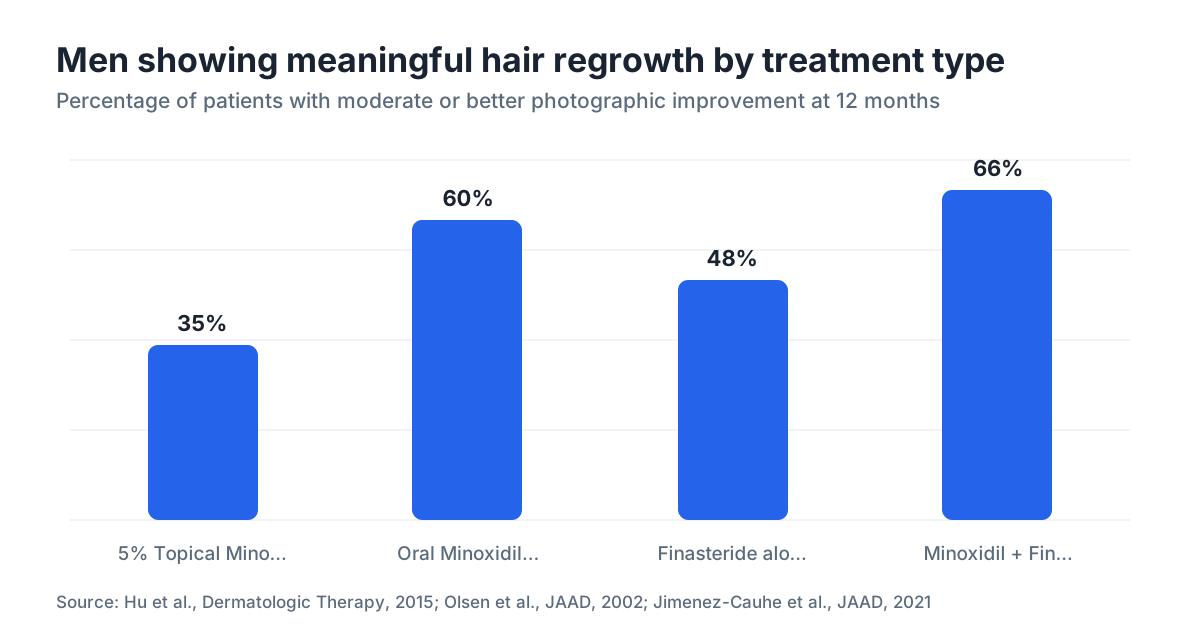
The most cited figure comes from the original large RCTs submitted for FDA approval. In studies of 5% topical minoxidil versus placebo over 48 weeks, about 84% of men showed some response (defined as stabilization or visible new growth), and around 35% showed moderate to dense regrowth at the vertex [2]. That sounds encouraging until you notice the regrowth endpoint was the crown, not the hairline.
A 2002 trial by Olsen and colleagues compared 5% minoxidil foam to 2% solution and found the 5% foam produced significantly more regrowth at 16 weeks, with a mean increase of 18.6 non-vellus hairs per cm² in the 5% group versus 12.7 in the 2% group [2]. Vertex-focused again.
For frontal hairline data specifically, the best evidence comes from oral minoxidil, where the drug reaches every scalp region equally. A 2021 prospective study in the Journal of the American Academy of Dermatology followed 30 men with androgenetic alopecia taking 2.5 mg oral minoxidil daily and found global photographic improvement, including frontal areas, in 18 of 30 patients (60%) at 6 months [5]. Small study, but it is the kind of signal that explains why dermatologists have warmed up to frontal regrowth claims.
About 30 to 60% of men see some meaningful response at the hairline with consistent use, and oral routes may outperform topical for frontal areas. The spread is wide because genetics, stage of loss, and how faithfully you apply it all vary enormously.
How long does it take for minoxidil to regrow hairline hair?
Four to six months before you can expect to see anything meaningful. And that timeline assumes you are applying it every single day without skipping.
Here is why the wait is so long. Minoxidil first has to shift miniaturized follicles into a new anagen cycle. Hair grows roughly 1 cm per month on a healthy follicle, and miniaturized follicles grow slower than that. So even after a follicle wakes up, it takes months for a terminal hair to push through the scalp and become visible to the naked eye.
There is also an early shed that trips people up. Many users see increased shedding in weeks 2 through 8. This is minoxidil pushing resting (telogen) hairs out to make room for new anagen growth. It is called telogen effluvium, and it is a temporary sign the drug is working, not a sign it is making things worse. Many people quit right at this point, which is a mistake.
The full assessment window is 12 months. Most dermatologists will not call minoxidil a failure until someone has used it consistently for a year. Progress typically plateaus around the 12-month mark, and whatever you have gained by then is roughly what you keep as long as you keep using it.
One realistic note on tracking. Photos taken in consistent lighting, at the same angle, every 4 weeks are the only reliable way to judge progress. The change is gradual enough that day-to-day observation is useless and often misleading.
Does minoxidil work better at early or late Norwood stages?
Earlier is always better. This is probably the single biggest variable in predicting whether minoxidil will do anything for your hairline.
At Norwood I and II (minimal or beginning recession), most hairline follicles are still viable and just starting to miniaturize. Minoxidil can extend their growth cycles, and some may recover close to full terminal thickness. Results here are genuinely encouraging.
At Norwood III (temple recession creating an "M" shape), many temple follicles are significantly miniaturized. Some regrowth is still possible, but density recovery will be partial rather than complete. You are more likely to get stabilization plus modest improvement than a full restoration.
At Norwood IV through VII, the frontal zones have extensive or complete follicle death. Minoxidil cannot grow hair where there are no living follicles. No topical treatment can. This is the territory where a hair transplant becomes the realistic option for hairline reconstruction, not medication.
The American Academy of Dermatology frames minoxidil as first-line therapy for androgenetic alopecia, but the expected outcome is slowing progression and stimulating some regrowth, not full restoration [6]. That framing matters. Minoxidil is a maintenance and modest recovery tool, not a reset button.
Not sure what Norwood stage you are at? An objective read helps before you pick a treatment. MyHairline's free AI scan (/scan) analyzes your current pattern and gives you a baseline, which is useful for tracking changes over time.
Is 5% minoxidil better than 2% for hairline regrowth?
Yes, and the data is clear. The 5% formulation consistently beats 2% in head-to-head trials for both speed and degree of regrowth [2]. The FDA-approved label for men specifically calls for the 5% concentration. The 2% is the approved strength for women, partly because women often have higher scalp sensitivity and a slightly different loss pattern.
If you are a man trying to recover a hairline, start with 5% if you have no contraindications. The foam has one practical edge over the solution: it dries faster and leaves less residue, which matters when you are applying near the hairline and do not want your hair looking wet or greasy all day.
The solution penetrates a bit better through thicker hair, but at the hairline where hair is already thin, the foam is easier to target precisely. That is a practical point, not a clinical one.
There is no approved formulation above 5% for topical use. Some compounding pharmacies offer higher concentrations (7% to 15%), but no solid clinical trial shows extra benefit above 5% topical, and irritation risk climbs. Oral minoxidil is increasingly popular as an alternative that skips topical application entirely, and early evidence suggests it may reach frontal areas more effectively.
What happens if you stop using minoxidil?
You lose what you gained. Usually within 3 to 6 months.
This is not a side effect or a complication. It is the basic pharmacology of the drug. Minoxidil does not fix the underlying DHT-driven miniaturization. It creates an environment where follicles function better, and when you remove that environment, the follicles return to their pre-treatment state. The hair that grew with minoxidil's help sheds as those follicles cycle back into telogen and keep miniaturizing.
This is also why minoxidil has to be framed as a long-term commitment, not a course of treatment. You are not treating a condition until it resolves. You are managing a chronic condition indefinitely.
For a lot of people, that reality changes the math. Spending $25 to $50 a month on topical minoxidil for the rest of your life is manageable. But if you are unsure about the commitment, think it through before you start, because the emotional experience of losing regrown hair after stopping is often harder than the original gradual loss.
Combining minoxidil with finasteride, which does address the DHT cause, gives you a better maintenance outcome and makes the whole treatment more durable.
Does combining minoxidil with finasteride improve hairline regrowth?
Substantially, yes. This is one of the clearest findings in the hair loss literature.
Finasteride reduces scalp DHT by roughly 60 to 70% by inhibiting the type II 5-alpha reductase enzyme [7]. That removes the primary driver of follicle miniaturization. Minoxidil then works on follicles that are no longer under active hormonal attack, which is a much better environment for regrowth.
A 2015 randomized trial published in Dermatologic Therapy by Hu and colleagues directly compared finasteride alone, minoxidil alone, and the combination in men with androgenetic alopecia. The combination group had significantly greater hair count improvements than either drug alone at 12 months [8]. Later meta-analyses have backed this up, finding the combination beats monotherapy for both density and patient satisfaction.
For hairline regrowth specifically, finasteride and minoxidil together give you the best non-surgical odds. Finasteride halts the loss. Minoxidil provides the growth stimulus. Neither alone does both.
Finasteride does carry potential side effects including sexual dysfunction in a small percentage of men (1 to 2% in placebo-controlled trials) [7], and it is not appropriate for women of childbearing age. Read the full FDA label before starting. The combination is not right for everyone, but for motivated men at early to moderate Norwood stages, it is what most evidence-based dermatologists would recommend. You can read more about minoxidil for men and DHT blockers for fuller context on how these treatments interact.
What are the realistic side effects of using minoxidil at the hairline?
Applying minoxidil near the hairline creates a few specific risks that are less common on the crown.
Contact dermatitis is the most common local issue: redness, flaking, or itching at the application site. The propylene glycol in the liquid formulation is usually the culprit, which is one reason the foam (which contains no propylene glycol) is gentler for sensitive skin [1]. If you get significant irritation, switching from solution to foam often solves it.
Unwanted facial hair growth is a real concern for hairline application. If minoxidil runs down your forehead or temples onto your face, it can stimulate hair on the forehead or upper cheeks. This is more common in women but happens in men too. Applying the foam with your fingertips, letting it dry fully before lying down, and not using more than the directed amount all help prevent it.
Scalp shedding in the first 4 to 8 weeks (the telogen effluvium discussed earlier) is not dangerous but is alarming. It is temporary.
Systemic side effects from topical application are rare at standard doses because absorption through intact skin is low, but they can include rapid heartbeat or lightheadedness, especially if you apply more than directed [1]. Oral minoxidil has a higher systemic effect profile, including fluid retention and body hair growth. The full breakdown of what to watch for is in our minoxidil side effects guide.
Topical minoxidil has one of the better safety records of any long-term medication. Most people tolerate it well for years.
Can women use minoxidil to regrow a receding hairline?
Yes, and it is FDA-approved for women at the 2% concentration for androgenetic alopecia [1]. Women do lose hair at the hairline, though the pattern usually differs: more diffuse thinning than the sharp temple recession men experience, and frontal fibrosing alopecia is increasingly common in post-menopausal women.
Women tend to respond to minoxidil at least as well as men, sometimes better, possibly because female hair loss involves different hormonal pathways and follicles tend to be less thoroughly miniaturized at the time of diagnosis. A Cochrane review of minoxidil for alopecia confirmed its efficacy across sexes [9].
The 5% formulation is now used off-label for women too, and many dermatologists prescribe it. The main caution is unwanted facial hair from runoff, which shows up more in women and is the reason 2% became the standard approved dose for them.
Women considering finasteride for hairline loss face more restrictions. It is contraindicated in pregnancy due to teratogenic risks to male fetuses, and its evidence base for female pattern hair loss, while growing, is not as strong as for men. Spironolactone is an alternative anti-androgen sometimes used in women. These decisions are worth discussing with a board-certified dermatologist.
For both sexes, understanding what causes hair loss in the first place is useful context before committing to a treatment strategy.
When should you consider a hair transplant instead of minoxidil?
Minoxidil is not a substitute for a hair transplant at advanced stages. It is also not a reason to delay a transplant if you are already a good candidate.
The general clinical thinking runs: medication first, surgery as needed. If you are Norwood III or below, try minoxidil (with or without finasteride) for 12 months before discussing surgery. Respond well and you may not need a transplant for years. If you do not respond, or your loss keeps progressing aggressively, that is the signal to consult a hair restoration surgeon.
At Norwood IV and above, particularly with significant frontal recession, medication alone is unlikely to restore a natural-looking hairline. A Follicular Unit Extraction (FUE) or strip transplant can place grafts directly at the hairline, and those transplanted follicles are typically taken from DHT-resistant donor areas (usually the back and sides of the scalp). The transplanted hairs do not fall out the same way.
There is a nuance here. Even after a transplant, continuing minoxidil on the native (non-transplanted) hair is standard practice to protect the remaining follicles from continued miniaturization. A transplant restores what is gone. Minoxidil protects what remains.
Cost matters too. Hair transplants run roughly $4,000 to $15,000 or more in the US depending on graft count and clinic [10]. Minoxidil costs $25 to $50 per month out of pocket. The decision tree is about what stage you are at, not which option sounds better. A thorough assessment helps. Running your hairline through the MyHairline AI scan (/scan) before any consultation gives you a starting point for that conversation.
Read more about what the surgical option actually involves in our hair transplant explainer.
Sources
- FDA, Rogaine (minoxidil) Drug Label
- Olsen EA et al., Journal of the American Academy of Dermatology, 2002 (Minoxidil 5% vs 2% RCT)
- Starace M et al., Journal of the American Academy of Dermatology, 2019 review
- Jimenez-Cauhe J et al., Journal of the American Academy of Dermatology, 2021 (oral minoxidil prospective study)
- American Academy of Dermatology, Hair Loss Guidelines
- FDA, Propecia (finasteride 1 mg) Prescribing Information
- Hu R et al., Dermatologic Therapy, 2015 (finasteride + minoxidil combination RCT)
- van Zuuren EJ et al., Cochrane Database of Systematic Reviews, 2016 (Interventions for alopecia)
- International Society of Hair Restoration Surgery, Practice Census 2022