

TL;DR: In most cases, a hair transplant is not recommended for alopecia areata. The same autoimmune process that caused the original hair loss will likely attack the transplanted follicles too. Surgeons generally require at least one to two years of disease stability before even considering surgery, and many will decline the procedure entirely. Better first-line options exist.
Why does alopecia areata make hair transplants so risky?
Alopecia areata is an autoimmune condition, not a structural one. Your immune system identifies hair follicles as foreign and attacks them. [1] That distinction matters enormously for transplant surgery, because moving follicles from the back of your scalp to a bald patch does nothing to change what your immune system is doing. You're placing healthy follicles directly into hostile territory.
Androgenetic hair loss, the type that causes a receding hairline or classic male-pattern baldness, destroys follicles through a different mechanism: dihydrotestosterone shrinks them over time. [2] Transplanted follicles from the back of the scalp resist DHT because of their genetic origin, which is the whole reason hair transplants work so reliably for that condition. Alopecia areata offers no such advantage. The immune attack isn't site-specific in the same predictable way, so "donor dominant" follicles don't get a free pass.
The American Academy of Dermatology describes alopecia areata as a condition in which "the immune system attacks hair follicles," and notes that hair can regrow when the attack stops, but the underlying tendency remains. [1] That underlying tendency is exactly what makes surgery a gamble rather than a predictable outcome.
There's also a phenomenon called the Koebner effect, sometimes called koebnerization. In some autoimmune and inflammatory skin conditions, trauma to the skin can trigger or worsen disease activity at the injury site. Surgical incisions, needle punctures, and the general trauma of a transplant procedure all count as that kind of skin trauma. Some researchers and clinicians believe this can provoke fresh alopecia areata lesions right at the transplant site, though the evidence is observational rather than from controlled trials. [3]
Has anyone actually tried transplanting hair into alopecia areata patches?
Yes, and the outcomes lean toward disappointment when the disease is active.
A case series published in Dermatologic Surgery followed patients with stable alopecia areata who received follicular unit transplants. Some patients with long-standing stable patches did show meaningful regrowth, but relapse of the autoimmune attack wiped out grafts in a subset of those cases within months to a few years. [3] This is the core problem: surgery can succeed temporarily, but durability depends entirely on sustained disease remission, which alopecia areata does not guarantee.
For alopecia totalis (total scalp hair loss) and alopecia universalis (loss of all body hair), the outcome data is even worse. Most dermatologic surgeons will not perform transplants for those subtypes at all. The scalp-wide immune activation leaves essentially no "safe zone," and donor follicles have fared poorly in published reports. [4]
For patchy alopecia areata that has been genuinely stable, meaning no new patches, no expansion of existing patches, and ideally confirmed by dermoscopy, a minority of surgeons will consider the procedure. But even then, they're having an honest conversation with the patient about the real chance of graft loss if the disease reactivates.
What does "stable" alopecia areata actually mean, and why does it matter so much?
Almost every published guideline and case report that discusses transplantation in alopecia areata draws a hard line at disease stability, usually defined as no new patches and no progression of existing ones for a minimum of one to two years. [3][4] Some surgeons push that to three to five years before they'll operate.
Stability is assessed clinically and sometimes with dermoscopy, a handheld magnification tool that lets a dermatologist look at follicle openings and early inflammation signs at the scalp surface. Certain dermoscopic patterns, like yellow dots and short vellus hairs, suggest the follicles are still present but dormant rather than permanently lost, which at least means the immune attack has paused. [5]
Even with confirmed stability, the patient needs to understand that a flare can erase the surgical results. Alopecia areata has a relapse rate estimated between 30 and 80 percent over a patient's lifetime depending on the subtype and extent of initial involvement. [1] That's not a narrow risk. A surgeon who doesn't mention it upfront is a surgeon you should walk away from.
Stability also matters because it's the only proxy for predicting whether the immune environment is hospitable enough to let grafts survive the early vascularization phase after transplant, which takes roughly two to three weeks.
What are the actual success rates for hair transplants in alopecia areata?
Honest answer: there are no large randomized controlled trials. The literature is almost entirely case reports and small case series, which makes precise success rates impossible to state.
For patchy, long-stable alopecia areata, the best published outcomes show reasonable graft survival and cosmetically meaningful regrowth in patients who maintained remission throughout follow-up. [3] But follow-up periods in these reports are often only one to three years, and alopecia areata can stay quiet for years before a relapse.
For alopecia totalis and universalis, published results are consistently poor. One review described the prognosis for transplantation in extensive forms as "very unfavorable" because immune activity persists across the scalp even when hair loss appears to have plateaued. [4]
Compare this to hair transplants for androgenetic alopecia, where published survival rates for transplanted follicular units run around 85 to 95 percent at experienced centers over five to ten years of follow-up. [6] That gap in predictability is why most board-certified hair restoration surgeons and most dermatologists see transplantation as the wrong first move for alopecia areata.
What treatments actually work for alopecia areata?
Several evidence-based options exist, and the landscape has changed meaningfully in the last few years with FDA-approved medications that didn't exist before 2022.
Topical and intralesional corticosteroids remain the most common first-line treatment for limited patchy alopecia areata. Intralesional triamcinolone injections directly into bald patches are a standard dermatology office procedure with decades of use. They suppress local immune activity and often stimulate regrowth in patches smaller than about 50 percent of scalp involvement. [1]
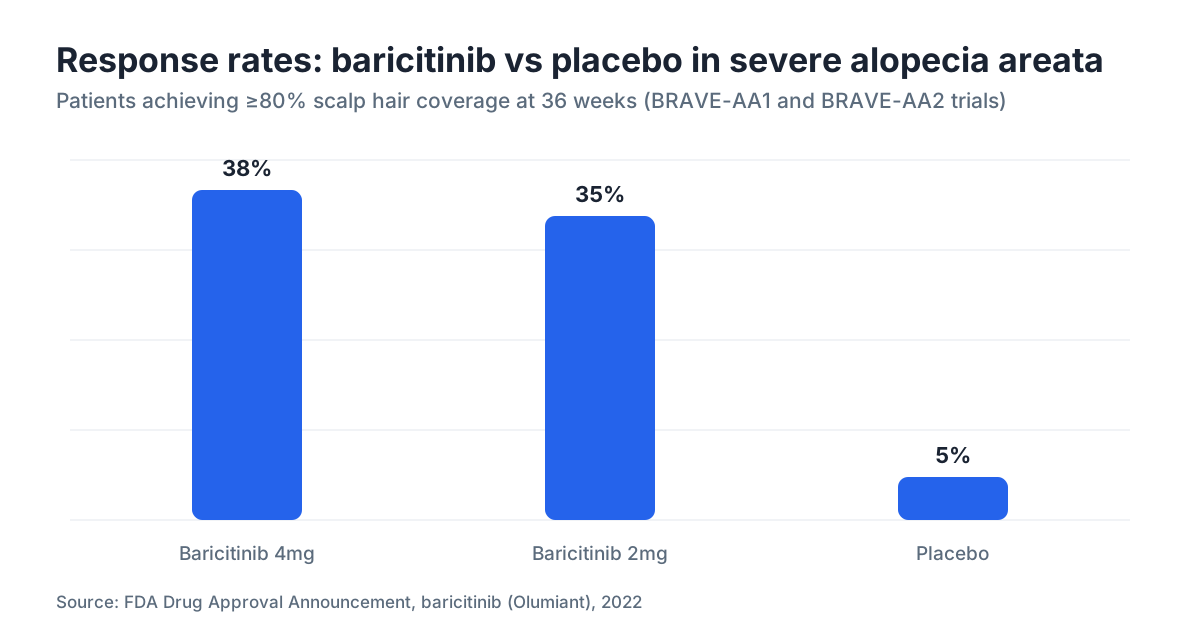
JAK inhibitors are the biggest change in alopecia areata treatment in a generation. Baricitinib (Olumiant) received FDA approval in June 2022 for severe alopecia areata in adults, and ritlecitinib (Litfulo) received FDA approval in June 2023 for patients aged 12 and older. [7][8] These are oral medications that block part of the inflammatory signaling pathway the immune system uses to attack follicles. In the registration trials for baricitinib, 35 to 38 percent of patients with severe alopecia areata achieved 80 percent or more scalp coverage after 36 weeks, versus about 5 percent on placebo. [7] That's a meaningful treatment effect for a condition that previously had very few good options.
Topical minoxidil doesn't treat the underlying immune cause, but it can support regrowth in patients who are in remission by keeping follicles in a growth phase longer. It won't stop a flare. You can read more about how minoxidil works in our minoxidil for men guide, though the same topical mechanism applies across sexes.
Anthralin, contact immunotherapy (DPCP or SADBE), and systemic immunosuppressants like oral prednisone are older options still used in practice, with varying response rates and side effect profiles. [1]
Finasteride and DHT blockers are largely irrelevant for alopecia areata because DHT is not the mechanism. If you have both androgenetic alopecia and alopecia areata, they might be used for the androgenetic component separately. Our DHT blocker article explains how that mechanism works.
If you're unsure which type of hair loss you're dealing with, what causes hair loss is a good place to get oriented before spending money on treatments that target the wrong mechanism.
Are there any scenarios where a surgeon might say yes to a transplant?
Yes, a few specific situations exist where a thoughtful, experienced surgeon might discuss transplantation as a possibility, not a guarantee.
First scenario: patchy alopecia areata, stable for three or more years, verified by dermoscopy, affecting a small area of the scalp, with the patient fully informed about the real risk of graft loss if a flare occurs. Some case reports show acceptable outcomes in exactly this situation. [3]
Second scenario: a patient whose alopecia areata has completely remitted and who has patches where follicles appear permanently lost, meaning they've converted to scar-like areas without viable follicles. In these cases, some clinicians argue the immune attack has long since moved on and the scarred area might accept grafts. This is controversial and the evidence base is thin.
Third scenario: eyebrow or beard reconstruction in patients with localized stable patches. The face is a different immune microenvironment, and anecdotally some surgeons report better outcomes in facial hair transplants for alopecia areata than scalp work. Good controlled data doesn't exist here.
In every scenario, the honest surgeon will tell you that androgenetic hair loss and alopecia areata are categorically different problems. They won't apply the same confidence level. If a clinic is promising you the same success rate they'd quote for pattern baldness, that's a red flag.
Could a hair transplant actually make alopecia areata worse?
Potentially, yes. The Koebner phenomenon, where skin trauma triggers disease activity at the injury site, has been documented in alopecia areata. [3] Transplant surgery involves thousands of tiny punch wounds (in FUE procedures) or a linear incision (in FUT). Any of those could theoretically provoke immune activity at the surgical site.
Beyond koebnerization, the stress of surgery itself is a real concern. Physiologic stress can trigger hair loss in people with autoimmune conditions. The connection isn't perfectly documented for alopecia areata specifically, but there's good evidence that major stressors precipitate or worsen immune dysregulation generally. [1]
The worst-case scenario is spending $5,000 to $15,000 on a transplant, watching the grafts initially take, then losing them entirely to a disease flare within the first year. That outcome is documented in the literature. [4] It's not common, but it's common enough that most experienced surgeons won't take the risk in active or recently active disease.
How is alopecia areata different from other types of hair loss that do respond to transplants?
Understanding the distinction can save you from spending money on the wrong thing. The table below compares the conditions most likely to bring someone to a hair restoration consultation.
| Condition | Mechanism | Transplant viable? | Notes |
|---|---|---|---|
| Androgenetic alopecia | DHT-driven follicle miniaturization | Yes, reliable | Donor follicles are DHT-resistant [2] |
| Alopecia areata (stable, patchy) | Autoimmune follicle attack | Sometimes, with caveats | Relapse risk remains; long stability required [3] |
| Alopecia totalis / universalis | Autoimmune, scalp-wide | Rarely if ever | Published outcomes consistently poor [4] |
| Telogen effluvium | Stress-triggered shedding | Usually no (regrows spontaneously) | Most cases resolve in 6-9 months [9] |
| Traction alopecia | Mechanical tension on follicles | Yes, if caught before permanent scarring | Follicles must still be viable |
| Cicatricial / scarring alopecia | Inflammation destroys follicle permanently | Rarely, and only in burned-out disease | Scarred follicles cannot regrow naturally |
If you've noticed heavy diffuse shedding rather than patches, telogen effluvium explains that pattern and why it's usually temporary. If your loss looks like the classic hairline and crown retreat, hair transplant options for androgenetic alopecia are much more predictable.
Alopecia areata specifically tends to present as smooth, round or oval patches, often with an "exclamation mark" hair pattern at the border, where hairs are narrow at the base and wider at the tip. A dermatologist can usually distinguish it clinically, and a scalp biopsy confirms the diagnosis if there's any doubt. [1][5]
What should you do before seeing a hair transplant surgeon if you have alopecia areata?
Start with a board-certified dermatologist, ideally one with a specific interest in hair disorders. Hair transplant consultations before a proper diagnosis are money spent in the wrong order. A dermatologist will confirm whether you have alopecia areata or something else, classify the severity, and assess current disease activity.
If you do have alopecia areata, the realistic first goal is achieving and sustaining remission. Treating active disease is not optional prep work you can skip to get to surgery faster. It's the actual treatment.
Keep a photo record of your patches every four to six weeks. This gives you and any clinician a real picture of whether you're stable or fluctuating. Most modern phone cameras are good enough for this. Some platforms like MyHairline let you use a free AI hair analysis to track changes over time, which can be useful for building that longitudinal record before a specialist appointment.
If you're considering a transplant consultation despite active disease, be direct with the surgeon about your diagnosis. Surgeons who don't ask about your hair loss history before booking a procedure are not evaluating you properly. A good surgeon will want your dermatology records, more than a look at your scalp.
What questions should you ask a surgeon before agreeing to any procedure?
These are the questions that separate surgeons who've thought carefully about autoimmune hair loss from those who are selling procedures:
- How many patients with alopecia areata have you personally transplanted, and what were their outcomes at two-plus years?
- How will you define and verify stability before agreeing to operate?
- What happens to my grafts if I have a flare six months after surgery? Is there any recourse?
- Do you see a role for continuing JAK inhibitor therapy after surgery, and have you coordinated that with a dermatologist?
- What's your policy if I lose the transplanted hair within the first year?
If the surgeon can't answer question one with actual cases, that's informative. Alopecia areata transplants are rare enough that a surgeon who hasn't done them yet should say so plainly rather than extrapolating from their androgenetic alopecia experience.
Surgeons who are worth seeing for this question are usually affiliated with academic medical centers or are members of the International Society of Hair Restoration Surgery (ISHRS), which maintains educational standards for hair restoration practitioners. [6]
Also ask whether the surgeon would recommend continuing or starting a systemic treatment like a JAK inhibitor before and after surgery. The best outcomes in the literature tend to involve patients who are on active immunosuppressive treatment during the post-operative period, though this adds cost and its own risk profile.
What does the future look like for alopecia areata and hair restoration?
The approval of JAK inhibitors for alopecia areata is a genuine shift in how the condition can be managed. Baricitinib and ritlecitinib are producing regrowth rates in severe disease that nothing achieved before. [7][8] If a patient can achieve stable, sustained remission on a JAK inhibitor, the theoretical case for eventually doing a small transplant in a permanently denuded patch becomes marginally stronger. But that's still speculative, and no published trials have evaluated transplantation as an adjunct to JAK inhibitor therapy.
Researchers are also exploring whether PRP (platelet-rich plasma) injections, which are sometimes used as an adjunct to hair transplants in androgenetic alopecia, have any immunomodulatory effect that might help in alopecia areata. Early data is thin and inconclusive. [3]
For people with extensive or total alopecia areata who are not candidates for surgery, high-quality wigs, hairpieces, and scalp micropigmentation (a cosmetic tattooing technique) remain realistic options that don't carry the risk of graft loss. These aren't consolation prizes. For a condition this unpredictable, they're often the smarter choice.
At MyHairline, we'd rather help you understand the biology clearly than send you toward an expensive procedure with a real chance of failure. If you want an objective baseline on how your hair is changing over time, our free AI hair scan is a reasonable starting point before any clinical consultation.
Sources
- American Academy of Dermatology, Alopecia Areata: Overview
- NIH National Library of Medicine, Androgenetic Alopecia
- Dermatologic Surgery, Hair Transplantation in Alopecia Areata (Dua & Dua, 2010)
- Journal of the American Academy of Dermatology, Alopecia Areata Review
- Journal of the American Academy of Dermatology, Trichoscopy of Alopecia Areata
- International Society of Hair Restoration Surgery (ISHRS), Practice Guidelines
- NIH National Library of Medicine, Telogen Effluvium
- National Alopecia Areata Foundation, About Alopecia Areata