TL;DR: Minoxidil is not addictive. There's no craving, no tolerance, no withdrawal syndrome. But it only works while you use it, so stopping causes the hair it grew to shed within roughly 3 to 6 months, returning you to where your genetics were already heading. That's dependence on a treatment to hold results, not addiction to a drug.
What does 'addicted to minoxidil' actually mean?
Minoxidil is not addictive. People throw the word around loosely, so let's be precise. Clinical addiction means three things: compulsive drug-seeking, tolerance (needing more to get the same effect), and a physical withdrawal syndrome when you stop. Minoxidil has none of them. The FDA-approved labeling for topical minoxidil does not list dependence, tolerance, or withdrawal, and minoxidil is not a controlled substance under any schedule. [1]
What minoxidil has is a continuous-use requirement. Your follicles respond to the drug only while it's present. Stop applying it and they revert to the trajectory your genetics set. The hair minoxidil stimulated enters a resting (telogen) phase and sheds. That's why people say they're 'dependent' on it. Not because the drug hooks them chemically, but because the benefit vanishes when they quit.
Those two things look alike from the outside. They're mechanically nothing alike. Addiction rewires your brain's reward circuits. Minoxidil doesn't touch your brain at all in topical doses. It works on scalp blood vessels and follicle cells locally, and that's it.
How does minoxidil actually work, and why do you have to keep using it?
Minoxidil started as an oral blood pressure drug. Researchers noticed patients growing extra hair (hypertrichosis), and someone built a topical version to aim that effect at the scalp. The FDA approved 2% topical minoxidil for women in 1991 and 5% for men in 1997. [1]
At the follicle, minoxidil opens potassium channels in the smooth muscle cells around the follicle's blood supply. That widens the small vessels feeding each follicle, which appears to prolong the anagen (active growth) phase and may stimulate follicle cells directly. Hairs that would have miniaturized or shed instead stay larger and keep growing. [2]
Here's the part that matters. Minoxidil doesn't change your genetics. Androgenetic alopecia, the most common cause of pattern hair loss, is driven by dihydrotestosterone (DHT) slowly shrinking follicles. Minoxidil pushes against that while it's present. It doesn't stop DHT from doing its job. The moment you quit, DHT-driven miniaturization picks up from wherever it would have been without the drug. You don't lose extra hair because of minoxidil. You lose the hair minoxidil was propping up.
Dermatologists call it a maintenance drug from the first appointment for exactly this reason. It manages the condition. It doesn't cure it. For more on what's actually driving your hair loss, see what causes hair loss.
What happens to your hair if you stop using minoxidil?
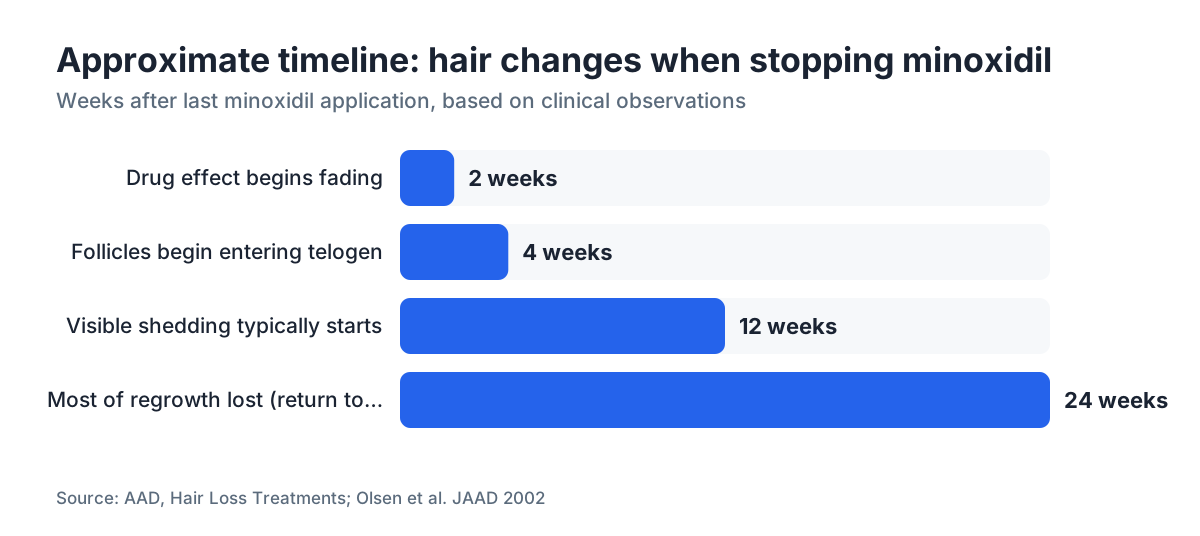
Stopping minoxidil reverses your gains within 3 to 6 months. The timeline is fairly predictable. Within about 2 to 4 weeks, the hairs minoxidil was holding in anagen start transitioning into telogen (resting phase). Many follicles sync up in this process, so you'll often see a heavy shed around 3 to 4 months after your last application. By 6 months, most people are back to the density they'd have had if they'd never used it at all. [3]
That shed can rattle you if you don't see it coming. Plenty of people read it as their hair getting worse than baseline, which is genuinely upsetting. It isn't worse. You're just catching up to where your genetics were taking you anyway. The follicles aren't damaged.
One practical point. If you've been on minoxidil for years, your baseline can look noticeably thinner than day one, because the underlying loss kept advancing the whole time. Minoxidil masked it. Stopping reveals it all at once. That's not a side effect. It's the natural history of androgenetic alopecia.
Some users call this a 'hostage situation.' I get it. You keep using the drug indefinitely or you lose what you grew. That's a real commitment. But understanding the mechanism makes it easier to decide whether the commitment fits your life.
Does minoxidil cause tolerance, meaning do you need more over time to get results?
No. Tolerance in the classic pharmacological sense has never been demonstrated with minoxidil. You don't jump from 5% to 10% after a year the way someone might need bigger doses of a sedative over time. [2]
What does happen is that the visible effect often seems to level off after 12 to 18 months. People mistake that for tolerance. Two overlapping things explain it better. First, minoxidil is fighting a progressive disease. As androgenetic alopecia advances, DHT-driven miniaturization can outrun what the drug sustains. Second, most of the regrowth lands early. Trials of 5% topical minoxidil found meaningful hair count gains versus placebo at 48 weeks, with later gains being more modest. [4]
So if your results fade after several years, the likely culprit is advancing hair loss, not your body adapting to the drug. The productive move is switching to oral minoxidil or adding a DHT blocker like finasteride, not doubling your topical dose. See finasteride and minoxidil for how that pairing works.
Is minoxidil psychologically addictive?
No. Minoxidil has no psychoactive properties. At topical doses it doesn't cross the blood-brain barrier in meaningful amounts, doesn't touch dopamine or serotonin, and produces no mood-altering effect anyone would chase. There's nothing here like the pull of stimulants or opioids. [1]
The distress about stopping, though, is real and deserves respect. Hair is tied to self-image for a lot of people. A drug that gives some of it back becomes emotionally loaded, and the thought of quitting feels like a threat. That's a normal reaction to caring how you look. It's not pharmacological addiction.
If hair loss anxiety is running your days, that's worth raising with a doctor or therapist, separate from the minoxidil question. The drug regrows hair. It won't fix distress about appearance.
Is the initial shedding when you start minoxidil a sign of dependence?
No. This one trips up new users constantly. When you first start minoxidil, usually 2 to 8 weeks in, many people shed more, not less. It's a sign the drug is working, not a reason to panic. [5]
Here's the mechanism. Minoxidil pushes follicles stuck in a prolonged, weak telogen phase into a fresh anagen cycle. To start a new anagen phase, the old hair has to drop first. That's a telogen effluvium response, and it's temporary. It usually clears within 1 to 3 months, and new growth follows. See telogen effluvium for why hair sheds in cycles.
Some people read this early shed as the hair 'becoming dependent' on the drug. It's the opposite. The follicles are waking up, not weakening. If the shedding drags past 3 months or turns severe, take it to a dermatologist.
What are the actual risks of long-term minoxidil use?
Dependence isn't one of them. The real side effects of topical minoxidil are scalp problems: irritation, dryness, flaking, and sometimes contact dermatitis from the propylene glycol carrier in some formulas. Foam versions carry less propylene glycol and tend to sit better on sensitive scalps. [6]
Systemic absorption with topical use is low but not zero. Scalp vessels move a small amount into circulation. The most reported systemic effects are mild fluid retention and, rarely, unwanted facial or body hair (the same hypertrichosis seen in the original blood pressure patients). If you have heart disease or take cardiovascular medications, run topical minoxidil past your doctor first, even though it's sold over the counter. [1]
Oral minoxidil is a different animal, because systemic absorption is the whole point. At hair-loss doses (typically 0.625 mg to 5 mg daily, well under the 10-40 mg used for blood pressure), serious cardiovascular effects are uncommon but not impossible. The FDA has not approved oral minoxidil for hair loss, though dermatologists prescribe it off-label with solid evidence behind it. [7] For the full breakdown, see oral minoxidil.
For the complete topical side-effect picture, minoxidil side effects covers the evidence in detail.
| Side effect | Topical (2-5%) | Oral (0.625-5mg) |
|---|---|---|
| Scalp irritation / dryness | Common | Rare |
| Contact dermatitis | Occasional | Rare |
| Facial / body hair growth | Rare | More common |
| Fluid retention / edema | Very rare | Occasional |
| Headache | Very rare | Occasional |
| Cardiovascular effects | Very rare | Rare (dose-dependent) |
| Pharmacological dependence | None | None |
Can you stop minoxidil without losing all your hair?
Sort of, if you plan for it. Combining minoxidil with a DHT blocker early gives you the best shot at keeping some benefit after you drop the minoxidil. Finasteride and dutasteride hit the underlying cause: DHT-driven follicle miniaturization. If you've been on both and then taper off minoxidil while staying on the DHT blocker, that blocker keeps slowing the disease, so some of what you held may stay. [8]
There's no guaranteed way to 'keep' minoxidil regrowth after quitting entirely. The biology doesn't allow it. But the state of your hair when you stop depends on how far the underlying disease has moved, and a DHT blocker slows that movement. See finasteride and dht blocker for how those options work.
A hair transplant is the only thing that permanently changes follicle location. Moved follicles from the back of the scalp are DHT-resistant by nature, so they tend to persist. But surgery doesn't stop loss in untreated areas. See hair transplant for a realistic look at what it does and doesn't fix.
If you're not ready to commit to indefinite use, say so upfront. It changes which treatments make sense to start at all.
How should you think about the minoxidil 'commitment' before you start?
Frame the decision clearly before your first bottle. Minoxidil isn't a two-week course of antibiotics you finish and forget. Stopping on purpose means accepting a return to wherever your genetics were taking you. That's not a reason to skip it. It's context you deserve.
A few honest questions to ask yourself. Are you okay applying a solution or foam to your scalp once or twice a day for the rest of your life, or for a defined stretch you can live with? Can you handle the cost (over-the-counter generic topical minoxidil runs roughly $10 to $30 a month, and oral versions vary by formulation and pharmacy)? How will you feel if it works and you later decide to stop for any reason?
If you don't know where your hair loss stands right now, a free AI hair scan at myhairline.ai/scan gives you a baseline picture of your hairline and density. That makes it far easier to tell whether any treatment is actually working. A clear starting point helps for any intervention you try, not only minoxidil.
For men specifically, minoxidil for men covers dosing, application, and realistic expectations.
Are there alternatives to minoxidil for people who don't want a lifetime commitment?
There's no clean escape hatch. Every effective hair loss treatment either needs ongoing use to hold results or is a one-time procedure with its own caveats.
Finasteride and dutasteride are indefinite commitments too. They slow progression while you take them. Stop either and DHT climbs back to its old level within weeks to months, resuming its work on your follicles. The regrowth timeline after stopping looks like minoxidil's: studies show meaningful loss resuming within 6 to 12 months of quitting. [9]
A hair transplant is a one-time surgery, but donor follicles are finite and your native hair in other zones keeps thinning. Most transplant patients stay on medical therapy to protect what they still have. Transplant plus nothing is a well-worn road to a second or third procedure.
Supplements sold for hair loss (biotin, saw palmetto, various blends) have far weaker evidence than minoxidil or finasteride. A few have modest supporting data. Most have none. See hair loss supplements for an evidence-based look at what's out there.
The receding hairline section walks through how to assess your stage, which matters for how aggressively you should treat.
What does the research actually say about long-term minoxidil use?
The evidence points one direction: it keeps working over years, without addiction. The longest clinical trials on topical minoxidil run to 5 years. A 48-week trial by Olsen and colleagues in the Journal of the American Academy of Dermatology found that 5% topical minoxidil produced statistically significant hair count increases versus placebo, outperforming 2% on some measures. [4] The American Academy of Dermatology grades topical minoxidil as Level A evidence for androgenetic alopecia in both men and women. [10]
Real-world use over years suggests the drug stays effective without tolerance developing. A 2021 review of low-dose oral minoxidil for hair loss in the Journal of the American Academy of Dermatology reported meaningful efficacy with an acceptable safety profile at doses between 0.25 mg and 5 mg daily, with no dependence or withdrawal phenomena reported. [7]
What the research doesn't show: physiological addiction, escalating dose requirements, or harm that piles up over time beyond the known side effects already covered. The FDA has tracked adverse event reports on minoxidil for decades, and the safety profile is well-characterized. [1]
Nobody has good data on the 20-year mark for continuous topical users. That study hasn't been done. The closest proxy is that minoxidil ran as a blood pressure drug for years before the hair indication existed, and long-term oral use at doses far higher than anything used for hair was judged safe enough to approve.
Sources
- FDA, Minoxidil Topical Solution Drug Label (NDA 019501)
- Messenger AG, Rundegren J. 'Minoxidil: mechanisms of action on hair growth.' British Journal of Dermatology, 2004
- American Academy of Dermatology, Hair Loss Treatments
- Olsen EA et al. 'A randomized clinical trial of 5% topical minoxidil versus 2% topical minoxidil and placebo in the treatment of androgenetic alopecia in men.' Journal of the American Academy of Dermatology, 2002
- Springer K et al. 'Common hair loss disorders.' American Family Physician, 2003
- Rossi A et al. 'Minoxidil use in dermatology, side effects and recent patents.' Recent Patents on Inflammation & Allergy Drug Discovery, 2012
- Randolph M, Tosti A. 'Oral minoxidil treatment for hair loss: A review of efficacy and safety.' Journal of the American Academy of Dermatology, 2021
- Kaufman KD et al. 'Finasteride in the treatment of men with androgenetic alopecia.' Journal of the American Academy of Dermatology, 1998
- Leyden J et al. 'Finasteride in the treatment of men with frontal male pattern hair loss.' Journal of the American Academy of Dermatology, 1999
- American Academy of Dermatology, Androgenetic Alopecia treatment guidance