
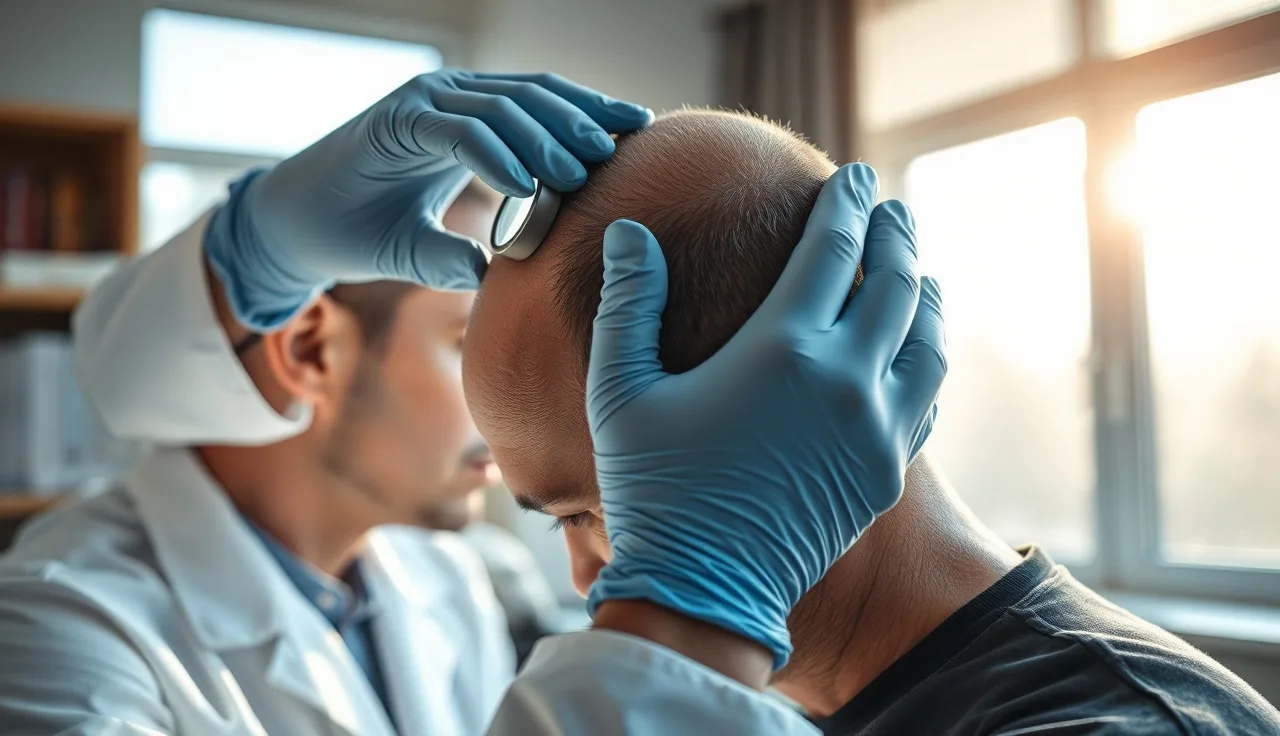
TL;DR: Yes, you can get a second hair transplant after an unsuccessful first one. Most surgeons want you to wait at least 12 months before revision. Success hinges on how much donor hair you have left, what killed the first result, and whether the original grafts survived at all. Repair work is harder and costs more, but good outcomes are common.
What counts as a 'failed' hair transplant?
A transplant is a true failure when grafts don't survive in meaningful numbers, meaning little to no new growth after the recovery window closes. Disappointment is different from failure, and the difference decides what you do next.
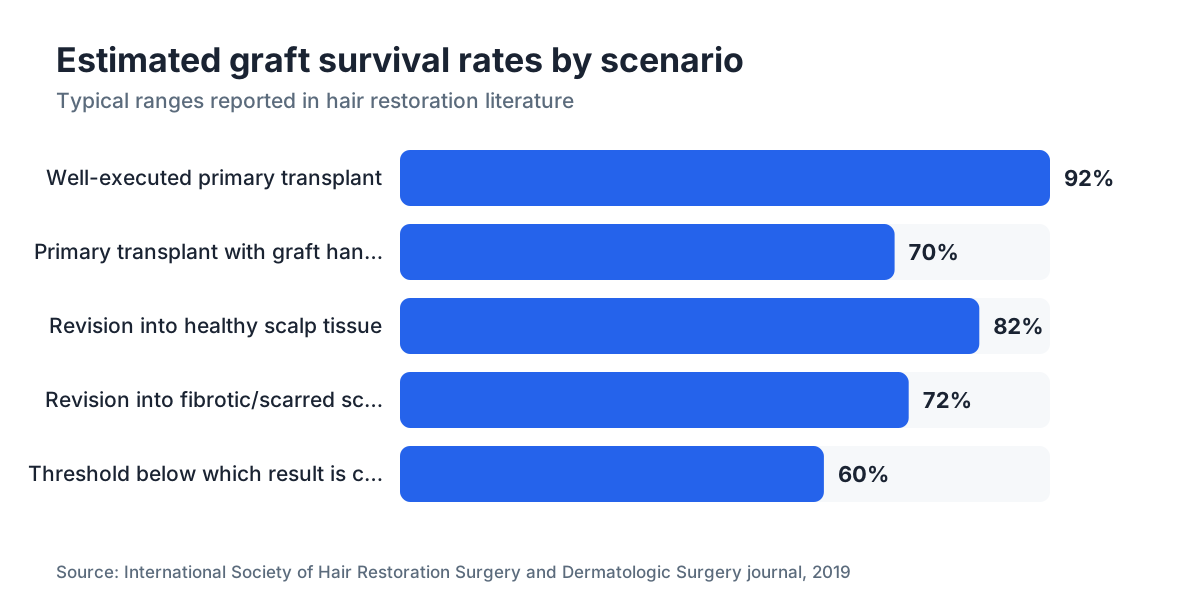
Surgeons generally call graft survival poor when fewer than 60 percent of transplanted follicles produce terminal hair after 12 months [1]. A well-executed procedure should hit 90 to 95 percent survival. That gap is the whole story.
Plenty of patients call their transplant a failure when the real problem is unmet expectations. The hairline sits too conservatively. The donor area couldn't cover a large bald zone in one session. The hair grew in fine rather than coarse. Real problems, all of them, but you fix them differently than you fix dead grafts.
Then there's the thing that looks like failure at six months and isn't. Shock loss. Telogen effluvium can strip out surrounding native hair and even some transplanted hair in the months after surgery, so the scalp looks worse before it looks better. Most of that hair comes back between months 9 and 14 [2].
Before you assume the worst, ask your surgeon for a trichoscopy or hair pull test at the 12-month mark. Get objective data before you commit to a second procedure. Guessing costs you thousands.
Why do hair transplants fail in the first place?
Grafts fail for a handful of reasons, and knowing yours is the only way to avoid a repeat. Technique is the most common. Bad patient selection, sloppy post-op care, and plain bad surgery fill out the list.
Grafts die when they're out of the body too long before placement. Anything past two hours at room temperature meaningfully raises graft mortality [3]. They also die when they're set at the wrong angle, or packed so densely that blood supply can't reach all of them. Clinics that rush huge sessions, especially the ones advertising 5,000 grafts in a single day at budget prices, fail more often because graft handling degrades at that volume.
Poor patient selection matters just as much. Operate on someone with active, fast-moving androgenetic alopecia, or transplant into a zone that's still shedding, and you've set up the failure before the first incision.
Post-op errors kill follicles too. Dislodging grafts in the first week (rubbing, trauma, pressure from sleeping), harsh shampoos too early, or picking crusts can take out follicles that would otherwise have survived.
Understanding what causes hair loss in your specific case is prerequisite knowledge before any transplant, first or second. If DHT-driven loss wasn't controlled with medication before the first surgery, the native hair around the grafts kept thinning, so the whole area looks worse even when the grafts themselves lived.
And then there's bad surgery. Clinics without a certified surgeon watching every graft placement produce more failures. This shows up a lot in certain medical tourism destinations, where technicians rather than surgeons do most of the work.
How long do you have to wait before getting a second transplant?
Twelve months is the minimum most experienced surgeons cite, and the reasons are biological, more than cautious. The scalp needs that year to heal the recipient sites, rebuild blood supply, and reveal which grafts actually took.
Transplant into an area that hasn't fully healed and you risk damaging surviving grafts, disrupting vascularity, and creating scar tissue that makes future work harder.
The grafts that survive go through a resting phase before they grow. Most surgeons and researchers agree final results aren't assessable until 12 to 14 months post-procedure [1]. Operate before that window closes and you might be treating a problem that would have fixed itself.
For FUT (strip) procedures, the scar has to mature before a second strip comes out. A fresh scar harvested too soon carries a much higher risk of wound dehiscence and wide scarring.
If the first procedure was FUE (follicular unit extraction), the surgeon needs to check donor density before going back in. Extract from a depleted donor zone too soon and you get visible moth-eaten patches.
Here's the practical timeline for most patients: consult at 12 months, plan the second procedure at 14 to 18 months. Complex revision cases sometimes need 18 to 24 months.
How much donor hair do you need for a second transplant?
Donor supply is the hard ceiling on everything. Every follicle taken from the back and sides is gone for good, and you start with a fixed budget.
The average person has roughly 6,000 to 8,000 follicular units in the safe donor zone [4]. A typical first transplant uses 1,500 to 3,000 grafts for hairline and frontal work, or up to 4,000 to 5,000 for larger coverage. If the first session used 3,000 grafts and those grafts died, you may still have 3,000 to 5,000 left in the donor zone, which is often enough for a solid second session.
The math gets ugly fast, though. If the first surgeon extracted carelessly, over-harvested, or left FUE punchmark scarring that thins viable follicle density, your real donor supply is well below the raw numbers.
A skilled surgeon maps your donor density with manual counting under magnification or a digital trichoscope before committing to a graft count. Don't agree to a second procedure without that assessment. Anyone quoting a number without measuring your scalp is guessing.
For patients who are genuinely donor-depleted, body hair transplantation (BHT) using beard or chest hair is a backup. Results aren't identical to scalp hair (body hair grows in different cycles and textures), but it can add coverage once scalp donor supply is gone [4].
What does a hair transplant repair procedure actually involve?
Repair transplants are harder than primary procedures in three specific ways: the recipient tissue, the existing grafts, and the artistry of a hairline. Go in with clear eyes about all three.
First, the recipient area is more complex. Scar tissue from the first surgery changes the vascularity and texture of the scalp. Grafts placed into dense fibrotic tissue survive at lower rates than grafts placed into healthy, untouched scalp. An experienced revision surgeon spaces placements more carefully, sometimes uses refined micro-incisions, and avoids over-dense packing.
Second, the existing grafts matter. If some grafts survived but grow at the wrong angle (a common cosmetic failure), the revision surgeon has to work around them. Removing a poorly angled graft, rotating it, and reimplanting it is possible but technically demanding, and not every surgeon offers it.
Third, hairline revision needs an eye for proportion and facial framing that goes well past placing grafts. Correcting a hairline that was set too low, too high, or with an unnatural edge is an art problem stacked on top of a technical one.
The steps themselves match a primary transplant: donor extraction (FUE or FUT), graft preparation, recipient site creation, placement. Operative time usually runs longer than an equivalent primary case because of the added complexity.
Expect the same recovery timeline. Crusting resolves in 7 to 14 days, shock loss is possible again in months 1 to 4, and final results show at 12 to 14 months.
How much does a second hair transplant cost?
A repair transplant almost always costs more per graft than a primary one, and the total can be steep. In the United States, FUE runs $4 to $10 per graft at reputable clinics, which puts a 2,000-graft repair session at $8,000 to $20,000 [5].
FUT is generally cheaper per graft, sometimes $3 to $7. Some clinics charge a flat fee instead of per-graft pricing.
Revision work adds a complexity premium on top of the base rate because it takes longer and demands more surgical judgment. You might pay 15 to 30 percent more per graft than a comparable primary case at the same clinic.
Here's what catches patients off guard: very few surgeons offer a free redo, even when the result was poor. Some will discount a revision if the failure was clearly their error and inside a defined window, typically 18 months. Many won't. Get any revision guarantee in writing before your primary procedure, and read the contract line by line.
Health insurance doesn't cover hair transplants in the United States because they're classified as cosmetic [5]. Medical tourism to Turkey, India, or Eastern Europe can drop per-graft costs to $1 to $3, and repair procedures on botched work from those same markets make up a meaningful share of revision cases at US and UK clinics. The cheap first surgery often funds an expensive second one.
| Procedure type | Average US cost (2024 est.) | Grafts typically needed |
|---|---|---|
| Primary FUE (hairline) | $8,000 to $15,000 | 1,500 to 2,500 |
| Primary FUT (larger area) | $6,000 to $12,000 | 2,000 to 4,000 |
| Revision FUE (repair) | $9,000 to $20,000+ | 1,000 to 3,000 |
| Body hair supplemental | $5,000 to $12,000 | 500 to 2,000 |
These are ranges, not quotes. Get itemized consultations from at least two board-certified surgeons before you commit.
Should you be on finasteride or minoxidil before a second transplant?
If you weren't on medication before the first transplant and progressive loss is part of why it looked bad, this is the single most important thing to fix before surgery. Medication protects the native hair a transplant can't.
Androgenetic alopecia doesn't stop because you transplanted hair. Native hair around and behind the grafted area keeps thinning while DHT attacks those follicles. Transplanted hair from the permanent zone is mostly DHT-resistant, but the native hair around it isn't. You can end up with islands of grafted hair surrounded by thinning or bare native scalp as the years pass.
Finasteride reduces scalp DHT by about 60 to 70 percent and, in randomized trials, slows or stops further loss in roughly 83 to 90 percent of men who take it [6]. A study in the Journal of the American Academy of Dermatology found men taking finasteride before and after a transplant had significantly better overall density than those who had surgery alone [9].
Minoxidil for men won't stop DHT-driven loss, but it extends the growth phase of existing follicles and holds FDA approval for androgenetic alopecia at 2% and 5% [7]. Using it before and after a second transplant protects native hair and may help grafts establish.
Most surgeons want you stable on finasteride for at least six months before a second transplant, long enough to tell whether your loss has plateaued. If you're not a finasteride candidate, dutasteride or a topical DHT blocker may be worth discussing.
Combining finasteride and minoxidil is the most evidence-backed non-surgical approach and should be the base of any long-term plan around a second transplant.
How do you choose the right surgeon for a second transplant?
The stakes climb the second time. Less donor hair, more complex scalp tissue, a narrower margin for error. Pick the surgeon like the outcome is permanent, because it is.
Board certification is your baseline filter. In the United States, look for surgeons certified by the American Board of Hair Restoration Surgery (ABHRS) or members of the International Society of Hair Restoration Surgery (ISHRS) [8]. The ISHRS runs a find-a-surgeon tool and publishes practice standards. Not a guarantee of a great outcome, but a floor.
Ask specifically about revision experience. A surgeon who does 20 primary cases for every one revision is not the same as one who specializes in repair. Ask how many revision cases they do per year, and ask to see photos from those cases rather than their best primary work.
Get a written graft count based on actual donor density mapping, not a number pulled from your age or Norwood stage. Any surgeon who quotes a graft count without examining your donor area in person (or through high-resolution images for remote consults) isn't being rigorous.
If cost is the main reason you're eyeing the same type of clinic as last time, stop and think. The pattern of buying a budget primary transplant and then paying more for revision at a higher-end clinic is common enough that repair surgeons see it constantly. Cheaper on the second attempt usually just buys you a third procedure.
Want an objective starting point before you choose? MyHairline's free AI hair scan (/scan) can document your current state, map where you've lost density, and organize what you bring to the consultation.
What are the risks specific to a second hair transplant?
All the standard risks apply: infection, scarring, continued shock loss, poor graft survival. Revision procedures add a few of their own, and they're worth knowing before you sign anything.
Lower graft survival. Fibrotic or previously scarred recipient tissue has reduced vascularity, so a graft placed there gets less nutrient and oxygen access than one in healthy scalp. Some studies report survival in heavily scarred areas running 10 to 20 percent lower than in virgin scalp [3].
Donor area damage. If the first FUE procedure mishandled the donor zone, a second round of extraction in the same area can wreck follicles that survived the first pass. Over-extraction leaves visible thinning in the donor strip that can look worse than the original hair loss.
Ethical overpromising. A surgeon who tells you a second transplant will fully correct a badly botched first one, no caveats, isn't being straight with you. Some damage from poor first procedures cannot be fully corrected with transplantation alone, particularly extensively scarred donor zones or misplaced hairlines that would need significant scalp repositioning.
In rare cases of severe scarring, ancillary procedures like scalp micropigmentation (SMP) or scalp reduction surgery come up alongside a second transplant, not as a fix-everything, but as part of managing what's realistic.
Shock loss can return. The same temporary shedding that follows a first transplant can follow a second. Knowing that in advance heads off the panic. If you had significant shock loss the first time, tell your surgeon so they can adjust the approach.
When is a second transplant not worth it?
Some situations don't warrant a second procedure, and knowing that beats spending money on a result that can't meaningfully improve.
Severe donor depletion is the clearest contraindication. If the first procedure used most of your donor supply and those grafts mostly took but just couldn't cover the whole area, there may not be enough hair left for another meaningful session. Body hair is an imperfect substitute with a different texture and cycle.
Active, fast-moving loss in a young patient is another reason to pause. A 22-year-old at Norwood 4 who transplants into the frontal area may watch the surrounding native hair keep receding, leaving the transplanted hairline stranded in five years. Stabilize on medication for two or more years first. That's the better call.
Heavy scarring from prior FUT can rule out a second FUT and complicate FUE extraction in the affected zone. A surgeon has to judge whether the scar tissue is workable at all.
Psychological factors count too. If the distress from the first failure runs deep, and you expect a second procedure to deliver perfection, talk to a mental health professional experienced with body image concerns before more surgery. Hair loss genuinely affects quality of life, and that's real. But surgery is a high-stakes way to manage it, and it shouldn't happen under pressure or on the back of unrealistic hopes.
A receding hairline that's still actively progressing deserves an honest conversation with a surgeon about timing, even if the first transplant was years ago.
What non-surgical options are worth trying before or instead of a second transplant?
If the first transplant gave you partial results rather than outright failure, non-surgical options may close the gap enough to skip a second procedure, or at least improve the baseline before one.
Minoxidil at 5% topical has the strongest evidence for maintaining and mildly improving density in men with androgenetic alopecia [7]. The FDA approved it for exactly this. If you're not using it, starting now is a low-risk move. Read up on the minoxidil side effects profile first, though most men tolerate it fine.
Oral minoxidil at 0.625 to 2.5 mg per day is increasingly used off-label, and some dermatologists rate its effect on overall density above topical, especially for patients who can't tolerate scalp application or foam. The side effect profile differs, including possible fluid retention and heart rate changes.
Platelet-rich plasma (PRP) injections into the scalp show up as an adjunct to transplants or as a standalone. The evidence is still forming. A 2019 systematic review in Dermatologic Surgery found positive effects across several trials but noted that PRP preparation varies so widely that direct comparisons are hard [10]. PRP is not FDA-approved as a standalone hair loss treatment.
Low-level laser therapy (LLLT) devices carry FDA clearance for promoting hair growth. The evidence points to modest density improvement, not dramatic regrowth [11].
Honestly, none of these match the density a good transplant delivers. But pairing them with a second transplant, instead of treating surgery as a solo fix, gives better long-term results.
You can also look at hair loss supplements, though the evidence for most of them is thin next to finasteride and minoxidil.
Sources
- International Society of Hair Restoration Surgery, ISHRS Practice Standards
- American Academy of Dermatology, Hair Loss Overview
- International Society of Hair Restoration Surgery, ISHRS Practice Standards
- International Society of Hair Restoration Surgery, Body Hair Transplantation Guidelines
- American Society of Plastic Surgeons, Plastic Surgery Statistics Report 2023
- FDA, Propecia (finasteride) Label
- FDA, Rogaine (minoxidil) 5% Topical Solution Label
- American Board of Hair Restoration Surgery (ABHRS), Certification Standards
- Journal of the American Academy of Dermatology, Finasteride and Hair Transplant Outcomes
- FDA, Laser Hair Growth Devices, 510(k) Clearances