
TL;DR: Yes, low iron can cause hair loss. Iron deficiency, even without full anemia, pushes hair follicles into a resting phase and triggers diffuse shedding. The number that matters is serum ferritin. Most dermatologists want it above 40 ng/mL for hair health, though labs flag deficiency only below 12 to 15 ng/mL. Correcting iron usually slows the shed within 3 to 6 months.
How does low iron actually cause hair loss?
Hair follicles are some of the busiest structures in your body. They divide fast, need a steady oxygen supply, and lean hard on iron-containing enzymes to keep going. When your iron stores drop, your body triages. It keeps the organs running and lets the hair wait. The follicles lose access to what they need to stay in the growth phase.
The result is telogen effluvium, the technical name for diffuse shedding set off by a systemic stressor [1]. Iron deficiency shifts follicles from the anagen (growth) phase into the telogen (resting) phase ahead of schedule. Two to four months later you see it, usually as handfuls in the shower or clumps on the brush.
Iron also matters inside the follicle. Ribonucleotide reductase, the enzyme that drives DNA synthesis in dividing cells, needs iron to work. Without enough of it, the matrix cells at the base of the follicle can't replicate fast enough to build a normal hair shaft [2].
Here's the part most people miss: iron deficiency doesn't have to reach clinical anemia to hit your hair. Your hemoglobin can read perfectly normal while your ferritin, the storage protein that acts as your reserve tank, is already running low. That gap is exactly why shedding goes unexplained for months while doctors keep telling patients their blood count looks fine.
What ferritin level is considered too low for hair health?
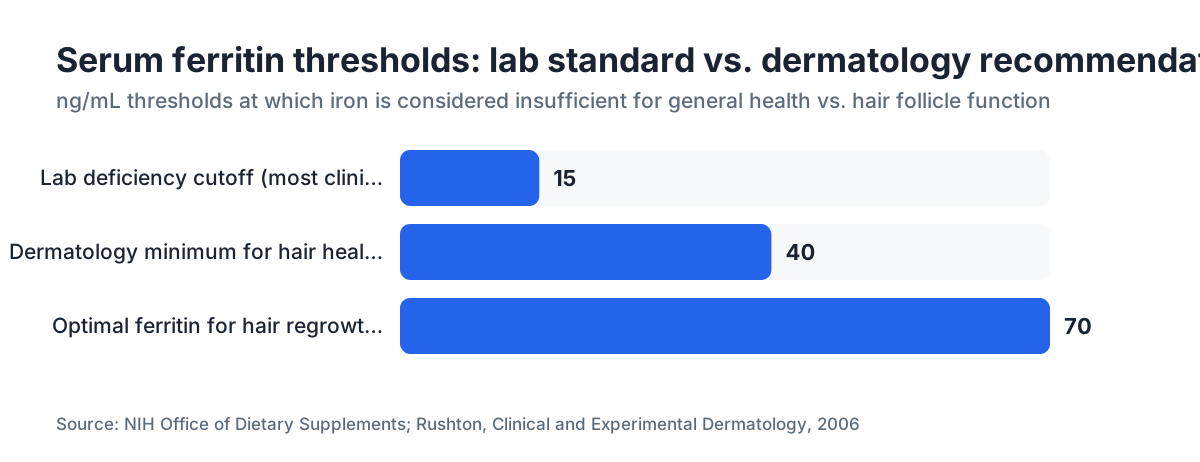
Aim for a serum ferritin above 40 ng/mL if hair loss is your main worry. That is a tighter target than your lab report suggests, and the gap between what labs call "normal" and what follicles actually need is where a lot of shedding hides.
Most clinical labs flag ferritin as deficient below 12 to 15 ng/mL [3]. That cutoff was set to catch iron deficiency anemia, not to protect hair. Follicles seem to need more.
A frequently cited 2006 review by Rushton in Clinical and Experimental Dermatology concluded that ferritin below 40 ng/mL was associated with hair shedding in women, and that levels below 70 ng/mL may be suboptimal for regrowth [4]. The American Academy of Dermatology's guidance on hair loss in women names iron deficiency as a correctable contributing factor and says to evaluate it before blaming shedding on something else [5].
In plain terms: your ferritin could read 18 ng/mL, your doctor could call it "low-normal", and your hair could be shedding at a rate that lines up with iron deficiency. The table below lays it out.
| Ferritin level (ng/mL) | What it usually means for hair |
|---|---|
| Below 12 | Deficient by most lab standards; high hair loss risk |
| 12 to 40 | Low-normal on labs; linked to increased shedding in dermatology research |
| 40 to 70 | Acceptable for most people; some research suggests regrowth may still be suboptimal |
| Above 70 | Generally enough for hair follicle function |
That 40 ng/mL floor is grounded in the available dermatology evidence, not in the standard lab range [4].
Who is most at risk for iron-related hair loss?
Women carry most of this risk, and the reason is blunt: menstruation drains iron every month, and heavy periods can create a chronic deficit that outpaces what any diet replaces. A 2003 study in the Journal of the American Academy of Dermatology found iron deficiency significantly more common in premenopausal women with chronic telogen effluvium than in controls [6].
Pregnant and recently postpartum women sit in a separate high-risk group. Pregnancy pulls heavily on iron stores for the developing baby, and blood loss at delivery deepens the deficit. The shedding many women notice at three to four months postpartum has two drivers working together: hormonal shifts and depleted ferritin.
Beyond the female-specific risks, these groups also run high:
- Vegetarians and vegans, because non-heme iron from plant foods absorbs at roughly 2 to 10 percent versus 15 to 35 percent for heme iron from meat [7]
- People with celiac disease, inflammatory bowel disease, or a history of gastric bypass, where absorption is impaired
- Regular blood donors
- Distance runners, where repeated foot-strike causes intravascular hemolysis
Men are not exempt. Men with low iron from GI bleeding, malabsorption, or a very restrictive diet shed for the same biochemical reasons. It's just rarer, statistically.
What other types of hair loss can low iron make worse?
Iron deficiency rarely works alone. It compounds other causes of hair loss more than it explains them on its own.
The clearest overlap is with androgenetic alopecia, the pattern loss driven by DHT sensitivity. Direct evidence that low iron speeds up DHT-mediated miniaturization is thin, but a follicle already stressed by genetic pattern loss is more exposed when systemic iron runs down. If you're losing hair at the temples and crown (see receding hairline for what that pattern looks like), getting your ferritin up is still worth doing even when genetics carry most of the blame.
Thyroid dysfunction often rides alongside iron deficiency and causes its own shedding. A decent workup for unexplained diffuse loss includes ferritin, a complete blood count, TSH, and sometimes a full thyroid panel. Fix the iron and leave hypothyroidism untreated, and your results will be partial at best.
Alopecia areata, an autoimmune condition, has a documented association with iron deficiency across several case-control studies. Whether low iron contributes mechanistically or just shows up alongside it as a comorbidity isn't settled [6].
For the wider picture on what causes hair loss, the connection between systemic deficiencies and hair cycling is one of the most underrated factors in most people's self-assessments.
How do you know if iron deficiency is causing your hair loss?
The symptom picture overlaps with a dozen other causes, so self-diagnosis is unreliable. A few patterns are still worth knowing.
Iron deficiency hair loss is almost always diffuse. You lose density evenly across the scalp rather than from one zone. Your ponytail feels thinner, your part looks wider, your scalp shows more under bright light. That differs from the progressive temple and crown recession of androgenetic alopecia.
Other signs of low iron (fatigue, cold hands and feet, brittle nails, a sore tongue) can ride along with the shedding, but none of them are required. Plenty of people with low ferritin have no symptom beyond the hair.
Bloodwork is the only reliable test. Ask your doctor to check:
- Serum ferritin (the single most useful marker for iron stores)
- Complete blood count with hemoglobin and hematocrit
- Total iron-binding capacity (TIBC) and serum iron if you want a fuller picture
- Transferrin saturation
Name serum ferritin specifically. Some GPs order a CBC and call it done. A normal hemoglobin does not rule out depleted iron stores.
If you want a starting point for reading your shedding pattern before the appointment, the free AI hair scan at MyHairline helps you tell diffuse thinning from patterned loss based on your photos.
How much iron do you need, and can diet alone fix this?
The recommended dietary allowance for iron is 18 mg a day for women aged 19 to 50, 8 mg a day for men, and 27 mg a day for pregnant women [7]. Those figures come from the NIH Office of Dietary Supplements.
Diet can rebuild iron stores if the deficiency is mild and your absorption is normal. Red meat, shellfish (oysters and clams especially), organ meats, and fortified cereals are the strongest sources. On the plant side, lentils, tofu, tempeh, and pumpkin seeds contribute, but you need to pair them with vitamin C to meaningfully improve absorption.
For moderate to severe deficiency, food alone is usually too slow. Iron is absorbed in the duodenum at a regulated rate, and your body won't simply take up double the amount because you ate more of it. Supplementation is faster in those cases.
Don't supplement iron without confirming you're deficient first. Iron overload (hemochromatosis) is a real condition, and dosing iron you don't need carries cardiovascular and liver risk. Test first, treat second.
If you've been reading up on hair supplements more broadly, the evidence for most of them is weak. A straight assessment of the hair loss supplements landscape is worth having before you spend money on anything.
What iron supplements work best for hair loss recovery?
Ferrous sulfate is the most prescribed oral iron and the most studied. Standard dosing is 150 to 200 mg of elemental iron a day, usually split into two or three doses [3]. The elemental iron in a tablet depends on the salt: a 325 mg ferrous sulfate tablet holds about 65 mg of elemental iron.
Ferrous gluconate and ferrous fumarate are alternatives with different elemental iron per tablet. Ferric forms (ferric citrate, ferric sulfate) generally absorb less efficiently than ferrous ones, though newer IV formulations like ferric carboxymaltose have high bioavailability.
A few practical notes:
- Take iron on an empty stomach for best absorption, or with a small amount of vitamin C (ascorbic acid)
- Keep iron at least two hours away from calcium supplements, antacids, coffee, and tea, all of which cut absorption sharply
- GI side effects (constipation, nausea) are common with ferrous sulfate; ferrous bisglycinate (iron chelate) tends to cause fewer complaints and still absorbs well
- Taking iron every other day instead of daily may reduce GI upset and, per a 2015 study in Lancet Haematology, actually improves total fractional absorption by easing hepcidin-mediated inhibition [8]
Run your dose decision past your doctor or a pharmacist. The right daily amount depends on how deficient you are and whether anything is blocking absorption.
How long does it take for hair to grow back after fixing iron deficiency?
Slow. Hair has no fast mode.
Once your ferritin climbs into a healthy range, the shedding usually slows within two to three months. Follicles pushed into telogen by the deficiency need time to finish that resting phase and re-enter anagen. You're not flipping a switch. You're waiting for a biological cycle to reset.
Visible regrowth, meaning new hairs of real length that fill the gaps, takes six to twelve months of steady, adequate iron. A 2003 study by Kantor and colleagues noted that hair loss tied to low ferritin could take up to a year to fully resolve after correction [6].
A couple of things confuse the timeline. If androgenetic alopecia is running alongside, iron correction may slow the shed but not deliver the density recovery you expect. The pattern component needs its own treatment, usually finasteride for men, minoxidil for men or women, or in some cases both together (see finasteride and minoxidil). A dermatologist can sort out which factor drives how much of your loss.
Patience is the price here. Three months in, a lot of people decide the supplement isn't working because they haven't seen regrowth. What they've actually done is stop the shed, which is the first and most important step.
Can minoxidil help while iron levels are being corrected?
Yes, and this pairing is used in practice. Minoxidil is FDA-approved for androgenetic alopecia, not for iron deficiency telogen effluvium [9]. It works by extending the anagen phase and increasing follicle size, which can help you hold onto hair while the deficiency gets addressed.
Using minoxidil during iron repletion can reduce visible thinning and give you a partial cosmetic bridge. The shedding phase people often notice when starting minoxidil (the early "dread shed" as follicles synchronize) is real and documented; see minoxidil side effects for what to expect.
Minoxidil comes topical and oral. Oral low-dose minoxidil (2.5 mg for women, 5 mg for men) is increasingly used off-label and may suit people who find topical formulas irritating (see oral minoxidil). It still needs a prescription in the US.
The framing that matters: minoxidil treats the hair loss, iron repletion treats the cause. Run both at once if the deficiency is moderate. Don't treat minoxidil as a substitute for testing and correcting iron.
When should you see a dermatologist instead of self-treating?
Some shedding needs a professional eye before you try anything yourself.
See a board-certified dermatologist if:
- Your shedding is severe, meaning what feels like more than 150 to 200 hairs a day, consistently
- You're seeing bald patches rather than diffuse thinning, which points toward alopecia areata rather than iron deficiency or telogen effluvium
- You've corrected your ferritin above 40 ng/mL and the shedding keeps going past four to six months
- You have symptoms suggesting another systemic cause (thyroid symptoms, lupus, scalp inflammation)
- You've taken iron supplements for three months with no change in ferritin
A dermatologist can run a pull test, trichoscopy, or a scalp biopsy if needed. Trichoscopy is especially good at telling the miniaturized hairs of androgenetic alopecia apart from the uniform-diameter hairs of telogen effluvium.
Self-treating mild iron deficiency with diet changes and a measured supplement dose while you monitor ferritin is reasonable for a lot of people. But if the picture is complicated, or you're also dealing with recession at the temples or crown, get a proper evaluation rather than piling on DHT blockers or other interventions without knowing what's actually going on.
If you want to frame that conversation before the appointment, the free scan at MyHairline maps your pattern and flags diffuse versus patterned loss so you walk in with something useful.
Are there any tests or conditions that can mimic iron deficiency hair loss?
Several. The diffuse shed of iron deficiency looks almost identical, on casual inspection, to shedding from hypothyroidism, vitamin D deficiency, zinc deficiency, protein malnutrition, or heavy emotional or physical stress.
A 2016 review in Dermatology and Therapy found that nutritional deficiencies broadly, including iron, vitamin D, zinc, and B12, were associated with several forms of hair loss, but the evidence quality varied a lot across nutrients [10]. Iron and vitamin D showed the most consistent links to telogen effluvium.
The workup worth requesting if you're shedding diffusely with no clear cause:
| Test | What it rules in or out |
|---|---|
| Serum ferritin | Iron stores (the key iron marker) |
| TSH | Hypothyroidism or hyperthyroidism |
| Free T4 | Thyroid function detail |
| 25-OH vitamin D | Vitamin D stores |
| Complete blood count | Anemia type, infection |
| ANA | Autoimmune conditions including lupus |
| Zinc | Less common, but worth checking in restrictive eaters |
Don't assume iron is the only issue. Fix the iron while missing an untreated thyroid problem and you'll get partial results. A structured blood panel either confirms the cause you suspect or points you at the real one.
Sources
- American Academy of Dermatology, Hair Loss Resource Center
- Rushton DH, Clinical and Experimental Dermatology (2002), 'Nutritional factors and hair loss'
- NIH Office of Dietary Supplements, Iron Fact Sheet for Health Professionals
- Rushton DH, Clinical and Experimental Dermatology (2006), 'Ferritin and hair loss in women'
- American Academy of Dermatology, Hair Loss in Women
- Kantor J et al., Journal of Investigative Dermatology (2003), 'Decreased serum ferritin is associated with alopecia in women'
- NIH Office of Dietary Supplements, Iron Fact Sheet for Health Professionals
- Moretti D et al., Lancet Haematology (2015), 'Oral iron supplements increase hepcidin and decrease iron absorption'
- US Food and Drug Administration, Drugs Database
- Guo EL, Katta R, Dermatology Practical and Conceptual (2017), 'Diet and hair loss: effects of nutrient deficiency and supplement use'
- NIH Office of Dietary Supplements, Iron Consumer Fact Sheet