
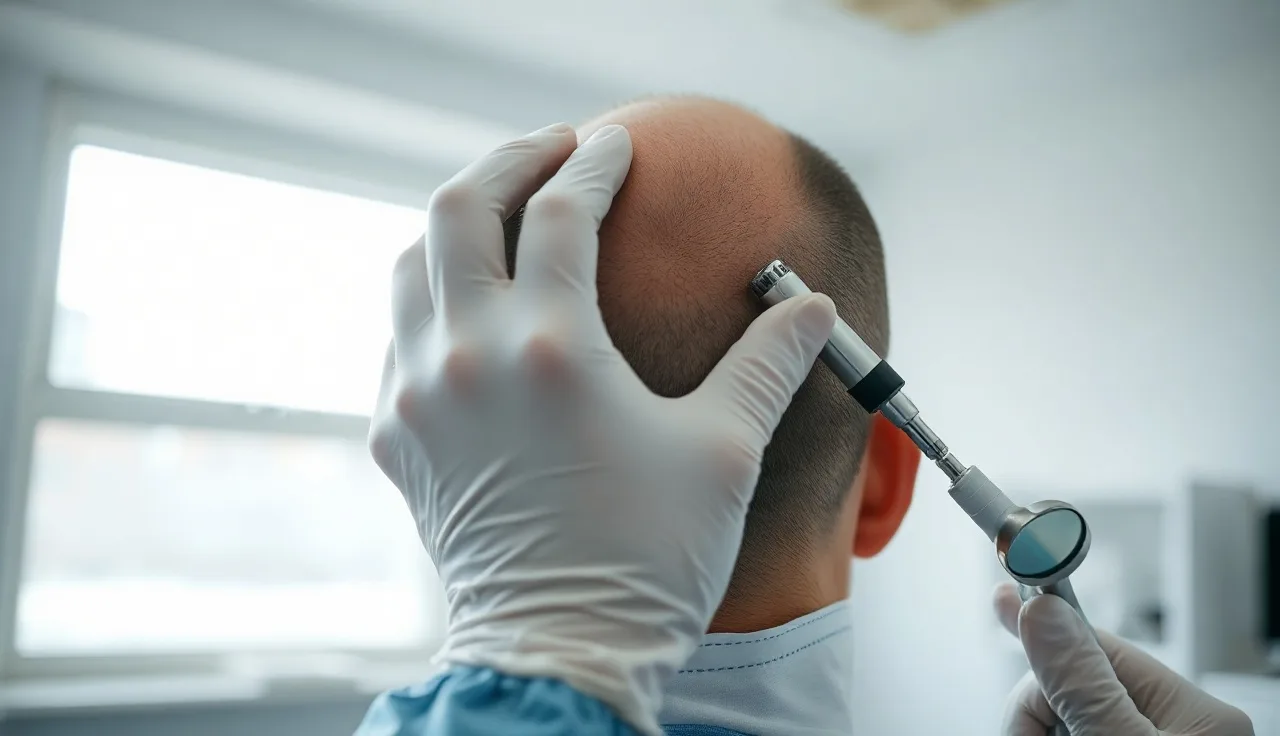
TL;DR: A crown hair transplant moves donor follicles from the back and sides of the scalp to the thinning vertex. It costs roughly $4,000, $15,000, takes 6 to 18 months to show full results, and works best when donor supply is strong and hair loss has stabilized. Surgeons often counsel caution: the crown is a high-risk area because loss usually continues after the procedure.
What is a crown hair transplant and how is it different from a hairline transplant?
The crown, also called the vertex, is the circular zone at the top rear of your scalp. When male-pattern baldness progresses past Norwood stage 3, the crown often opens into what patients and surgeons call a "whorl" of thinning skin surrounded by existing hair. A crown transplant takes DHT-resistant follicles from the permanent donor zone (the back and sides of the head) and redistributes them into that thinning circle.
The technical procedure is almost identical to a hair transplant for the hairline: either FUT (a strip excision that leaves a linear scar) or FUE (individual follicle punches that leave tiny dot scars). The difference is strategic, not surgical.
A hairline transplant fills a clear edge with a definite target density. Crown work is harder for two reasons. First, the whorl pattern means hair grows in multiple radial directions from a central point, so graft angulation has to be precise or the result looks fake. Second, there is no natural boundary. Hair loss tends to spread outward from the vertex over years, which means grafts placed at the edge of today's thinning zone may eventually be surrounded by new bare skin as the patient ages.
Surgeons at major hair restoration centers will often do a hairline case enthusiastically and approach a crown case more cautiously. That caution is warranted, more than commercial hesitancy.
Who is actually a good candidate for a crown hair transplant?
Good candidacy comes down to three things: donor density, degree of loss, and whether you've stabilized.
Donor density matters enormously at the crown because filling that circular zone requires a lot of grafts. Covering a Norwood 5 crown deficit often demands 2,000 to 4,000 or more grafts, depending on the area and the target density. A patient with fine hair, a naturally narrow donor strip, or previous transplant surgery may not have the reserves to fill the crown and still have grafts left if they need hairline work later. A board-certified hair restoration surgeon will measure your donor density in follicular units per square centimeter before agreeing to anything. Typical healthy donor density runs 65 to 85 follicular units per cm² [1], and spending a large fraction of that bank on the crown is a decision that affects every future procedure.
Degree of loss matters because someone with early thinning (Norwood 3 vertex, for example) may be a better candidate than someone at Norwood 6 whose donor zone is already being strained. The International Society of Hair Restoration Surgery (ISHRS) recommends treating the hairline first in most cases, because an intact hairline frames the face whether or not the crown is filled [2].
Stabilization is the part most patients underestimate. If your crown is still actively shrinking, you're essentially transplanting into a moving target. Surgeons frequently require that you've been on a DHT-blocking medication like finasteride for at least a year and that your loss has held steady before they'll commit large donor resources to your vertex.
Patients with scarring alopecia, active scalp infection, or unrealistic density expectations are generally poor candidates regardless of age.
How much does a crown hair transplant cost?
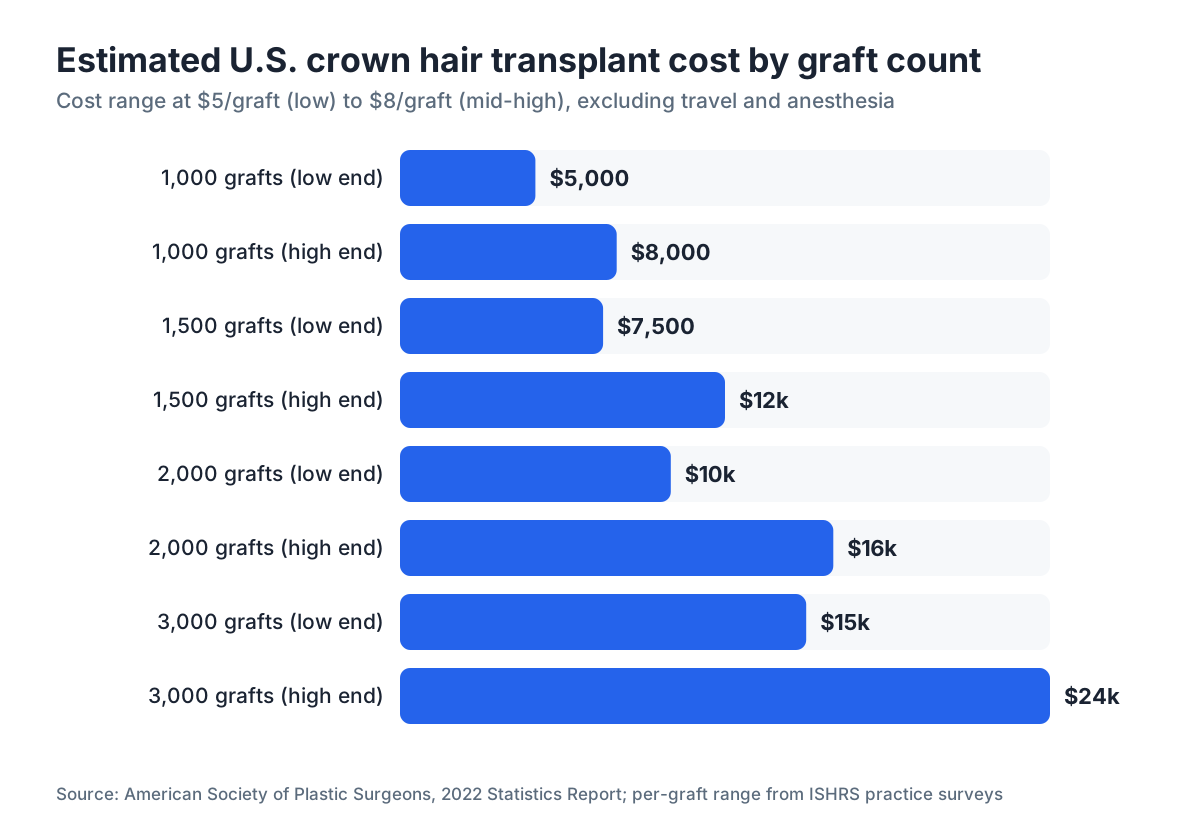
Expect to spend $4,000 on the low end for a small vertex procedure at a credible clinic, and $15,000 or more for a large Norwood 5 to 6 crown job at a well-regarded surgeon's practice in a major U.S. metro. The American Society of Plastic Surgeons reported that the average hair transplant cost in 2022 was $10,932 [3], though that figure spans all zones and methods.
Cost is almost always calculated by graft count, with per-graft pricing ranging from about $3 to $12 in the United States depending on method (FUE typically costs more per graft than FUT because it's more labor-intensive), clinic reputation, and geography. A crown job typically requires 1,500 to 4,000+ grafts.
| Graft count | Est. cost at $5/graft | Est. cost at $8/graft |
|---|---|---|
| 1,000 | $5,000 | $8,000 |
| 1,500 | $7,500 | $12,000 |
| 2,000 | $10,000 | $16,000 |
| 3,000 | $15,000 | $24,000 |
Hair transplants are almost never covered by insurance because they're classified as cosmetic procedures [4]. Medical financing through CareCredit or clinic payment plans is common but adds interest.
Medical tourism (Turkey, Thailand, Mexico) can cut prices to $1,500, $4,000 for the same graft counts. The ISHRS has published warnings about unregulated clinics and "hair mills" where technicians, not surgeons, perform most of the work [2]. If you go abroad, verifying the operating surgeon's credentials and reviewing before/after portfolios of their crown cases specifically is essential.
The crown is also one of the zones where revision surgery happens most often, because the results are harder to achieve and loss continues. Budget for that possibility.
FUE vs. FUT for the crown: which technique works better?
Neither technique is categorically better for the crown. Each has trade-offs that matter differently depending on your situation.
FUE (Follicular Unit Extraction) harvests individual follicular units one at a time using a small circular punch, leaving tiny scattered dot scars across the donor zone. Because there's no linear scar, you can wear your hair very short after healing. FUE is the dominant method today, and most patients requesting crown work prefer it. The downside is yield: per-session graft counts are generally lower than FUT, and the procedure takes longer.
FUT (Follicular Unit Transplantation) removes a strip of donor scalp, which a technician then dissects into individual grafts under magnification. You get higher graft counts per session, which matters when you need 3,000+ grafts for a large crown. The linear scar is the main objection; it's easily hidden under longer hair but visible with a buzzcut.
For large-area crown coverage, experienced surgeons sometimes recommend FUT precisely because you can harvest more grafts in one session. For patients with limited donor supply who want to minimize visible scarring, FUE is more appropriate. Some surgeons combine both techniques over two sessions.
Graft survival rates depend far more on surgeon and technician skill than on technique choice. A 2019 study in the Journal of Cosmetic Dermatology found graft survival rates of 90 to 95% in experienced hands with both methods [5].
How many grafts does a crown hair transplant need?
This is one of the most variable numbers in the entire field, and any clinic giving you a precise count before actually examining your scalp is guessing.
The crown's surface area ranges widely between individuals. A contained Norwood 3 vertex thinning patch might be 15 to 20 cm²; a full Norwood 6 crown can exceed 60 to 80 cm². To create the appearance of density (not necessarily full native density, but enough to reduce visible scalp contrast), surgeons generally aim for 30 to 40 follicular units per cm² in the recipient zone.
Doing the math: 40 cm² at 35 FU/cm² equals 1,400 grafts, on the low end. An 80 cm² deficit at the same density target equals 2,800 grafts. In practice, most crown cases run 1,500 to 3,500 grafts for the vertex alone, and that number can be higher if the zone has expanded significantly.
The reason surgeons press you to stabilize loss before surgery is exactly this math. If your crown grows another 10 cm² over the next five years, you need another 350+ grafts just to maintain the same density, and those grafts may not exist if you spent the donor bank already.
A good pre-surgery consultation includes a trichoscopy or densitometry measurement of both your recipient area and your donor zone so the surgeon can actually calculate what's feasible.
What does recovery look like after a crown transplant?
The recovery timeline is broadly similar to any hair transplant, but the crown adds one physical complication: sleeping position.
The first 72 hours matter most. Grafts are not yet anchored; physical trauma, rubbing, or bending them can dislodge or damage follicles. Most surgeons tell crown patients to sleep propped upright or semi-upright for the first three to five nights to keep the grafted area from pressing against a pillow. This is uncomfortable, and not everyone follows it perfectly.
Scabbing appears around days 3 to 7. The small crusts that form around each graft shed naturally by days 10 to 14. Washing protocols vary by clinic, but most allow gentle rinsing by day 2 to 3. Avoid scratching regardless of how much the scalp itches during healing.
Shock loss is real and often alarming. The transplanted hairs typically shed between weeks 2 to 8. The follicles themselves are not gone; they enter a resting phase before the new growth cycle begins. New hairs start to appear around months 3 to 5 and continue thickening through month 12, sometimes month 18 for the crown specifically, which can be slower than hairline grafts.
Swelling can migrate from the crown toward the forehead and temples in the first few days due to gravity. It usually resolves within a week.
Strenuous exercise, alcohol, and direct sun exposure on the recipient area are typically restricted for 2 to 4 weeks. Most patients return to desk work within a few days.
Does a crown hair transplant actually work long-term?
Yes, but with important qualifications that most marketing material omits.
Transplanted follicles are taken from the "permanent" donor zone, which is genetically resistant to DHT. Once successfully transplanted and grown in, those hairs are expected to stay. A study published in Dermatologic Surgery following FUE patients for 24 months found that graft survival in properly performed procedures exceeded 90% at the two-year mark [5].
The problem is not the transplanted hairs. It's the native hairs surrounding them. At the crown, you're typically transplanting into an area that still has some native miniaturizing hairs mixed in. Those native hairs will continue to be lost over time because finasteride and minoxidil slow the process but rarely stop it entirely. What you can end up with is a situation where the transplanted follicles thrive while the surrounding native hairs thin out, leaving visible gaps.
This is why the ISHRS and most experienced practitioners emphasize that a crown transplant is best viewed as one piece of a longer-term management plan, not a one-time fix. Combining it with ongoing medical therapy (finasteride and/or minoxidil for men) gives the best chance of maintaining the result by protecting native hairs around the grafts.
Patients who treat a crown transplant as a permanent solution and stop all medication often report disappointment at the 5 to 10 year mark, not because the grafts failed, but because the surrounding scalp continued to thin around them.
Should you treat hair loss medically before getting a crown transplant?
Almost every experienced surgeon will say yes.
Finasteride (brand name Propecia) is an FDA-approved oral DHT blocker for male androgenetic alopecia [6]. A key clinical trial published in the Journal of the American Academy of Dermatology showed that finasteride 1mg daily stopped or reversed crown hair loss in about 83% of men over two years, with 66% showing visible regrowth [7]. You can read more about how it works in our finasteride explainer and how combining it with minoxidil compares in our finasteride and minoxidil guide.
Minoxidil (topical or oral minoxidil) has an FDA-approved topical formulation for vertex hair loss specifically [8]. It doesn't block DHT, but it prolongs the growth phase of follicles and has a reasonable evidence base for the crown area.
The logic is straightforward: you want to spend your finite donor supply on a scalp that's as stable as possible. If you get surgery now and your loss progresses dramatically in the next decade, you'll need more grafts. Starting medication first, waiting 12 months to see how much loss you can arrest, and then making a surgery decision with better information is a more conservative and usually smarter approach.
Some patients see enough regrowth from medication that they decide against surgery, at least temporarily. Others find their loss stabilizes and proceed to surgery with much better data on what they're actually dealing with. If you haven't yet had a real look at what's causing your loss, our what causes hair loss guide is worth reading before making any commitments.
What are the risks and downsides specific to crown transplants?
The crown carries risks that go beyond the general risks of any hair transplant.
Donor depletion is the biggest long-term risk. A person has a finite number of grafts available, typically estimated at 5,000 to 8,000 lifetime for most patients, though this varies. Spending 2,500 to 3,500 grafts on the crown at age 35 may leave you short if you want hairline work at 45 or need a touch-up at 50. Surgeons who prioritize the hairline first are often protecting the patient's future options, more than being conservative.
Unnatural appearance is a real risk. The crown's whorl pattern makes angulation one of the hardest technical challenges in the field. If grafts are placed at the wrong angle or direction, the result can look pluggy or patterned even after full growth, particularly in men with straight hair where every shaft direction is visible.
Progressive loss creating an "island" effect is the cosmetically worst outcome. Imagine a circle of transplanted, thriving hairs surrounded by a ring of bare scalp that thinned after surgery. This happens. It's more common in patients who undergo crown surgery without being on medication and without counseling about future loss expectations.
Other general risks include infection (rare, under 1% in well-run clinics), folliculitis (small pustules in the recipient zone during early healing), scarring, and temporary shock loss of existing hairs near the recipient zone.
If your primary concern is a receding hairline, most surgeons will direct resources there first because the visual impact per graft is higher at the frontal frame of the face than at the crown.
How do you choose a surgeon for a crown hair transplant?
This is genuinely one of the biggest decisions in the whole process, because the crown is technically demanding and bad outcomes are hard to fix.
Start with credentials. In the U.S., look for board certification from the American Board of Hair Restoration Surgery (ABHRS), membership in the ISHRS, or a dermatologist or plastic surgeon with a documented specialty practice in hair restoration. The ISHRS maintains a physician finder at ishrs.org [2].
Ask specifically to see before-and-after photos of crown cases, more than hairline cases. Crown work and hairline work are different, and a surgeon who's excellent at hairlines may have limited crown experience. You want to see patients with similar hair texture, color, and Norwood stage to your own.
Ask who performs the graft dissection and placement. In many clinics, the surgeon makes the incisions and then technicians place the grafts. This isn't necessarily bad, but you want to know. Technician skill is a real variable in outcomes.
Get at least two consultations. Any surgeon who quotes you a graft count and price at the first appointment without measuring your donor density and discussing your long-term loss trajectory is telling you something about their approach. Good consultations take time.
If you want a starting point before committing to an in-person consultation, a tool like MyHairline's free AI scan (/scan) can give you a quick read on your Norwood stage and loss pattern so you walk into any surgeon's office already knowing your baseline.
Avoid any clinic that guarantees density levels, promises coverage equal to your native hair, or can't show you real patient outcomes from 12+ months post-op.
What results can you realistically expect from a crown hair transplant?
Realistic expectations are the single best predictor of patient satisfaction. Surgeons consistently report that dissatisfied patients had expectations that outpaced what the procedure can deliver.
Here's what a well-executed crown transplant can achieve: meaningful reduction in the visible scalp contrast at the vertex, a natural whorl pattern in the transplanted zone, and stable results in the grafted area over the long term. Photos taken in direct overhead lighting, which is the harshest possible condition for any crown work, will almost always show some visible scalp even after a successful procedure. The improvement is real but the result is rarely "full density."
What it cannot reliably deliver: complete coverage equal to your hairline density, a result that looks unchanged if you stop all medication and your surrounding native hairs thin, or a permanent solution that never needs revisiting.
Peer-reviewed data on patient satisfaction is limited, but a 2020 survey published in JAMA Dermatology found that hair transplant patients who received detailed pre-operative counseling reported significantly higher satisfaction rates at 12 months than those who felt they had received inadequate information [9]. The content of the counseling mattered more than the technical result.
If you're also experiencing diffuse thinning across your scalp rather than a discrete vertex patch, it may be worth looking into telogen effluvium or other causes of diffuse loss before attributing everything to androgenetic alopecia and planning surgery. The what causes hair loss guide covers this.
Is a crown hair transplant worth it compared to alternatives?
Worth it is a personal call, but here's an honest framing.
If you're Norwood 3 vertex with stable loss, good donor density, and you've been on finasteride for 12+ months with solid results, a crown transplant is a reasonable option. The cost per quality-of-life improvement can be very favorable for men who care about this.
If you're Norwood 5 or 6, still losing hair, with no medication history, a crown transplant at this stage is a gamble with limited donor capital on a moving target. The more conservative path is medication stabilization first, possibly hairline work second, and crown work only if donor supply permits.
The alternatives have their own limits. Finasteride and minoxidil can slow loss and produce modest regrowth, but they rarely restore significant density at the crown once it's significantly thinned. Scalp micropigmentation (SMP) can create the illusion of a shaved-head look and hide the vertex thinning, at a fraction of the cost, but it's a tattoo, not hair. Hairpieces and concealers like Toppik or Caboki are non-invasive and cheap, but they require daily management.
You can also look at dht blocker options and hair loss supplements as part of a broader strategy, though neither is a substitute for the proven medications. The honest hierarchy is: stabilize medically, consider surgery once stable, choose the surgical zone based on your donor math.
If you're uncertain where your loss currently stands and want a fast read before booking any consultations, MyHairline's free AI hair analysis (/scan) can identify your approximate Norwood stage from a few photos in minutes.
Sources
- International Society of Hair Restoration Surgery (ISHRS), Practice Census
- International Society of Hair Restoration Surgery (ISHRS), Patient Resources
- American Society of Plastic Surgeons, 2022 Plastic Surgery Statistics Report
- HealthCare.gov, What marketplace plans cover
- Journal of Cosmetic Dermatology, Graft survival in FUE and FUT (2019)
- U.S. Food and Drug Administration, Propecia (finasteride) Label
- Journal of the American Academy of Dermatology, Finasteride in vertex hair loss (Kaufman et al.)
- U.S. Food and Drug Administration, Minoxidil Topical Solution Label (Rogaine)
- JAMA Dermatology, Patient satisfaction in hair transplantation (2020)
- American Academy of Dermatology, Hair loss: Who gets it and causes