
TL;DR: DHI (Direct Hair Implantation) is a hair transplant method where extracted follicles are loaded into a pen-like implanter and placed straight into the scalp with no pre-made channels. It compresses two FUE steps into one, which can mean better angle control and less trauma to existing hair. Costs run from about $1,800 in Turkey to $15,000-plus in the US or UK.
What is a DHI hair transplant and how does it differ from FUE?
DHI stands for Direct Hair Implantation. It's a variation of FUE (Follicular Unit Extraction), not a separate category of surgery. Donor follicles still come out one by one from the back and sides of the scalp, exactly as in standard FUE. The implantation step is what changes.
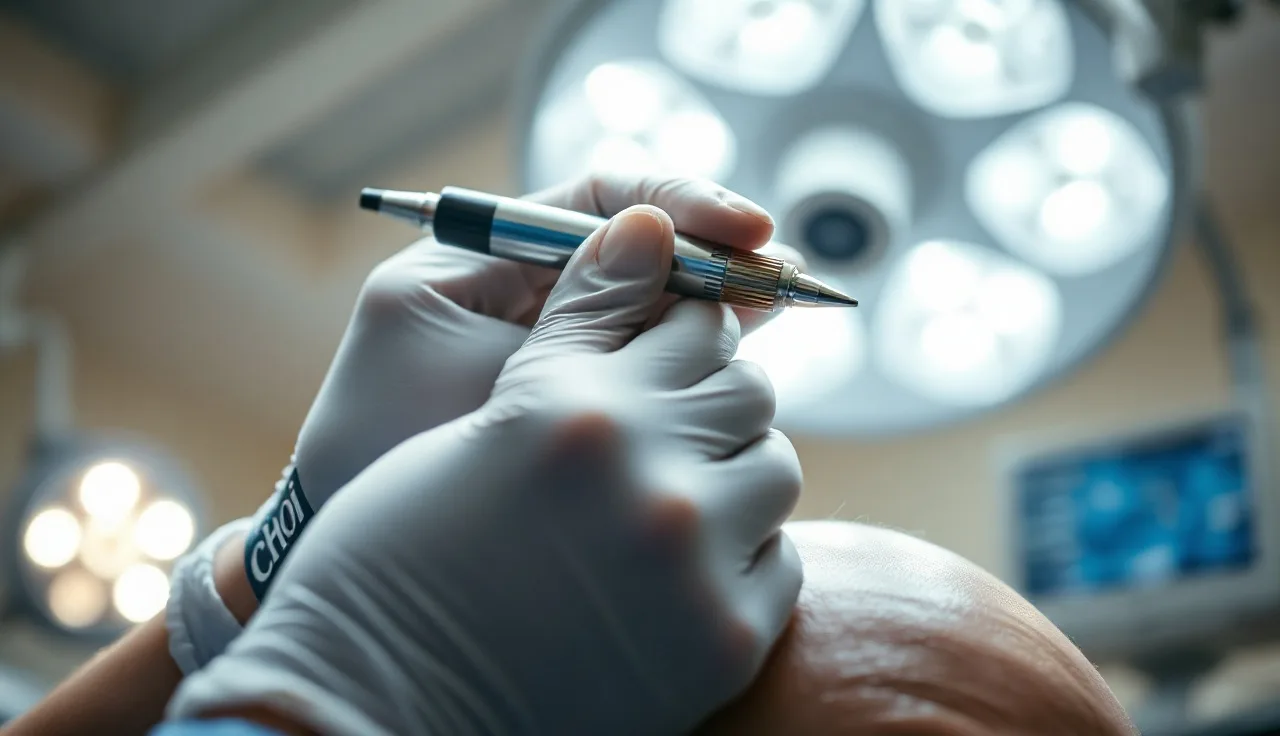
In standard FUE, the surgeon first makes hundreds or thousands of tiny incisions in the recipient area, then a team member places each graft into those pre-made channels. Two steps, separated in time. In DHI, the extracted follicle is loaded into a hollow needle implanter (most often the Choi Implanter Pen, developed in South Korea). The surgeon creates the incision and deposits the graft in one motion. One step.
That time compression matters because follicles are fragile outside the body. Every minute a graft sits on a tray in saline is a minute it isn't getting nutrients. Some surgeons argue DHI's faster implantation lifts graft survival. The honest answer: head-to-head trial data comparing DHI and FUE survival in the same patient population is thin. What exists comes mostly from individual clinic audits, not randomized controlled trials.
The other real advantage is angle and depth control. The pen lets the surgeon set the exact angle, direction, and depth of each graft before it goes in. That counts most in the hairline zone, where natural hair grows at a shallow forward angle. Get that wrong and the hairline looks fake even when every graft survives.
For how DHI fits alongside the other restoration options, start with the hair transplant overview.
What are the steps in a DHI procedure?
A DHI session runs four to eight hours depending on graft count. Here's what actually happens.
Consultation and design. The surgeon marks the new hairline with the patient sitting upright, eyes open. Hairline design is not a small detail. A line drawn 1 cm too low can look fine at 30 and cartoonish at 50 as surrounding hair keeps thinning.
Donor shaving and anesthesia. The donor zone (usually the occipital scalp) gets trimmed short. Local anesthetic is injected. For most patients this is the worst part of the day. Tumescent fluid is added to firm up the tissue and cut bleeding.
Follicle extraction. A micro-punch (typically 0.6 to 1.0 mm in diameter) rotates and cuts around each follicular unit. Fine forceps lift the unit out. A technician loads it into the Choi pen right away.
Implantation. The surgeon or a trained technician presses each loaded pen against the recipient scalp and depresses the plunger. The needle cuts the channel and drops in the graft at the same time. Multiple pens rotate so loading and implanting run without stops.
Post-procedure. The donor area is bandaged. The recipient area is left open. Patients usually get an antibiotic, a short course of oral corticosteroid for swelling, and detailed washing instructions. Many clinics also suggest starting or continuing minoxidil for men around week four to support the grafts as they enter the growth phase.
How much does a DHI hair transplant cost?
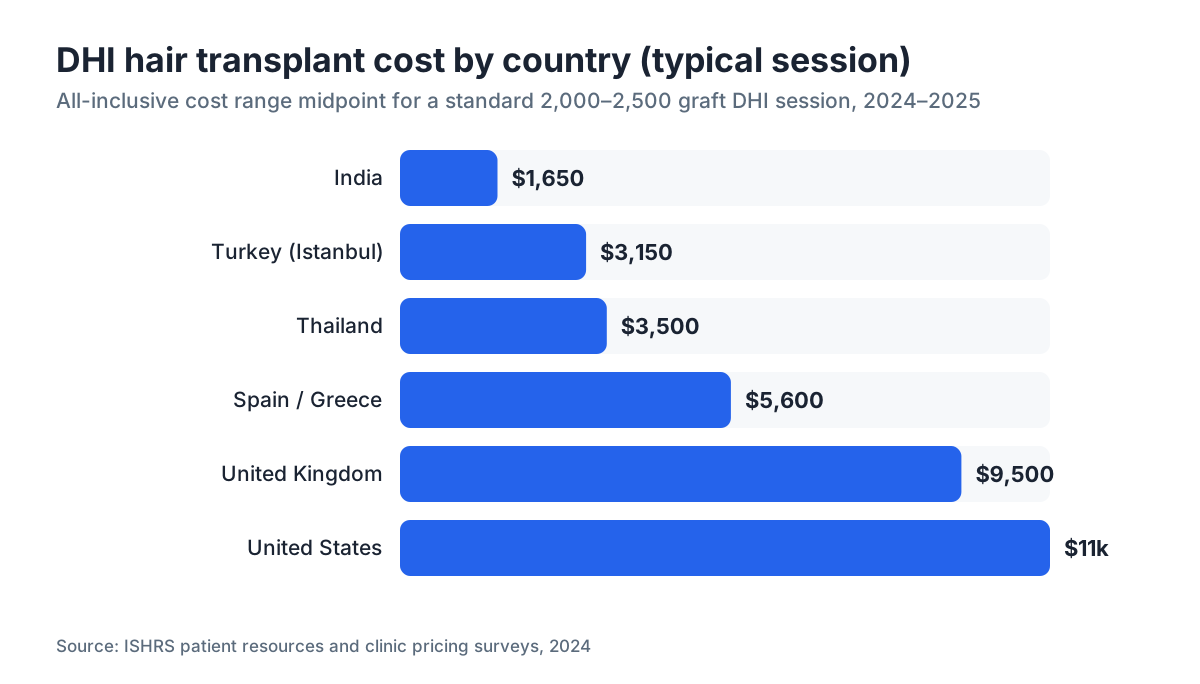
Cost swings hard by country, clinic tier, and graft count. No single authoritative price database exists for hair transplants, but the ranges below match figures reported consistently across patient forums, clinic pricing pages, and medical tourism cost analyses through 2024 and 2025.
| Location | Typical DHI cost range | Notes |
|---|---|---|
| United States | $7,000, $15,000+ | Priced per session, not per graft, at most reputable clinics |
| United Kingdom | £5,000, £12,000 | Similar tier structure |
| Turkey (Istanbul) | $1,800, $4,500 | Often includes hotel, transfers, post-op kit |
| Spain / Greece | €3,000, €7,000 | Mid-tier European pricing |
| India | $800, $2,500 | Wide quality range |
| Thailand | $2,000, $5,000 | Growing medical tourism hub |
Per-graft pricing is also common. In the US, DHI runs roughly $5 to $10 per graft [1]. A Norwood 3 hairline recession might need 1,500 to 2,500 grafts; a Norwood 5 crown restoration can take 3,000 to 5,000.
Health insurance almost never covers hair transplants in the United States, because they're classified as cosmetic [2]. The full cost is out of pocket. Many clinics offer financing through third-party lenders.
One warning on cheap packages. DHI is more demanding than standard FUE because it needs more trained hands. A real DHI, run with multiple Choi pens and a surgeon (not a technician) doing the implantation, costs more to deliver. A quote under $1,500 for a large session should make you ask exactly who is holding the pen.
Is DHI hair transplant in Turkey worth considering?
Turkey, and Istanbul specifically, is now the dominant destination for hair transplant medical tourism. The country performs an estimated 500,000-plus hair transplant procedures a year, the highest-volume market in the world by most industry accounts. DHI and FUE are both widely offered.
The cost gap is real. A session that runs $10,000 to $12,000 at a reputable US clinic might cost $2,500 to $3,500 at a comparable Istanbul clinic, including a two- to three-night hotel stay and airport transfers. Even with flights added, many patients spend 40 to 60% less than domestic pricing.
The quality range is enormous, though. Istanbul has world-class surgeons and also plenty of clinics running high-volume, low-attention operations where technicians do most or all of the work. Turkish medical law requires a licensed physician to supervise hair transplants, but supervision and execution are different things.
What separates a good Istanbul DHI clinic from a bad one: the surgeon personally marks the hairline and personally performs or closely directs implantation (more than extraction), the clinic requires real pre-op blood work, the quoted graft count fits your degree of loss (a promise of 6,000 grafts for a Norwood 3 is a red flag, not a bonus), and there's a genuine follow-up plan for patients traveling internationally.
The International Society of Hair Restoration Surgery (ISHRS) has documented concerns about unqualified practitioners in high-volume markets and publishes guidance on evaluating clinics abroad [3]. Read their patient resources before booking anything.
Want a clearer picture of your own loss before any consultation? MyHairline's free AI scan maps your thinning zones and Norwood stage from photos, which gives you something concrete to bring to clinic conversations.
What is the DHI hair transplant success rate and graft survival?
"Success rate" in hair transplantation means two things that often get blurred: graft survival (what percentage of transplanted follicles live and produce hair) and patient satisfaction (did the result match what the patient expected).
Graft survival in DHI, done correctly, is reported at 85 to 95% in clinic audits and smaller case series [4]. Standard FUE by experienced surgeons lands in the same range. A 2019 study in the Journal of Cutaneous and Aesthetic Surgery found no statistically significant difference in graft survival between FUE and DHI once surgeon experience and graft handling time were controlled [5]. That result should cool any marketing claim that DHI beats FUE across the board.
Where DHI may genuinely help is density in areas that already have existing hair. Because it skips the pre-made incision step, there's less trauma to surrounding tissue and existing follicles. That matters when you're filling in a partially thinned crown without wrecking the hairs still there.
Patient satisfaction data is harder to find clean. ISHRS surveys routinely show 70 to 80% of hair transplant patients report satisfaction with their results [3], but those figures pool all techniques and don't isolate DHI.
One point most surgeons agree on: results plateau around 12 to 18 months. Hair shed in the first 4 to 8 weeks ("shock loss") is normal and expected. New growth shows up around month 4 to 5. Judging the result before month 12 is too early.
Who is a good candidate for DHI and who isn't?
DHI works best for people with stable, patterned hair loss, enough donor density at the back and sides, and realistic expectations about what one session can do.
Strong candidates tend to be Norwood 2 to 5 with no active scalp disease, good general health, and no contraindication to local anesthesia. Men under 25 are usually told to wait, because their final loss pattern isn't set yet. Transplanting into an area that will thin further leaves the new hairs as obvious islands surrounded by loss.
People with telogen effluvium or other non-permanent loss should fix the underlying cause first. Transplanting into a scalp with active diffuse shedding is almost never the right call.
Scarring alopecia, certain autoimmune scalp conditions, or very poor donor density rule most people out regardless of technique. DHI doesn't create new follicles. It moves existing ones. If the donor bank is empty, no technique changes that math.
Understanding what causes hair loss in your case is the work you do before any surgical consultation. A dermatologist or trichologist can tell you whether your loss is androgenetic (and therefore predictably patterned) or something else.
What are the risks and side effects of DHI?
DHI carries the same risk profile as FUE. Extraction is identical, and implantation adds no new categories of risk. The FDA classifies hair restoration instruments as medical devices and requires practitioners to meet relevant state licensing rules [6].
Expected effects that aren't really harmful "side effects": forehead swelling (peaks around days 3 to 4, gone within a week), crusting around grafts (clears in 10 to 14 days), temporary numbness in donor and recipient zones, and the shock loss period of weeks 4 to 8 where transplanted hairs shed before regrowing.
Less common but real risks: infection (the scalp is a wound, and any break in skin can get infected), folliculitis (small pustules around grafts, usually self-limiting), poor growth if grafts were damaged during extraction or storage, and donor-site scarring (more visible in people who get very high-density extractions that leave obvious depletion).
Serious complications are rare but not impossible. Arteriovenous fistula, nerve damage, and systemic reactions to anesthetic have all been reported in the literature, though incidence in well-run clinics is very low.
The risk most people ignore is the opportunity cost of surgery with no medical management. Get a DHI, keep losing surrounding native hair with no finasteride or minoxidil, and within a few years your transplanted hairline can look stranded as everything around it recedes. Most surgeons want ongoing loss treated medically alongside or after surgery.
How does DHI compare to FUE and FUT?
Three techniques run the hair transplant market: FUT (Follicular Unit Transplantation, the strip method), FUE, and DHI. Here's an honest comparison.
| Factor | FUT | FUE | DHI |
|---|---|---|---|
| Extraction method | Strip of scalp removed | Individual follicles punched out | Individual follicles punched out |
| Recipient site creation | Pre-made slits, then graft placed | Pre-made slits, then graft placed | Simultaneous (Choi pen) |
| Linear scar | Yes (can be hidden under hair) | No | No |
| Graft survival | High (90%+) in skilled hands | High (85 to 95%) | High (85 to 95%) |
| Density per session | Highest graft counts possible | Moderate to high | Moderate (more time per graft) |
| Best for | Large sessions, tight scalps | Most patients | Hairline refinement, partial coverage |
| Cost | Usually lowest | Mid-range | Usually highest |
| Recovery | Longer, stitches out at 10-14 days | 7 to 10 days for donor | 7 to 10 days for donor |
FUT still earns its place for patients who need the maximum graft count in one session. FUE is the most versatile all-around option. DHI is best for hairline precision or for implanting into areas that still have existing hair.
DHI is not objectively better than FUE across all cases. It's a different tool for specific situations. A surgeon pushing DHI for every patient regardless of case type is a signal the clinic has spent more on DHI marketing than on technique selection.
How long does recovery take after DHI?
Most DHI patients are back to desk work within 3 to 5 days. Physical labor, heavy exercise, and anything that spikes blood pressure should wait 2 to 3 weeks. Swimming and contact sports usually need 4 weeks minimum.
The first 10 days demand the most from aftercare. Patients wash with a gentle, clinic-prescribed routine (usually a saline spray and a light shampoo applied without rubbing) to lift crusts without dislodging grafts. Sleeping with the head elevated around 45 degrees for the first week cuts forehead swelling.
Keep direct sun off the recipient area for at least a month. Hats are fine after about 10 days in most protocols, but tight caps earlier than that can disrupt grafts.
Typical medications: a 5 to 7 day antibiotic course, a 3 to 5 day oral corticosteroid (methylprednisolone or similar) for swelling, and a proton pump inhibitor to protect the stomach from the steroid. Some clinics start finasteride at 4 to 6 weeks post-op to protect existing hair.
The shock loss window (weeks 4 to 8) is the hardest part psychologically. Patients watch transplanted hairs shed and fear the procedure failed. It didn't. The follicle root stays put and re-enters the growth phase. New growth shows around months 4 to 5, and the final result isn't fair to judge until 12 to 18 months.
Should you combine DHI with finasteride or minoxidil?
For most people, yes. Combining surgery with medical treatment makes sense. A transplant moves follicles that resist DHT (dihydrotestosterone) from the donor zone into the recipient area. Those follicles keep their DHT-resistant programming, which is why the result is considered permanent. But the native hairs around the transplant are not DHT-resistant. They keep thinning on your genetic schedule.
Finasteride (1 mg/day oral) cuts DHT production by blocking the 5-alpha-reductase enzyme. Trials show it slows or stops further progression in roughly 83 to 90% of men and grows some hair back in a meaningful subset [7]. The FDA approved finasteride (Propecia) for male androgenetic alopecia in 1997 [8]. For the mechanism, dosing, and side effect profile, the finasteride article has the detail.
Minoxidil (topical 2% or 5%, or oral off-label) stretches the anagen growth phase and may help graft outcomes when started around week 4 after surgery. Some surgeons now recommend it specifically to shorten the shock loss window, though the evidence for that exact use is limited. The finasteride and minoxidil pairing is probably the most common medical-surgical combination.
DHT blockers more broadly, including some supplements, get covered in the dht blocker article if you want the mechanism behind why certain drugs work.
Skip medical therapy after a transplant and you're spending real money on surgery while letting the native hair around it keep thinning, which eventually makes the transplant look half-finished.
How do you choose the right DHI surgeon or clinic?
Choosing a hair transplant clinic is one of those decisions where the lowest price and the best outcome are almost never the same thing, and where marketing polish has almost no relationship to surgical quality.
The ISHRS runs a physician finder for board-certified and member hair restoration surgeons worldwide [3]. Membership doesn't guarantee quality, but it signals some commitment to the specialty.
Questions worth asking any clinic before booking:
- Who physically performs the implantation, the surgeon or trained technicians? In many high-volume clinics, technicians do most of it. That's not automatically bad (trained technicians can be skilled), but you should know.
- What punch size do they use for extraction? Smaller punches (0.6 to 0.8 mm) leave less scarring but need more skill.
- Can you see unedited 12-month results for cases like yours? Before/after photos from months 6 to 8 look impressive but don't show the final outcome.
- What's the follow-up plan if you live in another country?
- What happens if the result is poor? Reputable clinics have a written policy.
For Turkey specifically: the Turkish Ministry of Health regulates clinics and requires physician oversight, but enforcement is uneven. You can request the surgeon's medical license number and verify it with the Turkish Medical Association (Türk Tabipleri Birliği). For an expensive procedure, do it.
Still early in research and haven't mapped your exact pattern? MyHairline's free AI scan gives you a starting Norwood classification and thinning map that makes clinic consultations more useful.
What results can you realistically expect from DHI?
Realistic expectations are the single best predictor of patient satisfaction in hair transplant surgery, according to surveys published by the ISHRS [3].
DHI cannot give a person with advanced loss a full head of hair. It redistributes a finite supply of donor follicles. A surgeon who tells you otherwise is not someone to pay.
Typical outcomes by Norwood stage, assuming a well-run session:
- Norwood 2 to 3 (early hairline recession): Very high satisfaction. A single session of 1,500 to 2,500 grafts can rebuild the hairline to a natural, dense-looking result in most patients.
- Norwood 4 (mid-crown involvement): Good results possible, often 2,000 to 3,500 grafts. May need a second session.
- Norwood 5 to 6 (extensive loss): Harder. Donor supply becomes the ceiling. Coverage can improve a lot without reaching full density. Two sessions often needed.
- Norwood 7 (most severe): Surgery is a big compromise. Donor supply is limited. Results improve appearance but rarely create a convincingly dense look.
Hair thickness, the contrast between hair and scalp color, and natural curl or wave all move perceived density a lot. A patient with coarse, dark, wavy hair over a light scalp needs more grafts to reach the same perceived coverage as someone with fine, light hair over a similar scalp.
Final growth stabilizes at 12 to 18 months. Judging any result before then isn't fair to the procedure or the surgeon.
Sources
- American Society of Plastic Surgeons, Hair Transplant statistics and costs
- HealthCare.gov, cosmetic procedure coverage
- International Society of Hair Restoration Surgery (ISHRS), patient resources and physician finder
- Garg AK, Garg S. Journal of Cutaneous and Aesthetic Surgery, 'DHI vs FUE graft survival comparison'
- Journal of Cutaneous and Aesthetic Surgery 2019, comparison of FUE and DHI techniques
- U.S. Food and Drug Administration, medical devices for hair restoration
- Leyden J et al. Journal of the American Academy of Dermatology, finasteride 5-year trial
- U.S. Food and Drug Administration, Propecia (finasteride) approval history
- Garg S, Manchanda S. Dermatologic Surgery 2019, PRP meta-analysis for androgenetic alopecia
- U.S. Food and Drug Administration, ARTAS robotic system 510(k) clearance
- American Academy of Dermatology, hair loss diagnosis and treatment
- Kyungpook National University, history of the Choi Implanter Pen development