
TL;DR: Most experienced hair transplant surgeons prefer manual FUE over NeoGraft. NeoGraft is a motorized, suction-assisted FUE device marketed hard to clinics, but many top surgeons say it causes more graft trauma and lower yields than a skilled hand punch. The best predictor of your result is the surgeon's skill and how the grafts get handled, not the brand on the machine.
What is the difference between manual FUE and NeoGraft?
FUE, follicular unit extraction, harvests individual hair follicles from your scalp one at a time with a circular punch. The punch scores around the follicle, the graft comes free, and it goes into a holding solution before being placed into tiny recipient sites. That core process is the same by hand or by machine.
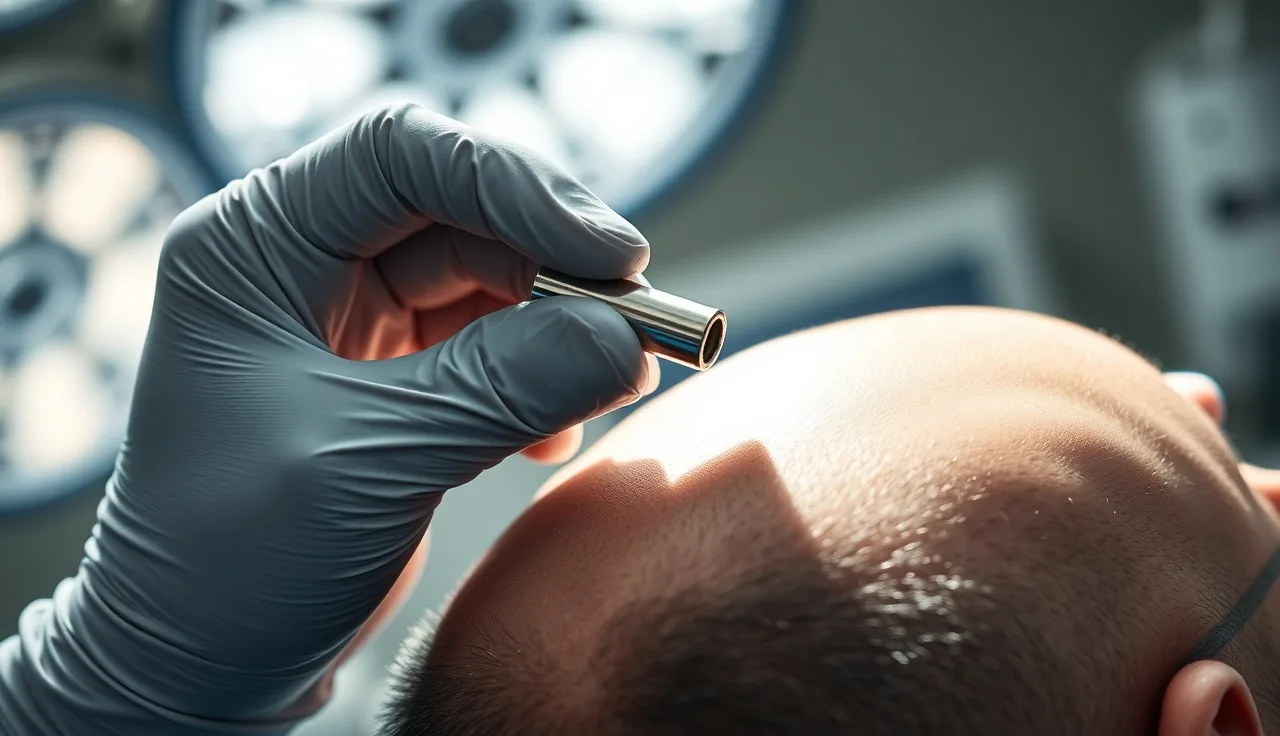
Manual FUE uses a small handheld punch, usually 0.7 to 1.0 mm across, driven entirely by the surgeon's wrist. The surgeon controls speed, depth, angle, and torque on every graft. It is slow and physically brutal. A skilled surgeon might extract 1,500 to 2,500 grafts in a full day.
NeoGraft is a specific brand of motorized FUE device made by Venus Concept. It pairs a rotating punch with pneumatic suction that pulls the graft up into a collection canister automatically after scoring [1]. The pitch is that suction speeds up extraction and cuts the number of people needed at the table. NeoGraft is FDA-cleared as a Class II medical device for follicular extraction [2].
The difference matters because the two approaches give you different levels of control. With manual FUE, the surgeon feels resistance in real time and adjusts. With NeoGraft's suction, the graft travels through tubing before anyone touches it, and that extra step is where desiccation and mechanical trauma can creep in.
Do most surgeons prefer manual FUE or NeoGraft?
Most high-volume, fellowship-trained hair restoration surgeons prefer manual FUE or other non-NeoGraft motorized punches over NeoGraft specifically. That is the short version.
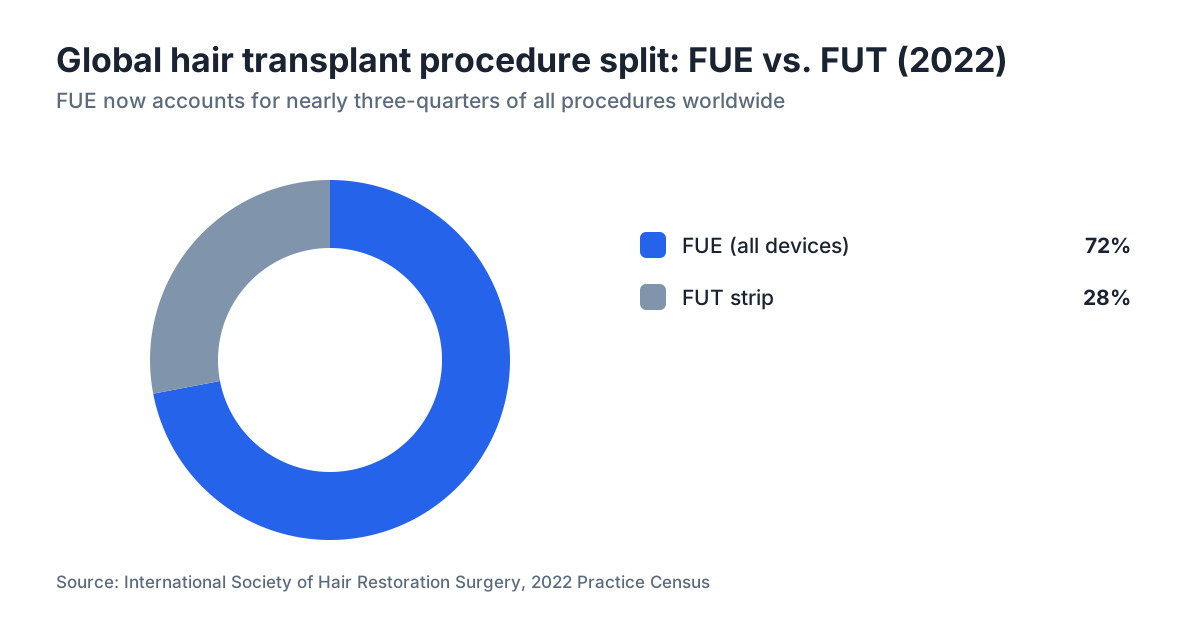
The International Society of Hair Restoration Surgery (ISHRS) runs a practice census roughly every two years. Its 2022 census found that FUE, across all devices and techniques, now accounts for about 72% of hair transplant procedures worldwide, passing FUT strip surgery for the first time [3]. The census does not name NeoGraft versus manual head to head, but it reports that most responding surgeons use a manually controlled or surgeon-operated punch rather than a fully automated suction device.
The surgeons who present case series and peer-reviewed work at ISHRS and ASAPS meetings mostly use manual punches or purpose-built motorized handpieces like the SAFE System, the Devroye WAW punch, or Cole Instruments. Not NeoGraft. Browse the published abstracts from ISHRS annual meetings and you will see the same pattern.
NeoGraft shows up far more in cosmetic chains and med spas than in dedicated hair transplant practices. It gets sold to clinics as a turnkey system because it lets less-experienced technicians extract grafts with less training. That is not a neutral point. It is the central criticism from surgeons who have used both.
None of this means NeoGraft cannot produce a good result. In experienced hands, outcomes can be solid. The catch is that the business model around NeoGraft often pulls the branded device away from the experienced hands.
What does the research say about graft survival rates?
Graft survival is the number that matters most in a transplant. A graft that dies is money gone and donor hair gone, permanently.
A 2016 study in Dermatologic Surgery compared automated FUE devices, including suction-based systems, to manual FUE. It found graft transection rates, meaning follicles accidentally cut and destroyed during extraction, were statistically similar across methods once you controlled for operator experience [4]. That finding cuts both ways. A skilled NeoGraft operator can match a skilled manual operator. An inexperienced NeoGraft operator does not magically beat a skilled manual surgeon.
The concern that is specific to NeoGraft is out-of-body time. The suction drops grafts into a canister where they can sit in open air longer than grafts that a tech places one at a time into chilled solution. A 2020 paper in the Journal of Cosmetic Dermatology reported that graft survival falls off when out-of-body time runs past four to six hours, and that storage conditions matter as much as extraction technique [5].
Here is the honest summary. No large randomized controlled trial has compared NeoGraft to manual FUE with graft survival as the primary endpoint. Nobody has good data on this at the study level. The closest we have is retrospective case series and expert opinion from surgeons who have switched methods. Most who switched report subjectively better graft quality with manual techniques, though who reports what carries real selection bias.
If you want to understand what actually drives your hair loss before deciding on a transplant, the what causes hair loss guide is worth your time.
Why do many clinics market NeoGraft so heavily if surgeons prefer manual FUE?
Follow the money. NeoGraft is a capital equipment sale. Venus Concept sells or leases the device to a clinic, and the clinic then markets the brand name to patients as if the machine itself is the thing that makes the result. Patients hear a brand and a claim that it is more advanced or less invasive, and most have no way to judge that claim.
The device also lets a clinic staff a procedure with less-trained technicians doing more of the work, because the suction step lowers the manual dexterity needed at extraction. That shifts the economics. A NeoGraft clinic can run more procedures a day on lower-cost labor. This is not hidden. It is right there in the device's marketing.
For a solo hair surgeon doing 200 to 300 cases a year, spending $100,000 or more on a NeoGraft system plus licensing fees makes no sense. Their hands are already the differentiator. For a multi-location chain running thousands of cases with rotating technicians, the device gives standardization and a marketing line.
That does not make every NeoGraft clinic bad. It means the business model should push you to ask harder questions: who actually performs your procedure, how many grafts they do a week, and what their transection numbers look like.
How does NeoGraft compare to other FUE devices and methods?
There are several motorized and robotic FUE options besides NeoGraft and the plain manual punch. Here is an honest look at the main ones.
| Method | How it works | Who operates it | Key tradeoff |
|---|---|---|---|
| Manual FUE | Surgeon uses handheld punch, no suction | Surgeon's hands entirely | Slowest per graft; highest tactile control |
| NeoGraft | Motorized punch + pneumatic suction | Surgeon or trained tech | Faster extraction; graft exposed to suction and tubing |
| ARTAS Robotic FUE | Robotic arm scores follicles; physician supervises | Robot + physician | Consistent depth and angle; expensive; struggles with curly hair [6] |
| WAW FUE system | Trumpet-shaped punch, motorized | Surgeon | Reduces transection in curved follicles; popular in Europe |
| SAFE System | Blunt dissection after scoring | Surgeon | Lower transection rate claimed by developer; no suction |
ARTAS, made by Restoration Robotics (now part of Venus Concept, the same company behind NeoGraft), is FDA-cleared for follicular dissection [6]. It costs a lot more than NeoGraft and is also concentrated in chain clinics. The ISHRS 2022 census found robotic FUE makes up a small minority of total cases globally [3].
The WAW and SAFE systems are the devices you most often see respected hair restoration surgeons reach for when they want motorized help without suction. Neither has a big marketing budget, which is probably why patients rarely hear about them.
What questions should you ask a clinic before booking?
Stop evaluating the device. Evaluate the surgeon and the team. That is where your result comes from.
Ask who will perform the extraction. In many NeoGraft clinics, a technician extracts the grafts. The physician may only design the hairline and place grafts, or in some cases mostly supervise. This is not illegal, but you should know it going in. Some states have specific rules about what non-physician staff can do during a procedure, and enforcement varies.
Ask for their transection rate. A good surgeon can quote an approximate rate from their own data. Anything under 5% is considered acceptable. Under 2 to 3% is excellent. If they cannot answer, that tells you something.
Ask how many grafts they do per day and who handles the grafts during the out-of-body window. Ask what solution the grafts sit in. (HypoThermosol and ATP-based solutions show better survival than plain saline in bench studies [5].)
Ask to see 12-month photos of patients at a Norwood stage close to yours. A Norwood IV with fine, light hair should want to see results in that exact population, not patients with thick dark hair where almost any technique looks good [7].
If you want a rough read on your own loss pattern before any consultation, MyHairline's free AI scan at myhairline.ai/scan can flag your approximate Norwood stage and thinning zones, which makes these conversations sharper.
Is NeoGraft more expensive than manual FUE?
Not necessarily for the patient, though the math is different on the clinic side. Hair transplant pricing in the United States usually runs from $4,000 to $15,000 or more for a full session, driven mostly by graft count, surgeon reputation, and geography rather than the device used [8]. A 2,000-graft session at a NeoGraft clinic in a major metro might run $8,000 to $12,000. A 2,000-graft session with a top manual FUE surgeon could cost the same or more.
The device cost does not map cleanly onto patient price because each clinic's margin structure is so different. What you should compare is cost per graft, not total price. Divide the quote by the guaranteed minimum graft count in your contract. Most reputable surgeons quote a range instead of a guaranteed minimum, which is worth pushing back on.
One cost never shows up in the first quote: revision procedures. If transection rates or graft survival are poor, you may need more grafts later. Donor hair is finite. A cheaper first procedure that wastes 20% of your donor supply through sloppy graft handling can cost more in the long run than a pricier one done well.
What is the recovery like, and does the device affect it?
Recovery from FUE is broadly the same whether the clinic used NeoGraft or a manual punch. You will have hundreds to thousands of tiny punch marks across the donor area, usually the back and sides of the scalp, plus recipient sites in the thinning or balding zones.
The donor area heals within 7 to 14 days for most people. Small pink dots show up at first and fade to undetectable over several weeks [9]. Plan to skip strenuous exercise for about 10 to 14 days. Grafts in the recipient area are fragile for the first two weeks and can be knocked loose by direct pressure, so sleeping upright on a travel pillow and skipping any hat that presses down is standard advice.
The shedding phase, where transplanted hairs fall out before re-entering growth, usually starts 2 to 6 weeks after the procedure and is expected. New growth typically shows at 3 to 6 months, with full results at 12 to 18 months. That timeline is the same for manual FUE or NeoGraft [9].
Shock loss, where existing native hairs temporarily shed from the trauma of surgery, can happen around the recipient sites. It usually reverses within 3 to 6 months, but raise it with your surgeon beforehand, especially if you have significant miniaturized hair next to the transplant zone. That risk is one reason many surgeons put patients on finasteride before and after a transplant, to stabilize miniaturizing hairs and protect the result.
Does hair type affect which method works better?
Yes, and most patient-facing content skips right over it.
Curly or tightly coiled hair, more common in patients of African descent, is a real challenge for any FUE technique because the follicle curves below the skin surface. The punch has to follow that curve or the follicle gets transected. ARTAS robotic FUE has documented trouble with curly hair in its FDA clearance data, which is part of why the manufacturer keeps working on algorithm updates [6]. Manual FUE by a surgeon who knows curly hair patterns is generally preferred here.
Fine, straight Asian and Caucasian hair extracts more predictably. The contrast between hair color and scalp color also changes how visible the donor harvest looks early in healing. A patient with dark hair and light skin shows the punch marks more obviously at first than someone whose hair and scalp tone are close.
NeoGraft's suction does not adapt to curl the way a surgeon's wrist does. This is not a theoretical worry. It is one of the specific criticisms published by hair restoration surgeons in review articles on how to pick an FUE technique [4].
Should you combine a transplant with medical therapy like finasteride or minoxidil?
Most hair restoration surgeons say yes, and the logic holds up. A transplant relocates permanent follicles, but it does nothing to stop the native hairs around them from continuing to miniaturize. If your loss is still moving at the time of surgery, the transplanted area can look great while the surrounding zone keeps thinning over the next few years, leaving an unnatural result that needs another procedure to fix.
Finasteride, 1 mg oral or a topical version, lowers DHT, the androgen most responsible for androgenetic alopecia, and peer-reviewed trials show it slows or halts miniaturization in most men who take it. A 1998 study in the Journal of the American Academy of Dermatology found that 83% of men on finasteride maintained or increased hair count over two years versus placebo [10]. It is FDA-approved for male pattern hair loss [11].
Minoxidil, applied topically or taken orally, has its own evidence for keeping and regrowing miniaturized hairs. The finasteride-plus-minoxidil combination works well together in clinical practice, though large head-to-head combo trials are thin. You can read more at finasteride and minoxidil.
If you are weighing medical options before a transplant, the minoxidil for men guide covers dosing and evidence, and dht blocker explains the mechanism. Some patients find medication alone is enough, especially at earlier Norwood stages. Starting with medication and watching for 12 months before committing to surgery is a low-regret path for most people under 30.
What is the bottom line on manual FUE vs. NeoGraft?
Manual FUE, in the hands of a surgeon who does it every day, is what most experienced hair restoration specialists prefer. The data does not prove NeoGraft is worse. But the settings where NeoGraft usually shows up (chain clinics, technician-heavy extraction, high throughput) create more chances for the things that actually damage grafts: too much out-of-body time, rough handling, and not enough surgeon attention per graft.
If you sit down for a consultation and the main selling point is the NeoGraft name and its machine, steer the conversation to the surgeon's personal graft volume, transection rate, and 12-month photos. If they struggle with those questions, that matters far more than any device name on the wall.
The right surgeon does hair transplants every working day, has outcome photos that match your pattern and hair type, gives you real numbers on complication and transection rates, and will recommend medication if your loss is still progressing.
For a broader look at what the procedure involves before you commit to any technique, the hair transplant guide walks through the full process from candidacy through recovery.
To understand your own loss pattern before you consult surgeons, MyHairline's free AI hair analysis at myhairline.ai/scan gives you a starting point on your Norwood stage and density map in a few minutes.
Sources
- Venus Concept, NeoGraft device overview
- U.S. FDA, 510(k) Premarket Notification Database
- International Society of Hair Restoration Surgery, 2022 Practice Census
- Journal of Cosmetic Dermatology, 2020 paper on graft out-of-body time and storage conditions
- U.S. FDA, 510(k) clearance for ARTAS Robotic Hair Restoration System
- American Academy of Dermatology, hair loss overview and Norwood scale
- American Society of Plastic Surgeons, 2023 statistics on hair transplant costs
- American Academy of Dermatology, hair transplant recovery guidance
- Journal of the American Academy of Dermatology, 1998 finasteride clinical trial
- U.S. FDA, finasteride (Propecia) prescribing information