
TL;DR: NeoGraft is an automated follicular unit extraction (FUE) device that suctions donor hair follicles one at a time and implants them without a linear scar. Procedures typically run $5,000 to $15,000 depending on how many grafts you need. Results take 9 to 18 months to fully appear, and you still need medication to protect the hair you didn't transplant.
What is NeoGraft and how does it differ from a regular hair transplant?
NeoGraft is a semi-automated FUE (follicular unit extraction) device cleared by the FDA for harvesting hair follicles [1]. The machine uses pneumatic suction to pull individual follicular units from the back and sides of your scalp, one at a time, then assists with implantation. That's the core difference between NeoGraft and the older strip method (FUSS): no long linear incision, no linear scar across the back of your head.
In a traditional strip harvest, the surgeon cuts a ribbon of scalp skin, dissects it under a microscope, and closes the wound with sutures. It's fast and efficient at producing high graft counts, but it leaves a horizontal scar that shows if you ever cut your hair short. NeoGraft's suction punches out each follicle with a tiny circular tool (typically 0.9 to 1.0 mm across), leaving small round dots that heal into near-invisible marks.
NeoGraft is not a clinic chain or a surgery brand. It's a device. Venus Concept makes it (the company was formerly called NeoGraft Technologies), and clinics license or lease the machine to use it. When a clinic advertises "NeoGraft transplants," they mean they own the machine and that a technician or surgeon runs it during your procedure [1]. The skill of the person behind the device still matters enormously for your result.
For a broader look at the full landscape of transplant options, hair transplant covers both FUE and FUT in detail.
How does the NeoGraft procedure actually work, step by step?
The procedure runs in one session and takes 4 to 10 hours depending on how many grafts are being moved.
Before the day: You'll have a consultation where the surgeon counts your available donor follicles (usually the back and sides of the scalp), maps your target zone, and estimates a graft count. You'll be told to stop certain medications and supplements that thin blood. Most clinics ask you to skip alcohol for a few days and wash your hair with a specific shampoo the morning of.
On the day: Local anesthesia goes into both the donor area and the recipient area. This is the most uncomfortable part for most patients, and it takes 15 to 30 minutes for everything to numb up properly. Once you're numb, you feel pressure but very little pain. You lie face-down first while the NeoGraft device extracts follicles from the donor zone. A technician or surgeon guides the suction punch along the scalp. Extracted follicles go into a chilled holding solution to stay viable. Most surgeons aim to keep grafts outside the body for under 6 hours [2].
After extraction, you flip over (or sit up) for the recipient phase. Tiny incision sites are made in the thinning or bald area, and then each follicle is placed individually. NeoGraft has an implantation component that helps with consistent depth and angle, though many surgeons do the implantation step by hand for more control. The size and direction of each incision decides how natural the final hairline looks.
After the procedure: The scalp looks red and dotted with small scabs. Most clinics wrap you in gauze for the first night. Swelling around the forehead is common in days 2 to 4. You're typically off work 3 to 7 days if you have a desk job. No heavy exercise or sun exposure for at least two weeks. Transplanted hairs shed within the first 2 to 6 weeks, which alarms almost everyone but is completely normal. The follicle stays alive underground. New hair grows from it starting around month 3 to 4, and full, mature results take 12 to 18 months.
How much does a NeoGraft hair transplant cost?
NeoGraft cost runs from roughly $5,000 on the low end to $15,000 or more for large sessions, with most patients landing between $6,000 and $12,000 [3]. Clinics price FUE procedures either per graft or as a flat session fee.
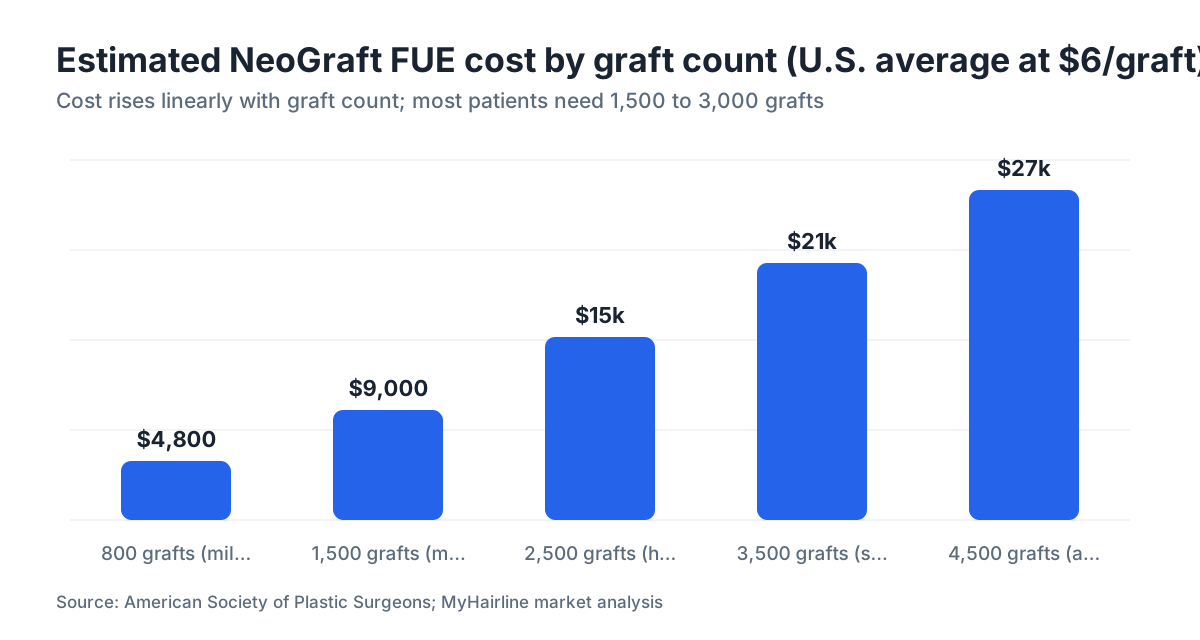
Per-graft pricing is the most common model in the U.S. Prices generally range from $3 to $8 per graft. A person with mild recession might need 800 to 1,500 grafts. Someone addressing a significantly bald crown might need 3,000 to 4,000 grafts in a single session. At $6 per graft, that's the difference between $4,800 and $24,000 for the same device.
Flat-rate sessions are offered by some clinics and usually cap around 2,000 to 3,000 grafts at a fixed price. These can be good deals if you're in that graft range, but always confirm exactly what's included (anesthesia fees, post-op medications, follow-up appointments).
Geography moves the number a lot. Major metros (New York, Los Angeles, Miami, Chicago) tend to charge more than mid-size cities. Some patients travel to lower-cost domestic markets or go abroad, though international transplant tourism carries its own risks if complications show up after you fly home.
Black hair transplant cost follows the same pricing structure, but transplanting tightly coiled hair takes a surgeon with specific experience. Afro-textured follicles curve beneath the skin surface, which means a standard extraction punch can transect (cut through) the follicle more easily if the surgeon misjudges the angle. Experienced clinics use larger or curved punches and slower extraction speeds. Ask to see a portfolio of patients with hair textures similar to yours before committing. The price range is the same as for straight hair, but the right surgeon matters more, which sometimes means fewer options and higher prices in some markets.
Neither Medicare nor most private health insurance covers hair transplants because they're classified as cosmetic [7]. Most clinics offer financing through third-party lenders. Compare the APR carefully. At 20 to 30% interest, a $9,000 procedure spread over three years costs a lot more than the sticker price.
| Graft count | Typical use case | Estimated cost at $6/graft |
|---|---|---|
| 800 to 1,500 | Early recession, temples | $4,800 to $9,000 |
| 1,500 to 2,500 | Moderate thinning, hairline + vertex | $9,000 to $15,000 |
| 2,500 to 4,000 | Significant loss, multiple zones | $15,000 to $24,000 |
| 4,000+ | Advanced loss (Norwood 5 to 7) | $24,000+ |
These are ballpark figures based on U.S. market pricing as of 2025. Your actual quote depends on clinic location, surgeon experience, and session length.
Does NeoGraft actually work? What does the evidence say?
FUE as a technique has a solid track record in skilled hands. Transplanted grafts are "permanent" in the sense that the follicles come from the donor-dominant area (back and sides), which is genetically resistant to the DHT-driven miniaturization that causes male and female pattern hair loss [4]. Once moved, those follicles keep their original characteristics and keep producing hair in their new location for the rest of your life in most cases.
Graft survival rates with well-performed FUE typically run 85 to 95%, meaning that share of transplanted follicles will establish and produce hair [2]. The automation NeoGraft provides can reduce technician fatigue during long extraction sessions and hold steadier suction pressure, which in theory helps follicle viability. Whether the device itself produces meaningfully better outcomes than manual FUE by an experienced surgeon is a genuinely open question. The published literature compares FUE and FUT broadly [8], but head-to-head randomized trials pitting NeoGraft's device against manual punch FUE are thin. Nobody has good independent data on that specific comparison.
Here's the honest summary from the surgical literature: FUE graft survival is highly operator-dependent, and device-assisted harvesting shows promise for consistency, but surgeon training and judgment stay the dominant variable [2]. The device is a tool. The result is still mostly about who's using it.
What NeoGraft cannot do: stop the hair loss that's continuing in your non-transplanted follicles. Transplant 2,000 grafts at age 30 and do nothing to slow your ongoing pattern baldness, and the native hair around your new grafts may thin out over the next decade, leaving you patchy. That's why most hair restoration physicians pair a transplant with finasteride and/or minoxidil for men to protect existing hair. Those medications don't touch the transplanted follicles (already DHT-resistant) but they protect the hair you still have.
Who is a good candidate for NeoGraft?
Good candidates share a few traits. First, a stable donor supply: you need dense, healthy hair on the back and sides of your scalp. If that area is thinning too, you may not have enough follicles to redistribute. Second, realistic expectations: a transplant moves existing hair, it doesn't create new hair. You're redistributing a finite resource.
Norwood stage matters. People at Norwood 2 to 4 tend to get the most satisfying results because they have real hair loss to address but still have strong donor zones. Norwood 5 to 7 is more complicated. Those patients often have extensive loss relative to their donor supply, and covering everything convincingly in a single session may not be possible. Some do multiple sessions over several years.
Age is a practical concern too. Surgeons are often reluctant to transplant someone in their early 20s, not because the procedure is riskier, but because your pattern of loss hasn't fully declared itself yet. Operating on a 22-year-old who ends up at Norwood 6 by 40 can produce an odd, isolated hairline island surrounded by bald scalp. Most experienced surgeons prefer to wait until loss has stabilized, or at least until they can project your trajectory with some confidence.
Women can be good candidates when they have a defined area of loss and enough donor supply. Traction alopecia (from tight hairstyles), hairline recession, and some cases of androgenetic alopecia in women respond well to transplants. But many women with diffuse thinning are not candidates because the entire scalp, including the donor area, may be affected. This is where a proper diagnosis comes first. What causes hair loss covers the distinction between androgenetic alopecia and other types like telogen effluvium, which is often reversible without surgery.
If you're unsure where your hair loss stands before booking a consult, the free AI scan at MyHairline can give you a baseline Norwood stage and flag whether your pattern looks transplant-appropriate.
What are the risks and side effects of NeoGraft?
NeoGraft uses the same tissue as any FUE procedure, so the risk profile matches FUE broadly. The FDA cleared the device as a mechanical harvesting tool, but clearance doesn't mean risk-free surgery.
Common and expected: Redness and swelling for 3 to 7 days. Scabbing at both extraction and implantation sites. Temporary scalp numbness. Shedding of transplanted hairs (called shock loss) in weeks 2 to 6. Post-procedural shedding of native hair in the treatment zone, which usually recovers over 3 to 6 months.
Less common but real: Folliculitis (small infected pustules at implant sites) affects a minority of patients and is usually treated with antibiotics. Over-harvesting from the donor zone can leave that area visibly thinned if too many follicles come out in one session, which is why sessions should stick to reasonable graft counts and space out by at least a year.
Rare but serious: Infection, significant scarring, and poor graft survival from handling errors. Cyst formation. In very rare cases, hyperpigmentation or hypopigmentation at treatment sites.
The most common reason people are unhappy isn't a medical complication. It's unmet expectations: insufficient density for the graft count, a hairline design that looks unnatural, or continued native hair loss around the transplant. These aren't risks of the device exactly. They're risks of the whole process, and they're why who performs the procedure matters as much as which device they use.
If you're on finasteride and minoxidil for men and considering a transplant, you can and generally should stay on both. Check with your surgeon about any timing adjustments they want before surgery.
How does NeoGraft compare to ARTAS, FUT strip, and manual FUE?
There are four main methods most U.S. patients run into: NeoGraft FUE, ARTAS robotic FUE, manual FUE, and FUT (strip). Here's the honest comparison.
| Method | Scar type | Automation level | Avg. U.S. cost per graft | Best for |
|---|---|---|---|---|
| NeoGraft FUE | Small round dots | Semi-automated suction | $4 to $8 | Most FUE patients; moderate-to-large sessions |
| ARTAS robotic FUE | Small round dots | Robotic AI-guided | $6 to $10 | Straight hair; patients who want robotic precision |
| Manual FUE | Small round dots | Fully manual punch | $4 to $9 | Experienced surgeon preference; curly or coiled hair |
| FUT (strip) | Linear scar (~15 to 30 cm) | Manual dissection | $3 to $7 | High graft counts; patients who keep hair longer |
ARTAS uses image-guided robotics to select and extract follicles. It tracks follicle spacing to avoid over-harvesting any single area, and it documents what it does. The downside: ARTAS works best on straight, dark hair against light skin where its camera can read contrast. Afro-textured hair, gray hair, or blonde hair can confuse the vision system, making it less reliable for those patients.
Manual FUE by a highly skilled surgeon can match or beat device-assisted outcomes. Many of the world's best-regarded hair transplant surgeons (at Istanbul, London, New York, and Miami clinics) use manual punches. The device doesn't make the surgeon. It's the other way around.
FUT still has a place. It reliably delivers higher graft counts in a single session (4,000 to 5,000 is achievable where FUE sessions usually cap around 2,500 to 3,000 in one day). If you need maximum grafts, don't mind the scar, and plan to keep your hair long enough to cover it, FUT's cost-per-graft advantage is real [8].
For a broader overview of what to ask during a transplant consult, hair transplant is a good place to start.
When will you see results after a NeoGraft procedure?
The transplanted hair sheds in the first 2 to 6 weeks. This is called effluvium, and it happens because the trauma of the procedure pushes those follicles into a resting (telogen) phase. The follicle bulb is intact under the skin and will grow again, but many patients panic here thinking the procedure failed. It didn't.
Here's the rough timeline most patients experience:
Months 1 to 3: Shedding, pinkness fading, scalp healing. Possibly no visible improvement yet. This is the hardest psychological stretch.
Months 3 to 5: New hairs start emerging. They look thin and wispy at first. This is the early growth phase. The hairs are real and permanent. They just need time to thicken.
Months 6 to 9: Noticeable density improvement. Most patients see meaningful coverage by month 6. Friends and family start commenting.
Months 9 to 18: Hair thickens and matures. The final texture and density become clear. Some patients keep improving all the way to 18 months [7].
Photographing your scalp in the same lighting and angle every 4 weeks is the single best way to track progress objectively. Month-to-month changes are subtle enough that memory is unreliable.
Because the growth process takes so long, evaluating whether a touch-up is needed before 12 months is hard. Most experienced surgeons ask you to wait the full year before assessing a second session.
Should you combine NeoGraft with finasteride or minoxidil?
For most patients with androgenetic alopecia, yes. Strongly yes.
A hair transplant addresses where you've already lost hair. It does nothing about the DHT-driven miniaturization still happening in your remaining native follicles [4]. If you're a 35-year-old man already at Norwood 3, native hair loss will likely continue without medication. You could spend $10,000 on a transplant and look worse at 45 than you did before, if the hair around your transplants thins out.
Finasteride (1 mg/day orally) reduces serum DHT by roughly 70%, which in clinical trials reduced further hair loss in 83% of men and produced visible regrowth in 66% of men over two years [5]. It works on native follicles only, not transplanted ones, because transplanted follicles are already DHT-resistant by nature. If you're not on finasteride before a transplant, most hair restoration physicians will recommend starting it. Finasteride and minoxidil together tend to outperform either alone for preservation.
Minoxidil (topical or oral) works through a different mechanism, improving blood flow and extending the anagen growth phase [10]. It's useful for preserving native hair and may even improve the density of transplanted hairs as they establish. Oral minoxidil has gained traction as an alternative for patients who find topical application inconvenient, though it carries different side effect considerations. Check minoxidil side effects before starting.
Not every patient wants or can take finasteride. It has real side effects for some men, and it's not appropriate for women who are pregnant or may become pregnant [5]. That's a legitimate reason to skip the drug, not a reason to skip the transplant. But go in with clear eyes about what medication adds to the long-term picture.
If you're weighing whether a DHT blocker or hair loss supplements fit your plan, those are worth reading before your consultation.
How do you choose a NeoGraft clinic and avoid a bad outcome?
The NeoGraft device is licensed to hundreds of clinics in the U.S. The barrier to entry is buying or leasing the machine, not a specific surgical credential. That matters because not every clinic running NeoGraft has a board-certified hair restoration surgeon in the room during your procedure. In some operations, a physician does the consultation and technicians run the machine. In some states that's legal; in others it's not. You need to know.
Here's what to actually check:
Surgeon credential: Look for board certification from the American Board of Hair Restoration Surgery (ABHRS) or membership in the International Society of Hair Restoration Surgery (ISHRS). These aren't guarantees of excellence, but they're a meaningful baseline [6][9].
Who performs each step: Ask directly who makes the recipient site incisions and who does the implantation. These steps decide hairline design and natural appearance. If the answer is "a technician" with no physician supervision, that's a red flag.
Portfolio with similar cases: Ask to see before-and-after photos of patients with your hair color, texture, and degree of loss, shot at 12 months or later. If the clinic can only show early results or patients who don't resemble your situation, look elsewhere.
Graft count discussion: A trustworthy surgeon gives you a realistic graft count based on your donor density, not a round-number sales pitch. If someone promises 4,000 grafts without measuring your donor area, be skeptical.
Refund and touch-up policies: Understand exactly what happens if your results are poor. Most clinics offer a complimentary touch-up session for weak outcomes, but get that commitment in writing before you pay.
Price shopping alone is a bad strategy for hair transplants. A $4,500 procedure that looks unnatural or yields 60% graft survival is not cheaper than a $9,000 procedure with excellent results, once you factor in corrective work later. Corrective transplants are among the hardest procedures in hair restoration.
Is NeoGraft worth it for a receding hairline?
A receding hairline at Norwood 2 or 3 is often the most satisfying use case for NeoGraft FUE. The graft counts are moderate (typically 800 to 2,000), the change is immediately obvious and motivating, and a single hairline session rarely depletes the donor area.
The main risk specific to early hairline work is design. The hairline you set at 30 is the one you're going to have for the rest of your life, and if your loss continues behind it, that hairline can start to look like a horizontal stripe across an otherwise bald scalp. Experienced surgeons handle this by designing slightly conservative, age-appropriate hairlines and by placing grafts to leave room for future sessions.
For men with a clear receding hairline who have been stable for at least 12 to 18 months and are willing to use medication to protect surrounding hair, NeoGraft FUE offers a permanent, natural-looking fix with no linear scar. That's genuinely valuable if your hair loss is hurting your confidence and you've done the research.
For women with hairline recession, the same logic applies, though women more often have a hairline that retreats evenly without significant vertex loss, which can make transplant design more straightforward.
Before booking a consult, knowing where you stand objectively helps. MyHairline's free AI hair analysis at myhairline.ai/scan can identify your current Norwood or Ludwig stage from photos, which gives you better grounding for what a surgeon will tell you about graft counts and realistic outcomes.
Sources
- FDA, Devices@FDA and 510(k) clearance database (NeoGraft mechanical harvesting device)
- Rassman WR et al., "Follicular Unit Extraction: A review," summarized in dermatologic surgical literature
- American Society of Plastic Surgeons, hair transplant cost and procedure overview
- American Academy of Dermatology, Hair Loss (Androgenetic Alopecia) overview
- FDA, Propecia (finasteride 1 mg) prescribing information via DailyMed
- International Society of Hair Restoration Surgery (ISHRS), physician directory and credentialing
- MedlinePlus (NIH/NLM), Hair transplant procedure overview
- Journal of the American Academy of Dermatology, FUE and FUT comparison literature
- American Board of Hair Restoration Surgery (ABHRS), board certification requirements
- FDA, Drugs@FDA (minoxidil OTC labeling and indication)