TL;DR: Yes, for most people minoxidil is a long-term commitment. It doesn't fix the underlying cause of hair loss, it just changes the hair growth cycle while you're using it. Stop using it and the hair you gained typically sheds within 3 to 6 months. A small number of people stop and keep some results, but that's not the norm.
What happens to your hair when you stop minoxidil?
The short answer: your hair goes back to wherever it was headed before you started. Minoxidil is not a cure. It works by prolonging the anagen (growth) phase of your hair follicles and increasing blood flow to the scalp, but it doesn't change the underlying hormonal or genetic process driving your loss [1]. When you stop, the follicles that were responding to it shift back into their old pattern.
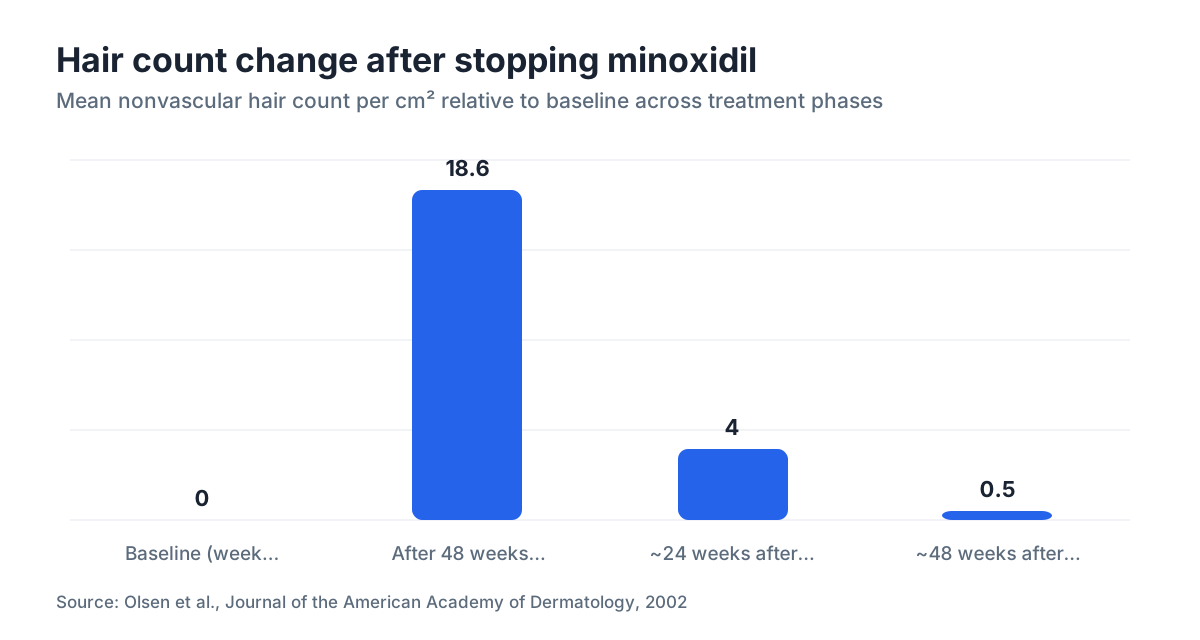
Most people see noticeable shedding within 3 months of stopping, with the majority of regrown hair gone by 6 months [2]. This is sometimes called a "rebound shed" though that phrase overstates it slightly. What you're really seeing is your hair returning to its baseline trajectory, not an accelerated loss beyond where you would have been anyway.
Some people are genuinely surprised by how quickly it happens. You might spend 12 months coaxing back coverage over your crown, then watch it thin back out in a fraction of the time. The follicles weren't repaired. They were just responding to a signal that's now gone.
A small minority of users report keeping some gains after stopping, particularly if they stopped at a point where their underlying hair loss had naturally stabilized, or if they addressed the root cause with another treatment like finasteride. But if you're relying on minoxidil alone, plan to use it long-term or plan to lose what you gained.
Why does minoxidil require lifelong use in the first place?
Minoxidil was originally developed as an oral blood pressure drug. Researchers noticed that patients taking it grew unwanted body hair, which led to the topical formulation for the scalp [3]. The FDA approved 2% topical minoxidil for men in 1988, and 5% in 1997 [1].
The mechanism is still not fully understood. The leading theory is that minoxidil opens ATP-sensitive potassium channels in follicle cells, which dilates blood vessels and prolongs the anagen growth phase. What it doesn't do is block dihydrotestosterone (DHT), the androgen responsible for genetic hair loss in most men and many women [4]. So the cause of loss keeps running in the background the entire time you're using it.
Think of it like a pump keeping water out of a basement. While the pump runs, the basement stays dry. Turn off the pump, the water comes back. The crack in the foundation is still there.
This is also why combining minoxidil with a DHT blocker like finasteride tends to work better than either drug alone. Finasteride addresses the hormonal cause; minoxidil addresses the follicle response. If you stop minoxidil while continuing finasteride, you may lose some ground but you won't lose everything, because the underlying driver is still being managed.
What does the clinical evidence actually say about stopping?
The clearest discontinuation data comes from the original FDA approval studies. After 48 weeks of treatment with 5% topical minoxidil, hair counts were significantly higher than baseline. When subjects stopped, they returned to baseline or below within roughly 3 to 6 months [2].
A 2022 study published in the Journal of the American Academy of Dermatology followed men using oral minoxidil (0.25 mg to 5 mg daily) and found similar maintenance-dependent patterns [5]. The researchers concluded that continued use was necessary to maintain results, consistent with the topical data.
A 2016 Cochrane systematic review of minoxidil for alopecia found that treatment effects are not maintained after cessation of therapy [6]. That language is about as unambiguous as clinical literature gets.
Nobody has good long-term data on what happens if you stop after, say, 10 or 15 years of use. The closest studies suggest the same pattern: loss of maintained hair within months. There's no evidence that years of use "trains" follicles to continue growing on their own.
Here's one number worth keeping in your head: in the original approval trials, 5% minoxidil produced an average increase of 18.6 nonvascular hairs per cm² at 48 weeks compared to placebo [2]. That gain is real. Stopping gives it back.
Are there any situations where stopping minoxidil makes sense?
Yes, and it's worth being honest about this rather than just saying "use it forever."
If you experience significant side effects, stopping is reasonable. These can include scalp irritation, unwanted facial hair growth (especially with topical minoxidil, from drips onto the forehead), and with oral minoxidil, fluid retention and heart rate changes [7]. Talk to a doctor before stopping if you're on oral minoxidil, since systemic effects are more meaningful than topical ones. See our minoxidil side effects guide for a full breakdown.
If you've had a hair transplant and your transplanted follicles are well-established (typically 12 to 18 months post-procedure), your surgeon may say you can taper off or stop. Transplanted follicles are generally DHT-resistant because they're taken from the back and sides of the scalp. Your non-transplanted native hair can still thin, though, so many surgeons recommend continuing minoxidil on non-transplanted areas.
If your hair loss has genuinely stabilized with age and the underlying process has slowed, stopping may result in less dramatic loss than if you were still in an active loss phase. But you're still likely to lose the maintained gains.
Some people decide the daily commitment isn't worth it for the results they're seeing. That's a legitimate personal choice. Going in with clear expectations is what matters.
How do you taper off minoxidil without making the shedding worse?
There's no well-studied tapering protocol in the clinical literature. Most dermatologists who address this will say that tapering doesn't meaningfully change the eventual outcome but may smooth the shed over a longer period.
A common informal approach: reduce application frequency from once daily (or twice daily) to every other day for 4 to 6 weeks, then every third day, then stop. Whether this actually reduces the peak shed compared to cold-turkey stopping isn't established by controlled trials. The follicles will still eventually catch up to where they would have been.
What you should not do is read the initial shed after stopping as proof something is seriously wrong. Telogen effluvium, the technical name for diffuse shedding triggered by a change in the hair cycle, is a predictable part of what happens after stopping minoxidil. The follicles that were held in anagen are now cycling through telogen. It looks alarming. It's expected.
If you're stopping in order to switch to a different treatment, timing matters. Starting finasteride before or at the same time as stopping minoxidil gives the finasteride time to start suppressing DHT while the minoxidil taper happens. Ask a dermatologist about sequencing if you're making a treatment change.
What's the difference between topical and oral minoxidil for long-term use?
Both formulations require continued use to maintain results. The discontinuation behavior is the same. The difference is practical: oral minoxidil is a pill, topical is a liquid or foam you apply to your scalp.
Oral minoxidil at low doses (0.25 mg to 5 mg daily) has gained attention because it's easier to apply consistently and may reach miniaturizing follicles more evenly across the scalp. The tradeoff is systemic exposure: cardiovascular effects including fluid retention and increased heart rate are real concerns at higher doses, which is why it's used off-label and requires a doctor's prescription [5].
Topical minoxidil (2% or 5% solution, 5% foam) is available over the counter in the US for androgenetic alopecia [1]. The systemic absorption is much lower, making the cardiovascular risk profile milder. The practical problem is that applying a liquid or foam to your scalp daily is a habit that many people find hard to maintain consistently.
For long-term commitment, compliance matters more than you'd think. A 2021 survey in the Journal of Cosmetic Dermatology found adherence rates to topical minoxidil below 50% at 12 months in real-world settings, largely because of the application burden. A pill people actually take daily may outperform a topical people forget half the time, regardless of the pharmacological equivalence.
If you're deciding between them for a lifelong regimen, talk to a doctor about your cardiovascular history first. See the minoxidil for men overview for a side-by-side on the formulations.
| Topical Minoxidil | Oral Minoxidil | |
|---|---|---|
| Prescription needed? | No (OTC in US) | Yes (off-label) |
| Typical dose | 1 mL 5% solution or 1/2 cap foam, 1-2x daily | 0.25 mg to 2.5 mg daily (low-dose) |
| Main side effect concern | Scalp irritation, facial hair | Fluid retention, heart rate changes |
| Systemic absorption | Low | Higher |
| Application burden | High (daily scalp application) | Low (one pill) |
| Stops working if discontinued? | Yes | Yes |
Does minoxidil work better when combined with other treatments?
Usually, yes. Using minoxidil alongside finasteride is the most studied combination for male androgenetic alopecia. A 2003 trial published in Dermatology compared finasteride alone, minoxidil alone, and the combination. The combination group saw the greatest hair count increase at 12 months, though the difference between finasteride alone and the combination was smaller than many expect [8].
The practical upside of combining: if you ever need to stop minoxidil (side effects, cost, fatigue with the regimen), you have finasteride as a floor. You'll still lose the minoxidil-specific gains, but finasteride will keep slowing the underlying DHT-driven loss. Some people find this a more sustainable strategy than trying to maintain both drugs indefinitely. You can read more about this approach in our finasteride and minoxidil breakdown.
For women, finasteride is less commonly prescribed (it's contraindicated in pregnancy), so minoxidil often carries more of the treatment load. Spironolactone is sometimes used as an alternative antiandrogen for women with hormonal hair loss. The same discontinuation principle applies: stop the active treatment, lose the maintained results.
Low-level laser therapy (LLLT) is sometimes used as an adjunct, though the evidence base is weaker than for minoxidil or finasteride. It won't save you from the shed after stopping minoxidil.
If you want an honest sense of where your hair loss stands before committing to any regimen, the free AI scan at MyHairline can map your current pattern, which at least gives you a baseline to measure any treatment against.
How long does it take minoxidil to work, and when should you expect to see results?
The first 3 months are often discouraging. Many people notice a shed in the first 4 to 8 weeks of starting minoxidil. This is the same mechanism as the post-cessation shed, but in reverse: minoxidil pushes resting hairs into the growth phase, and they have to push out the old telogen hairs first. It's counterintuitive and it scares people off.
Real growth typically becomes visible between months 4 and 6. In the FDA approval studies, meaningful hair count increases were measurable at 16 weeks, with peak results at around 48 weeks (one year) of continuous use [2].
If you've seen no improvement at all by 12 months, you may be a non-responder. Estimates vary, but roughly 30 to 40% of users don't see significant cosmetic improvement from minoxidil alone [1]. Non-response seems to correlate with more advanced hair loss, older age, and the absence of any additional treatment targeting DHT.
Patience matters here. People who quit at month 2 because of the initial shed are cutting off treatment before it has any chance to work. The patients who do best are usually the ones who stay consistent for a full year before evaluating.
What's the real cost of using minoxidil for life?
Generic topical minoxidil is cheap. You can find a 3-month supply of 5% solution for $15 to $30 at most pharmacies or online. That's roughly $60 to $120 a year, which over 10 years is $600 to $1,200. Not trivial but not ruinous.
The foam formulation costs more, usually $25 to $40 per month for the brand-name Rogaine, though generics have closed that gap significantly.
Oral minoxidil requires a prescription and the associated doctor visit cost. The drug itself is cheap (it's been generic for decades as a blood pressure medication), but the prescription process adds friction and cost that varies by country and insurance status.
Add finasteride and you're looking at another $10 to $30 per month for the generic, plus the prescription. So a combined regimen might run $100 to $200 a year on the low end, more if you're using branded products or paying out of pocket for doctor visits.
Compare that to a hair transplant: $4,000 to $15,000 or more depending on graft count and surgeon, with no guarantee you won't still need medication to maintain non-transplanted hair [9]. Most people who get transplants continue some form of medical therapy anyway.
The financial case for continuing minoxidil is actually pretty strong when you put it in those terms. The bigger cost is time and habit.
Is it safe to use minoxidil every day for years or decades?
The long-term safety profile of topical minoxidil is generally reassuring. The drug has been on the market since 1988, which means there's 35-plus years of real-world exposure data. The FDA label lists scalp irritation, itching, and unwanted facial hair as the main topical concerns [1]. Serious systemic effects from topical use are rare, though not impossible if you're applying to a damaged or broken scalp barrier.
Oral minoxidil has a more complex safety picture. At the high doses used for hypertension (10 mg to 40 mg daily), cardiovascular effects including pericardial effusion and serious fluid retention are documented [3]. At the low doses used for hair loss (0.25 mg to 5 mg), these risks appear to be much lower based on the existing data, but decades-long safety data at hair-loss doses simply doesn't exist yet because widespread off-label use at low doses is a relatively recent practice [5].
People with cardiovascular disease, low blood pressure, or kidney disease should be especially careful with oral minoxidil and should absolutely have a doctor monitor them. For most healthy adults using topical minoxidil, decades of use appears safe based on available evidence, but no one can honestly say "definitely safe forever" because that kind of data doesn't exist for any drug.
Annual check-ins with a dermatologist are a reasonable approach for anyone on long-term hair loss treatment. They can catch scalp issues early and adjust your regimen if your situation changes.
Are there permanent alternatives so you don't have to use minoxidil forever?
The most durable alternative is a hair transplant. Follicles moved from the donor zone (the back and sides of the scalp, which are genetically DHT-resistant) to thinning areas keep their donor characteristics. That hair is permanent in the sense that those specific follicles won't miniaturize due to DHT. The native hair around and behind the transplant can still thin, though, so many transplant patients continue some medical therapy post-procedure.
Finasteride isn't a permanent fix but it attacks the cause rather than the symptom. Some men on finasteride for 5 or 10 years report stable hairlines without needing minoxidil. The evidence for finasteride maintaining hair long-term is solid: the original 5-year study showed continued benefit in most men who stayed on it [10]. But stop finasteride and the underlying DHT-driven loss resumes.
There is no FDA-approved treatment that permanently stops androgenetic hair loss without ongoing use. Stem cell therapies, exosomes, and platelet-rich plasma (PRP) are being studied but none have the evidence base to replace established treatments as of 2026 [11].
If permanent alternatives interest you, understanding your exact pattern and how far it's progressed helps you make a more realistic plan. The receding hairline guide walks through Norwood staging, which affects what's actually achievable with different approaches.
Minoxidil is genuinely useful. It's just not a one-and-done solution, and anyone who tells you otherwise is either misinformed or selling something.
Sources
- FDA, Rogaine (minoxidil) Drug Label
- Olsen EA et al., Journal of the American Academy of Dermatology, 2002 (5% minoxidil vs placebo in men)
- NIH, National Library of Medicine, Minoxidil drug profile
- American Academy of Dermatology, Hair Loss: Diagnosis and Treatment
- Randolph M, Tosti A, Journal of the American Academy of Dermatology, 2022 (oral minoxidil review)
- van Zuuren EJ et al., Cochrane Database of Systematic Reviews, 2016 (interventions for alopecia areata)
- FDA MedWatch, Minoxidil topical adverse events
- Leyden J et al., Dermatology, 2003 (finasteride plus minoxidil vs either alone)
- International Society of Hair Restoration Surgery, Practice Census 2023
- Kaufman KD et al., Journal of Investigative Dermatology, 1998 (5-year finasteride study)
- NIH National Institute of Arthritis and Musculoskeletal and Skin Diseases, Hair Loss overview