

TL;DR: The most evidence-backed solutions for female hair loss are topical minoxidil 2% or 5% (FDA-approved), low-level laser therapy, and off-label oral minoxidil or finasteride for androgenetic alopecia. Fixing an underlying cause, such as iron deficiency or thyroid dysfunction, often works better than any topical treatment. No single solution works for every pattern or cause.
What is female hair loss and how common is it really?
Female-pattern hair loss affects roughly 40% of women by age 50, according to the American Academy of Dermatology [1]. That number surprises most people because women rarely go fully bald the way men do, so the condition stays invisible longer. The hair thins across the top and crown, the part widens, and the ponytail gets thinner, but the frontal hairline usually holds.
Hair loss in women is not one condition. It's a symptom. A dermatologist can identify at least a dozen distinct diagnoses that all produce shedding or thinning, and the right solution depends entirely on which one you have. Treating androgenetic alopecia with iron supplements does nothing. Treating iron-deficiency shedding with minoxidil is treating the wrong thing. Getting the diagnosis right is step one, and it matters more than choosing between products.
For a broader look at what causes hair loss across both sexes, that article covers the shared biology in more depth.
What causes female hair loss? The main triggers you need to rule out
The causes of female hair loss fall into a few overlapping buckets, and more than one can be active at the same time.
Androgenetic alopecia (AGA): This is hereditary thinning driven by dihydrotestosterone (DHT) sensitivity in the hair follicle. Women have it too, though the pattern differs from men's. Hair miniaturizes progressively, mostly over the crown and top of the scalp. DHT blockers can slow this process.
Telogen effluvium: A sudden large shed, typically 2 to 4 months after a physiological stress, such as childbirth, crash dieting, surgery, severe illness, or a major emotional shock. Shedding can look alarming, 200 to 400 hairs a day versus a normal 50 to 100, but it usually reverses once the trigger resolves. See a fuller explanation at telogen effluvium.
Nutritional deficiencies: Iron is the big one. Ferritin levels below 30 ng/mL are associated with increased shedding in some studies, though the cutoff is debated [2]. Zinc, vitamin D, and B12 deficiencies also appear in the hair loss literature, but the evidence for supplementing beyond correcting a true deficiency is weak.
Thyroid dysfunction: Both hypothyroidism and hyperthyroidism can cause diffuse shedding. A basic TSH test catches most cases.
Hormonal shifts: Polycystic ovary syndrome (PCOS), perimenopause, stopping hormonal contraceptives, and postpartum hormonal changes all alter the androgen-to-estrogen ratio enough to trigger shedding or AGA progression.
Scalp inflammation and scarring alopecias: Conditions like lichen planopilaris and frontal fibrosing alopecia destroy follicles permanently if untreated. These are less common but important to catch early because topical minoxidil does nothing for a follicle that's already scarred over.
Rapid female hair loss causes deserve specific mention: if you're losing a lot of hair fast, the most common reasons are telogen effluvium from a recent stressor, a newly diagnosed thyroid problem, or a medication side effect. A blood panel (CBC, ferritin, TSH, free T4, and androgens if PCOS is suspected) is the most efficient first step.
How do doctors diagnose which type of hair loss you have?
A dermatologist or trichologist will typically combine a scalp examination with a pull test (gently tugging 40 to 60 hairs to count how many release), dermoscopy (a magnified view of the scalp and follicle openings), and targeted blood work.
The blood panel worth asking for: serum ferritin, complete blood count, TSH, free T4, total and free testosterone, DHEA-S, and vitamin D. Some dermatologists add prolactin if there's reason to suspect a pituitary cause. None of these are exotic or expensive.
A punch biopsy of the scalp is the gold standard for distinguishing scarring from non-scarring alopecia, though most cases don't require one. If your dermatologist can see follicle openings on dermoscopy, scarring is probably not present.
Skipping diagnosis and going straight to buying products is the most common and most expensive mistake. A $50 lab panel can tell you more than six months of trial-and-error with topicals.
Which female hair loss solutions are FDA-approved?
Exactly two treatments carry FDA approval specifically for female-pattern hair loss: topical minoxidil and low-level laser therapy (LLLT) devices.
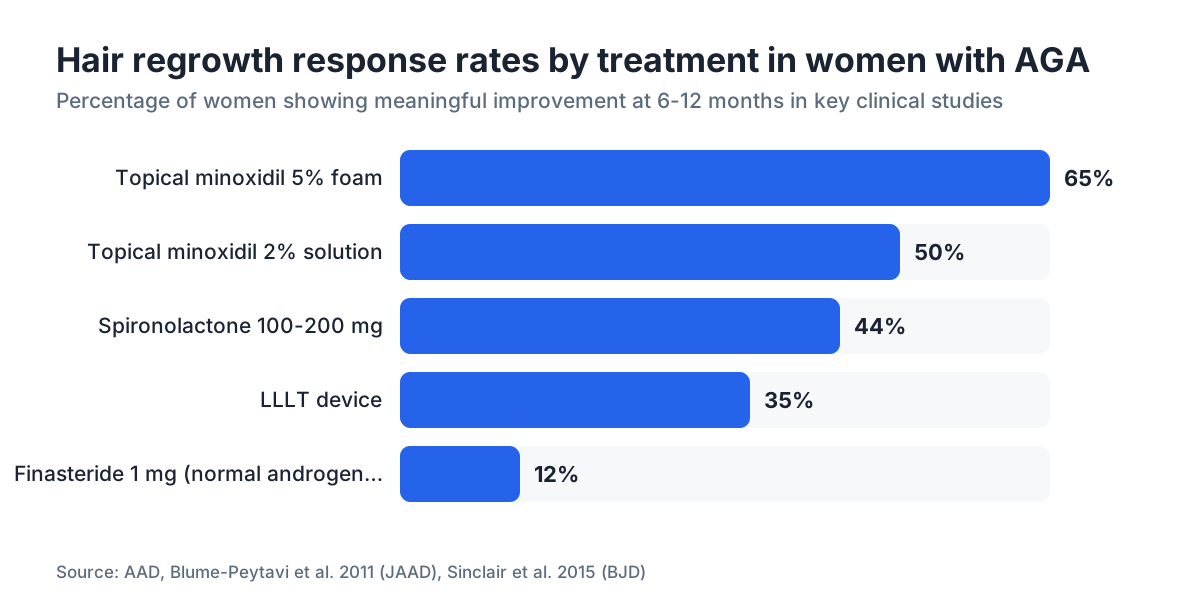
Topical minoxidil: The FDA cleared 2% minoxidil solution for women in 1991 and the 5% foam formulation was later approved as well [3]. The 5% foam is approved for once-daily use in women; the 2% solution is approved for twice daily. Clinical trials show the 5% foam produces statistically significant increases in hair count versus placebo. In one key trial, 5% foam applied once daily outperformed 2% solution twice daily, with 18.6 new non-vellus hairs per cm² versus 12.7 after 24 weeks [4].
The mechanism is not fully understood, but minoxidil extends the anagen (growth) phase and may increase follicle diameter. It does not block DHT. You have to keep using it or the benefit reverses within a few months. For a detailed look at unwanted effects, read about minoxidil side effects.
Low-level laser therapy (LLLT): Several devices (helmets, combs, caps) are FDA-cleared as medical devices for hair growth. The 2009 study supporting the HairMax LaserComb found statistically significant terminal hair density improvements versus sham device in women with AGA [5]. Effect sizes are modest compared with minoxidil, but LLLT has essentially no systemic side effects, which matters if you're sensitive to medications.
Everything else, including finasteride, spironolactone, platelet-rich plasma (PRP), and oral minoxidil, is used off-label or is not FDA-approved specifically for female hair loss, though some have solid supporting evidence.
Does minoxidil work for women, and what should you expect?
Minoxidil works for androgenetic alopecia in women, with meaningful evidence behind it. Realistic expectations matter, though.
You will almost certainly shed more hair for the first 4 to 8 weeks after starting. This is called minoxidil-induced shedding: the drug pushes resting hairs out to make room for new growth. It's temporary, but it's alarming if you don't know it's coming, and it's the single biggest reason women stop treatment too early.
Actual regrowth or stabilization takes 4 to 6 months to assess. Dermatologists typically say give it a full year before deciding it isn't working. At the one-year mark in clinical trials, roughly half to two-thirds of women using 5% minoxidil see meaningful improvement in hair count or density [4].
Topical minoxidil can cause facial hypertrichosis (fine hair growth on the face) in some women, particularly with the 5% solution. Using the foam formulation and applying it only at night, letting it dry before your head touches a pillow, reduces facial transfer. The 2% solution has a lower rate of this side effect.
Oral minoxidil at low doses (0.25 mg to 1.25 mg daily in women) is being used increasingly off-label and some dermatologists prefer it because adherence is better and scalp coverage is more consistent. The side effect profile differs; fluid retention and unwanted body hair are the main concerns at higher doses.
Can women use finasteride or spironolactone for hair loss?
Both are used off-label in women, and both have real evidence, but neither is FDA-approved for hair loss in women.
Finasteride: At 1 mg/day, finasteride showed no significant benefit versus placebo in postmenopausal women in the 1999 Leyden trial [6]. That trial is the one everyone cites when they say finasteride doesn't work in women. But later work using higher doses (2.5 mg to 5 mg) and focusing on premenopausal women with documented hyperandrogenism told a different story. A 2020 systematic review in the Journal of the American Academy of Dermatology found that finasteride at doses of 2.5 mg or higher produced significant improvements in hair density in women with AGA, particularly those with elevated androgens [7]. Finasteride carries a pregnancy category X label; it must not be used in women who are or may become pregnant [3]. Read more about finasteride.
Spironolactone: An aldosterone antagonist that also blocks androgen receptors. It's widely used in women with AGA, particularly those with PCOS. Typical doses range from 100 mg to 200 mg daily. A 2015 retrospective study found that 44% of women treated with spironolactone for AGA experienced improvement, 44% stabilized, and only 12% continued to worsen [8]. It requires potassium monitoring and is contraindicated in pregnancy.
The combination angle: Some dermatologists combine topical minoxidil with oral spironolactone or finasteride for women with AGA. See the logic behind finasteride and minoxidil used together, though most of that evidence is in men.
If you're premenopausal and your blood work shows normal androgens, the yield from anti-androgen therapy is lower. If androgens are elevated, it's often the first thing worth treating.
What about PRP, hair transplants, and other procedural options?
Procedural options sit in a different category from daily medications: higher up-front cost, less commitment to daily use, but results that aren't guaranteed either.
Platelet-rich plasma (PRP): The scalp is injected with concentrated growth factors drawn from your own blood. A 2019 meta-analysis in Aesthetic Surgery Journal found statistically significant improvements in hair density after PRP treatment for AGA [9]. Effect sizes vary a lot between studies, protocols differ widely (number of sessions, centrifuge speed, injection depth), and there's no standardized technique. Three sessions spaced 4 to 6 weeks apart, followed by maintenance every 6 to 12 months, is a common protocol. Cost runs roughly $500 to $2,000 per session, so it adds up fast. The evidence is promising but not conclusive.
Hair transplants: Follicular unit extraction (FUE) can work well for women with stable AGA where there's a clear, defined area of loss and a healthy donor zone. The problem is that diffuse thinning, which is the typical female pattern, often doesn't leave a clean donor area. A surgeon will want to see that your donor hair is stable and that the thinning pattern is predictable. Women with scarring alopecias can also benefit from transplants once the underlying inflammation is controlled. Read the full breakdown at hair transplant.
Microneedling: Dermarolling the scalp (0.5 mm to 1.5 mm depth) is thought to stimulate growth factors and improve minoxidil penetration. A 2013 randomized trial found significantly greater hair count improvement in the group using minoxidil plus microneedling versus minoxidil alone [10]. It's low cost and low risk, which makes it a reasonable add-on, not a standalone treatment.
Hair loss supplements: Biotin, saw palmetto, and various blend products are marketed heavily. The honest summary: biotin supplementation has no good evidence for hair growth unless you have a true biotin deficiency, which is rare. Saw palmetto has weak evidence for mild DHT inhibition. Nutrafol and similar products contain several ingredients with minor supporting data but no large randomized trials. More detail at hair loss supplements. Supplements are not FDA-approved to treat hair loss.
How do the main female hair loss solutions compare?
Here's an honest side-by-side of the approaches with the most evidence:
| Treatment | FDA status | Evidence level | Monthly cost (approx.) | Key limitation |
|---|---|---|---|---|
| Topical minoxidil 5% foam | FDA-approved for women | Strong (multiple RCTs) | $20 to $50 | Must use indefinitely; facial hair risk |
| Oral minoxidil (0.25-1.25 mg) | Off-label | Growing (RCTs emerging) | $10 to $30 | Fluid retention, body hair at higher doses |
| Spironolactone 100-200 mg | Off-label | Moderate (retrospective + RCTs) | $15 to $40 | Contraindicated in pregnancy; potassium monitoring |
| Finasteride 2.5-5 mg | Off-label | Moderate (mixed RCT data) | $20 to $60 | Contraindicated in pregnancy; better with elevated androgens |
| LLLT device | FDA-cleared | Modest (RCT, small effects) | $0 after device cost ($200-$800) | Small effect size; compliance needed |
| PRP injections | Not FDA-approved | Promising, inconsistent | $500 to $2,000/session | No standardized protocol; expensive |
| Hair transplant | Surgical, not drug-regulated | Strong for right candidates | $4,000 to $15,000 one-time | Diffuse thinning often not a good candidate |
| Microneedling + minoxidil | Not FDA-approved standalone | RCT support as add-on | $0 to $100/month DIY | Benefit is enhancement, not standalone |
Cost ranges are approximate US retail/procedure averages as of 2025 and will vary by region, provider, and brand.
What should women with postpartum hair loss actually do?
Postpartum hair loss is almost always telogen effluvium, not permanent AGA. During pregnancy, elevated estrogen keeps more hairs in the growth phase simultaneously. After delivery, estrogen drops sharply and those hairs enter telogen together, then shed 2 to 4 months later. It's a normal physiological process, not a sign of permanent damage.
The shed typically peaks around 3 to 6 months postpartum and resolves on its own by 12 months in most women [1]. No medication is required. What does help: making sure ferritin is not depleted (pregnancy draws heavily on iron stores), eating adequate protein, and managing sleep deprivation to the extent possible.
Starting minoxidil during this phase is not recommended by most dermatologists, partly because it's not approved for use during breastfeeding. Starting it and then stopping because you see improvement means going through another shedding cycle when you discontinue. If you're 12 months postpartum and still shedding significantly, that warrants evaluation for a separate underlying cause.
If your hair loss pattern before or during pregnancy looked like a widening part over the crown, that suggests underlying AGA that the pregnancy temporarily suppressed and postpartum revealed.
Are there hair loss solutions specifically for menopausal women?
Menopause is one of the most common triggers for AGA progression in women. Estrogen's protective effect on hair follicles diminishes, and the relative androgen effect increases even with no change in absolute androgen levels.
Hormone replacement therapy (HRT) is not a hair loss treatment and is not approved for that purpose, but some women notice stabilization of hair loss after starting HRT. The effect is indirect, through restoring estrogen balance rather than directly blocking DHT. Any HRT decision should be made based on the full risk-benefit picture with a physician, not primarily for hair.
For AGA in menopausal women, topical minoxidil remains the first-line FDA-approved option. Spironolactone is also widely used. Finasteride has better evidence in postmenopausal women than in premenopausal women because pregnancy is no longer a risk, which removes the biggest contraindication.
One structural issue: postmenopausal women often tolerate the 5% minoxidil concentration better than premenopausal women because body hair changes are less of a concern. The 1999 Leyden trial mentioned above that found finasteride ineffective was conducted entirely in postmenopausal women with normal androgen levels, which may explain the lack of effect. Women with elevated androgens from any cause appear to respond better [6].
Myhairline's free AI scan (/scan) can help you identify your likely hair loss pattern before deciding which treatments to discuss with your doctor.
What lifestyle and nutritional factors make the biggest difference?
This section is often underestimated because lifestyle changes don't cost $150 a month and don't come in a bottle with before-and-after photos. But they matter.
Iron: Get your ferritin checked, more than hemoglobin. You can be non-anemic with ferritin under 30 ng/mL and still be contributing to shedding [2]. Some dermatologists aim for ferritin above 70 ng/mL in women with hair loss, though the evidence for that specific threshold is observational, not from a controlled trial.
Protein: Hair is keratin, which is protein. Crash diets and very low-calorie eating are among the most reliable ways to trigger telogen effluvium. Aim for at least 0.8 g of protein per kg of body weight; more if you're actively trying to reduce overall calorie intake.
Thyroid: Even subclinical hypothyroidism (normal TSH but slightly low free T4) is associated with hair thinning in some women. Treatment of the thyroid condition is the solution here, not topical products.
Stress: Chronic psychological stress raises cortisol and can push follicles into telogen. This is real but hard to quantify. Hair loss from stress is usually diffuse and responsive to resolution of the stressor.
Scalp health: Significant seborrheic dermatitis or scalp psoriasis can worsen hair loss. Treating the scalp inflammation with appropriate shampoos or topicals is part of the picture.
Nobody has good data on whether specific diets beyond correcting deficiencies make a meaningful difference in hair growth. The Mediterranean diet has been associated with lower AGA risk in one observational study [2], but that's not a treatment trial.
How do you know if your hair loss treatment is working?
Most people try to judge progress by looking in the mirror and feeling their ponytail, which is unreliable. Hair growth cycles mean you won't see real change for months, and daily variation in how hair looks creates a lot of false signals.
The most reliable method is standardized photography: same lighting, same angle, same wet or dry status, every 3 months. A part-line photo from directly above is the most sensitive for female AGA. Some dermatologists do automated hair count analysis from trichoscopy images.
At-home assessment: count shed hairs for two separate mornings, before shampooing. More than 100 hairs on two separate counts suggests active shedding, though this is crude. Shampoo day counts are higher than non-shampoo day counts regardless of loss, so adjust accordingly.
Give any topical treatment at least 6 months before concluding it isn't working. Give oral treatments the same window. The exception is scarring alopecia, where inactivity of the inflammatory process should be confirmed within 3 to 6 months of starting treatment.
If you're unsure where your thinning falls on the spectrum, a baseline AI assessment through a tool like MyHairline's free scan can help you track changes and structure that conversation with a dermatologist.
Sources
- American Academy of Dermatology, Hair Loss Overview
- Rushton DH, Nutritional factors and hair loss, Clinical and Experimental Dermatology 2002
- FDA Drug Label, Rogaine (minoxidil) for Women
- Blume-Peytavi U et al., Journal of the American Academy of Dermatology, 2011
- Leavitt M et al., Journal of Clinical and Aesthetic Dermatology, 2009 (HairMax LaserComb RCT)
- Leyden J et al., Journal of the American Academy of Dermatology, 1999
- Iamsumang W et al., Journal of the American Academy of Dermatology, 2020 systematic review
- Sinclair R et al., British Journal of Dermatology, 2015
- Giordano S et al., Aesthetic Surgery Journal, 2018 meta-analysis on PRP for AGA
- Dhurat R et al., International Journal of Trichology, 2013
- National Institutes of Health, MedlinePlus, Androgenetic Alopecia