

TL;DR: Female pattern hair loss (FPHL) is a hereditary, androgen-influenced condition that thins the crown while the frontal hairline mostly holds. It affects roughly 6% of women under 50 and up to 38% by age 70. Topical minoxidil 2% is the only FDA-approved treatment for women. Spironolactone and finasteride are used off-label with real evidence behind them.
What is female pattern hair loss?
Female pattern hair loss (FPHL) is the most common cause of hair loss in women. It's a slow, non-scarring thinning that concentrates on the crown and top of the scalp, driven by genetic predisposition and sensitivity to androgens like dihydrotestosterone (DHT). Unlike male pattern baldness, the frontal hairline usually stays intact, at least early on.
Without treatment, the shed hair doesn't grow back on its own once follicles miniaturize. But it's not a cliff-edge event. Thinning happens over years or decades, which is actually good news: there's almost always a real window to intervene.
FPHL is distinct from telogen effluvium, a temporary, diffuse shed triggered by stress, illness, or nutritional deficiency. The two can overlap, and some women have both at once, which is part of why getting a proper diagnosis matters before spending money on treatment. A dermatologist can usually tell them apart with a scalp exam, pull test, and targeted blood work. [1]
How common is female pattern hair loss?
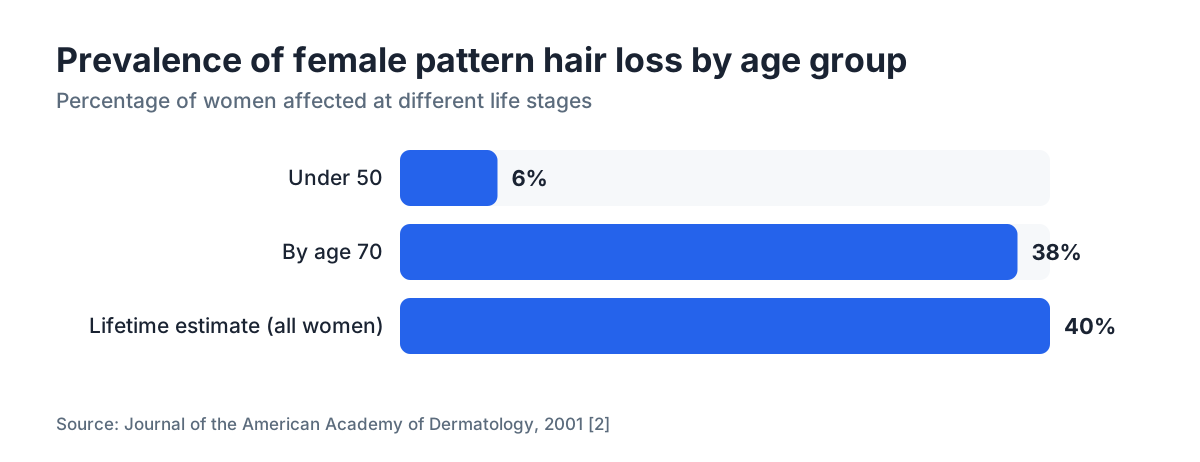
More common than most people realize. A 2001 population study published in the Journal of the American Academy of Dermatology found FPHL affects roughly 6% of women under 50, rising to about 38% by age 70 [2]. Other estimates put lifetime prevalence closer to 40%, depending on how you define clinically significant thinning.
Those numbers matter because FPHL is chronically underdiagnosed. Women often assume diffuse shedding is hormonal, stress-related, or from iron deficiency. All of those are worth ruling out, but FPHL frequently gets dismissed or goes untreated for years. By the time a woman is diagnosed, miniaturization may already be advanced in certain zones.
Race appears to influence prevalence. Studies suggest FPHL is more common in white women than in Asian or Black women, though the data here is thin and likely reflects differences in dermatology access as much as true biology. The underlying causes of hair loss across populations are still being studied.
What causes female pattern hair loss?
Genetics is the main driver. If your mother, grandmother, or maternal aunts had significant thinning, your risk is meaningfully higher. FPHL is polygenic, meaning many genes contribute, and it can come from either parent's side.
Androgens, specifically DHT, are the other key piece. DHT binds to androgen receptors in susceptible follicles and shortens the growth phase (anagen), so hairs get finer and shorter before eventually stopping. Here's the counterintuitive part: most women with FPHL have completely normal androgen levels on a blood test. Their follicles are simply more sensitive to DHT than average. [3]
That said, some women with FPHL do have elevated androgens, often from polycystic ovary syndrome (PCOS). If you have FPHL along with irregular periods, acne, or unwanted facial hair, ask your doctor to check androgen levels. Treating the underlying hormone imbalance can help the hair too.
Menopause is a common trigger. Estrogen protects hair follicles, and as estrogen falls after menopause, the relative androgenic environment shifts, which can speed up FPHL in genetically predisposed women. This is one reason FPHL gets diagnosed so often in women over 50, even when the susceptibility was always there. [4]
For a closer look at how DHT drives follicle miniaturization, see our piece on DHT blockers.
What are the stages of female pattern hair loss (Ludwig scale)?
The Ludwig classification, described by Dr. Erich Ludwig in 1977, is the standard staging system for FPHL [5]. It has three grades:
| Ludwig Stage | What you see |
|---|---|
| Stage I | Mild thinning at the part line and crown; hairline intact; easy to camouflage with styling |
| Stage II | Wider part, more visible scalp on top; moderate diffuse thinning across the crown |
| Stage III | Extensive thinning on crown with visible scalp; frontal hairline often preserved but scalp clearly visible |
A separate, less commonly used system called the Sinclair scale uses a 1-5 grading and is slightly better validated for clinical research. The Hamilton-Norwood scale used for men doesn't map well to female hair loss because the pattern differs.
Knowing your stage matters for treatment. Stage I and early Stage II respond best to medical therapy. Stage III, where many follicles may have permanently miniaturized, can need a combination of medical treatment and a hair transplant to restore meaningful density. A dermatologist or trichologist can stage you accurately, which is hard to do on your own in a mirror.
How do you tell FPHL apart from other types of hair loss?
The pattern is the tell. FPHL produces a characteristic "Christmas tree" shape on the frontal scalp: a central part that widens toward the front and narrows toward the crown. Dermoscopy (looking at the scalp under magnification) shows follicle miniaturization and variation in hair shaft diameter, the hallmarks of FPHL. [1]
Contrast this with alopecia areata, which causes patchy, round bald spots, or traction alopecia, which follows the hairline and temples in women who wear tight hairstyles. Frontal fibrosing alopecia is a scarring condition that retreats the entire frontal and temporal hairline in a band, something FPHL doesn't do.
Blood tests to rule out other contributors typically include a complete blood count, ferritin (iron stores), thyroid function (TSH), vitamin D, and sometimes sex hormones (total and free testosterone, DHEAS, prolactin). A normal panel doesn't rule out FPHL. It rules in the diagnosis by exclusion. You don't need a biopsy unless the diagnosis is genuinely uncertain.
Which treatments actually work for female pattern hair loss?
Minoxidil topical solution 2% is the only treatment with FDA approval specifically for women with FPHL. In a randomized controlled trial of 256 women, the 2% topical solution produced significantly more regrowth than placebo after 32 weeks [6]. The 5% foam, FDA-approved for men, is used off-label in women and may work better in some, but it carries a higher risk of unwanted facial hair, so many women start with 2%.
Minoxidil doesn't regrow hair by blocking DHT. It's a vasodilator that stretches out the anagen (growth) phase and is thought to open potassium channels in follicle cells. You apply it to a dry scalp once or twice daily and need to keep using it. Stop, and the hair you gained returns to baseline within a few months.
Before starting, read up on minoxidil side effects so you know what to expect, including the initial shed that often hits in weeks 2 to 4 (normal and temporary).
Spironolactone (off-label) is an anti-androgen diuretic that blocks androgen receptors in hair follicles. It's commonly prescribed at 100 to 200 mg/day for FPHL and is useful in women with elevated androgens or PCOS-associated loss. A 2020 retrospective study in JAAD found 74% of women with FPHL reported improvement on spironolactone [7]. It's not FDA-approved for hair loss but has decades of use in dermatology.
Finasteride (off-label) blocks the enzyme that converts testosterone to DHT. It's FDA-approved for men but used off-label in postmenopausal women. Pre-menopausal women should avoid it or use strict contraception because of fetal risk. The evidence in women is real but thinner than in men. A meta-analysis found finasteride improved FPHL scores in postmenopausal women, though less dramatically than in men. [8] See our full article on finasteride for the complete picture.
Oral minoxidil (off-label) at low doses (0.25 to 1.25 mg/day) has drawn heavy research attention lately. A 2021 randomized trial by Rossi et al. showed low-dose oral minoxidil produced greater hair density improvement than topical 2% minoxidil in women with FPHL. The side effect profile at low doses is generally manageable, though fluid retention and increased body hair are possible. [9] More on this in our oral minoxidil guide.
Low-level laser therapy (LLLT) devices have FDA clearance (not approval) as cosmetic devices for hair growth. The evidence base is growing but still modest; a 2014 randomized trial found increased hair count versus a sham device over 26 weeks. Most dermatologists rank it behind minoxidil and anti-androgens, but it works as an add-on.
Can combining treatments get better results?
Yes, and this is how many dermatologists approach moderate-to-advanced FPHL. Topical minoxidil works on follicle biology from one angle (prolonging anagen), while an anti-androgen like spironolactone attacks DHT sensitivity from another. The two aren't redundant.
The combination of finasteride and minoxidil has strong evidence in men and is increasingly studied in women, especially post-menopausal women. Adding LLLT as a third layer is common practice, though the extra benefit is harder to pin down.
Platelet-rich plasma (PRP) injections have a growing evidence base for FPHL. The theory: growth factors in concentrated platelets wake up dormant follicles. Randomized trials are genuinely positive, though effect sizes vary and the treatment is expensive (typically $600 to $1,500 per session, often needing 3 or more sessions). Insurance doesn't cover it.
Supplements get marketed hard for hair loss. The honest answer is they work if you have a specific deficiency (iron, zinc, biotin). If your levels are normal, there's little evidence that piling on more helps. Our hair loss supplements article covers what the trials actually show.
Is hair transplant an option for women with FPHL?
It can be, with important caveats. Transplants relocate follicles from a donor area at the back and sides of the scalp (the zone less sensitive to DHT) into the thinning crown. In men with pattern hair loss, the donor area is stable, which is why transplants work well.
In women with FPHL, the donor area itself can be affected by diffuse thinning, which drops donor follicle quality and makes results less predictable. A transplant surgeon needs to check donor density carefully before recommending surgery. Women with Ludwig Stage II-III who have a stable, dense donor area and have already maximized medical therapy are reasonable candidates.
With the right candidate selection, transplants for women can produce excellent results. But the first question a good surgeon asks is whether you've tried medical therapy long enough. Transplanting into a scalp with ongoing, uncontrolled miniaturization means the transplanted hairs survive while surrounding native hairs keep thinning. The full picture is in our hair transplant guide.
Do female celebrities with hair loss talk about it?
Some do, and the conversations matter because they push back on the cultural silence around female hair loss.
Wilmer Valderrama's partner and several public figures have spoken about postpartum shedding. Kristin Davis has talked about thinning hair. Naomi Campbell has openly discussed traction alopecia from years of tight hairstyles and weaves. Tyra Banks has talked about hair loss. Jada Pinkett Smith disclosed her alopecia areata diagnosis publicly in 2018, saying she had to make peace with it, and her openness brought mass attention to the condition, though alopecia areata is distinct from FPHL.
The common thread: hair loss causes real psychological distress in women. A 2012 study in the British Journal of Dermatology found women with FPHL scored significantly lower on quality-of-life measures than men with comparable hair loss [10]. Women are socialized to tie hair to femininity in ways men often aren't, which makes the emotional weight of FPHL genuinely significant, not a vanity issue.
If you're unsure where your thinning falls on the spectrum, the free AI scan at MyHairline can map your current hairline and flag early signs of pattern loss before you spend money on treatments.
What does a realistic treatment timeline look like?
Slow is the honest answer. Hair growth cycles run roughly 3 to 6 months, which is why every legitimate hair loss treatment needs at least 6 months before you can judge whether it's working. Most dermatologists want 12 months of consistent use.
With topical minoxidil 2%, the FDA-approved course studied in the key registration trial ran 32 weeks. Many women see the most improvement between months 4 and 12. The initial shed in weeks 2 to 6 is a known phenomenon, not a sign the treatment is failing.
Spironolactone typically needs 6 to 12 months before you see meaningful density changes, because you're slowing a process rather than rapidly stimulating regrowth.
Tracking progress at home works best with standardized photos under consistent lighting. Take a top-down shot and a photo of the part line every month. The changes are subtle enough that month-to-month comparison is discouraging. Compare month 1 to month 12, and that's where you'll see it.
PRP results are typically visible around 3 to 6 months after the initial series. Low-dose oral minoxidil, based on recent trials, showed measurable improvement at 6 months [9].
What lifestyle factors affect female pattern hair loss?
FPHL has a genetic foundation that lifestyle can't erase, but several factors speed it up or hold it back.
Iron deficiency is the most clinically relevant nutritional factor. Ferritin levels below 30 ng/mL are linked to increased hair shedding. If you're pre-menopausal and eating a vegetarian or calorie-restricted diet, check your iron. A commonly recommended target is ferritin above 70 ng/mL, though the exact threshold for hair is debated.
Chronic psychological stress raises cortisol and can push more follicles into the telogen (resting/shedding) phase at once, worsening existing FPHL and triggering overlapping telogen effluvium. The mechanism is real. The practical lesson is obvious but hard to act on: manage stress.
Hairstyle habits matter. Tight ponytails, braids, and extensions put mechanical tension on the hairline and temporal area, causing traction alopecia that can pile on top of FPHL. Alternating styles and keeping tension loose cuts the risk.
There's some interest in whether creatine supplementation might raise DHT and worsen FPHL. The evidence is limited and largely rests on one small study; our article on does creatine cause hair loss breaks down what we actually know.
When should you see a dermatologist for female hair loss?
Sooner than most women do. The typical woman waits 2 to 3 years after noticing visible thinning before seeking medical help. That delay matters because FPHL is much easier to slow early than to reverse later.
See a dermatologist promptly if your part is visibly wider than it was a year ago, you're seeing scalp through hair under normal lighting, your ponytail is noticeably thinner, or you're losing more than 100 to 150 hairs a day consistently. A rapid shed over a few months points more toward telogen effluvium. Slow, progressive widening of the part over years points to FPHL.
A general practitioner can order blood work and refer you, but a dermatologist, ideally one with a hair specialty, can do dermoscopy, stage the loss accurately, and prescribe the right medications. If you can find a board-certified dermatologist who lists hair loss as a subspecialty interest, that's worth the extra effort.
MyHairline's free AI scan is a reasonable first step if you want to see whether your pattern matches FPHL before booking an appointment, but it's no substitute for a clinical diagnosis.
Sources
- American Academy of Dermatology, Hair loss types: Androgenetic alopecia diagnosis and treatment
- Norwood OT, Journal of the American Academy of Dermatology (2001), prevalence of female pattern hair loss
- Blumeyer A et al., JDDG: Journal der Deutschen Dermatologischen Gesellschaft (2011), guidelines for FPHL
- Vujovic S & Stevic S, Menopause (2009), menopause and female hair loss
- Ludwig E, British Journal of Dermatology (1977), classification of androgenetic alopecia in women
- Olsen EA et al., Journal of the American Academy of Dermatology (2002), randomized controlled trial of topical minoxidil 2% in women
- Sinclair R et al., Journal of the American Academy of Dermatology (2020), retrospective study of spironolactone for FPHL
- Iorizzo M & Vincenzi C, JDDG: Dermatology (2020), finasteride in postmenopausal women with FPHL, meta-analysis
- Rossi A et al., JAMA Dermatology (2021), randomized trial of low-dose oral minoxidil vs topical minoxidil in women with FPHL
- Hunt N & McHale S, British Journal of Dermatology (2012), psychological impact of FPHL
- FDA, Minoxidil topical solution labeling and approval history
- NIH National Library of Medicine, MedlinePlus: Hair loss in women