TL;DR: Daily 1mg finasteride and weekly 5mg deliver roughly the same total weekly dose, but they are not equivalent. Finasteride's half-life is only 5-6 hours in blood, though its effect on DHT lasts longer. Clinical trials used daily dosing. No trial has validated weekly 5mg for hair loss. Daily dosing is what the evidence supports.
Why do people think 1mg daily and 5mg weekly are the same thing?
The math looks obvious. One milligram times seven equals seven, and five is close enough. Some guys, especially those anxious about side effects or trying to stretch a prescription, land on that logic and decide the weekly pill must be a reasonable swap.
It is not, and the reason is pharmacokinetics, not arithmetic.
The idea gets reinforced by the fact that 5mg finasteride (sold as Proscar) is the tablet size approved for benign prostatic hyperplasia (BPH). Some people split Proscar into four roughly 1.25mg doses to save money. That works, because you are still dosing daily. Once-a-week is a different animal.
Understanding why means looking at what finasteride actually does in your body hour by hour, not week by week. For a fuller picture of how DHT drives follicle miniaturization, the dht-blocker piece covers the mechanism in detail.
How does finasteride work in the body, and how long does it last?
Finasteride is a 5-alpha-reductase inhibitor. It blocks the enzyme that converts testosterone into dihydrotestosterone (DHT), the hormone behind androgenetic alopecia, the pattern hair loss that affects most men who lose hair.
In blood plasma, finasteride has a half-life of roughly 5 to 6 hours in healthy young men, and 8 hours in men over 70 [1]. The drug itself clears your system fast.
Here is where people get confused. DHT suppression outlasts the drug's presence in plasma. A 1mg daily dose keeps scalp and serum DHT suppressed by roughly 60% on an ongoing basis [2]. That steady suppression is what halts the follicle-miniaturizing signal. The enzyme inhibition is partially reversible, so once finasteride clears, 5-alpha-reductase activity starts recovering.
The FDA-approved prescribing information for Propecia (finasteride 1mg) states that after stopping the drug, DHT levels return to pretreatment levels within approximately 14 days [1]. That is a two-week recovery window from stopping cold. Dose only once a week and you are handing the enzyme six days to partially recover before the next pill arrives.
There is also a scalp tissue binding component. Finasteride accumulates in scalp tissue and the prostate at higher concentrations than in blood, and some researchers argue this extends the functional effect beyond what plasma half-life suggests. But "extends" is the honest word. Nobody has good data showing tissue binding is enough to hold meaningful DHT suppression across a full seven-day gap at any common dose.
What do DHT suppression studies actually show about dosing frequency?
The trials that got finasteride approved for hair loss used once-daily dosing. The main 1mg studies published in the Journal of the American Academy of Dermatology showed statistically significant hair count increases versus placebo at one and two years, all on daily dosing [3].
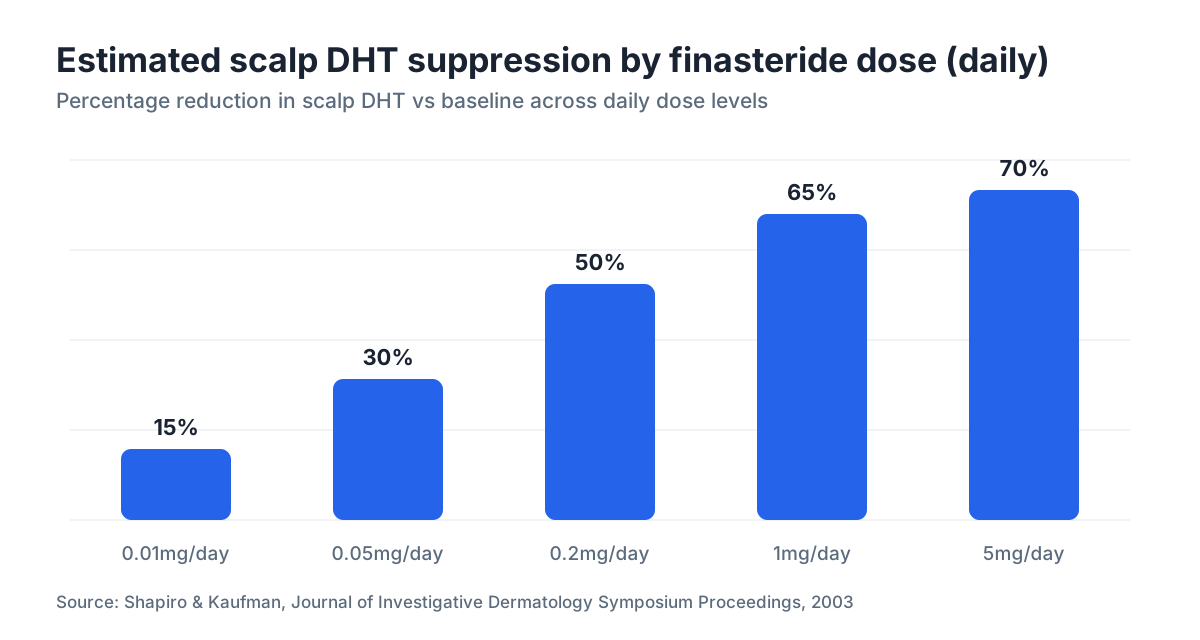
For DHT suppression specifically, a dose-ranging study compared finasteride at 0.01mg, 0.05mg, 0.2mg, 1mg, and 5mg daily. Even 0.2mg daily cut scalp DHT by about 50%, and 1mg daily reached roughly 60-70% suppression [2]. Every one of those doses was daily.
No published randomized controlled trial has compared 1mg daily against 5mg weekly for androgenetic alopecia. The weekly 5mg regimen is off-label, unstudied, and the dosing interval is biologically mismatched to the drug's half-life.
One category of data gets cited to defend intermittent dosing: finasteride for prostate cancer prevention. The Prostate Cancer Prevention Trial used 5mg daily, not intermittent dosing, and BPH studies use daily regimens too [4]. None of that literature backs weekly finasteride for hair.
The honest position: weekly 5mg is a reasonable hypothesis for someone who cannot tolerate daily dosing, but it has no trial support for hair outcomes, and the pharmacokinetics argue against it.
Does the DHT suppression actually drop off between weekly doses?
Almost certainly yes, though the size of the drop is hard to pin down because nobody has published a study tracking DHT hour-by-hour over a full week on a single 5mg dose in men taking it for hair loss.
What we do know from pharmacokinetic modeling: finasteride plasma levels become negligible within 24-36 hours of a dose. Scalp tissue concentrations run higher and last longer, but "longer" here likely means a day or two, not six.
A 2004 paper in the Journal of Clinical Endocrinology and Metabolism measured DHT recovery after finasteride discontinuation and found meaningful recovery starting within the first few days [5]. By day 7 post-dose, tissue DHT is substantially back up in most men.
So on the weekly schedule you probably get strong suppression for 1-2 days after your dose, partial suppression for another day or two, then near-baseline DHT for the last 3-4 days. Your follicles see DHT for more than half the week. That is unlikely to match the continuous suppression behind the hair count results in the trials.
This does not mean 5mg weekly does nothing. It probably does something. But "does something" is a long way from the proven effect of daily 1mg.
Finasteride 1mg daily vs 5mg weekly: a direct comparison
| Factor | 1mg daily | 5mg once weekly |
|---|---|---|
| Weekly total dose | 7mg | 5mg |
| Evidence base | Multiple RCTs, FDA-approved | No RCTs for hair loss |
| DHT suppression (scalp) | ~60-70% sustained [2] | Estimated partial, drops mid-week |
| Plasma half-life relevance | Well-matched to daily interval | Mismatched to 7-day interval |
| FDA approval status | Approved (Propecia, generics) | Off-label |
| Typical monthly cost | $15-40 for generic [6] | Similar or lower |
| Side effect theoretical risk | Established baseline from trials | Unknown, possibly lower on off-days |
Note that 1mg daily is actually a higher total weekly dose (7mg vs 5mg), the opposite of what most people assume when they call the schedules equivalent.
If cost is driving the question, the better-supported workaround is splitting 5mg Proscar tablets into quarters and dosing 1.25mg daily. You land close to 1mg, and you keep dosing every day. Generic finasteride 1mg is also cheap enough in the US now that the savings from weekly 5mg are minimal at most pharmacies.
For a full overview of how finasteride works and what it costs, see the finasteride guide.
Could weekly 5mg finasteride still slow hair loss even if it is not optimal?
Probably, to some degree. This is where honest hedging beats a clean answer.
Androgenetic alopecia moves slowly. Follicle miniaturization happens over years, not days. Even partial DHT suppression for part of the week might slow the process compared to no treatment at all. Think of a ratchet: you are not letting DHT run completely unchecked, just giving it more time to act than a daily schedule would.
But the comparison that matters is not "weekly 5mg vs nothing." It is "weekly 5mg vs daily 1mg." And the pharmacokinetics say daily 1mg wins, possibly by a lot.
If someone has daily pill fatigue or a genuine adherence problem, the weekly regimen might be a pragmatic compromise. That should be a conversation with a prescribing physician, not a self-directed experiment. No dose or schedule of finasteride cures hair loss. The drug manages progression while you take it.
What about side effects: is weekly dosing safer?
This is the most emotionally charged part of the question. Men worried about sexual side effects, mood changes, or the disputed condition called post-finasteride syndrome sometimes reason that a less frequent dose means fewer side effects.
The logic is not completely wrong. Finasteride side effects are dose-related to some extent: 5mg daily (the BPH dose) produces more sexual side effects than 1mg daily in clinical trials [1]. A single 5mg weekly dose delivers a large hit once a week instead of a steady lower level. Whether that profile is actually safer for side effect risk is unknown, because nobody has studied it.
Here is the uncomfortable truth. If you want to reduce side effect risk, the evidence-based move is the lowest effective dose, which is 1mg daily. Going less frequent with a bigger single dose is a different tradeoff, and it is unstudied. You are not necessarily reducing systemic DHT suppression risk either, because the peak suppression from 5mg is still significant on dosing day.
Some dermatologists have tried alternate-day dosing (0.5mg or 1mg every other day) for patients with side effect concerns. That keeps the interval shorter than the half-life gap and preserves more continuous suppression. Even that is off-label.
For a detailed breakdown of what the trial data says on adverse effects, the finasteride and minoxidil article covers both drugs' risk profiles when used together.
What do dermatologists actually prescribe in practice?
The American Academy of Dermatology guidelines for androgenetic alopecia recommend finasteride 1mg orally once daily as first-line medical treatment for men [7]. That is the standard recommendation across essentially every major dermatology society.
Off-label schedules do exist in practice. Some clinicians prescribe alternate-day dosing for patients who get side effects on daily use. A few case series and small studies suggest alternate-day 1mg may hold meaningful DHT suppression, though with less data than daily dosing.
Weekly 5mg is a less common prescribing pattern precisely because the pharmacokinetics are unfavorable. It is not unthinkable. It just lacks the evidence to be a default, so most dermatologists stick with what the trials showed.
If you are deciding between schedules, have the conversation with your prescribing doctor, not a forum. Bring the specific concern driving the question (cost, side effects, adherence), because each one has a different answer. If you have not started looking at treatment options and want a baseline picture of your hair loss pattern, a free AI hair loss analysis at MyHairline can help you understand where you stand before that appointment.
For context on what a receding hairline looks like at different stages, see the receding hairline guide.
What happens if you switch from daily 1mg to weekly 5mg?
Switch from daily to weekly and you should expect the effect on hair to fade over time compared to what daily dosing maintains. How fast that shows up as visible loss depends on how far along your androgenetic alopecia is, your genetics, and how aggressively your follicles respond to DHT.
Finasteride does not produce a permanent change. The hair you keep on daily dosing stays because the drug works continuously. Shift to a schedule with weaker continuous suppression and you are likely to see regression, though it might take 6-12 months to become visually obvious given how slowly follicle miniaturization moves.
If you are switching because of side effects, tell your doctor before stopping or changing anything. Some worrying symptoms are transient, particularly the early telogen effluvium shed that some people hit in the first few months, which is actually a sign the drug is working.
Coming back from a period of inadequate dosing is possible. Partially miniaturized follicles can often respond again when suppression returns, especially if they have not fully miniaturized. But you are not banking the progress from daily use. You are depending on continuous treatment to hold it.
Is there a middle ground: every other day or twice weekly?
Every other day (EOD) dosing has more pharmacokinetic justification than once-weekly. A 48-hour interval still runs longer than finasteride's plasma half-life, but DHT recovery in that window is partial rather than near-complete, the way it would be by day 7.
Small studies and case reports suggest EOD dosing with 1mg can hold meaningful DHT suppression, though the data are thin next to daily dosing [8]. Some dermatologists use this for patients who get side effects on daily use.
Twice-weekly dosing (say 1mg Monday and Thursday) is a further step down in suppression and even further from the evidence. It is not a commonly recommended schedule.
The honest ranking on evidence strength: daily 1mg is best supported, every-other-day 1mg has some supporting logic and minimal data, twice-weekly has almost no data, and once-weekly 5mg is pharmacokinetically problematic no matter how the milligrams add up.
If you are also using minoxidil alongside finasteride and want to understand how the two interact, see finasteride and minoxidil.
What should you actually do if you want to reduce your dose or frequency?
Start with an honest conversation with your prescribing doctor about why. The answer depends on the specific concern.
If cost is the issue, generic finasteride 1mg runs $15-40 per month at major US pharmacies [6], and GoodRx and similar discount programs often push it lower. Splitting 5mg Proscar tablets (each quarter is about 1.25mg) is another cost strategy that keeps daily dosing intact. Some online hair loss clinics offer generic 1mg at competitive prices.
If side effects are the concern, write down what you are experiencing and when it started relative to when you began the drug. Many reported early side effects are either coincidental or part of the adjustment period. If they persist, your doctor might try alternate-day dosing or a lower dose like 0.5mg daily rather than a schedule change.
If adherence is the challenge, a pill organizer, a phone reminder, or linking finasteride to another daily habit (coffee, brushing teeth) beats a once-weekly schedule that is both harder to remember and less effective.
Understanding what causes hair loss in the first place can also clarify how much consistency matters, because the underlying process does not pause when the medication does.
Sources
- FDA, Propecia (finasteride 1mg) prescribing information
- Shapiro J & Kaufman KD, Journal of Investigative Dermatology Symposium Proceedings, 2003 - finasteride dose-response for DHT suppression
- Kaufman KD et al., Journal of the American Academy of Dermatology, 1998 - finasteride 1mg RCT for androgenetic alopecia
- Thompson IM et al., NEJM 2003 - Prostate Cancer Prevention Trial (PCPT), finasteride 5mg daily
- Clark RV et al., Journal of Clinical Endocrinology and Metabolism, 2004 - DHT recovery after finasteride discontinuation
- GoodRx, finasteride 1mg price data
- American Academy of Dermatology, guidelines for androgenetic alopecia
- FDA, Proscar (finasteride 5mg) prescribing information