
TL;DR: The FDA-approved finasteride dose for male pattern hair loss is 1 mg taken orally once daily. The 5 mg dose is FDA-approved for benign prostatic hyperplasia, not hair loss. Studies show 1 mg blocks roughly 60-70% of scalp DHT and halts or reverses hair loss in about 83-90% of men who take it consistently.
What is the standard finasteride dose for hair loss?
1 mg per day. That's it. The FDA approved Propecia (finasteride 1 mg) in 1997 for androgenetic alopecia in men, and the label has not changed since [1]. You take one tablet in the morning, or at night, or whenever you'll actually remember, and you do it every day. Timing relative to meals doesn't matter.
The drug is a 5-alpha reductase inhibitor, meaning it blocks the enzyme that converts testosterone into dihydrotestosterone (DHT). DHT is the androgen that miniaturizes hair follicles in genetically susceptible men. A lower-dose pill hitting the scalp enzyme at just the right level was the clinical target, and 1 mg hit it.
To understand why 1 mg and not something else, it helps to know that finasteride was already on the market as a 5 mg pill (Proscar) for enlarged prostate [2]. Merck's researchers found that even at 0.2 mg, finasteride suppressed serum DHT by about 65%, and that 1 mg produced near-maximal suppression in scalp tissue without meaningfully increasing suppression at higher doses [3]. So 1 mg was the dose that worked well and kept drug exposure to a minimum.
For a broader look at how finasteride works and who it's for, see our overview on finasteride.
Does finasteride 1 mg actually work, and what do trials show?
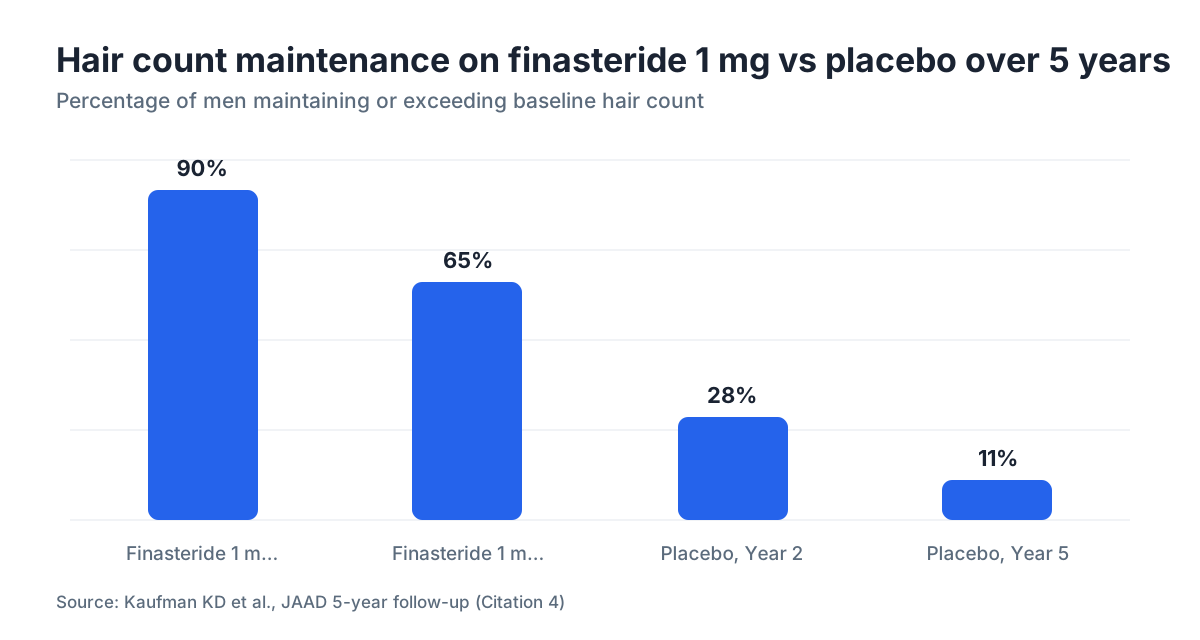
Yes, and the evidence is solid for a hair loss drug. The main two-year randomized controlled trial published in the Journal of the American Academy of Dermatology enrolled 1,553 men aged 18 to 41 with mild to moderate vertex hair loss. Among men taking 1 mg finasteride daily, 83% maintained or increased their hair count versus baseline, compared with 28% in the placebo group [4].
A five-year follow-up of a subset of those men found continued improvement: 90% of men on finasteride maintained or exceeded their baseline hair count at year two, and 65% showed an increase in hair count from baseline at year five [4]. Men on placebo kept losing hair the whole time.
Five years is a long time to take a pill. The catch is that regrowth, as opposed to just maintenance, was strongest at the vertex and weaker at the hairline. Men with a significantly receding hairline see more modest results than men whose main concern is thinning at the crown. If a receding hairline is your primary issue, read about the realistic expectations on our receding hairline page.
The drug does nothing once you stop. DHT bounces back within two weeks of stopping finasteride, and most of whatever hair you retained will shed over the following six to twelve months.
How does 1 mg compare to 5 mg for hair loss?
The short answer: the extra four milligrams probably don't buy much more hair and do raise the chance of side effects.
A dose-ranging study by Merck tested 0.01 mg, 0.05 mg, 0.2 mg, 1 mg, and 5 mg. All doses above 0.2 mg suppressed serum DHT by roughly 65-70% [3]. Scalp DHT suppression at 1 mg was around 60%, and 5 mg pushed that to roughly 70%. That 10-percentage-point difference in scalp DHT did not translate into a statistically significant difference in hair count in clinical trials [3].
Some dermatologists do prescribe 5 mg for hair loss, cutting the Proscar tablet into quarters to save money (brand-name Propecia costs around $70-100 per month in the US, while generic finasteride 5 mg tablets can cost $10-20 per month for the same effective dose when quartered). That's a real cost gap. But off-label use of 5 mg for hair loss means you're taking a dose the FDA never validated for that purpose, and the side effect risk runs modestly higher at 5 mg.
If cost is your concern, generic finasteride 1 mg is widely available and runs $15-40 per month depending on pharmacy and discount program [5].
| Dose | FDA indication | DHT suppression (serum) | Hair-loss evidence |
|---|---|---|---|
| 0.2 mg | None | ~65% | Minimal hair data |
| 1 mg | Androgenetic alopecia (men) | ~65-70% | 2 RCTs, 5-yr data [4] |
| 2.5 mg | None | ~70% | No controlled trial |
| 5 mg | Benign prostatic hyperplasia | ~70-72% | Off-label, no hair-specific RCT |
Can you take a lower dose, like 0.5 mg or every other day?
This is where the evidence gets genuinely thin, so I'll be honest about the uncertainty.
Finasteride has a long half-life, around six hours for the drug itself but much longer for its effect on scalp tissue. Some researchers and clinicians argue that 1 mg every other day, or even twice weekly, might sustain meaningful DHT suppression given how slowly scalp enzyme activity recovers. A small pharmacokinetic study (not a hair-count trial) suggested that every-other-day dosing keeps scalp DHT suppression in the same range as daily dosing [3]. But no large randomized controlled trials compare daily 1 mg to alternate-day dosing for hair outcomes.
Some men try 0.5 mg daily to cut side effect risk while keeping some DHT suppression. This makes pharmacological sense. Whether it works as well as 1 mg for hair is genuinely unknown. Nobody has good data on this; the closest study found that doses as low as 0.2 mg suppressed serum DHT comparably to 1 mg, but that study wasn't built to measure hair growth.
If you're thinking about a modified dose because of side effects, talk to your prescribing doctor first. Adjusting the dose is a reasonable clinical conversation. Stopping and restarting haphazardly is probably worse than staying on a lower consistent dose.
Finasteride works on the same DHT pathway we cover in detail on our DHT blocker page.
What is the finasteride dose for women?
Finasteride is not FDA-approved for hair loss in women, full stop [1]. The label says it's for men only.
That said, it is prescribed off-label for women with androgenetic alopecia, especially postmenopausal women where pregnancy risk is zero. Doses in the published literature range from 1 mg to 5 mg daily, with 2.5 mg being a common off-label starting point in some dermatology practices [6]. A systematic review published in the Journal of the American Academy of Dermatology found modest benefit in postmenopausal women, but the evidence base is much weaker than it is for men.
The reason for the FDA exclusion is serious: finasteride causes birth defects in male fetuses (ambiguous genitalia) when pregnant women are exposed to the drug or even to crushed tablets, because 5-alpha reductase inhibition during fetal development disrupts normal male sexual differentiation [1]. The label warns that women who are or may become pregnant should not handle crushed or broken finasteride tablets.
Any woman considering finasteride should have this conversation with a board-certified dermatologist, not a telehealth service that skips proper history-taking.
How long does it take for finasteride to work at the right dose?
Three months before you see anything meaningful. Six months before you can judge whether it's working. Twelve months before you know your full response.
The reason is follicle biology. Hair grows in cycles. Finasteride halts the DHT-driven miniaturization process, but the follicles currently in a growth phase have to finish that cycle, shed, and regrow thicker before you see a visible difference. That takes months.
Some men experience a shed in the first two to three months of starting finasteride. This is sometimes called a finasteride shed or a telogen effluvium-like phase, where follicles stuck in a prolonged, miniaturized resting state get pushed into a new cycle. It's alarming but usually a sign the drug is doing something. A true telogen effluvium triggered by finasteride is temporary.
If you've taken 1 mg daily for twelve straight months and see no change at all, the drug probably isn't working for you. Somewhere between 10-15% of men are non-responders. There's no reliable genetic test yet that predicts response before you start.
What are the side effects of finasteride at 1 mg vs. higher doses?
The FDA label for 1 mg finasteride reports sexual side effects in the trials: decreased libido (1.8% on drug vs. 1.3% placebo), erectile dysfunction (1.3% vs. 0.7%), and decreased ejaculate volume (0.8% vs. 0.4%) [1]. These are modest differences in trial conditions, but they're real.
A 2019 JAMA Dermatology study found that in a real-world cohort, rates of persistent sexual dysfunction ran higher than trial rates, possibly because trials selected healthier patients or had shorter follow-up [7]. The debate around post-finasteride syndrome, a cluster of persistent sexual, neurological, and mood-related symptoms that some men report continuing after stopping the drug, is ongoing and contested. The FDA revised the label in 2012 to note that sexual side effects may persist after stopping [1].
At 5 mg (the BPH dose), the label reports similar side effects but at slightly higher rates. The absolute difference is not dramatic, but since 1 mg is equally effective for hair loss, there's no clinical reason to accept a higher dose.
Gynecomastia (breast tissue growth) is listed as a rare adverse event across all doses. Prostate cancer risk is not increased; the large PCPT trial actually showed finasteride reduces prostate cancer incidence, though it may influence biopsy detection rates for high-grade tumors [8].
If you're weighing finasteride against other options, our comparison of finasteride and minoxidil covers how the two drugs stack up together and separately.
Does finasteride dose affect PSA levels, and does that matter?
Yes, and this matters if you're over 40 or if your doctor checks PSA (prostate-specific antigen) as part of routine screening.
Finasteride at 1 mg reduces serum PSA by roughly 50% [1]. That means a man on finasteride with a PSA of 2.0 ng/mL likely has an actual PSA closer to 4.0 ng/mL when interpreted for screening. The FDA label states that PSA values from men on finasteride should be doubled when interpreting results in the context of prostate cancer screening.
If you start finasteride, tell your doctor. If your doctor orders a PSA and doesn't know you're on finasteride, the result could read as normal when it's actually elevated. This is a real clinical error that happens.
The PSA suppression is fully reversible when the drug is stopped.
How is finasteride dosed differently from other hair loss treatments?
Most hair loss treatments need topical application twice a day. Finasteride is the outlier: one oral pill per day, no topical prep, no drying time, no scalp massage.
Minoxidil topical is applied once or twice daily to the scalp. Oral minoxidil runs at much lower doses (0.625 mg to 5 mg daily) than its original hypertension formulation but is still off-label for hair loss. Our piece on oral minoxidil has the dose detail on that. Combining 1 mg finasteride with minoxidil is the most common combination in clinical practice, and a 2022 trial in JAMA Dermatology found the combination significantly outperformed either drug alone [9].
Hair transplant surgery is not a daily medication at all, it's a one-time (or staged) procedure. But even after a transplant, dermatologists typically recommend continuing finasteride to protect the native hair that was not transplanted. Read more about timing and expectations in our hair transplant article.
For the full landscape of options, the American Academy of Dermatology's guidelines for androgenetic alopecia recommend both topical minoxidil and oral finasteride as first-line treatments for men [10].
If you want a quick, data-informed sense of where you fall on the hair loss spectrum before committing to anything, a free AI hair analysis at MyHairline can give you a baseline to track against.
Can you get finasteride without a prescription, and what does it cost?
No. Finasteride is a prescription-only drug in the United States, the UK, Canada, and Australia [1]. You need a licensed physician or other prescriber to order it.
In the US, telehealth companies can legally prescribe it after a virtual consultation. Generic 1 mg finasteride from major pharmacy chains with GoodRx or a similar discount card runs roughly $15-40 per month [5]. Some telehealth hair loss subscriptions bundle the prescription and medication for $20-50 per month.
In the UK, finasteride 1 mg is available via online prescribers, usually for £20-40 per month. It's not on the NHS for cosmetic hair loss, only for BPH at 5 mg.
Buying finasteride from unregulated online pharmacies without a prescription is illegal in most countries and genuinely risky: counterfeit pills, wrong doses, no medical oversight. Don't do it.
The cost argument for splitting 5 mg Proscar tablets is financially real: if a 5 mg generic costs $10/month and you split it into quarters, you're paying $2.50/month for an equivalent dose. But you're also taking an off-label dose, getting an imprecise split (pills don't cut into perfect quarters), and going without label protection. Some doctors are fine with this, others aren't. It's a legitimate cost conversation to have with your prescriber.
Who should not take finasteride at any dose?
Women who are pregnant or could become pregnant. Full stop. The teratogen risk for male fetuses is well-documented in animal studies and consistent with the drug's mechanism [1].
Men with a history of hypersensitivity to finasteride or dutasteride (a related 5-alpha reductase inhibitor) should avoid it. Men with significant liver disease should be cautious, since finasteride is metabolized in the liver.
Men with a personal or family history of high-grade prostate cancer should discuss finasteride carefully with a urologist before starting, given the interaction with PSA interpretation and the findings from the PCPT trial [8].
Men under 18 have no controlled trial data. The FDA label does not cover pediatric use.
Men with depression or a history of significant mood disorders should know that the FDA label includes a warning about reports of depression and, rarely, suicidality, particularly after stopping the drug. The causation is debated but the signal is there and worth raising with a prescriber.
For anyone wondering whether their hair loss comes from something other than genetics (nutrition, stress, thyroid, and so on), understanding the cause matters before starting any drug. Our what causes hair loss guide covers the main non-genetic factors.
What happens if you miss a dose or want to stop?
Missing one day is irrelevant. The enzyme inhibition from a single dose of finasteride lasts well beyond 24 hours. If you forget on Monday and remember Tuesday morning, just take Tuesday's pill. Don't double up.
Missing a week will start to let DHT levels rise. Missing a month essentially resets your DHT suppression. Missing three to six months will start reversing any hair you gained.
Stopping finasteride permanently means your hair loss resumes at whatever rate it would have followed without the drug. There's no evidence that stopping makes hair loss accelerate faster than if you'd never started; you simply lose the protection. Most of the hair maintained or gained on finasteride will shed within six to twelve months of stopping.
That's why starting is a longer-term commitment than most men expect. If you're not willing to take a pill daily for years, finasteride probably isn't the right fit. That doesn't mean you're out of options. Understanding your hair loss pattern and severity is the first step in figuring out what actually fits your situation. The MyHairline AI scan is a free way to get a clearer picture of your pattern before that conversation with a dermatologist.
Sources
- Rittmaster RS et al., Journal of Clinical Endocrinology and Metabolism, 1997 - dose-ranging finasteride study
- Kaufman KD et al., Journal of the American Academy of Dermatology, 1998 and 5-year follow-up 2002 - finasteride RCT
- GoodRx, finasteride pricing data
- Yeon JH et al., Journal of the American Academy of Dermatology, 2011 - finasteride in postmenopausal women
- Belknap SM et al., JAMA Dermatology, 2019 - real-world sexual dysfunction finasteride
- Thompson IM et al., New England Journal of Medicine, 2003 - Prostate Cancer Prevention Trial (PCPT)
- Hu R et al., JAMA Dermatology, 2022 - finasteride plus minoxidil combination RCT
- American Academy of Dermatology, clinical guidelines for androgenetic alopecia