TL;DR: Finasteride (1 mg for hair loss, 5 mg for BPH) does not raise blood pressure and is not classified as a cardiovascular risk drug. Some studies show a modest drop in blood pressure in BPH patients. Men on antihypertensives should tell their doctor, but no specific contraindication exists. The main documented side effects are sexual, not cardiac.
Does finasteride affect blood pressure?
The short answer is no. Finasteride does not raise blood pressure. It is not an adrenergic agent, it has no known vasoconstrictive mechanism, and neither the FDA label for Propecia (1 mg) nor the label for Proscar (5 mg) lists hypertension as an adverse reaction.[1]
What the drug actually does is block 5-alpha reductase, the enzyme that converts testosterone into dihydrotestosterone (DHT). DHT has some vasoactive properties, so reducing it shifts the hormonal environment inside blood vessels a little. The direction of that shift, in the clinical data that exists, leans toward a small drop in blood pressure rather than a rise, and mostly at the 5 mg BPH dose.[2]
That does not make finasteride a blood pressure drug. The effect is small, it varies across studies, and it is not clinically meaningful for most men. Nobody prescribes 5 mg finasteride to treat hypertension.
But it does mean the fear some men carry, that a hair loss pill will spike their blood pressure or stress their heart, has no support in the evidence. If you want the wider picture on how the drug works, dosing, and what the hair loss trials showed, start with the overview at finasteride.
What does the FDA label actually say about cardiovascular risks?
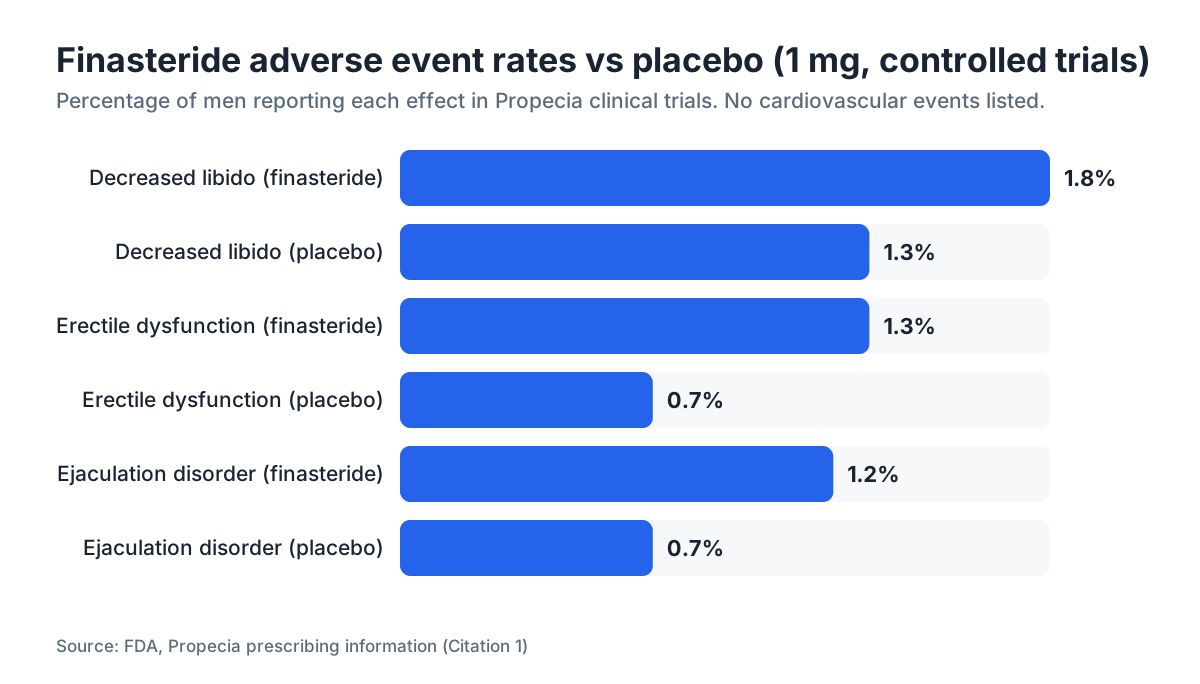
The FDA-approved prescribing information for Propecia (finasteride 1 mg) lists the most common adverse reactions as decreased libido, erectile dysfunction, and ejaculation disorder, occurring in roughly 1.3 to 3.8 percent of men in controlled trials versus 0.7 to 2.1 percent on placebo.[1] Cardiovascular events are not on that list.
For Proscar (finasteride 5 mg), the label points to sexual function as the primary adverse-effect category too. It notes that the drug was studied in men with benign prostatic hyperplasia, a group that often carries concurrent cardiovascular disease, and serious cardiac event rates in those trials were not statistically different from placebo.[3]
The label also flags finasteride as Pregnancy Category X. That tells you where the agency's attention went: reproductive risk, not cardiac. Regulators scrutinized this drug for years, and the category they raised the alarm on was reproductive.
One caveat, stated plainly. Drug labels reflect the trials that supported approval, and those trials were not powered to catch rare cardiac events. Absence of a warning is not a guarantee of zero risk. It means the signal was never large enough to surface in the data on hand.
Is there evidence finasteride lowers blood pressure?
Yes, modest evidence exists, mostly from the 5 mg dose in BPH populations. A study published in the American Journal of Hypertension examined men with hypertension and lower urinary tract symptoms and found finasteride produced a small but measurable reduction in blood pressure over 12 months, separate from any antihypertensive the men were already taking.[2] The drop landed around 3 to 5 mmHg systolic, which is clinically minor.
The proposed mechanism traces back to DHT. Dihydrotestosterone stimulates vascular smooth muscle and may add to arterial stiffness. Cut the DHT, and you may slightly lower vascular tone. Plausible pathway. Not confirmed in a large randomized trial built to test blood pressure as the primary endpoint.
For men on 1 mg for hair loss, the data thins out fast. The dose is one-fifth as large. The DHT suppression is real (roughly 60 to 70 percent in scalp DHT, about 64 percent in serum DHT at 1 mg per day [1]), but the systemic vascular effect at that dose has not been characterized well in published work. Taking the BPH blood pressure numbers and mapping them onto the 1 mg hair loss dose is guesswork.
Can men with high blood pressure safely take finasteride?
Having hypertension is not a contraindication to finasteride. The drug is not metabolized through pathways that clash with most antihypertensives, and the FDA label lists no specific interactions with blood pressure medications.[1]
Men on alpha-blockers deserve a specific mention. Alpha-blockers like doxazosin or terazosin can cause orthostatic hypotension, a sudden blood pressure drop when you stand up. Finasteride is often paired with alpha-blockers for BPH, and the MTOPS trial studied that combination without finding a clinically significant interaction.[10] Still, your prescribing doctor should know every medication you take before you start.
If your hypertension is well controlled and you are weighing finasteride for a receding hairline or early thinning, the cardiovascular piece is rarely the reason a physician hesitates. The sexual side effects, which hit a small but real minority, and the reproductive risk for any female partner who might become pregnant, are the conversations most doctors open with.
Nobody should start or stop a drug because of a blog post. Talk to whoever manages your blood pressure, list your current medications, and get their sign-off. That is baseline medicine.
Does finasteride affect cardiac function directly?
Finasteride has no known direct cardiac effect. It is not a beta-blocker, not a calcium channel blocker, not any class of agent that acts on heart muscle cells or the conduction system. The mechanism is purely enzymatic, aimed at 5-alpha reductase Type I and Type II.
There is one research thread worth knowing about. Sex hormones, including DHT and its downstream metabolites like the neurosteroid allopregnanolone, connect to cardiac function in ways that are still being worked out. Some animal studies suggest reduced neurosteroid production, a consequence of 5-alpha reductase inhibition, could theoretically affect autonomic regulation. Early mechanistic findings. No demonstrated cardiac harm signal in human trials.[4]
The Prostate Cancer Prevention Trial (PCPT) followed over 18,000 men for seven years on finasteride 5 mg and reported no excess cardiac mortality in the finasteride arm versus placebo.[5] That is the longest, largest finasteride dataset in existence, and it raised no cardiac flag.
For men with existing heart disease, arrhythmias, or recent cardiac events, the sensible move is to loop in your cardiologist before any new medication, finasteride included. Not because there is known risk. Because that is how you run a complicated cardiac chart.
Does finasteride interact with common cardiovascular medications?
Based on the FDA label and available pharmacokinetic data, finasteride has no clinically significant interactions with most cardiovascular drug classes. It is metabolized mainly by the CYP3A4 enzyme system in the liver.[1] Drugs that strongly inhibit or induce CYP3A4 could in theory shift finasteride blood levels, but this has not caused cardiovascular problems in practice.
Here is a quick reference for the drug classes men with hypertension actually take:
| Medication class | Known interaction with finasteride? | Notes |
|---|---|---|
| ACE inhibitors (lisinopril, ramipril) | None documented | Different metabolic pathways |
| ARBs (losartan, valsartan) | None documented | No shared enzyme targets |
| Beta-blockers (metoprolol, atenolol) | None documented | Different mechanism entirely |
| Calcium channel blockers (amlodipine) | Theoretical minor CYP3A4 overlap | Not clinically significant in practice |
| Alpha-blockers (tamsulosin, doxazosin) | Studied in combination; no clinically significant interaction found [10] | Monitor for orthostatic hypotension |
| Statins (atorvastatin, rosuvastatin) | None documented | |
| Diuretics (hydrochlorothiazide) | None documented |
The alpha-blocker combination gets studied most because it is used on purpose in BPH treatment. The MTOPS trial, which ran 4.5 years in men taking finasteride plus doxazosin, found no rise in cardiovascular events compared to either drug alone.[10]
If you are on a complex cardiac regimen, several antihypertensives plus aspirin or an anticoagulant, have your pharmacist run a formal interaction check. Their databases update far more often than any article.
What cardiovascular side effects does finasteride actually cause?
The honest answer is that the FDA label does not list any cardiovascular adverse effects in the dedicated adverse reaction sections for Propecia or Proscar.[1][3]
Post-marketing reports are a messier category. Post-marketing surveillance captures everything patients and doctors report after a drug reaches the market, whether or not the drug caused it. Some individual case reports describe palpitations or chest discomfort in men on finasteride, but these have not added up to a signal strong enough to trigger an FDA label change for cardiac risk.
What the label does warn about, and what has produced updated warnings since original approval, is the cluster some call post-finasteride syndrome: persistent sexual, neurological, and psychological effects that some men report continuing after they stop the drug.[6] In 2012 the FDA updated finasteride labeling to note that some sexual side effects may continue after discontinuation. Real for some users. Prevalence debated. Mechanism not fully understood. Read the actual FDA safety communication rather than forum threads.[6]
The cardiovascular side of that reported syndrome, heart rate changes or blood pressure spikes, is not established in peer-reviewed literature. Individual reports live online. They cannot substitute for controlled data.
How does finasteride compare to minoxidil on cardiovascular safety?
This comparison matters because many men run both drugs together for hair loss, and the two sit at opposite ends of the cardiovascular spectrum.
Minoxidil, especially oral minoxidil, is a direct vasodilator. It lowers blood pressure by relaxing smooth muscle in artery walls, which is exactly why it started life as an antihypertensive. Oral minoxidil for hair loss (typically 2.5 to 5 mg daily, far below the 10 to 40 mg once used for resistant hypertension) can still cause fluid retention, tachycardia (fast heart rate), and a drop in blood pressure.[7] For men with heart disease or hypertension, oral minoxidil opens a real cardiovascular conversation that finasteride does not.
Topical minoxidil (2 percent or 5 percent solution or foam) has far lower systemic absorption, roughly 1 to 2 percent of the applied dose reaches the bloodstream, which shrinks but does not erase cardiovascular effects.[7]
Finasteride has no vasodilatory mechanism. It does not cause tachycardia. It does not cause fluid retention. If heart health is your main concern in the choice, finasteride is the one with the cleaner cardiac profile. More detail sits at minoxidil side effects and oral minoxidil.
Plenty of men do well on both together, covered at finasteride and minoxidil, but your doctor should know you use both.
Should men over 50 with heart disease worry about finasteride?
Men over 50 are the core BPH population and have taken finasteride 5 mg in large numbers since 1992. Many carry hypertension, high cholesterol, and some degree of coronary disease. The MTOPS and PCPT trials, both enrolling mostly older men with real comorbidities, did not find finasteride to drive cardiovascular events.[10][5]
The PCPT trial reported: "There was no significant difference between the finasteride and placebo groups in the incidence of cardiovascular events or deaths."[5] That is a direct quote from the study's safety findings, over a population followed for seven years.
For a 50-year-old man with controlled hypertension who wants finasteride 1 mg for hair loss, the evidence gives no specific reason for cardiac worry. The worries worth having are the sexual side effects (roughly 2 to 3 percent incidence of erectile dysfunction in trials [1]) and prostate cancer screening, since finasteride cuts PSA values by about 50 percent and your urologist needs to know you are on it.
Uncontrolled hypertension or a recent cardiac event? Stabilize that first before adding any new medication. Common sense, not a finasteride-specific rule.
The free AI hair analysis at MyHairline can map your hair loss pattern before you decide whether finasteride is even the right tool for your situation. A reasonable first step before any medical conversation.
What does the evidence say about DHT and cardiovascular health more broadly?
DHT's role in cardiovascular health is genuinely unsettled. Some older research linked higher DHT levels to higher cardiovascular risk, which would make DHT reduction via finasteride a cardiovascular positive. Other research suggests DHT has protective vascular effects in men, and that lowering it too far could hurt. Neither camp holds clean, definitive human evidence at the doses used for hair loss.[4]
A review in the Journal of Clinical Endocrinology and Metabolism noted that androgens, DHT included, have complex effects on vascular biology that shift with vessel type, hormonal context, and individual genetics.[4] That is the honest state of the science. Complex, context-dependent, and not yet translated into clear clinical guidance beyond what the FDA label already carries.
What this means in practice: finasteride at 1 mg is not going to move your cardiovascular risk profile in either direction. The dose is too low and the vascular effect too indirect to matter next to the established risk factors of smoking, blood pressure, cholesterol, blood sugar, activity, and weight.
Worrying about finasteride's cardiac effects while ignoring your actual modifiable risks is the wrong order of priorities. If your blood pressure reads 145/95, that deserves your attention far more than whether 1 mg of finasteride nudges your DHT.
Are there alternatives if cardiovascular concerns make finasteride feel too uncertain?
If you have significant cardiovascular disease and your doctor is uneasy prescribing finasteride, or you simply want an option with no hormonal mechanism, alternatives exist.
Topical minoxidil is the most evidence-backed non-hormonal option for androgenetic alopecia. It does not block DHT and has no anti-androgenic effect, so it sidesteps the hormonal worry entirely. The cardiovascular consideration at standard concentrations is minimal, though anyone with existing heart disease should still mention it to their doctor. How it works for men is covered at minoxidil for men.
Ketoconazole shampoo has weak evidence as a topical anti-androgen at the scalp, but the effect is far smaller than finasteride's.
Low-level laser therapy (LLLT) devices carry modest supporting evidence for androgenetic alopecia and no cardiovascular interaction at all. The data is weaker than for finasteride or minoxidil, but it is a route for those who want to skip both.
Hair transplant surgery, covered at hair transplant, brings surgical and anesthesia risk that matters far more for cardiac patients than any topical or oral hair drug. That path needs a fuller medical evaluation.
Still figuring out the cause of your shedding? Read what causes hair loss and telogen effluvium first. Some shedding patterns do not call for finasteride at all.
Sources
- FDA, Propecia (finasteride 1 mg) prescribing information (search Drugs@FDA)
- American Journal of Hypertension, study of finasteride and blood pressure in hypertensive BPH patients
- FDA, Proscar (finasteride 5 mg) prescribing information (search Drugs@FDA)
- Journal of Clinical Endocrinology and Metabolism, review of androgens and vascular biology
- New England Journal of Medicine, Thompson et al., Prostate Cancer Prevention Trial (PCPT)
- FDA Drug Safety and Availability, finasteride label update on persistent sexual side effects
- FDA, minoxidil prescribing information and drug class background (search Drugs@FDA)
- American Academy of Dermatology, hair loss treatment information
- National Institutes of Health, MedlinePlus, finasteride drug information
- NEJM, McConnell et al., Medical Therapy of Prostatic Symptoms (MTOPS) trial