

TL;DR: GLP-1 drugs like semaglutide (Ozempic, Wegovy) and tirzepatide (Mounjaro, Zepbound) trigger hair shedding in roughly 3% of clinical trial participants. The mechanism is almost certainly telogen effluvium driven by rapid weight loss and caloric restriction, not a direct drug toxicity. Shedding typically starts 2 to 4 months after weight loss begins and resolves on its own within 6 to 12 months in most cases.
What is GLP-1 hair loss and how common is it?
GLP-1 receptor agonists, the class that includes semaglutide and tirzepatide, have become the most widely prescribed weight-loss drugs in history. With that scale comes a side effect many users notice before their prescribers ever mention it: heavy hair shedding.
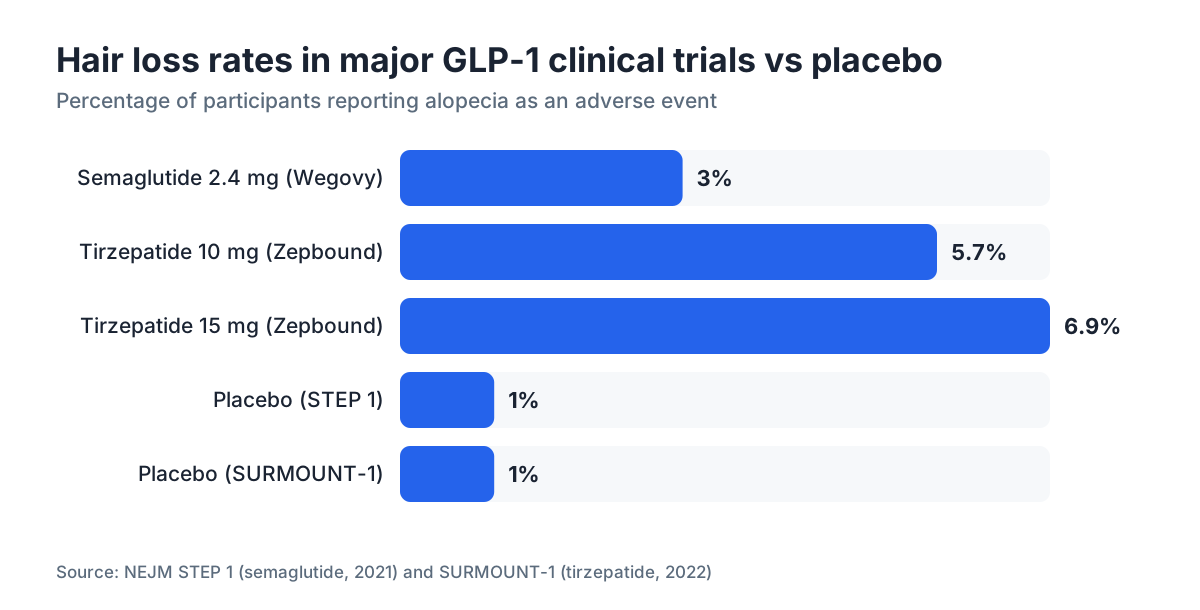
In the STEP 1 trial of semaglutide 2.4 mg (Wegovy), alopecia was reported as an adverse event by 3.0% of participants on the active drug versus 1.0% on placebo [1]. The SURMOUNT-1 trial of tirzepatide reported a similar signal, with hair loss appearing in the adverse event tables at rates between 5.7% and 6.9% depending on the dose arm, compared with 1.0% in the placebo group [2]. Those numbers look small. But when millions of people take the drug, a 3 to 6% rate means hundreds of thousands of people watching their hair fall out.
The hair loss is almost never permanent. Nearly every case described in the dermatology literature fits the profile of telogen effluvium, a self-limiting shed triggered by physical or metabolic stress. Understanding why that happens is the key to knowing whether it will happen to you, and what to do if it does.
Why do GLP-1 drugs cause hair shedding?
The leading explanation is not the drug itself. It is what the drug does, which is drive rapid, sustained weight loss through appetite suppression and slower gastric emptying. Hair follicles are expensive tissue to run. When the body senses a big calorie deficit or weight drop, it pulls resources away from non-essential structures, and hair growth is one of the first things that gets cut [3].
The biology works like this. Growing hairs (in the anagen phase) get pushed early into the resting phase (telogen) by the metabolic stress of rapid weight loss. Around 2 to 4 months later, all those hairs that entered telogen at the same time exit together. You get a synchronized mass shed, which is why it feels sudden and alarming even though the trigger happened months earlier.
Protein deficiency compounds this. GLP-1 drugs suppress appetite hard, and many patients do not eat enough protein to hold onto muscle mass or hair growth. The hair shaft is roughly 95% keratin, a protein. If dietary protein drops below about 1.2 g per kg of body weight per day, follicles are among the first structures to feel it [4].
Micronutrient depletion is a secondary factor worth naming. Eating less can drop ferritin, zinc, and biotin below the levels follicles need. Low ferritin (below 30 ng/mL by some dermatologists' benchmarks, though the exact cutoff is debated) correlates with hair shedding in observational data [5]. Nobody has proven the GLP-1 molecule is directly toxic to follicles at a cellular level, and the placebo-adjusted trial rates point to weight loss as the driver, not the drug.
How is this different from androgenetic hair loss?
This matters a lot for treatment decisions. Telogen effluvium from GLP-1 drugs looks and behaves nothing like the pattern baldness most people picture when they hear "hair loss."
With telogen effluvium, the shedding is diffuse. Hair comes out evenly all over the scalp, not in a receding hairline or thinning crown. You'll notice it in your brush, your shower drain, and your hands when you wash. The scalp does not become visible right away because all the follicles are still alive and intact; they have just paused. A pull test (gently tugging 20 to 40 hairs) releases more than usual during an active shed.
Androgenetic alopecia (male or female pattern hair loss) is a different animal. It is driven by dihydrotestosterone (DHT) binding to follicles that are genetically sensitive to it, shrinking them over years. That process does not self-correct. If you had borderline pattern baldness before starting a GLP-1 drug, the telogen effluvium can unmask it by shedding hairs that were already miniaturizing, so the pattern loss suddenly looks worse. Here is the nuance that trips people up: the drug did not cause the pattern loss, but the shed revealed it earlier than it would have shown up on its own.
A dermatologist can tell these apart with a scalp exam, trichoscopy, or dermoscopy. If you are losing hair in a defined pattern rather than diffusely, that points toward androgenetic alopecia and calls for a different treatment approach.
When does GLP-1 hair loss start and how long does it last?
The typical timeline tracks the biology of telogen effluvium closely. The metabolic stress of rapid weight loss triggers the follicle shift around the time weight loss accelerates, which for most patients on semaglutide or tirzepatide is in the first 8 to 16 weeks. Because hairs rest in telogen for roughly 2 to 3 months before they fall, the visible loss usually peaks between months 3 and 6 [3].
Most cases resolve within 6 to 12 months without any intervention, once the body settles into a new metabolic equilibrium. Regrowth starts when follicles re-enter anagen, and it shows up as short, slightly different-textured new hairs near the hairline and part. If shedding runs past 6 months or regrowth does not appear within 12 months, get a proper dermatology workup because something else may be going on.
Severity varies a lot person to person. How fast you lose weight matters: crash-rate losses (more than 1 to 1.5 lbs per week, sustained) correlate with worse shedding. Baseline nutrition matters too. People who start GLP-1 therapy already iron-deficient or eating low-protein diets tend to shed more.
Does stopping Ozempic or Wegovy stop the hair loss?
Not necessarily, and this is one of the more counterintuitive points. Stopping the drug stops weight loss (and often triggers rapid weight regain), but the shed already underway runs on its own clock. If your follicles were pushed into telogen before you quit the medication, those hairs will fall regardless.
The FDA prescribing information for semaglutide (Wegovy) lists alopecia as an adverse reaction but does not specify a resolution timeline with discontinuation [6]. Clinical experience reported in dermatology case series suggests shedding usually tapers within a few months of weight stabilization, whether that happens on the drug or off it.
Stopping a GLP-1 drug just to save your hair is rarely the right call. The decision to continue or stop belongs with the prescribing physician, based on your overall health goals. Most people who stay on the medication and fix the nutritional gaps find the shedding resolves on its own.
Who is most at risk for hair loss on a GLP-1 drug?
Several factors raise the risk, based on what we know about telogen effluvium generally and the trial data specifically.
Rapid weight loss is the biggest predictor. The STEP 1 trial showed mean weight loss of 14.9% of body weight over 68 weeks [1]. Patients who lose faster than that average, especially those who drop a lot in the first few months, seem more vulnerable. Women get telogen effluvium more often than men across all causes, and SURMOUNT-1 enrolled predominantly female participants, which may partly explain the higher rates seen there [2].
Pre-existing nutritional weak spots matter: low ferritin, iron-deficiency anemia, low protein intake, or restrictive diets before starting the drug all push the risk up. A family history of androgenetic alopecia raises the chance that a telogen effluvium shed will unmask pattern loss that was creeping along silently. Age plays in too. After 40, follicles have less reserve and tend to react harder to metabolic stress.
People already dealing with a receding hairline or thinning before starting a GLP-1 drug should have a frank talk with a dermatologist first, so they walk in with a baseline and a plan.
What can you do to prevent or treat GLP-1 hair loss?
There is no proven way to fully prevent telogen effluvium from rapid weight loss, but several practical steps cut the severity and duration.
Protein intake is the most evidence-supported lever. Aim for at least 1.2 to 1.6 g of protein per kg of body weight daily, and some clinicians push 1.6 to 2.0 g/kg for people losing weight quickly [4]. This is hard when a GLP-1 drug has killed your appetite, which is why most obesity medicine physicians now counsel patients on high-protein supplementation before shedding even starts.
Get bloodwork before you start, and repeat it at 3 to 6 months. A basic panel should include ferritin (more useful than hemoglobin here), serum iron, zinc, and a full metabolic panel. If ferritin comes back below 30 to 40 ng/mL, iron supplementation is reasonable, though the evidence that it reverses hair loss specifically is moderate at best [5].
Topical minoxidil 5% once daily is the most evidence-backed way to speed regrowth once the shed begins. It shortens the telogen phase and nudges follicles back into anagen. A Cochrane review and multiple randomized trials establish its efficacy for hair growth, though most trials studied androgenetic alopecia rather than telogen effluvium specifically [7]. If you want the side-effect profile before starting, the minoxidil side effects page covers it. Oral minoxidil at 0.625 to 2.5 mg daily is increasingly used as an alternative with comparable or better results for some patients; oral minoxidil has its own considerations around systemic absorption.
Slowing the rate of weight loss, if it is medically feasible, can ease the shedding trigger. That might mean adjusting the titration schedule with your prescriber rather than stopping the drug entirely.
If you want to check whether what you are seeing in the mirror is diffuse shedding consistent with telogen effluvium or something else, a free AI hair analysis at MyHairline can give you a baseline read before you book a dermatology appointment.
For people whose pattern loss was already progressing before the GLP-1 shed, treating the underlying androgenetic alopecia with finasteride or a DHT blocker becomes relevant. These drugs do nothing for telogen effluvium itself, but they hit the root cause of pattern hair loss the shed may have revealed. Combining finasteride and minoxidil often beats either one alone for androgenetic alopecia; the finasteride and minoxidil article covers the evidence on that combination.
Does the type of GLP-1 drug matter? Semaglutide vs tirzepatide
Both drugs cause hair loss at similar rates relative to placebo, but their trial populations and dosing differ enough that a direct comparison gets tricky.
Semaglutide (Wegovy 2.4 mg weekly): alopecia in 3.0% active vs 1.0% placebo in STEP 1 [1]. Tirzepatide (Zepbound/Mounjaro): hair loss adverse events ranged from 5.7% to 6.9% across the 10 mg and 15 mg arms in SURMOUNT-1, versus 1.0% placebo [2]. The higher tirzepatide numbers probably reflect greater weight-loss efficacy (mean 20.9% of body weight at the top dose vs 14.9% with semaglutide), not a follicle toxicity specific to the dual GIP/GLP-1 mechanism.
Liraglutide (Saxenda), an older GLP-1 agent with less dramatic weight loss, does not show up in alopecia adverse event tables with the same prominence, which again points to the magnitude of weight loss as the driver rather than the drug class itself.
The short answer: if tirzepatide is driving faster weight loss for you, it may also drive more shedding. The molecule itself is probably not the key variable.
Are there any hair loss supplements worth taking alongside GLP-1 therapy?
The supplement aisle is full of products aimed at people losing hair on GLP-1 drugs. Most of them lack strong evidence for the specific ingredients at the doses used.
Biotin gets a lot of attention. Unless you are genuinely biotin-deficient (rare in adults eating any varied diet), supplemental biotin does nothing for hair loss. The American Academy of Dermatology has noted that biotin supplementation interferes with thyroid and cardiac biomarker lab tests and should be stopped before bloodwork [8]. It is not dangerous, but for most GLP-1 users it is a waste of money.
Iron is worth taking if bloodwork confirms you are deficient. Iron supplementation when ferritin is genuinely low (under 30 ng/mL) has some observational support for improving shedding, but randomized trial evidence is thin.
Zinc, vitamin D, and collagen peptides show up in many hair loss supplement formulas. The evidence for zinc is modest; severe deficiency does cause hair loss, but dosing past repletion adds nothing. Vitamin D deficiency is common and worth correcting for general health, and some dermatologists mention it around telogen effluvium, but the trial evidence for hair specifically is weak.
The most useful "supplement" is arguably a good protein powder that helps you hit daily protein targets when your appetite is gone. Not a glamorous answer, but it addresses the actual mechanism.
Will the hair grow back after GLP-1-induced shedding?
In the vast majority of cases, yes. Telogen effluvium from weight loss is reversible. The follicles are dormant, not dead. Once the metabolic trigger clears, they cycle back into anagen and hair regrows.
Here is what "resolves" looks like in practice: weight loss slows or plateaus, nutritional gaps get corrected, and the body reaches a new steady state. Most people see active shedding taper by 6 months and visible regrowth by 9 to 12 months [3]. New growth often has a slightly different texture at first, sometimes finer or wavier, which is normal as follicles restart.
The exception is when the telogen effluvium has unmasked underlying androgenetic alopecia. In that case, the hairs lost in pattern-affected zones will not fully return, because those follicles were already miniaturizing. That is the scenario where finasteride, minoxidil, or eventually a hair transplant becomes a real conversation.
If 12 months pass with continued shedding and no regrowth, that warrants a biopsy or at least a detailed dermatology workup. Chronic telogen effluvium (lasting more than 6 months) does happen, though it is less common and often has an identifiable co-trigger such as thyroid dysfunction or ongoing iron deficiency.
What should you tell your doctor if you're losing hair on a GLP-1 drug?
The prescribing physician needs to know. Hair loss from GLP-1 therapy is underreported in the real world because patients chalk it up to stress or hormones, or they feel awkward raising it alongside the win of the weight loss.
Bring these details to the visit: when the shedding started (exact month), how much (handfuls vs slightly more than normal), whether it is diffuse or patterned, and whether you have had hair loss before. Ask specifically for a ferritin level, more than a standard CBC. A CBC can read normal while ferritin sits low enough to affect hair.
If your prescriber is not a dermatologist, consider a referral. A dermatologist can run trichoscopy to separate telogen effluvium from androgenetic alopecia and steer treatment from there. The American Academy of Dermatology has resources for finding board-certified dermatologists by location [8].
For a quick preliminary read on whether your shedding looks diffuse or patterned, the free AI scan at MyHairline gives you something concrete to take into that appointment.
Do not stop the GLP-1 medication without talking to your doctor. The cardiovascular and metabolic benefits are significant, and trading those away to stop a probably self-resolving hair shed is rarely the right deal.
Sources
- NEJM, Wilding et al. (STEP 1 trial), 2021
- NEJM, Jastreboff et al. (SURMOUNT-1 trial), 2022
- American Academy of Dermatology, Telogen Effluvium overview
- Harvard T.H. Chan School of Public Health, Protein and the Body
- Journal of the American Academy of Dermatology, Rushton et al., iron deficiency and hair loss
- FDA, Wegovy (semaglutide) prescribing information
- Cochrane Database of Systematic Reviews, Minoxidil for androgenetic alopecia
- American Academy of Dermatology, Biotin and hair loss
- FDA, Zepbound (tirzepatide) prescribing information
- NIH National Library of Medicine, Paus & Cotsarelis, Biology of Hair Follicles, NEJM 1999