
TL;DR: Everyone sheds 50 to 100 hairs a day. Hair loss becomes a problem when shedding outpaces regrowth, patches appear, or the hairline moves back. Genetics is the most common cause in both men and women. Two FDA-approved drugs, minoxidil and finasteride, have the most evidence behind them. Catching it early is your best shot at keeping what you have.
What is the difference between hair fall and hair loss?
Hair fall and hair loss sound identical, but they name two different things. Hair fall is shedding, a normal and continuous part of the hair growth cycle. Hair loss, called alopecia in the clinic, is what happens when the cycle breaks down and shed hairs stop getting replaced.
Every hair on your head spends two to six years in a growth phase (anagen), a short transition phase (catagen), and then a resting phase (telogen) before it drops. At any moment, roughly 85 to 90 percent of your hair is actively growing and 10 to 15 percent is resting and preparing to shed [1]. That is why losing 50 to 100 hairs a day is normal. You see them on your pillow, in the shower drain, on a brush, and they mean nothing.
Problematic hair loss is a different animal. It shows up as thinning you can see in a mirror, a hairline that has moved, patches of bare skin, or diffuse shedding that clearly beats your baseline. The distinction matters because the treatment changes completely depending on what is driving it.
If you want the full list of root causes, what causes hair loss is a good place to start.
How much hair loss per day is actually normal?
The American Academy of Dermatology puts the normal range at 50 to 100 hairs per day [2]. Some researchers push the ceiling to 150 hairs on wash days, because washing dislodges hairs that were already in telogen and ready to go.
The raw number is not the most useful thing to track. The change is. If you have always lost a moderate amount and nothing has shifted, you are probably fine. If you have suddenly started losing noticeably more over several weeks, pay attention to that shift.
Here is a rough home test: the pull test. Take about 60 hairs between your thumb and forefinger, hold near the root, and pull gently along the full length. Losing more than six hairs counts as a positive test and points to active shedding above baseline [3]. It is not a diagnosis, just a quick signal. A dermatologist can run a proper trichoscopy or pull test in the office and give you a real count.
What are the most common causes of hair loss in men and women?
The single most common cause in both sexes is androgenetic alopecia, also called male-pattern or female-pattern hair loss. It affects roughly 50 percent of men by age 50 and up to 40 percent of women by age 70, per data in the Journal of the American Academy of Dermatology [4]. The mechanism is follicle sensitivity to dihydrotestosterone (DHT), a hormone made from testosterone. DHT shortens the anagen phase over successive cycles until affected follicles miniaturize and finally stop producing visible hair.
Beyond genetics, the common culprits:
- Telogen effluvium: a stress-triggered mass shed where a large share of follicles enter resting phase at once. It can follow a severe illness, major surgery, childbirth, rapid weight loss, or a long stretch of psychological stress. Shedding usually starts two to three months after the trigger. Telogen effluvium covers this in detail.
- Thyroid disorders: both hypothyroidism and hyperthyroidism disrupt the hair cycle.
- Nutritional deficiencies: iron is the most studied; low ferritin is consistently tied to diffuse thinning in women [3].
- Scalp conditions: seborrheic dermatitis, scalp psoriasis, and fungal infections cause localized loss.
- Alopecia areata: an autoimmune condition where the immune system attacks follicles, making round patches of sudden loss.
- Traction alopecia: mechanical tension from tight hairstyles worn repeatedly over years.
- Medications: anticoagulants, retinoids, some antidepressants, and certain chemotherapy agents list hair shedding as a side effect.
One question keeps coming up: do supplements like creatine raise DHT enough to matter? The evidence is thin, but does creatine cause hair loss covers what the one often-cited study actually found.
A receding hairline specifically, with recession at the temples and crown, is almost always androgenetic alopecia. See receding hairline if that is your pattern.
What does early hair loss look like, and how do you spot it?
Early androgenetic alopecia is easy to miss because it creeps. In men, the first signs are usually slight recession at the temples and some thinning at the crown. The hairline might move a centimeter, but photos taken years apart often show it plainly. In women, the pattern differs: the part line widens and overall density on top drops, while the frontal hairline usually holds.
Diffuse shedding from telogen effluvium looks different again. Hair comes out in larger clumps than usual, often with no change to the hairline pattern. The scalp gets more visible through the hair, but evenly, not in one zone.
Alopecia areata tends to be sudden and local: a coin-shaped smooth patch shows up, often over a few days, sometimes with a slight tingle first.
Want an objective read on your own pattern? The free AI hair scan at MyHairline gives you a baseline assessment from your phone camera, useful if you are not sure whether what you are seeing is real or just wash-day paranoia.
The main move early: take a photo in consistent light, from the same angle, every three to six months. Your memory of your hair density is unreliable. A photo record is not.
What treatments actually work for hair loss?
This is where marketing separates people from their money. The honest list of treatments with real clinical evidence is short.
Minoxidil is the only FDA-approved topical treatment for hair loss and sells over the counter for both men and women [5]. It started as an oral blood pressure drug whose accidental side effect was hair growth. The topical version was approved in 1988. It works by lengthening the anagen phase and increasing follicle size. Roughly 40 to 60 percent of men see some regrowth with the 5 percent formula applied twice daily over 48 weeks [5]. The catch: use it forever or lose the gains. Stop and the new hair sheds within three to six months. Minoxidil for men breaks down dosing, formulations, and what to expect early.
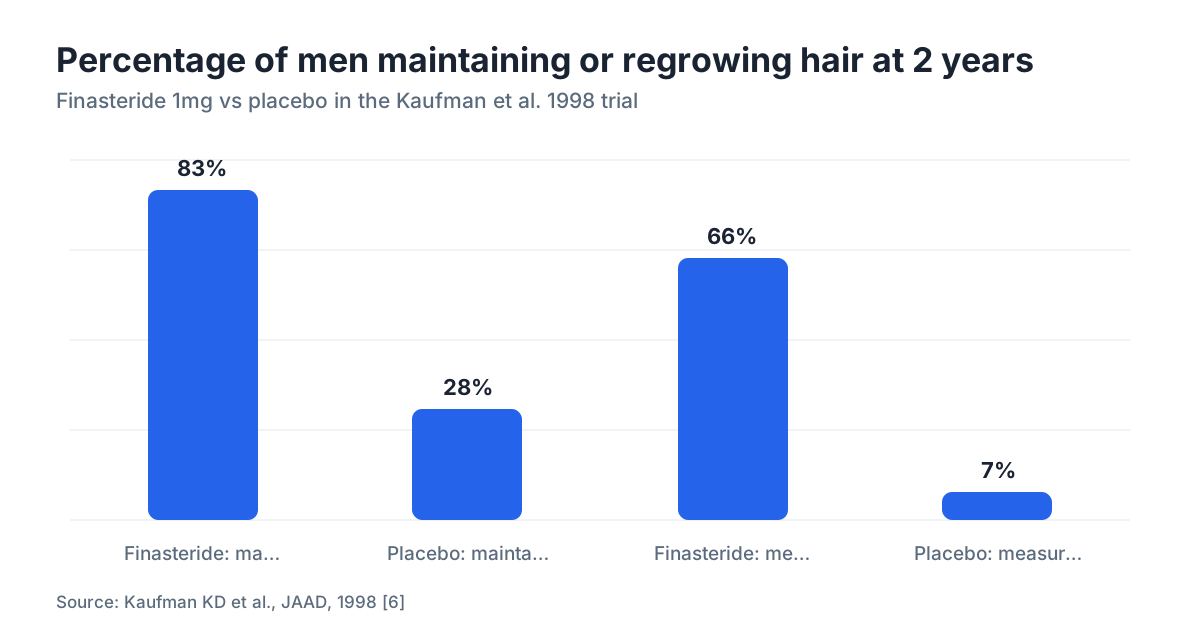
Finasteride is an oral prescription drug that blocks the enzyme (5-alpha reductase) converting testosterone to DHT. In a two-year randomized trial, 83 percent of men taking 1 mg daily kept their hair versus 28 percent on placebo, and 66 percent saw measurable regrowth [6]. It is approved for men only and not recommended for women of childbearing potential because of a birth defect risk in male fetuses. Like minoxidil, it needs continuous use. Finasteride covers the mechanism, the evidence, and the sexual side effect data that gets misread a lot.
Finasteride plus minoxidil together beats either alone. A 2021 randomized trial found the combination better than monotherapy on measurable hair count changes. Finasteride and minoxidil covers the combined approach.
Oral minoxidil at low doses (0.25 mg to 5 mg daily) has gained ground as a prescription alternative to the topical form, with some evidence it beats the topical for coverage and compliance. Oral minoxidil has the details.
Hair transplant surgery moves follicles from the back and sides of the scalp (the donor area) to thinning zones. It does not create new hair; it relocates existing hair. Follicular unit extraction (FUE) and follicular unit transplantation (FUT) are the two main techniques. Results can look very natural with an experienced surgeon, but the procedure is expensive (commonly $4,000 to $15,000 or more in the U.S. depending on graft count) and needs stable donor density. Hair transplant explains what the surgery involves and who is a realistic candidate.
DHT blockers in supplement form (saw palmetto, pumpkin seed oil) sell hard online. The evidence is weaker than for finasteride, though a few small trials show modest benefit. DHT blocker covers what those studies found and what to realistically expect.
Low-level laser therapy (LLLT) devices have FDA clearance (not approval, a lower bar) for hair loss. Some randomized controlled trials show statistically significant gains in density. The effect size is modest, and the devices cost $200 to $900.
Hair loss supplements like biotin, collagen, and herbal blends are everywhere. Biotin deficiency is rare, and there is no good evidence biotin helps people with normal levels. Iron supplementation matters if ferritin is low, which is why testing first is worth it. Hair loss supplements sorts the worthwhile from the useless.
Platelet-rich plasma (PRP) injections have growing but still inconsistent trial data. They are not FDA approved for hair loss and not covered by insurance. They may help as an add-on to other treatments but should not be your first stop.
How do minoxidil and finasteride compare head to head?
These are the two most studied treatments, so a direct comparison is worth laying out.
| Feature | Minoxidil (topical 5%) | Finasteride (oral 1 mg) |
|---|---|---|
| FDA approval | Yes, OTC for men and women | Yes, prescription for men only |
| Mechanism | Extends anagen, vasodilator | Blocks DHT production (inhibits 5-alpha reductase) |
| Regrowth in trials | ~40-60% of men see some regrowth [5] | 66% saw measurable regrowth at 2 years [6] |
| Hair maintenance | ~83% maintained hair | 83% maintained hair |
| Application | Topical, twice daily | Oral, once daily |
| Side effects | Scalp irritation, possible facial hair growth, initial shedding | Sexual side effects reported in ~2-3% in trials; rare post-finasteride syndrome claims [6] |
| Cost (approx.) | $20-$40/month generic | $15-$40/month generic |
| Works for women | Yes (2% formulation; 5% off-label) | Not recommended for women of childbearing age |
| Requires ongoing use | Yes | Yes |
The two drugs hit different parts of the problem, which is why combination therapy keeps outperforming either one. Finasteride slows or stops the miniaturization; minoxidil pushes the follicles that remain to grow thicker, longer hair.
Can hair loss be reversed, or only slowed?
The honest answer hangs on what type of hair loss you have and how far it has gone.
Androgenetic alopecia miniaturizes follicles over time. If a follicle has shrunk but is not completely gone, minoxidil and finasteride can often recover some function. Once a follicle is completely gone (smooth skin, no vellus hair), no medication brings it back. That is when surgery or acceptance are the real options.
Telogen effluvium is fully reversible in most cases. The follicles stay healthy, so once the trigger clears, hair usually regrows over six to twelve months with no treatment at all. The waiting is the hard part.
Alopecia areata is unpredictable. Mild cases often resolve on their own. Severe or chronic cases may need intralesional corticosteroid injections or newer JAK inhibitor drugs like baricitinib, which the FDA approved for severe alopecia areata in 2022 [7].
The window for a meaningful medication response is earlier, not later. Treating a Norwood scale stage 2 or 3 is far more productive than treating a stage 6. Not a comfortable message for anyone who has been putting it off, but it is true.
Does hair loss affect women differently than men?
Yes, in several real ways.
The pattern is different. Female-pattern hair loss (FPHL) usually shows as diffuse thinning across the top with a widening central part, graded on the Ludwig scale rather than the Norwood scale used for men. The frontal hairline usually stays put, which is why women often look fine in photos from the front even while they are keenly aware of thinning on top.
The causes are more mixed. Androgens matter in FPHL, but the DHT link is less direct than in men. Estrogen shapes the hair cycle, which is why postmenopausal women and women who have just given birth are especially exposed. Thyroid dysfunction and iron deficiency contribute more often in women than in men.
Treatment options are narrower. Finasteride is not FDA-approved for women and is specifically contraindicated in pregnancy due to teratogenicity risk. Minoxidil 2 percent is FDA-approved for women; the 5 percent is used off-label and looks more effective in some studies. Spironolactone, an antiandrogen, gets prescribed off-label by dermatologists for women with FPHL.
The emotional weight lands differently too. Not because men don't find hair loss distressing (many do), but because social expectations around women's hair are heavier. Studies consistently show higher anxiety and depression scores tied to hair loss in women than in men with comparable severity [4].
When should you see a doctor about hair loss?
Not every shed needs a doctor. But specific situations are where a professional evaluation changes the outcome.
See a dermatologist if:
- Shedding jumped suddenly and has not slowed after three months.
- You are losing hair in patches rather than diffusely.
- Your scalp is itchy, flaky, inflamed, or painful where you are losing hair.
- You are a woman and your part is visibly widening or your ponytail has gotten noticeably thinner.
- You are a man under 25 and your hairline is receding fast.
- You have used OTC minoxidil consistently for six months and seen nothing.
- Your hair loss shows up alongside fatigue, weight change, or irregular periods.
A dermatologist can run bloodwork (TSH, ferritin, complete blood count, hormone panel), a scalp biopsy if needed, and trichoscopy to classify the type of loss. Getting a diagnosis first is not box-ticking. Treating telogen effluvium the way you'd treat androgenetic alopecia wastes time and money.
There is a cost argument too. Finasteride and minoxidil used for the wrong type of hair loss will not work. One consultation prevents years of spending on the wrong fix.
What lifestyle factors make hair loss better or worse?
Genetics sets the ceiling for androgenetic alopecia, and no lifestyle change overrides a strong genetic hand. But several factors do move shedding and the health of the hair you have.
Nutrition matters more than supplement marketing suggests, but in a narrow way: deficiency makes things worse; loading up above normal levels does not make things better. Iron, zinc, and protein have the most support. A diet very low in protein triggers diffuse shedding because hair is almost pure keratin. Ferritin below 30 ng/mL is tied to hair loss in women [3].
Stress is real. Psychological stress can trigger telogen effluvium. The likely mechanism is cortisol throwing off the hair cycle. Chronic stress and acute severe stress both seem to matter.
Smoking has some evidence linking it to faster progression of androgenetic alopecia, possibly through effects on scalp microcirculation.
Heat styling, chemical processing, and tight hairstyles worn for years cause traction alopecia and mechanical damage, but they do not cause androgenetic alopecia. Wearing a hat does not cause hair loss. Washing your hair daily does not cause hair loss.
Sleep is understudied here. The closest data links severe sleep apnea to elevated cortisol and some added shedding, but that relationship is not well established.
The bottom line: what is good for your heart, enough protein, managing chronic stress, not smoking, tends to be good for your hair. There is no hair-loss superfood or miracle habit.
What is the hair growth cycle and why does it matter for treatment?
Understanding the hair cycle is genuinely useful because it explains why treatments take so long, and why the shedding you see after starting minoxidil is not a disaster.
The three phases:
- Anagen (growth): lasts two to six years. The follicle actively makes a hair shaft. How long your hair can get depends on how long anagen runs.
- Catagen (transition): lasts about two weeks. The follicle shrinks and detaches from the dermal papilla.
- Telogen (resting): lasts two to three months. The old hair sits in the follicle as a club hair while a new hair starts forming beneath it.
Start minoxidil and follicles in late telogen get pushed into anagen early. Those resting hairs shed all at once before new growth shows, producing what people call a "dread shed" in the first four to eight weeks. It is normal and a sign the drug is doing something. It passes.
Because anagen phases run years, you cannot judge whether a treatment works until you have given it at least six months, and twelve months is more reliable for finasteride. Anyone selling a supplement that shows results in two weeks is selling something that cannot biologically work in two weeks.
Are there any newer or emerging hair loss treatments to know about?
A few things are worth watching without buying the hype.
JAK inhibitors: Baricitinib (Olumiant) was FDA-approved in June 2022 for adults with severe alopecia areata [7]. Ritlecitinib (Litfulo) followed in 2023 for patients 12 and older [8]. These matter a lot for alopecia areata, a condition with very few options before. They do nothing for androgenetic alopecia.
Topical finasteride: A compounded or proprietary topical finasteride is being studied as a way to get DHT-blocking activity in the scalp with less systemic absorption, which may cut side effect risk. Some dermatologists prescribe compounded versions off-label now. A topical finasteride/minoxidil spray has been in trials.
Clascoterone (Winlevi) is an androgen receptor inhibitor approved for acne; research on its use in hair loss is ongoing.
Hair cloning or follicle banking research continues, but commercial reality is still years off. Companies have announced breakthroughs on this for fifteen years. Be skeptical of timelines.
Exosome therapy gets marketed hard at hair clinics despite a thin controlled-trial base. The FDA has sent warning letters to providers marketing unapproved exosome products [9]. That does not mean the science is wrong, but it is far too early to spend $3,000 on it.
Sources
- StatPearls (NCBI Bookshelf), Hair Follicle
- American Academy of Dermatology, Hair Loss
- Rushton DH, Journal of Clinical and Experimental Dermatology Research, 2002 - iron and hair loss
- Dinh QQ and Sinclair R, Journal of the American Academy of Dermatology, Female-pattern hair loss prevalence
- FDA, Minoxidil OTC label and approval history
- Kaufman KD et al., JAAD 1998, Finasteride 1mg randomized trial
- FDA, drug approvals and databases
- FDA, drug approvals and databases
- FDA, Consumer Alert on Regenerative Medicine Therapies
- Gupta AK et al., Dermatologic Therapy, Combination minoxidil and finasteride superiority trial 2021
- Heilmann-Heimbach S et al., Nature Communications 2017, polygenic loci for male-pattern baldness