
TL;DR: A hair graft transplant moves individual follicular units from a donor area to a thinning zone. In the US, grafts cost $2 to $10 each, so a 2,000-graft session runs roughly $4,000 to $20,000. FUE leaves no linear scar; FUT yields more grafts per session. Results take 12 to 18 months to fully show, and hair loss medication is usually needed to protect the hair you still have.
What exactly is a hair graft, and what happens during a transplant?
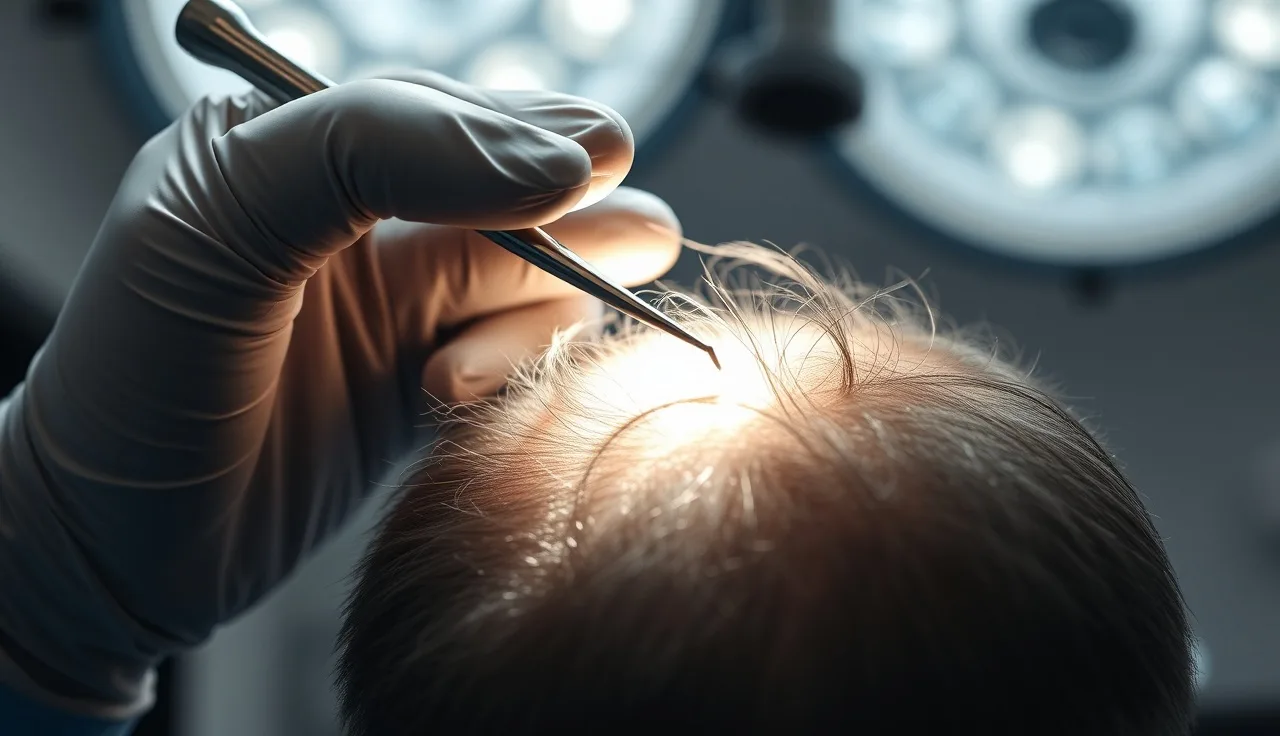
A hair graft is a tiny cluster of skin holding one to four hair follicles, called a follicular unit. Surgeons harvest these units from the back and sides of the scalp, where hair is genetically resistant to DHT-driven miniaturization, then implant them into areas that have thinned or stopped growing entirely [1].
The word "graft" trips people up. It sounds like major surgery. It isn't. Each graft is about 1mm wide. A typical session moves 1,000 to 3,500 grafts in a single day. The follicles carry the same genetic programming they had in the donor zone, so transplanted hair keeps growing for life in most patients [2].
Two techniques run the field. Follicular Unit Transplantation (FUT) removes a strip of scalp from the back of the head, dissects it under a microscope into individual grafts, then closes the donor site with sutures. That leaves a linear scar but produces a high graft yield in one session. Follicular Unit Extraction (FUE) punches out individual follicular units one at a time with a 0.8 to 1.0mm tool, leaving tiny circular scars that are nearly invisible once healed. FUE takes longer and costs more per graft. Most patients pick it anyway, because short haircuts stay possible afterward.
Neither technique wins across the board. High Norwood-stage patients who need 4,000 or more grafts often do better with FUT, because FUE alone may not supply enough donor hair. Someone at Norwood 2 to 3 who just wants to lower a hairline usually does fine with FUE.
How much does a hair transplant cost per graft in the US?
The honest answer is $2 to $10 per graft, with most reputable US clinics landing between $4 and $8 [3]. That range exists because pricing isn't regulated, clinics vary widely in surgeon experience and overhead, and the graft count gets set after a consultation, not off a price list.
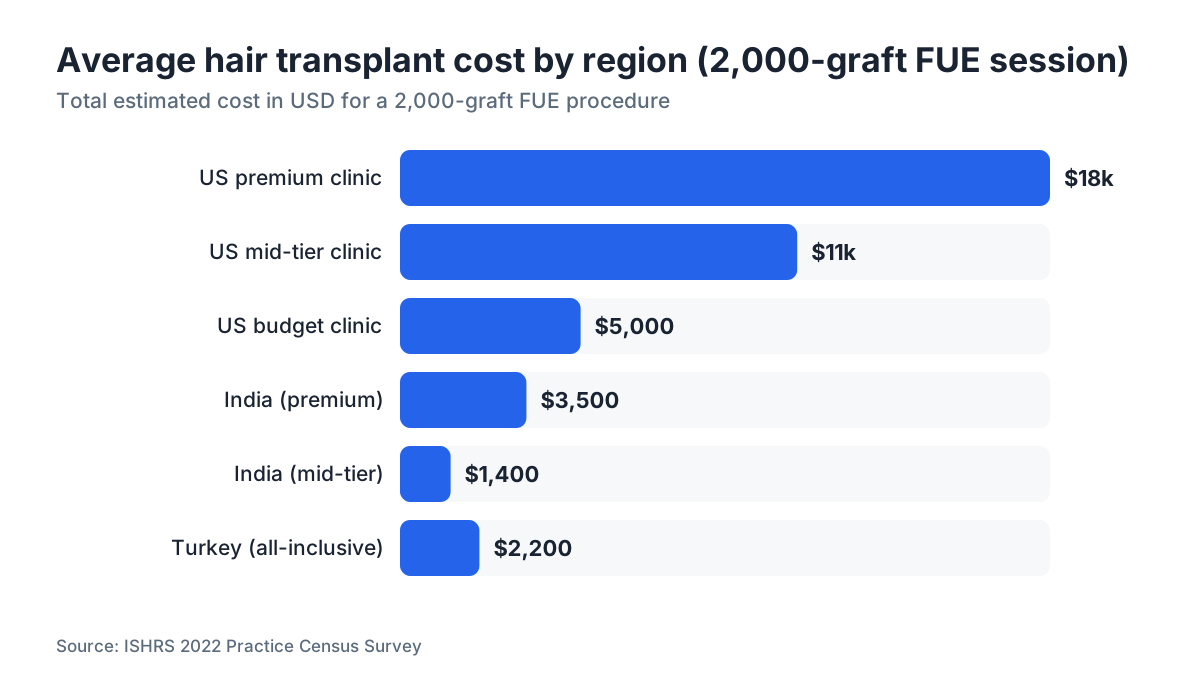
A 2,000-graft session at a mid-tier US clinic typically costs $8,000 to $14,000. At premium clinics in New York, Los Angeles, or Miami, the same session can hit $16,000 to $20,000. Budget clinics advertising $2 to $3 per graft almost always hand the extraction and implantation to technicians rather than the physician, and that correlates with lower graft survival.
The IRS treats hair transplants as cosmetic. They are not deductible as a medical expense under Publication 502, and health insurance does not cover them [4]. You pay out of pocket.
Financing through CareCredit or clinic payment plans is common. Be careful with it. A $12,000 procedure at 26% APR stretched over 24 months ends up costing roughly $15,800. Run the math before you sign anything.
Price should not be your main filter. The variable that most predicts your outcome is graft survival, which depends on how fast grafts get extracted and implanted, how they're stored (chilled saline or a dedicated holding solution like HypoThermosol), and the surgeon's recipient-site angulation. None of that shows up in a price quote.
What does a 2,000-graft hair transplant cost, and is that enough grafts?
A 2,000-graft hair transplant costs roughly $4,000 to $16,000 in the United States depending on clinic tier, and about $800 to $2,500 in India or Turkey [3]. Two thousand grafts is a common session size and a useful benchmark.
Whether 2,000 grafts is enough depends on how much area you need to cover. The International Society of Hair Restoration Surgery (ISHRS) puts native scalp density at about 80 to 100 follicular units per square centimeter [2]. A single 2,000-graft session can reasonably cover 40 to 60 cm² at about 35 to 45 grafts/cm², which reads as acceptable cosmetic density. The frontal third of the scalp, the area most people want back first, runs roughly 60 to 80 cm² depending on head size.
For a Norwood 3 or 4 patient focused on the front, 2,000 grafts is often the right number. A Norwood 5 or 6 who wants midscalp and crown coverage too may need 3,500 to 5,000 grafts across one or two sessions.
Here's something worth knowing: surgeons stay conservative with crown coverage on younger patients. The crown is a graft black hole because loss there tends to keep spreading. Drop 1,000 grafts into a crown at 28 and it can look good for a few years, then odd as the surrounding native hair thins around it. Experienced surgeons frame the front first.
How much does a hair transplant cost in India compared to the US?
India runs one of the most competitive hair transplant markets on earth. Cost per graft in India typically lands at 150 to 400 Indian rupees, roughly $1.80 to $4.80 USD at mid-2025 exchange rates. Many clinics quote "per hair" pricing rather than per graft to look cheaper. Per-hair pricing is not apples-to-apples: one graft usually holds 1.8 to 2.2 hairs, so multiply a per-hair quote by about 2 before you compare it to a per-graft quote [3].
A full 2,000-graft FUE session at a mid-tier clinic in Delhi, Mumbai, Pune, or Chennai runs about $800 to $2,000 all-in. Premium clinics in India with ABHRS (Association of Hair Restoration Surgeons)-certified surgeons charge $2,500 to $4,500, still far below US prices.
Turkey competes at similar numbers, with Istanbul clinics advertising full sessions at $1,500 to $3,000 including a hotel stay.
The risks of medical tourism are real. If something goes wrong (infected donor sites, necrosis, poor graft survival, a misaligned hairline) you're dealing with a foreign clinic, a language barrier, and no easy legal recourse. The American Board of Hair Restoration Surgery has no jurisdiction abroad. Flying home days after surgery also raises infection risk. That said, several top Indian and Turkish surgeons hold legitimate international reputations and publish peer-reviewed work. The credential to look for is FISHRS (Fellow of the ISHRS) or equivalent board certification from that country's recognized body.
If you're going abroad, spend as much time vetting the surgeon's credentials and reviewing unfiltered patient results (Reddit's r/HairTransplants community is genuinely useful for this) as you would for a US clinic.
FUE vs FUT: which technique gives you more grafts and better results?
FUE (Follicular Unit Extraction) and FUT (Follicular Unit Transplantation, or strip surgery) both move the same thing: follicular unit grafts. The difference is how they get harvested.
| Feature | FUE | FUT |
|---|---|---|
| Donor scar | Multiple tiny circular scars | One linear scar |
| Max grafts per session | 1,500 to 3,000 typical | 2,000 to 4,000+ possible |
| Cost per graft | Higher | Lower |
| Recovery | Faster (7 to 10 days) | Longer (10 to 14 days) |
| Short haircut viability | Yes | Limited (scar visible) |
| Graft transection risk | Slightly higher | Lower (under microscope) |
FUE has mostly pushed FUT aside because patients want the freedom of short hair. But FUT still earns its place. Strip surgery can yield more grafts per session, the linear scar hides completely at normal hair lengths, and graft quality from microscopic dissection is excellent. If a patient needs 4,500 grafts and has a tight scalp, FUT may be the only realistic way to do it in one session.
Robotic FUE systems (ARTAS is the best-known brand) automate part of the extraction. They're marketed hard, but published evidence doesn't show consistently better outcomes than skilled manual FUE, and they add cost [5]. Don't pay a premium for robot branding unless the surgeon can show you real graft survival data from their own practice.
One more technique to know: DHI (Direct Hair Implantation) is a variant of FUE that loads grafts into a Choi implanter pen and places them without pre-made incisions. Some clinics claim it sharpens angle precision and survival. The independent evidence is mixed, and it often costs 20 to 30% more. Interesting in theory. I'd want to see the clinic's own survival numbers before paying extra.
How many grafts do you actually need for your hair loss stage?
Graft needs scale with your Norwood stage, your head size, and the density you want. The table below gives realistic estimates based on published ISHRS guidance and standard surgical planning [2].
| Norwood Stage | Area of Coverage | Estimated Grafts Needed |
|---|---|---|
| Norwood 2 to 3 | Hairline restoration | 800 to 1,500 |
| Norwood 3 to 4 | Hairline + frontal third | 1,500 to 2,500 |
| Norwood 4 to 5 | Frontal + midscalp | 2,500 to 3,500 |
| Norwood 5 to 6 | Full top coverage | 3,500 to 5,000 |
| Norwood 6 to 7 | Extensive coverage (multiple sessions) | 5,000 to 8,000+ |
These are approximations. A surgeon who physically examines your scalp, measures your donor density, and checks scalp laxity (which matters for FUT planning) gives you a more accurate number. Clinics that quote a graft count over email without seeing your donor zone are guessing.
Donor supply is finite. The average person has 6,000 to 8,000 extractable grafts from the scalp, plus more from beard or body hair (though body hair grafts often survive worse and run shorter natural cycles). Planning matters enormously. A 25-year-old who puts 3,000 grafts into his front and midscalp may not have enough donor hair left for the crown or future sessions if his loss keeps moving.
This is why many surgeons pair a transplant with a DHT blocker like finasteride or add minoxidil for men. Slowing further native loss protects both the transplant result and your remaining donor supply.
What does recovery look like after a hair graft transplant?
The first 10 days are the awkward part. Transplanted grafts sit proud of the skin surface and form small crusts around each site. They look alarming and fall off on their own between days 7 and 14. Picking or scrubbing them off early yanks grafts out with them. Most surgeons hand you a gentle saline spray protocol starting around day 3.
Shock loss is real and nearly universal. Between weeks 2 and 8, most transplanted hairs shed. This is normal. The follicle is still alive underneath; the shaft drops because the follicle enters a resting phase after the surgical trauma. New growth starts around months 3 to 4. Visible improvement shows around month 6. Full density and final results take 12 to 18 months [2].
With FUE, most people get back to desk work within 3 to 5 days. Strenuous exercise and swimming stay off-limits for 2 to 3 weeks to hold down sweating and infection risk. With FUT, the suture line takes 10 to 14 days to heal, and numbness along the donor strip can linger for weeks to months.
Post-op medications usually include a short antibiotic course, an anti-inflammatory (often a corticosteroid), and sometimes a sleeping pill for the first couple of nights, because lying flat presses on the recipient area. Some surgeons keep patients on minoxidil through the peri-operative window; others pause it. There's no strong consensus, so follow your surgeon's protocol.
One thing predictably wrecks outcomes: sun on the scalp in the first month. UV damage to healing grafts cuts survival. Wear a loose hat or stay inside.
What's the actual success rate, and what can go wrong?
Graft survival in the hands of an experienced surgeon running a well-controlled clinic is typically cited at 90 to 95% [2]. That means 90 to 95 of every 100 transplanted follicles establish blood supply, survive, and eventually grow hair. In sloppier settings, survival can drop to 70% or lower, which is why the same graft count produces wildly different results across clinics.
The most common complications:
Infection: fairly rare, roughly 1% of cases when proper protocols are followed [6]. Treated with antibiotics, but it can leave localized scarring.
Folliculitis: small pustules around transplanted grafts in the first few months. Usually self-limiting, sometimes needs topical or oral antibiotics.
Donor-area scarring: FUE punch sites can merge into visible scarring if too many grafts come out too close together (overharvesting). An experienced surgeon maps density and avoids it.
Unnatural hairline: the most visible long-term failure. A hairline built without age-appropriate angulation and irregularity looks like a row of planted corn. The standard fix is single-hair grafts along the edge with multi-hair grafts behind them.
Persistent numbness: common after FUT along the scar line, usually resolves within 6 to 12 months.
The FDA has cleared certain hair transplant devices (like the ARTAS system) as Class II medical devices, but the procedure itself falls under state medical board oversight rather than a specific FDA approval pathway [7]. If a clinic claims FDA "approval" of its results or technique, that's a red flag.
If you want a baseline picture of your loss pattern before a consultation, MyHairline's free AI scan can map your recession and thinning zones in minutes. That gives you something concrete to bring to a surgeon instead of walking in cold.
Should you use finasteride or minoxidil alongside a hair transplant?
Almost certainly yes, unless you're near the end of your natural loss progression.
Here's the problem a transplant alone leaves unsolved: it moves existing follicles. It does nothing to stop DHT from miniaturizing the native hairs that weren't transplanted. So a patient who gets a beautiful hairline restoration at 30 can look strange at 40 if the midscalp and crown keep thinning around dense transplanted frontal hair.
Finasteride (1mg/day oral, brand name Propecia) cuts scalp DHT by roughly 60% and has solid evidence for slowing or stopping loss in men [11]. A 5-year randomized controlled trial in the Journal of the American Academy of Dermatology found that men on finasteride kept significantly more hair than those on placebo. The FDA approved finasteride 1mg for male androgenetic alopecia in 1997. Side effects (sexual dysfunction, mood changes) hit a minority of users and reverse on stopping in most cases, though this stays an active research area.
Minoxidil (topical 2 to 5% solution or foam, or oral minoxidil) works differently, extending the anagen growth phase and enlarging follicles. The FDA approved topical minoxidil for androgenetic alopecia. Running finasteride and minoxidil together is a common pairing many dermatologists recommend for post-transplant patients who want to protect what's left.
For women, finasteride is not FDA-approved for hair loss and carries teratogenicity risk in women of childbearing age. Minoxidil 2% is FDA-approved for women; 5% foam is also available and widely used off-label [9].
The upshot: a transplant is a one-time capital investment in follicles. Medication is the maintenance cost that protects the return. Skipping it after a transplant is like patching a roof leak and ignoring the water spreading through the ceiling around it.
How do you choose a hair transplant surgeon and avoid bad clinics?
Credentials first. The two worth checking are FISHRS (Fellow of the International Society of Hair Restoration Surgery) and board certification from your country's recognized body (in the US, the American Board of Hair Restoration Surgery). These require documented surgical experience, case logs, and passed examinations. They don't guarantee skill, but they filter out the worst actors.
After credentials, before-and-after photos are your most useful signal. Look for photos taken in consistent lighting (not a flash that washes out thinning), photos at 12 to 18 months post-op rather than 6, and photos showing the hairline and crown separately. A surgeon who can only show you frontal shots with wet hair is hiding something.
Ask exactly what the surgeon's graft survival protocol looks like: how grafts get stored between extraction and implantation, whether the surgeon performs the incisions personally or hands them to technicians, and the maximum grafts they'll attempt in a day. More than 3,500 grafts in one session with full surgeon involvement is logistically hard. If a clinic advertises 6,000 grafts in a single day at a rock-bottom price, ask precisely who performs which parts.
Online communities like r/HairTransplants on Reddit have documented specific clinic experiences at scale, good and bad, and make a genuine counterweight to curated clinic testimonials.
One warning sign that rarely gets mentioned: clinics that guarantee a specific hair count or density outcome are promising something they can't deliver. Graft survival is probabilistic. A legitimate surgeon gives you expected ranges, not guarantees.
If you're trying to place yourself on the Norwood scale before consultations start, MyHairline's free AI scan gives you a useful starting point. It doesn't replace a surgeon's in-person assessment, but it helps you walk in knowing what you're looking at.
Are hair transplants permanent, and what happens to the transplanted hair long-term?
Transplanted hair is generally permanent because the follicles are DHT-resistant, having come from the DHT-resistant donor zone. This principle, donor dominance, has been understood since Dr. Norman Orentreich's work in the 1950s and remains the scientific footing under all modern hair transplant surgery [2].
In practice, permanent means most of the hair. A small share of transplanted follicles may miniaturize over decades, especially if they came from the outer edges of the donor zone, where DHT resistance runs lower. Some studies have documented partial loss of transplant results at the 15 to 20 year mark in patients who received grafts from the periphery of the safe donor area [10].
Transplanted hair also keeps its own growth cycle. It grows, rests, sheds, and regrows just as it did in the donor area. It grays at roughly the same time as the rest of your hair. It won't necessarily match the texture of hair that originally grew in the recipient site, worth knowing for scalp-to-beard or beard-to-scalp transplants.
The hair surrounding a transplant keeps thinning if the underlying cause (usually androgenetic alopecia) goes untreated. This is why planning is so important. A well-executed transplant into a realistic coverage zone, paired with ongoing medical management of native hair loss, can look excellent for decades. A transplant into an aggressively expanded zone on a young patient with no medical management often looks good for 5 years and problematic for the next 30.
What should you do before booking a hair transplant?
A few concrete steps save money and regret.
Get a diagnosis first. Androgenetic alopecia is the most common cause of the loss transplants address, but it's not the only one. Telogen effluvium (diffuse shedding from stress, illness, or nutritional deficiency) can look like early androgenetic loss but usually resolves on its own. Transplanting into an area where loss is active and unstable wastes grafts. A board-certified dermatologist can tell the difference, often with a dermoscopy exam and basic blood work (TSH, ferritin, complete blood count).
Understand what causes your hair loss before you pay for a permanent surgical fix. This matters especially for women, where the causes are more varied and a transplant is less often the right first move.
Try medical management for 6 to 12 months first if you're early. Finasteride and minoxidil slow loss and sometimes produce meaningful regrowth. If they work well, you may need a smaller transplant or none at all. If they don't, you've ruled them out and have a clearer read on your loss pattern.
Get at least three in-person consultations, not video calls. A surgeon who won't examine your donor density and scalp laxity in person before quoting a graft count isn't giving you a real assessment.
Look honestly at your family history. If your father and maternal grandfather both went to Norwood 7, your loss probably isn't finished at 28. A good surgeon factors your likely future trajectory into the plan.
And check your expectations. A hair transplant does not restore your hair to how it looked at 18. It redistributes what's left. The outcome is a more flattering version of partial coverage, not a full reversal. Patients who understand this going in are consistently more satisfied than those who expected a complete restoration [2].
Sources
- American Academy of Dermatology, Hair Loss Overview
- International Society of Hair Restoration Surgery (ISHRS), Practice Standards
- ISHRS 2022 Practice Census Survey
- IRS Publication 502, Medical and Dental Expenses
- Journal of the American Academy of Dermatology, FUE and robotic hair transplant review
- American Society of Plastic Surgeons, Hair Transplant Safety Data
- FDA, Medical Devices section
- MedlinePlus (U.S. National Library of Medicine), Finasteride
- MedlinePlus (U.S. National Library of Medicine), Minoxidil Topical
- Journal of the American Academy of Dermatology, long-term hair transplant outcomes
- Journal of the American Academy of Dermatology, finasteride 5-year randomized controlled trial