
TL;DR: Hair implants (transplants) move your own follicles from the back of your scalp to a receding hairline. FUE and FUT are the two techniques. Results are permanent but take 9 to 18 months to fully show. Costs run $4,000 to $15,000 in the US depending on graft count. You need stable donor hair and realistic expectations to be a good candidate.
What are hair implants and how do they fix a receding hairline?
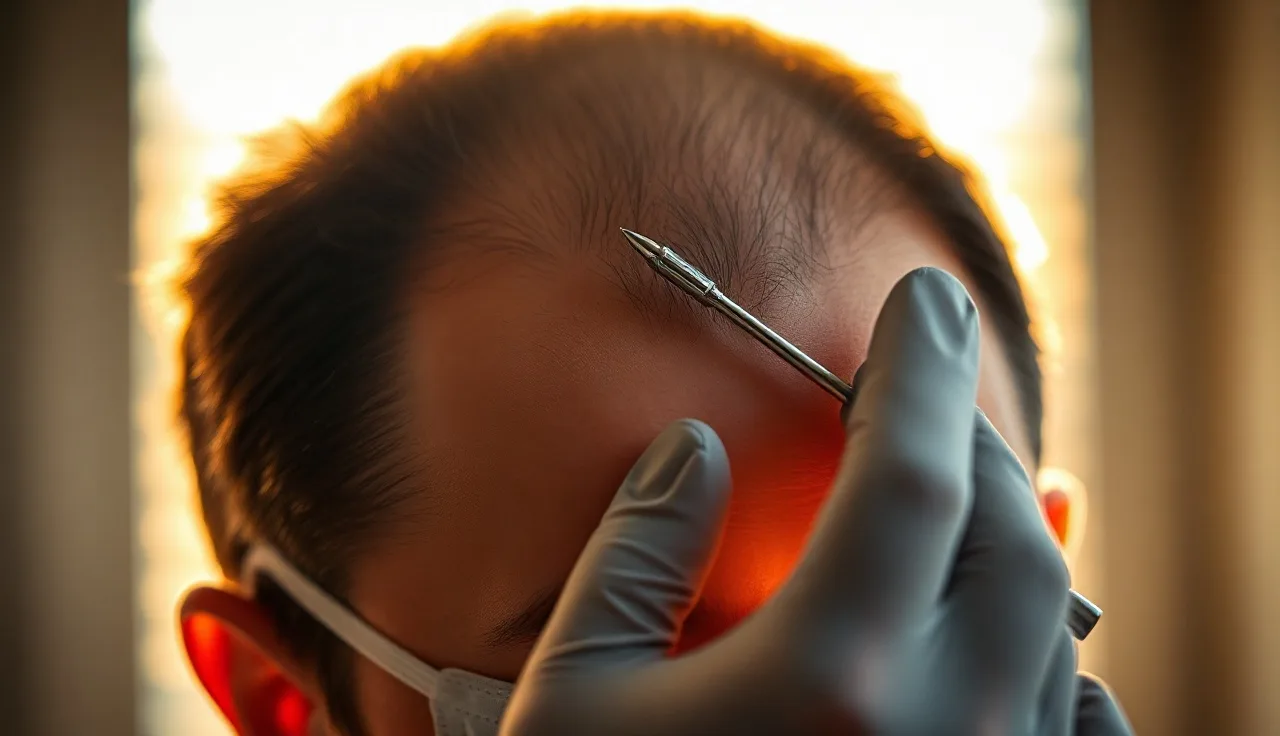
Hair implants is a lay term for hair transplant surgery. No artificial fibers get sewn in. What actually happens: a surgeon removes living hair follicles from a donor zone (almost always the back and sides of your scalp, where DHT-resistant hair grows) and places them into tiny incisions along your receding hairline. Those follicles keep their original genetic programming, so they keep growing for life in their new spot.
There are no synthetic implants approved by the FDA for standard hairline restoration in the US. The old "hair plug" era is dead. Modern hair transplants move individual follicular units, usually groups of one to four hairs, giving results that look like they grew there.
Surgeons use two techniques most: Follicular Unit Transplantation (FUT) and Follicular Unit Extraction (FUE). FUT cuts a strip of scalp from the donor zone. FUE punches out individual follicular units one by one. Both deliver the same follicles to your hairline. The difference is how the donor site looks and heals, which we cover in detail below.
A receding hairline is the most common presentation of male-pattern baldness, classified on the Norwood scale from Stage 1 (no recession) through Stage 7 (near-total loss). [1] Most men seeking a hair transplant for a receding hairline sit at Norwood 2 through 4, where donor supply is usually still adequate and realistic density is achievable in a single session.
FUE vs FUT: which technique is better for a receding hairline?
Neither is categorically better. The right choice depends on how many grafts you need, how you wear your hair, and your surgeon's skill.
FUT (strip method) removes a horizontal strip of scalp, usually from the mid-occipital area. A microscope dissects the strip into individual follicular units. A skilled surgeon can harvest 2,000 to 3,500 grafts in one session this way, which matters if your recession runs deep. The downside is a linear scar. With good technique that scar is often less than 1 to 2 mm wide and hidden easily by hair worn at a guard-2 length or longer. If you plan to keep your hair short or shaved, FUT is the wrong choice.
FUE punches out follicular units one by one with a circular punch tool ranging from 0.7 mm to 1.0 mm in diameter. No linear scar. Healing is faster. You can wear your hair very short. The trade-off: harvesting large numbers of grafts (over 2,500) in a single session takes much longer, sometimes two days, and the risk of transection (cutting the follicle during extraction) rises with less experienced surgeons. FUE also costs more per graft at most clinics.
| Feature | FUT (Strip) | FUE (Punch) |
|---|---|---|
| Typical graft yield per session | 2,000 to 3,500 | 1,500 to 2,500 (single day) |
| Scarring | Linear scar, 1 to 2 mm wide | Scattered tiny dots |
| Recovery time | 10 to 14 days | 7 to 10 days |
| Short-hair wearability | Requires some length to hide scar | Yes, even grade 0 to 1 |
| Cost per graft (US average) | $5, $8 | $7, $12 |
| Transection risk | Low (microscopic dissection) | Varies by surgeon skill |
For a hairline-only case at Norwood 2 to 3, most surgeons hit the target density with 1,000 to 2,000 grafts. FUE handles that comfortably in one day. For deeper recession at Norwood 4, where you may need 2,500 or more grafts for the hairline plus mid-scalp, FUT's higher yield becomes a real advantage.
A 2021 systematic review in Plastic and Reconstructive Surgery found no statistically significant difference in graft survival rates between FUT and FUE when performed by experienced surgeons. [2] The decision comes down to your goals and lifestyle, not which sounds more modern.
How much do hair implants for a receding hairline cost in the US?
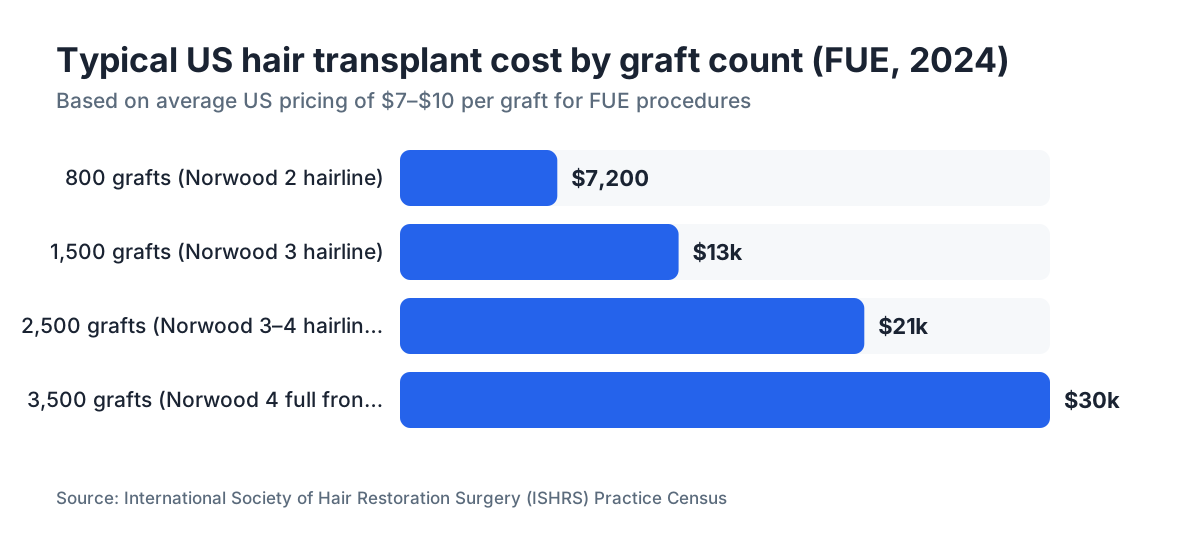
Clinics almost always quote per graft or as a package for a graft-range. A hairline restoration at Norwood 2 to 3 typically needs 1,000 to 2,500 grafts. A Norwood 4 hairline-plus-midscalp case may need 2,500 to 4,000 grafts.
US pricing averages $5 to $12 per graft depending on technique, clinic reputation, and geography. That puts a typical hairline case between $5,000 and $15,000. Clinics in major metro areas (New York, Los Angeles, Miami) tend to sit at the upper end. Practices in mid-tier cities can run $4,000 to $8,000 for the same procedure.
Hair transplants are cosmetic. Insurance does not cover them. HSA and FSA funds generally cannot be used for cosmetic surgery. Some clinics offer financing through CareCredit or similar, which is worth asking about if cost is a barrier.
Overseas clinics, especially in Turkey, advertise full procedures at $1,500 to $3,500 all-inclusive. The graft counts can be huge (5,000+ in claims), which raises its own concerns: over-harvesting the donor zone, transection rates, and follow-up care if something goes wrong at home. That does not mean all overseas clinics are bad. It means you have to vet an overseas surgeon at least as hard as a domestic one. Review the clinic's before/after photos with a critical eye, confirm the operating surgeon's credentials, and understand that revision surgery across borders gets complicated fast.
One benchmark: the International Society of Hair Restoration Surgery (ISHRS) publishes a biannual practice census that has consistently shown median US pricing in the $6 to $9 per graft range. [3]
Am I a good candidate for hair implants?
Good candidates share a few traits. Adequate donor density is the top factor. If the back and sides of your scalp have been thinned by androgenetic alopecia or prior bad transplants, there may not be enough follicles to harvest. Surgeons typically want a donor density of at least 70 to 80 follicular units per cm² before proceeding.
Age and progression matter too. Transplanting a 21-year-old at Norwood 2 is risky because the pattern may keep expanding. A surgeon who agrees to operate on a young patient with early recession without a plan for future loss (usually meaning medical therapy alongside the transplant) is waving a red flag. You could end up with an island of transplanted hairline hair surrounded by continued native loss.
Medical stability is required. Uncontrolled diabetes, active autoimmune conditions, blood-thinning medications, and certain cardiac conditions can complicate surgery and healing. Your surgeon should take a full history.
Who is not a good candidate? People with diffuse thinning across the entire scalp (where the donor zone is also thinning), those with alopecia areata in an active phase, and those with unrealistic expectations about density. A transplant reproduces the appearance of hair, not the density of a full, youthful scalp. Photos of transplanted results often show good cosmetic coverage, but careful inspection reveals lower follicle density than untouched scalp.
If you are unsure where your hairline stands, MyHairline's free AI hair scan gives you a Norwood-stage estimate and flags whether your pattern looks like a candidate for surgical or medical options before you book a consultation.
What happens during the procedure and what is recovery like?
The day starts with pre-op photographs and hairline design. Surgeons draw the proposed hairline directly on your scalp with a skin marker. This is a collaborative step. You have input. The angle, height, and shape of that line decide how natural the result looks, so study it in a mirror before you agree.
Local anesthetic goes into both the donor and recipient areas. This is the most uncomfortable part of the day. After that you are awake but feel little. FUE extraction or strip removal takes 2 to 4 hours. Implanting grafts into the hairline takes another 2 to 5 hours depending on graft count. Total chair time for a typical hairline case runs 5 to 8 hours.
You go home the same day. The donor zone has small scabs over punch sites (FUE) or sutures (FUT). The hairline has tiny scabs at each graft site. Both areas feel tender for a few days. Forehead swelling is common on days 2 to 4 and looks alarming but resolves on its own.
For the first 7 to 10 days, avoid touching the recipient area, no gym, no swimming, and sleep with your head elevated. FUT sutures come out around day 10 to 14. Most people return to desk work within 3 to 5 days.
Shock loss happens next. Between weeks 2 and 6, most of the transplanted hairs shed. This is normal and expected. The follicle itself is alive. It just enters a resting phase from the trauma of being moved. New growth starts at 3 to 4 months. Real cosmetic improvement shows at 6 to 9 months. Full results take 12 to 18 months. This is slow. It takes patience. Nobody walks out of surgery looking better.
How many grafts does a receding hairline actually need?
Clinics often hedge on this during consultations because the honest answer depends on your recession depth, your native hair caliber, and the density you want.
As a general guide: frontline hairline restoration at Norwood 2 typically needs 800 to 1,500 grafts. A deeper Norwood 3 vertex recession adds another 500 to 1,000. Norwood 4 hairline plus mid-scalp work often requires 2,500 to 3,500 grafts. These are not guarantees. They are the ranges that show up consistently in published case series.
Hair caliber matters as much as graft count. Coarse, straight, dark hair from people of East Asian or African heritage packs more coverage per graft than fine, wavy, light-colored hair. Someone with coarse hair may hit good visual density with 1,200 grafts where someone with fine blonde hair needs 1,800 to cover the same area.
Ask any surgeon you consult for a specific graft estimate in writing before you agree to a price. A clinic that quotes a blanket package without examining your scalp in person or via high-resolution photos is not one to trust with this decision.
Do I need medication (finasteride or minoxidil) alongside the transplant?
Almost certainly yes, if you want to protect the result long-term.
A hair transplant moves DHT-resistant follicles to the hairline. It does nothing to protect your remaining native hair behind that hairline. If androgenetic alopecia keeps progressing (which it usually does without intervention), the native hair around the transplanted zone keeps thinning. The transplanted hairline stays put while the scalp behind it recedes further, creating an odd look.
Finasteride (Propecia, generics) cuts scalp DHT by about 60 to 70% by inhibiting the 5-alpha reductase enzyme that converts testosterone to DHT. [4] The 5-year Merck trial found that 65% of men on finasteride maintained or increased hair count versus baseline, compared to 14% on placebo. [4] The FDA approved finasteride 1 mg for male-pattern hair loss. It works best started early and continued indefinitely. Learn more in our overview of finasteride.
Minoxidil (Rogaine, generics) is FDA-approved in 2% and 5% topical formulations for androgenetic alopecia. [5] It stretches the anagen (growth) phase of hair follicles and increases follicle size. On a transplant patient's scalp, it can also speed post-surgical regrowth. Most transplant surgeons recommend starting minoxidil 4 to 6 weeks after surgery. More on that in our guide to minoxidil for men.
Using both together is common. Our article on finasteride and minoxidil covers the combination in detail. It is not mandatory, but surgeons who transplant without discussing ongoing medical therapy are leaving a real gap in the plan.
Oral minoxidil (0.625 to 5 mg daily) is an emerging alternative to topical for some patients. See our oral minoxidil guide for the current evidence.
What do results look like at 6 months, 12 months, and beyond?
Month 1 to 2: You look roughly the same as before, maybe worse because of shock loss shedding. The donor zone may show redness or stubble at punch sites.
Month 3 to 4: Fine, thin hairs emerge from the transplanted follicles. They look wispy and do not yet create meaningful coverage. This phase tests your patience.
Month 6: Real cosmetic improvement for most patients. Hairs are thickening. Friends who have not seen you in months will notice. A 2019 study in Dermatologic Surgery found that most patient-reported satisfaction with results landed after the 6-month mark. [6]
Month 9 to 12: The transplanted hairs approach final caliber. Density looks its best. At this point, the result is essentially what you will keep permanently.
Beyond 12 to 18 months: The transplanted hair is permanent, assuming its DHT resistance holds (which it typically does). You can cut, color, and style it like any other hair. It needs no special shampoos or ongoing treatment to survive. What you do need ongoing medication for is the native hair around it.
Some patients pursue a second session at 12 to 18 months to add density or address adjacent areas that kept thinning. That is normal and not a sign the first surgery failed. It is the nature of a progressive condition.
Can you style long hair with a receding hairline before or instead of surgery?
Yes, and it is worth thinking through your options honestly before committing to surgery.
Long hair with a receding hairline can work as a concealment strategy for early recession (Norwood 2 to 2.5). Longer hair on top gives you something to brush forward or to the side to soften a high hairline. Side-swept styles, textured crops, and longer fringes shift visual weight toward the face. The receding hairline guide covers style options in more detail.
The limit of long hair is that it conceals but does not restore. If recession has reached Norwood 3 or beyond, there may not be enough hair left to style over the temples convincingly. And longer hair can paradoxically expose recession more when wet or in wind.
If you are in an early stage, committing to medical therapy (finasteride, minoxidil) and reassessing in 12 months before deciding on surgery is a sensible path. Many men stabilize well enough on medication that surgery becomes optional rather than necessary.
Styling and medical therapy are not mutually exclusive with planning a transplant. They are a bridge. You can grow your hair out, use what coverage you have, take medication to slow progression, and revisit surgery once your pattern has stabilized.
What are the risks and what can go wrong?
Hair transplantation is low-risk compared to most surgery, but the risks are real and worth knowing before you hand over thousands of dollars.
An unnatural hairline design is the most visually damaging outcome. A hairline placed too low, too straight, or with grafts angled wrong looks obviously fake. You cannot blame that on biology. It is a surgical error. Judge a surgeon's before-and-after photos for hairline naturalness first, density second.
Poor graft survival happens when grafts sit outside the body too long, get implanted too deep or too shallow, or dry out during the procedure. Good clinics keep grafts in chilled saline or specialized holding solutions and minimize the time between extraction and implantation. Ask about their protocols.
Donor-zone scarring shows if FUT is done by a surgeon with poor wound closure, or if FUE grafts are harvested too densely in a small area (overharvesting). The ISHRS recommends that FUE harvesting not exceed 30 to 40% of the available donor area to protect long-term density. [3]
Infection is rare, under 1% of cases in most published series, but it can damage follicles permanently if not treated promptly. [7]
Persistent numbness or tingling in the donor or recipient zone can last weeks to months. Permanent sensory changes are uncommon.
Shock loss of existing native hair around the recipient site happens in some cases. Most of that hair recovers.
One trap: clinics that guarantee results or promise graft counts that are implausibly high for the donor area available. A reputable surgeon tells you what they honestly expect to achieve and will not promise outcomes they cannot verify.
How do I choose a surgeon and avoid bad results?
Board certification in the US means a lot less here than in other fields, because hair transplantation is not a recognized specialty. Dermatologists, plastic surgeons, and general practitioners can all legally perform hair transplants. Quality varies enormously.
Start with the ISHRS member directory (ishrs.org). Membership requires training and a commitment to ethical standards, though it is not a guarantee of skill. The American Board of Hair Restoration Surgery (ABHRS) offers a tougher credential: a written and oral examination plus case submission. A surgeon with ABHRS certification has cleared a meaningful bar. [8]
Ask to see at least 20 to 30 before-and-after cases that match your own Norwood stage and hair type. Ask specifically about hairline cases if that is what you need. Look for:
- Natural, irregular hairline designs (not perfect arcs)
- Single-hair grafts at the very front, transitioning to two- and three-hair grafts behind
- Consistent density without obvious plug-like clusters
- Patient photos taken at similar angles, lighting, and hair length (not cherry-picked with clever lighting)
Consult at least two to three surgeons before deciding. Most reputable practices offer free consultations. If a surgeon quotes you a graft count without examining your scalp in person or with high-resolution photos, leave.
For a broader sense of what drives hair loss and who is likely to progress further, our guide on what causes hair loss is a useful read before your consultations.
At MyHairline, the free AI hair scan helps you understand your current Norwood stage and whether your pattern looks surgically addressable before you spend time on clinic visits.
Are there non-surgical alternatives worth trying first?
For a genuinely receding hairline, no non-surgical option restores lost ground as reliably as a well-executed transplant. But some are worth trying before surgery, and some can hold off the need for surgery for years.
Finasteride is the strongest non-surgical tool for men. Stopping further loss is easier than restoring what is gone, and finasteride does that well for most men who take it. The earlier you start, the more you keep. See our DHT blocker article for a fuller picture of how DHT-blocking treatments compare.
Minoxidil can thicken existing miniaturized hairs along the hairline and, in some men, modestly restore early recession. It will not regrow hair in areas bald for years. Review the full evidence in our minoxidil side effects piece if you are weighing that option.
Platelet-Rich Plasma (PRP) gets offered more and more as an adjunct to transplant surgery or as a standalone treatment. The evidence for standalone PRP reversing a receding hairline is limited and inconsistent. A 2019 meta-analysis in Dermatologic Surgery found PRP produced modest improvements in hair density but noted the studies were small and methodologically variable. [9] PRP may have a role as a post-surgical add-on. The data for standalone hairline restoration are too weak to justify spending $1,500 to $3,000 per session on it.
Low-level laser therapy (LLLT) devices (combs, caps, helmets) are FDA-cleared for hair loss, but cleared under a lower regulatory bar than a drug approval. The evidence shows a modest effect on hair density for androgenetic alopecia but essentially no data on reversing an established receding hairline. [10]
Hair loss supplements get a lot of marketing attention. The evidence base for most is thin. Our hair loss supplements article separates the ones with some evidence from the noise. None of them reverse a receding hairline the way finasteride or a transplant can.
Sources
- American Academy of Dermatology (AAD), Hair loss overview
- Plastic and Reconstructive Surgery, Systematic review of FUE vs FUT outcomes, 2021
- International Society of Hair Restoration Surgery (ISHRS), Practice Census
- MedlinePlus (NIH/NLM), Finasteride drug information
- MedlinePlus (NIH/NLM), Minoxidil topical drug information
- Dermatologic Surgery, Patient satisfaction outcomes in hair transplantation, 2019
- StatPearls (NCBI/NIH), Hair transplantation complications
- American Board of Hair Restoration Surgery (ABHRS), Certification standards
- Dermatologic Surgery, Meta-analysis of PRP for androgenetic alopecia, 2019
- FDA, Device 510(k) clearance database