
TL;DR: See a board-certified dermatologist first. They can diagnose androgenetic alopecia, alopecia areata, telogen effluvium, and scalp disease, then prescribe FDA-approved treatments or refer you to a hair restoration surgeon. Trichologists are not licensed physicians and cannot prescribe or biopsy. Expect $150 to $400 for an initial dermatology visit, often just a copay if it's coded as medical.
What kind of doctor actually treats hair loss?
A dermatologist is your best first call. Dermatologists are medical doctors who finished four years of medical school plus a three-year residency in diseases of the skin, hair, and nails. Hair and scalp conditions sit squarely in their scope, and they have the prescribing authority to order the blood work, biopsy, and medications that a real hair loss diagnosis requires [1].
Below dermatology, the landscape gets muddier.
Hair restoration surgeons are physicians (usually dermatologists or plastic surgeons) with extra fellowship or certification training in surgical transplantation. They do FUE and FUT procedures and are the right specialist once you've confirmed you're a transplant candidate. Seeing one before you've tried medical therapy is premature, and sometimes expensive in the wrong direction.
Trichologists sit in a separate category. They are not licensed physicians in the United States. Trichology is a specialty certification, not a medical license, so a trichologist cannot prescribe medications, order blood panels, or perform a scalp biopsy [2]. Some are genuinely good at spotting pattern hair loss and guiding lifestyle changes, and many work alongside dermatologists in clinics. But if your loss has a hormonal, autoimmune, or nutritional root, a trichologist working alone will miss it.
Endocrinologists, rheumatologists, and gynecologists treat hair loss when it's downstream of a systemic problem. Thyroid disorders, polycystic ovary syndrome, lupus, and iron-deficiency anemia all cause shedding. The dermatologist usually coordinates with those specialists once labs come back.
What does a hair loss specialist actually do at your first visit?
The first appointment has three parts: history, physical exam, and testing.
History means a real conversation about when the loss started, how fast it moved, your family history on both sides, medications you take, any recent illness or surgery, diet changes, and stress events over the past six to twelve months. The timeline narrows the diagnosis fast. Telogen effluvium, for example, usually shows up two to four months after the trigger, not during it [3].
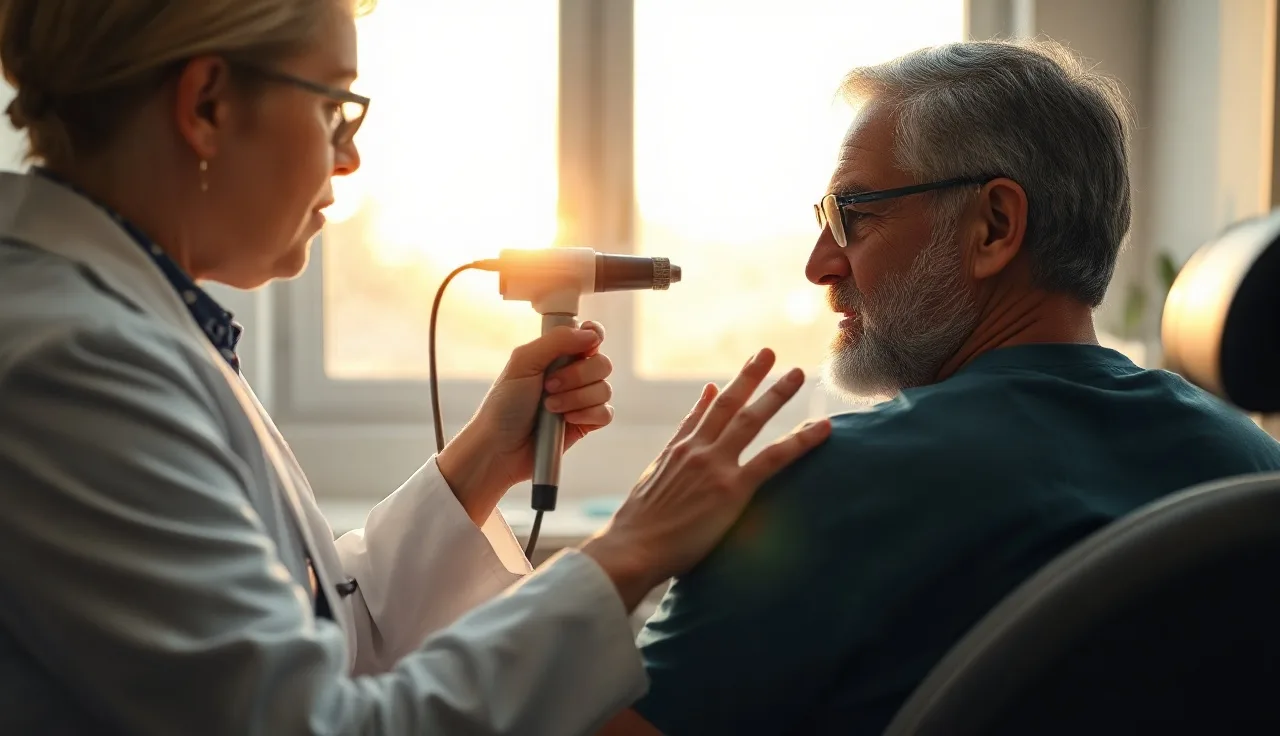
The exam involves looking at your scalp under a dermatoscope (a handheld magnifier) to assess follicle miniaturization, inflammation, scarring, and density patterns. Some practices use a trichoscope wired to a screen so you can see the images in real time. The specialist also does a pull test: gently tugging 40 to 60 hairs from different zones and counting how many release. More than six hairs per pull is abnormal [4].
Testing depends on what the exam suggests. A standard first-pass blood panel usually covers a complete blood count, ferritin, TSH, free T4, DHEA-S, total and free testosterone, and sometimes zinc and vitamin D. For women the panel runs broader, because female androgenetic alopecia often ties to hormonal patterns that need more digging. Scalp biopsy is held in reserve for cases where the pattern is unclear or scarring alopecia is on the table, because scarring alopecia is treated completely differently and much more urgently.
Want a head start before the appointment? MyHairline's free AI hair scan gives you a preliminary read on your pattern and helps you frame the right questions for your dermatologist. It's not a diagnosis. It just means you walk in knowing what you're looking at.
How do you find a qualified hair loss specialist near you?
Start with the American Academy of Dermatology's free "Find a Dermatologist" directory at aad.org, where you can filter by specialty including hair disorders [1]. It's the cleanest starting point, because every listing is a board-certified MD or DO.
For surgical evaluation, the International Society of Hair Restoration Surgery keeps a member directory at ishrs.org. ISHRS membership and the Fellow designation (FISHRS) signal a surgeon has met peer-reviewed standards in surgical hair restoration [5].
A few things worth checking before you book:
- Look for someone who specifically lists hair loss, alopecia, or trichology as a subspecialty interest. General dermatologists are capable, but a focused practice sees more cases and stays current.
- Confirm the clinic offers dermoscopy or trichoscopy. Diagnosing hair loss by naked eye alone in 2025 is below the standard of care.
- In big metros, academic medical centers (NYU Langone, Cedars-Sinai, UCSF) run dedicated hair disorder clinics staffed by dermatologists whose entire practice is hair. Wait times run longer, but the evaluation goes deeper.
Searching for a female hair loss specialist in NYC? The NYU Langone hair loss program and Mount Sinai's dermatology department both have women's hair loss subspecialists. In Los Angeles, Cedars-Sinai dermatology and UCLA's dermatology program both see women with complex androgenetic and hormonal loss. In both cities, private practices built around women's hair loss have grown over the past five years, usually pairing dermatology oversight with cosmetic trichology.
How much does a hair loss specialist consultation cost?
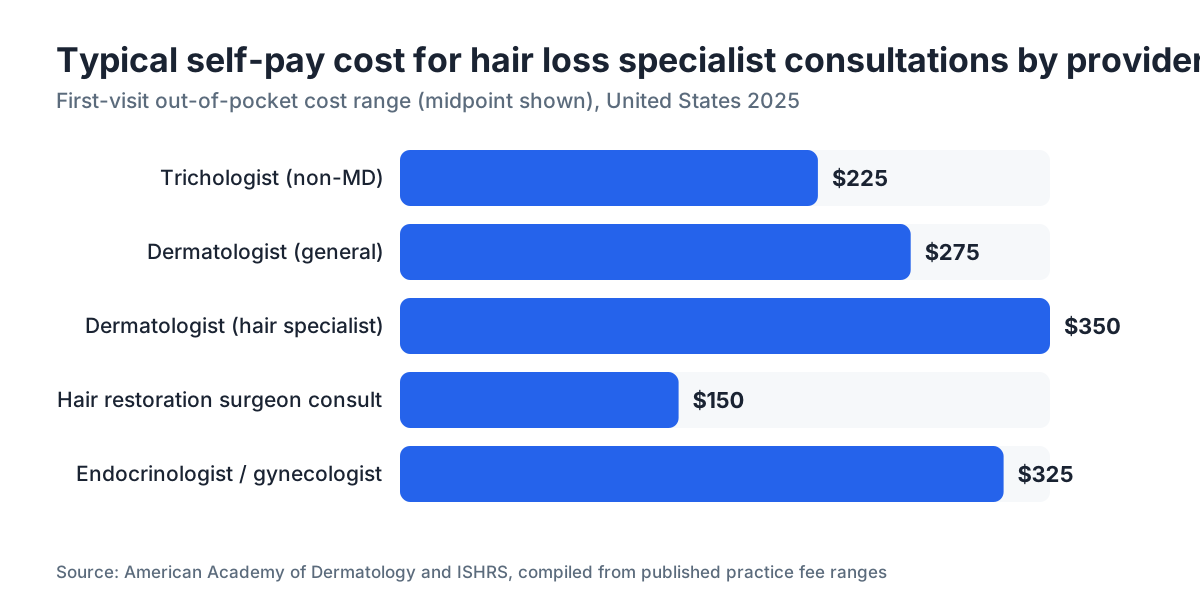
A first visit runs roughly $150 to $400 self-pay with a board-certified dermatologist in a standard private practice, and often just a copay if you have insurance and the visit is coded as medical. Specialty hair clinics charge more. Surgical consults are frequently free.
Here's the detail. Most major insurers cover dermatology visits for medical (non-cosmetic) hair loss, so your real cost could be a copay if the visit is coded as a medical condition. Androgenetic alopecia is a legitimate medical diagnosis. Ask the scheduler how the visit will be coded before you arrive.
Specialty hair clinics, especially the ones branding themselves as "hair loss centers" or "hair restoration clinics," often charge $300 to $700 for a first consult. Some of that premium buys better equipment and more time. Some of it is marketing. Be skeptical of any clinic that hands you a full treatment plan with prices on visit one, before a proper diagnostic workup.
Hair restoration surgery consults are commonly free or low-cost at reputable practices, because the surgeon is sizing you up as a surgical patient. That's fine, as long as you walk in knowing a transplant may not be the right answer yet.
Cost comparison for reference:
| Specialist type | Typical first-visit cost (self-pay) | Prescribing authority? | Surgical capability? |
|---|---|---|---|
| Dermatologist (general) | $150, $400 | Yes | No |
| Dermatologist (hair specialist) | $200, $500 | Yes | No |
| Hair restoration surgeon | $0, $300 (consult often free) | Yes | Yes |
| Trichologist (non-MD) | $100, $350 | No | No |
| Endocrinologist / gynecologist | $200, $450 | Yes (for systemic causes) | No |
Which hair loss conditions can a specialist diagnose and treat?
A handful of conditions account for most of what a specialist sees.
Androgenetic alopecia (AGA) is the most common form in both sexes, affecting roughly 50 million men and 30 million women in the United States per the AAD [1]. In men it follows the Norwood pattern, starting at the temples and crown. In women it shows as diffuse thinning at the part line. For both, the FDA has approved topical minoxidil, and oral finasteride for men [6]. Women have fewer FDA-approved options, which is exactly why seeing a specialist matters more, not less, for female pattern loss.
Telogen effluvium is diffuse shedding triggered by physical or emotional stress, illness, surgery, rapid weight loss, or hormonal shifts like postpartum changes. It's usually temporary, but a specialist rules out the chronic form and treats any nutritional deficiency underneath it. More on this in our piece on telogen effluvium.
Alopecia areata is an autoimmune condition that causes patchy or total loss. Treatment shifted after 2022, when the FDA approved baricitinib and ritlecitinib (JAK inhibitors) for severe cases, the first new drug class for alopecia areata in decades [7].
Scarring alopecias (lichen planopilaris, frontal fibrosing alopecia, discoid lupus) destroy the follicle for good. Early diagnosis by a specialist who can biopsy is the only way to slow the damage before it's permanent.
For a wider view of what's driving your pattern, our piece on what causes hair loss covers the full range.
What treatments can a hair loss specialist prescribe or perform?
Medical treatment is first line for most non-scarring loss.
Minoxidil comes over the counter as a topical and by prescription as an oral. It's FDA-approved for androgenetic alopecia, and the 5% topical foam is approved for men and women. Low-dose oral minoxidil (0.25 mg to 2.5 mg daily for women, up to 5 mg for men) is used off-label with growing evidence behind it. A 2022 randomized trial in JAMA Dermatology found low-dose oral minoxidil worked significantly better than topical 5% minoxidil for female pattern hair loss, though head-to-head data is still thin [8]. Read the details on minoxidil for men or oral minoxidil. Before you start, check the minoxidil side effects profile too.
Finasteride (1 mg daily) is FDA-approved for male pattern baldness and blocks the conversion of testosterone to DHT, the hormone that shrinks follicles [6]. It's not FDA-approved for women, but gets used off-label in postmenopausal women. Our full breakdown of finasteride covers the evidence, the side effects, and what the literature actually says about post-finasteride syndrome. For the mechanism, see DHT blockers and the combined approach in finasteride and minoxidil.
Platelet-rich plasma (PRP) means drawing a little blood, concentrating the growth factors in a centrifuge, and injecting it into thinning areas. The evidence is positive but not settled. A 2019 meta-analysis in Aesthetic Plastic Surgery found statistically significant gains in hair density and thickness, but study heterogeneity was high [9]. A treatment course runs $1,500 to $3,500.
Hair transplant surgery (FUE or FUT) is the most permanent fix for the right candidate, usually someone with stable loss and enough donor density. Your specialist tells you if you're there yet. Our guide to hair transplant covers candidacy and cost.
Supplements like biotin, saw palmetto, and marine collagen come up constantly. The evidence for most is weak or indirect. Our honest review of hair loss supplements sorts what has some data from what's a waste of money.
How is a hair loss specialist for women different from one for men?
It's a genuinely different clinical problem, not a marketing angle.
Female hair loss is hormonally more tangled. PCOS, thyroid dysfunction, perimenopause, and postpartum shifts all touch follicle health in ways with no male equivalent. A specialist who mostly treats male pattern loss may not be comfortable with the expanded blood panel, the different look on trichoscopy, or the off-label prescribing that female AGA often calls for.
The presentation differs too. Female AGA rarely produces a receding hairline in the male sense. It shows as a widening part, diffuse thinning over the crown, and a thinner ponytail. Ludwig Stage I often goes undiagnosed for years, because the shedding is slow and gets brushed off. Women also have higher rates of telogen effluvium and scarring alopecia than men, so the differential is wider.
Treatment options are narrower for women, plainly. Finasteride is not FDA-approved for women and carries teratogenic risk in women of childbearing age, so the decision needs careful discussion. Spironolactone, an androgen blocker, is used off-label and requires regular potassium monitoring. Low-dose oral minoxidil has become one of the more practical options for women, and a good specialist will raise it.
Searching for a female hair loss specialist in NYC or Los Angeles? Prioritize practices with a dermatologist who lists women's hair loss as a defined subspecialty, not as one service on a menu. Academic hair clinics in both cities tend to have more female patients and more experience with the hormonal workup.
What questions should you ask a hair loss specialist at your appointment?
Good questions get you better answers, and they tell you whether the specialist is any good.
Ask what the diagnosis is and how confident they are. A good specialist will be honest if it isn't clear yet. "I think this is androgenetic alopecia, but I want to see your ferritin before we start treatment" is an honest answer. "You clearly need this package of treatments" before labs come back is not.
Ask what the treatment goal is and what a realistic outcome looks like. Halting the loss? Some regrowth? Just holding steady? Most FDA-approved treatments are better at stopping further loss than reversing it, and you should know that going in.
Ask about the evidence level for anything they recommend. Is it FDA-approved for your condition, used off-label with published trial data, or basically anecdotal?
Ask what happens if you do nothing. For some conditions, inaction costs you. For others, the natural course is slow enough that you have time to think.
Ask about monitoring. How will you know it's working? What's the follow-up schedule?
If they recommend a receding hairline assessment or Norwood staging, ask to see the dermoscopy images yourself. It's your scalp.
When should you see a specialist urgently rather than waiting?
Some hair loss is medically urgent. Most isn't. These patterns earn a faster appointment.
Rapid, diffuse loss over a few weeks is a red flag for systemic illness, a drug reaction, or severe nutritional deficiency. Losing clumps rather than thinning gradually needs prompt evaluation.
Any scalp that hurts, burns, or shows redness and scarring needs to be seen quickly. Scarring alopecia is irreversible once the follicle dies, and the window to slow it is real.
Sudden patchy loss in a child or teenager should be checked soon, both to rule out autoimmune causes and because early treatment of alopecia areata produces better outcomes.
Loss that started shortly after a new medication should be flagged with your prescribing doctor and a dermatologist at the same time, not one or the other. Plenty of common drugs cause hair loss, including beta-blockers, anticoagulants, retinoids, and some antidepressants [10].
Otherwise, if your pattern looks like typical male or female androgenetic alopecia and you've had it a year or more, a few weeks' wait for an appointment won't change your prognosis.
Does insurance cover a visit to a hair loss specialist?
Often yes, if the visit is coded as a medical diagnosis. Most private plans and Medicare cover dermatology visits for medical hair loss. Androgenetic alopecia, alopecia areata, and telogen effluvium are all legitimate ICD-10 diagnoses. Coded that way, your usual specialist copay or deductible applies.
What insurance usually won't touch: anything deemed cosmetic. Minoxidil is over the counter and not covered by most plans. Finasteride for hair loss (as opposed to BPH) is sometimes covered, sometimes not, depending on your plan. PRP is almost never covered. Hair transplants are explicitly excluded as cosmetic procedures under nearly all commercial plans, and Medicare excludes them too [11].
HSA and FSA funds usually cover physician consultations and prescription medications. PRP's HSA eligibility is a gray area and varies by plan administrator.
If cost is a real barrier, community health centers and academic dermatology training clinics often run reduced-fee appointments. Resident-supervised clinics at university hospitals are another route, and care quality is typically high because faculty attending physicians oversee each case.
Is a telehealth hair loss consultation worth it?
For some cases yes, for others it's genuinely not enough.
Telehealth works reasonably well for uncomplicated androgenetic alopecia with a classic visual pattern, especially for prescription refills or starting finasteride after an initial in-person workup. Several direct-to-consumer platforms (Keeps, Ro, Hims) run legally as telehealth practices and can prescribe finasteride and recommend minoxidil. They are not a substitute for a specialist evaluation.
Telehealth is a poor stand-in for a first diagnostic workup if your pattern is atypical, if you've had rapid shedding, if there's any scalp inflammation, or if past treatments haven't worked. Dermoscopy, the pull test, and the option to biopsy all require an in-person visit. A phone camera cannot assess follicle miniaturization accurately.
A sensible plan: use a telehealth platform to start treatment if your pattern is clear and you want to move fast, then get a proper in-person evaluation within the first year, especially if you're not responding. Not sure what your pattern even looks like before booking anything? MyHairline's free AI scan gives you a baseline picture to bring to your first appointment, in person or virtual.
Sources
- American Academy of Dermatology, Hair Loss Overview
- StatPearls (NCBI Bookshelf), Telogen Effluvium
- StatPearls (NCBI Bookshelf), Hair Pull Test
- International Society of Hair Restoration Surgery, Member Directory
- US Food and Drug Administration, Drugs
- US Food and Drug Administration, Drugs
- JAMA Dermatology, Low-dose oral minoxidil vs topical minoxidil for female pattern hair loss (2022)
- Aesthetic Plastic Surgery, Meta-analysis of PRP for androgenetic alopecia (2019)
- StatPearls (NCBI Bookshelf), Drug-Induced Hair Loss